

The stores issue 5,000 kg of raw material and the line delivers 4,660 kg of good product. Of the 340 kg in between, how much is true scrap, how much is rework, how much is still sitting on the line as work in progress, and how much is just a weighing error? If nobody can answer that, scrap and yield tracking in manufacturing does not exist yet; all you have is a feeling that "we used a lot of material this month". Tracking means matching input to output one to one and splitting the difference into causes.
This guide covers scrap types, how to put a scrap allowance into a bill of materials, yield and mass balance, overall yield across stages, reason codes and Pareto, the effect of scrap sales on net cost, the rework loop, fair comparison between shifts, target setting and how to set all of this up in an ERP. All figures are illustrative; they are not an industry average.
What Is Manufacturing Scrap and What Types Are There?
Scrap is material that does not become a sellable product during production. It is not all the same: the unavoidable part and the avoidable part are managed differently.
| Type | Definition | Example | How to manage it |
|---|---|---|---|
| Normal (standard) scrap | Loss that comes with the process and is allowed for in the BOM | Machine warm-up and setup waste, colour change | Written into the BOM as a standard rate |
| Abnormal scrap | Avoidable loss above the standard | Wrong setting, operator error, surface defect | Reason coded, owner assigned |
| Rework | Parts corrected and made sellable again | Granulate crushed and reprocessed, a carton re-taped | Second-pass cost and capacity tracked |
| Scrap sale and recovery | Scrap material sold or fed back to the line | Selling plastic scrap, adding regrind to the mix | Revenue is deducted from net scrap cost |
| By-product and co-product | Planned output with its own value | Second-grade product, offcuts | Its own stock code, not scrap |
We recommend reading: How to calculate product cost
How Is a Scrap Rate Written into the Bill of Materials?
The net quantity in a BOM is the material that stays in the product. There are two common ways to add a scrap allowance and they do not give the same result. When the scrap rate is defined on input, use required gross input = net output ÷ (1 − scrap rate). For 1,000 kg of net output and 4% scrap that is 1,000 ÷ 0.96 = 1,041.67 kg of input. If you instead add the rate on top of the net (1,000 × 1.04) you get 1,040 kg and are 1.67 kg short.
The gap looks small but grows with volume: on 80,000 kg of net output a month it is 133.3 kg, which at ₺45 per kg of material is ₺6,000 a month. Always state in the BOM which base the rate refers to; the rates in this article are on input.
The same logic applies to a work order: 4,800 kg of good output at a 96% standard yield means 4,800 ÷ 0.96 = 5,000 kg of input. Multiplying gives 4,992 kg and leaves 8 kg uncovered.
How Are Yield and Mass Balance Calculated?
Yield = good output ÷ input. On its own, yield does not say where the loss happened. A mass balance does: the input is split into good output, scrap, rework, work in progress left on the line and measurement loss, and the parts must add up to the input.
| Item | Quantity (kg) | Share of input | Note |
|---|---|---|---|
| Input (material issue) | 5,000 | 100.0% | Weighed issue |
| Good output (first pass) | 4,660 | 93.2% | Standard 96% |
| Normal scrap | 140 | 2.8% | Setup and colour change |
| Abnormal scrap | 110 | 2.2% | Avoidable |
| Rework | 60 | 1.2% | To be reprocessed |
| Measurement and unexplained gap | 30 | 0.6% | Target at most 0.5% |
| Total | 5,000 | 100.0% | 4,660 + 250 + 60 + 30 |
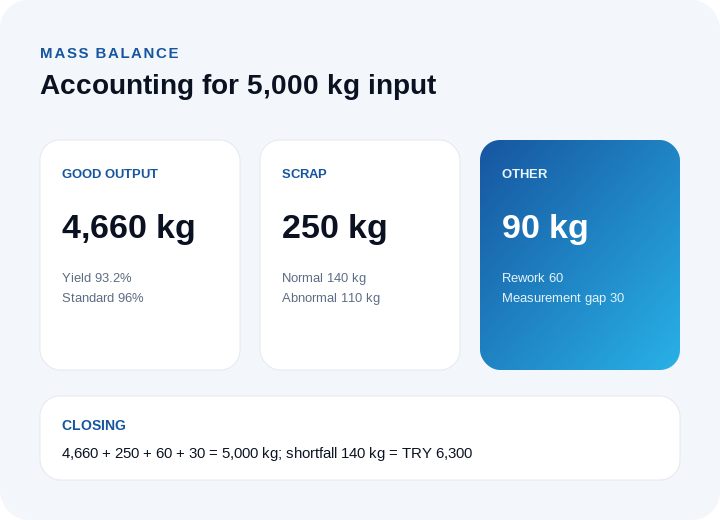
At a 96% standard yield, 5,000 kg of input should deliver 4,800 kg of good output. Only 4,660 kg came out, so 140 kg is missing. The 0.6% measurement gap is above target, which points to a weighing and recording problem.
Work in progress still on the line is not a loss. If 50 kg is still on the line while the order is open, use 4,950 kg as the denominator, otherwise yield looks lower than it is.
How Is Overall Yield Found on a Multi-Stage Line?
On a three-stage line, stage yields multiply: cutting 97%, machining 95% and assembly 98% give an overall yield of 0.97 × 0.95 × 0.98 = 90.3%. An input of 10,000 kg falls to 9,700, 9,215 and 9,030.7 kg, with losses of 300, 485 and 184.3 kg. Every stage looks like "above 95%", yet the overall yield is 90.3%.
The biggest loss in kilograms is in stage two, and in money as well. With material at ₺45 per kg and stages adding ₺6, ₺9 and ₺5 of processing, a lost kilogram costs ₺51, ₺60 and ₺65. The loss cost is 300 × 51 = ₺15,300, 485 × 60 = ₺29,100 and 184.3 × 65 = ₺11,979.50; the total is ₺56,379.50 and stage two carries 51.6% of it. Raising stage two from 95% to 96% lifts overall yield from 90.3% to 91.3% (0.97 × 0.96 × 0.98 = 0.9126).
We recommend reading: Lean manufacturing, waste analysis and value stream mapping
How Are Scrap Reasons Coded and a Pareto Chart Read?
Scrap without a reason cannot be managed. Keep the code list short (6 to 10 codes) and understandable on the shop floor. The table shows the 250 kg of scrap on the example work order.
| Code | Reason | Type | Kg | Share | Cumulative |
|---|---|---|---|---|---|
| F1 | Start-up and setup waste | Normal | 85 | 34% | 34% |
| F2 | Colour and product changeover | Normal | 55 | 22% | 56% |
| F3 | Short fill | Abnormal | 50 | 20% | 76% |
| F4 | Surface defect | Abnormal | 30 | 12% | 88% |
| F5 | Operator error | Abnormal | 15 | 6% | 94% |
| No code | Reason not entered | Abnormal | 15 | 6% | 100% |
The top three reasons make up 76% of scrap (190 kg). But the first two are normal scrap, so also run the Pareto on abnormal scrap alone: 80 of the avoidable 110 kg sit in F3 and F4. The coded share of scrap is 235 ÷ 250 = 94%; the target is 100%, and the system should not let a scrap entry be saved without a code.
How Do Normal and Abnormal Scrap Affect Cost?
As a concept, normal scrap is the unavoidable loss loaded into the standard cost of the product, while abnormal scrap is not added to product cost and is tracked separately as an avoidable loss. This keeps abnormal scrap from inflating unit cost and makes it visible to management as its own line. The actual accounting treatment depends on your company and on regulation; settle it with your accountant. The software only keeps the two types apart.
On the example work order, abnormal scrap is 110 kg; after deducting the scrap sale value the net loss is 110 × (45 − 12) = ₺3,630. The 140 kg of normal scrap sits inside the standard cost.
We recommend reading: Inventory valuation methods
How Are Scrap Revenue and Net Scrap Cost Calculated?
Scrap material is rarely worth nothing. Net scrap cost = scrap kg × (material cost − scrap sale value). Take 400 kg of scrap in a month, material at ₺45 per kg and scrap sold at ₺12 per kg: gross loss is 400 × 45 = ₺18,000, scrap revenue is 400 × 12 = ₺4,800, and the net is ₺13,200 (₺33 per kg).
How Is Yield Variance Turned into Money?
Yield variance is the missing good output in kilograms multiplied by the material cost. With a 96% standard, a 93.2% actual and 5,000 kg of input, the shortfall is (5,000 × 0.96) − 4,660 = 140 kg, and 140 × ₺45 = ₺6,300 is the first-pass variance. Rework changes that figure: if 75% of the 60 kg, which is 45 kg, is corrected, final good output is 4,705 kg, final yield is 94.1% and the shortfall is 95 kg (95 × 45 = ₺4,275). The rework itself costs money too: at ₺8 per kg, 60 × 8 = ₺480, so the total variance is ₺4,755.
Report first-pass yield and final yield separately. If you look only at final yield, the rework burden disappears from view.
How Is Data Quality Ensured in Scrap Recording?
Calculations are only as good as the records. There are three typical problems. The first is the scale: if the input scale reads 0.5% high and the output scale reads 0.5% low, the measured yield drops to 0.932 × (0.995 ÷ 1.005) = 92.3%. Without any real increase in loss, that is a phantom loss of about 0.9 points, roughly 46 kg on 5,000 kg of input.
The second is unit conversion. If a part weighs 0.250 kg in the standard but 0.254 kg in reality, 4,660 kg is not 18,640 pieces but about 18,346; the 294-piece (1.6%) gap comes purely from the unit assumption. Keep kilograms and pieces on the same posting and re-weigh the part regularly.
The third is delay: if scrap is entered in bulk at the end of the shift, nobody remembers the reason. Record scrap when it happens.
How Does the Rework Loop Affect Yield?
In the example, 60 kg of parts go through a second pass; 75% comes out good and 15 kg becomes scrap. The second pass uses capacity and labour. Track three things: the rework rate (60 ÷ 5,000 = 1.2%), the second-pass success rate (75%) and the machine hours given to rework. Put a limit on the number of passes.
We recommend reading: What is quality control and nonconformance management software?
Is Comparing Shifts, Machines and Operators Fair?
Raw yield comparisons can mislead because the product mix differs. Say product X has a standard yield of 97% and product Y 92%. Shift A runs 3,000 kg of X and 1,000 kg of Y and gets 3,760 kg of good output; shift B runs 1,000 kg of X and 3,000 kg of Y and gets 3,700 kg.
| Shift | Input (kg) | Raw yield | Weighted standard | Expected good output | Actual ÷ expected |
|---|---|---|---|---|---|
| A | 4,000 | 94.0% | 95.75% | 3,830 | 98.2% |
| B | 4,000 | 92.5% | 93.25% | 3,730 | 99.2% |
On raw yield A looks better (94.0% against 92.5%), but against a standard scaled to the mix B is better (99.2% against 98.2%). B only looks worse because it ran more of the difficult product. Use the scaled standard for operator and machine comparisons too.
How Is a Standard Scrap Target Set?
Targets are set by looking at the distribution of past results. Take the total scrap rates of 20 work orders of the same product (illustrative): they range from 3.1% to 7.8%; the median (P50) is 4.55%, the value that 80% of orders stay below (P80) is 5.76%, the best-quarter limit (P25) is 3.98% and the mean is 4.84%. For the first six months, setting the target at the median (about 4.5%) is realistic. After that, move towards the best quarter (about 4.0%).
A target that is too tight turns every work order red and nobody looks; one that is too loose normalises the loss. Review the standard every quarter.
How Is the Effect of Scrap Reduction Actions Calculated?
On a line with 50,000 kg of input a month, annual input is 600,000 kg. If scrap falls from 5.2% to 4.0%, it drops from 31,200 kg to 24,000 kg, a saving of 7,200 kg. At a net cost of ₺33 per kg the annual saving is 7,200 × 33 = ₺237,600. Actions come from the Pareto; each needs an owner, a date and an expected kg effect, and the result must be measured with the same codes.
How Is Scrap and Yield Tracking Set Up in an ERP?
Setup takes six steps: the scrap rate and target yield are defined in the BOM; material is issued by weight when the work order opens; scrap is entered on the line with kg, type and shift; a scrap record cannot be saved without a reason code; actual and standard yield are compared when the work order closes; and an action is opened for the top three reasons.
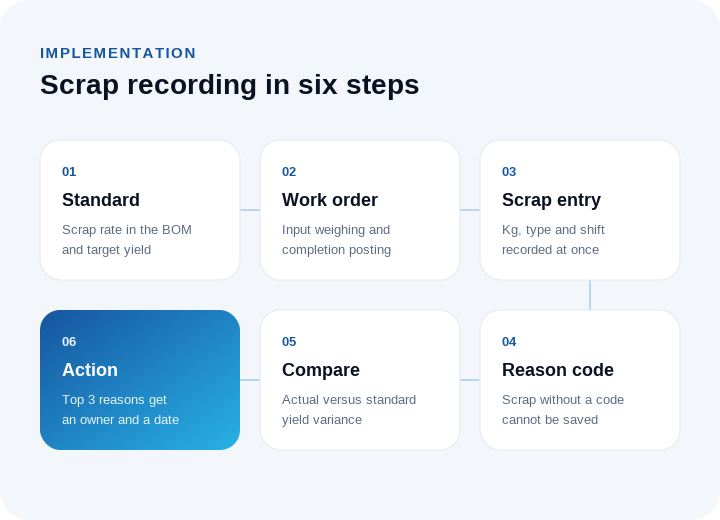
The scrap line on the work order completion posting is a separate stock movement; normal and abnormal scrap have different type codes; scrap gets its own stock location; and a warning goes to the person responsible when scrap exceeds the standard by 20%.
We recommend reading: What is a manufacturing execution system (MES)?
Which Measures Should Be Tracked?
| Measure | Formula | Example | Reading |
|---|---|---|---|
| Scrap rate | Scrap ÷ input | 250 ÷ 5,000 = 5.0% | Normal 2.8%, abnormal 2.2% |
| First-pass yield | Good output ÷ input | 4,660 ÷ 5,000 = 93.2% | Standard 96% |
| Mass balance gap | Unexplained ÷ input | 30 ÷ 5,000 = 0.6% | Target at most 0.5% |
| Coded scrap share | Coded scrap ÷ scrap | 235 ÷ 250 = 94% | Target 100% |
| Abnormal scrap share | Abnormal ÷ total scrap | 110 ÷ 250 = 44% | The avoidable part |
Read the five measures by work order, line and product; a scrap percentage alone hides rework and measurement loss.
How Is the Payback Calculated?
Say the setup costs ₺216,000 (scrap entry, scale connection, code list, training) and the annual running cost is ₺36,000. With the annual saving of ₺237,600 from the earlier section, the monthly net benefit is (237,600 − 36,000) ÷ 12 = ₺16,800 and payback is 216,000 ÷ 16,800 ≈ 12.9 months. If only half of the saving is realised, the net benefit is (118,800 − 36,000) ÷ 12 = ₺6,900 and payback is about 31.3 months.
Custom Software for Production and Scrap Tracking with İnovabil
At İnovabil our focus is building software from scratch for your company: custom software, ERP, CRM, e-commerce, web, mobile and integration. We developed warehouse management for Sleepy, logistics and shipment planning plus wholesale order management for Karyak, CRM, purchasing and mobile for Avcılar İnşaat, and a purchasing system for İZBAN; none of these is a production scrap module reference. If you need scrap and yield tracking, we suggest starting with a written scope in the requirements analysis that covers the BOM, work order, reason code and scale connection.
We recommend reading: Our software development process: step by step from analysis to launch
Frequently Asked Questions
What is scrap and yield tracking in manufacturing?
It means matching input to good output, scrap, rework, open work in progress and measurement gap, and splitting the loss into causes. The goal is not one scrap percentage but a mass balance that closes and an owner for every avoidable loss.
How is a scrap rate added to a BOM?
If the rate is a percentage of input, use net output ÷ (1 − scrap rate); 1,000 kg net at 4% scrap needs 1,041.67 kg of input. Multiplying the net (1,040 kg) falls short. State in the BOM which base the rate refers to.
What is the difference between normal and abnormal scrap?
Normal scrap is unavoidable in the process and allowed for by a standard rate; abnormal scrap is avoidable loss above the standard. They are coded and tracked separately. Ask your accountant how to book them.
How much does scrap revenue reduce cost?
Net scrap cost = scrap kg × (material cost − scrap sale value). For 400 kg in the example, gross is ₺18,000, scrap revenue ₺4,800 and net ₺13,200.
How can shifts be compared fairly on scrap?
Compare against a standard scaled to the product mix instead of raw yield: actual good output ÷ the sum of each product's input times its standard yield. A shift with a low raw yield may come out better on the scaled figure if it ran more of the difficult product.