

Pricing a product without knowing what it costs you is like driving with your eyes closed. Sales go up, revenue grows, and yet at year end the cash simply isn't there. More often than not, the problem isn't sales but cost: scrap was forgotten, labor was underestimated, and rent and electricity never made it into the product at all. In this guide we answer how to calculate product cost step by step, using one example product all the way from raw materials to selling price and break-even point.
We built this guide like a short course. There are seven lessons. Each lesson explains one concept, works it through on the same example product and ends with a small exercise for you to apply to your own product. A calculator and a spreadsheet are all you need. At the end you will find the most common costing mistakes, a comparison of spreadsheets and software, and a 30-day plan to put it all into practice.
What Is Product Cost?
Product cost is the total of the direct materials, direct labor and manufacturing overhead spent to make a product. In short: Unit cost = Direct materials + Direct labor + Share of manufacturing overhead.
These three elements are the classic structure of manufacturing cost. Direct materials are the raw materials and parts that go into the product. Direct labor is the work of the people who handle the product directly. Manufacturing overhead covers the costs that cannot be traced to a single product but are essential to production: rent, energy, depreciation, maintenance and supervisors. Marketing, administration and financing costs are not part of product cost; they are tracked as period expenses and considered separately when you set prices.
For a trading business that buys and resells goods, cost is simpler: freight, customs and receiving costs are added to the purchase price. But the lessons on scrap, cost allocation, pricing and break-even in this guide apply to trading businesses just as well.
How Should You Use This Guide?
Follow the lessons in order; each one builds on the result of the previous one. Every example uses the same product: a wooden work desk made in a small furniture workshop. All figures are illustrative and exclude VAT; recalculate them with your own product's data.
| Lesson | Topic | What you will be able to do |
|---|---|---|
| 1 | Classifying costs | Put every expense in the right group |
| 2 | Material cost and scrap | Derive material cost from the bill of materials |
| 3 | Direct labor | Find the hourly labor cost and the product's share |
| 4 | Manufacturing overhead | Allocate rent, energy and depreciation to products |
| 5 | Unit cost | Find total unit cost and see the effect of capacity |
| 6 | Selling price | Price correctly, knowing margin from markup |
| 7 | Break-even point | Calculate how many units you must sell to make a profit |
Recommended reading: Our ERP development service: bills of materials, production and costing in one system
Lesson 1: How Do You Classify Costs?
Before you calculate anything, sort your expenses by two questions. Can this cost be traced directly to a specific product? Does it change when production volume changes? The first question separates direct from indirect costs; the second separates variable from fixed costs.
A direct cost is one you know for certain was spent on a particular product, such as the board bought for the desk top. An indirect cost serves several products at once, such as the workshop rent. A variable cost rises and falls with production; a fixed cost stays the same within a given capacity no matter how much you produce.
| Cost | Direct or indirect? | Variable or fixed? |
|---|---|---|
| Board, legs, screws, paint | Direct | Variable |
| Packaging | Direct | Variable |
| Assembly worker's time | Direct | Usually treated as variable |
| Workshop rent | Indirect | Fixed |
| Machine depreciation | Indirect | Fixed |
| Electricity | Indirect | Semi-variable |
| Supervisor's salary | Indirect | Fixed |
| Accounting and administration | Not part of product cost | Fixed (period expense) |
Lesson 2: How Do You Calculate Material Cost and Scrap?
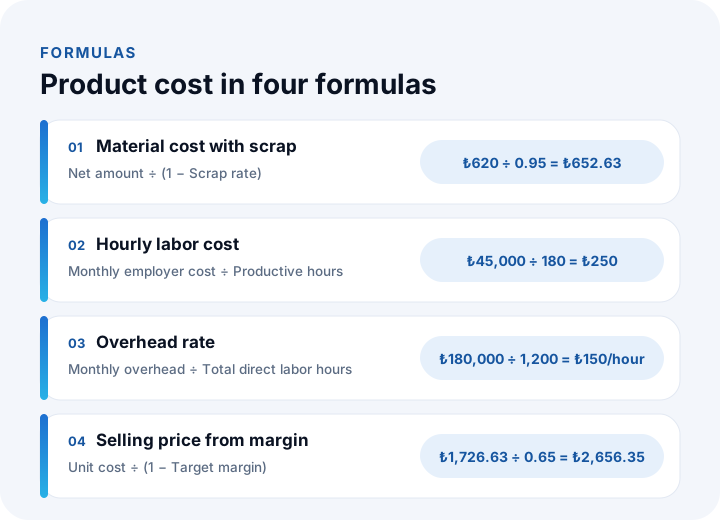
Material cost is the sum of each bill-of-materials line's quantity multiplied by its unit price. Where there is scrap, use the gross quantity grossed up for scrap instead of the net quantity: Gross quantity = Net quantity ÷ (1 − Scrap rate).
A bill of materials (BOM) is the list of what, and how much, goes into a product. Here is the BOM for our example desk. When the top is cut, part of the board is lost as sawdust and edge trim; in this example the scrap rate is 5%.
| Item | Quantity | Unit price | Amount |
|---|---|---|---|
| Desk-top board | 1 piece (5% scrap) | ₺620 | ₺620 ÷ 0.95 = ₺652.63 |
| Metal leg | 4 pieces | ₺85 | ₺340.00 |
| Screw | 16 pieces | ₺1.50 | ₺24.00 |
| Paint | 0.2 kg | ₺250/kg | ₺50.00 |
| Packaging | 1 set | ₺60 | ₺60.00 |
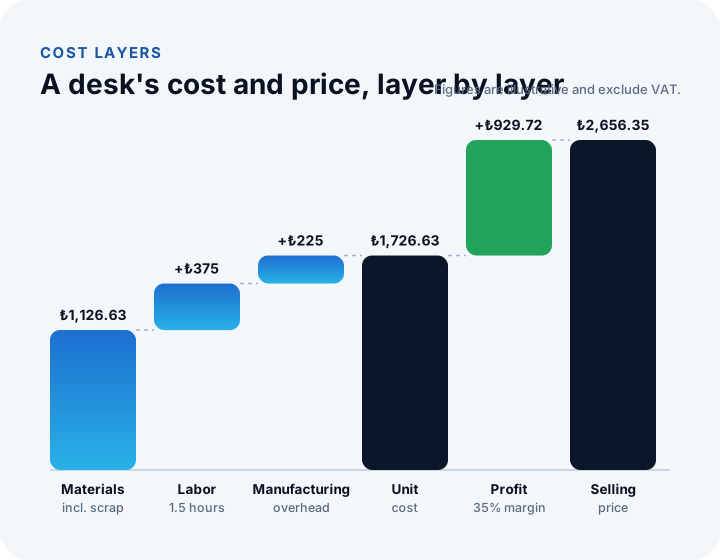
| Direct material cost | ₺1,126.63 | ||
Why divide instead of multiply? Because the scrap rate is a percentage of the material used. To get one net desk top with 5% scrap you need 1 ÷ 0.95 ≈ 1.053 boards. Multiplying (₺620 × 1.05 = ₺651) comes close here, but the larger the scrap rate, the further the multiplied figure falls short.
You also need to decide which unit price to use: the latest purchase price or the weighted average cost. Most businesses price from the latest purchase price and keep their books on the valuation method their accounting rules require. Write down which one you use and stay consistent.
Recommended reading: How to track inventory: a training guide with worked examples
Lesson 3: How Do You Calculate Direct Labor Cost?
Direct labor cost is the time spent on the product multiplied by the hourly labor cost. The hourly cost is the employee's total monthly cost to the employer divided by the hours actually spent producing: Hourly labor cost = Total monthly employer cost ÷ Productive hours.
The most common mistake here is using net pay. What an employer actually pays for an employee includes gross wages plus employer social security contributions and benefits such as meals and transport. The denominator needs care too: not every paid hour is spent producing. Deduct breaks, cleaning, waiting and training time and use what remains.
In our example, an assembly worker costs the employer ₺45,000 a month and spends 180 productive hours a month. The hourly cost is ₺45,000 ÷ 180 = ₺250. One desk takes 0.5 hours of cutting, 0.6 hours of assembly and 0.4 hours of painting: 1.5 hours of labor in total.
Direct labor = 1.5 hours × ₺250 = ₺375
Lesson 4: How Do You Allocate Manufacturing Overhead to Products?
Manufacturing overhead is shared out to products with an allocation base. The most common method divides monthly overhead by total monthly direct labor or machine hours to get an overhead rate, then multiplies that rate by the hours the product uses: Overhead rate = Monthly manufacturing overhead ÷ Total monthly direct labor hours.
Our example workshop's monthly manufacturing overhead looks like this:
| Cost | Monthly amount |
|---|---|
| Workshop rent | ₺60,000 |
| Electricity and gas | ₺30,000 |
| Machine depreciation | ₺25,000 |
| Maintenance and consumables | ₺10,000 |
| Supervisor and storekeeper | ₺55,000 |
| Total | ₺180,000 |
The workshop uses 1,200 direct labor hours a month. The overhead rate is ₺180,000 ÷ 1,200 = ₺150 per hour. Since the desk takes 1.5 labor hours:
Overhead share = 1.5 hours × ₺150 = ₺225
Choose the allocation base to match how you produce. Labor hours suit labor-intensive workshops, machine hours suit plants where machines set the pace, and material value suits work where materials dominate cost. If your products consume overhead in very different ways, consider activity-based costing, which allocates each overhead pool with its own driver.
Lesson 5: How Do You Find Unit Cost?
Unit cost is the sum of the results of the previous three lessons. For our example desk:
| Element | Amount | Share |
|---|---|---|
| Direct materials (incl. scrap) | ₺1,126.63 | 65% |
| Direct labor | ₺375.00 | 22% |
| Overhead share | ₺225.00 | 13% |
| Unit cost | ₺1,726.63 | 100% |
The share column tells you where to look to reduce cost. Two thirds of this desk's cost is materials, so a price negotiation with the supplier or a cutting plan that reduces scrap will have a bigger impact than shaving labor time.
How does capacity change unit cost?
Most manufacturing overhead is fixed. When output falls, the same rent and salaries are spread over fewer products and unit cost rises. In our example, if orders are slow one month and direct labor drops from 1,200 to 900 hours, the overhead rate becomes ₺180,000 ÷ 900 = ₺200 per hour. The desk's overhead share rises to ₺300 and its unit cost to ₺1,801.63. Same product, same materials, yet the cost is ₺75 higher.
That is why it is healthier to price using the overhead rate at normal capacity rather than any single month. The cost of low output is the cost of idle capacity, not of the product, and should be tracked separately.
Lesson 6: How Do You Set a Selling Price from Cost?
To price for a target profit margin, use: Selling price = Unit cost ÷ (1 − Target margin). Adding the same percentage on top of cost (markup) gives a different result and is one of the most common pricing mistakes.
Profit margin is profit as a share of the selling price. Markup is profit as a share of cost. The two are easily confused. Here are both calculations side by side for our desk with a 35% target:
| Method | Calculation | Selling price | Actual profit margin |
|---|---|---|---|
| 35% markup on cost | ₺1,726.63 × 1.35 | ₺2,330.95 | 25.9% |
| 35% profit margin | ₺1,726.63 ÷ 0.65 | ₺2,656.35 | 35.0% |
A business that "adds 35% on top" actually keeps only 25.9% of each sale as profit. The gap is more than ₺325 on every desk. If your target is a margin, always calculate the price by dividing.
Cost alone does not set the price. What the market will pay, competitor prices and the costs of each sales channel matter too. If you sell on marketplaces, commission, shipping and payment fees are extra deductions from the price. You can see your net profit after these items with our profit margin calculator (Turkish interface).
Lesson 7: How Do You Calculate the Break-Even Point?
The break-even point is the sales volume at which total revenue equals total cost. Break-even units = Monthly fixed costs ÷ (Selling price − Variable cost per unit). The difference in the denominator is the unit contribution margin: how much each sale contributes towards covering fixed costs.
In our example, variable cost is materials plus direct labor: ₺1,126.63 + ₺375 = ₺1,501.63. With a selling price of ₺2,656.35, the unit contribution margin is ₺1,154.72. Monthly fixed costs are ₺250,000: ₺180,000 of manufacturing overhead plus ₺70,000 of administrative and selling expenses.
Break-even units = ₺250,000 ÷ ₺1,154.72 ≈ 216.5 → 217 desks
Below 217 desks a month the workshop makes a loss; above it, a profit. This is a single-product simplification; businesses selling several products use a contribution margin weighted by their sales mix. You can try your own numbers with our break-even calculator (Turkish interface).
How Do You Compare Standard Cost with Actual Cost?
The unit cost we have calculated so far is a standard cost: the target cost assuming everything goes to plan. At month end, actual cost is compared with it and the difference is analyzed as a variance. Variance analysis splits a change in cost into price, quantity and efficiency effects.
Example: 200 desks were made in October. The standard for 200 desks is 200 ÷ 0.95 ≈ 210.5 boards, but 220 boards were used. The boards were also bought at ₺680 instead of ₺620.
| Variance | Formula | Example | What it tells you |
|---|---|---|---|
| Material price variance | (Actual price − Standard price) × Actual quantity | (₺680 − ₺620) × 220 = ₺13,200 unfavorable | Purchase price went up; update the price list |
| Material usage variance | (Actual quantity − Standard quantity) × Standard price | (220 − 210.5) × ₺620 = ₺5,890 unfavorable | Scrap was higher than expected; review the cutting process |
| Labor efficiency variance | (Actual hours − Standard hours) × Standard hourly cost | With your own data | Work took longer than planned; look for the bottleneck |
Variances are tracked to fix standards and processes, not to find someone to blame. A variance that keeps pointing the same way means the standard is unrealistic and that your prices rest on the wrong cost.
What Are the Most Common Product Costing Mistakes?
Costing errors rarely come from the wrong formula; they come from a forgotten item. The most frequent ones are:
- Ignoring scrap: Material cost calculated on net quantities always comes out too low.
- Costing labor at net pay: Use the total employer cost, including contributions and benefits.
- Leaving overhead out of the product: If rent, energy and depreciation aren't in the price, losses can grow as sales grow.
- Confusing margin and markup: A percentage added on top of cost is not the same as the profit share of the sale.
- Using old purchase prices: When prices change, the BOM cost must change too; a cost calculated once a year goes stale quickly.
- Pricing on a single month's capacity: A slow month's overhead rate inflates prices unnecessarily, and a busy month's deflates them.
- Forgetting channel costs: Commissions, shipping, payment fees and returns mean the same product earns a different profit in each channel.
Should You Calculate Cost in a Spreadsheet or in an ERP?
A spreadsheet is a good start for a handful of products with simple BOMs. Once products and BOMs multiply, purchase prices change often or you want to track actual cost, costing belongs inside an ERP, alongside inventory and production records.
| Topic | Spreadsheet | ERP costing module |
|---|---|---|
| Updating purchase prices | Manual; cost goes stale if forgotten | Automatically from purchase invoices |
| Bill of materials | A separate sheet per product | Multi-level BOMs including semi-finished goods |
| Scrap and labor | Based on assumptions | Actuals from production records |
| Overhead allocation | Manual, at month end | With defined bases, at period close |
| Standard vs. actual | Laborious | Variance reports |
| Impact of a price change | Follow the formula chain by hand | Cost recalculated across all products |
Recommended reading: What is ERP and what is it used for? A guide for businesses
How Can You Set Up Product Costing in 30 Days?
Use the plan below to apply the seven lessons to your business within a month:
| Week | What to do | Output |
|---|---|---|
| Week 1 | Classify expenses (Lesson 1), write BOMs for your five best sellers (Lesson 2) | Expense list, five BOMs |
| Week 2 | Measure scrap and operation times, find the hourly labor cost (Lessons 2–3) | Scrap rates, operation times |
| Week 3 | Calculate the overhead rate and unit costs (Lessons 4–5) | Unit cost of five products |
| Week 4 | Calculate real margins and break-even, review pricing decisions (Lessons 6–7) | Price proposals, break-even volume |
By the end of the first month you will have a reliable cost table for your best-selling products. In the following months you can extend it to the rest of the range and start comparing actual cost with standard.
We recommend reading: What is procurement software? Process, approval matrix, quote scoring and three-way matching guide
Recommended reading: How to Do Production Planning
Product Costing with İnovabil
In the ERP systems we build at İnovabil, cost is not a separate spreadsheet but a natural result of everyday records. Multi-level bills of materials, material prices updated from purchase invoices, actual scrap and labor times from work orders, overhead allocated with defined bases, and variance reports comparing standard with actual cost all come together in one system.
By carrying cost data into business intelligence dashboards, we also make profitability visible by product, customer and channel. Tell us in a few sentences about your products, your BOM structure and how you calculate cost today, and we will prepare a costing system roadmap tailored to you.
Recommended reading: Business intelligence and reporting: product and channel profitability dashboards
Frequently Asked Questions
How do you calculate product cost, and what is the formula?
Unit cost is the sum of direct materials, direct labor and a share of manufacturing overhead. Materials come from the bill of materials including scrap, labor is the time spent on the product multiplied by the hourly employer cost, and overhead is allocated to the product with a base such as labor or machine hours.
What is the difference between margin and markup?
Profit margin is profit as a share of the selling price; markup is profit as a share of cost. A 35% markup gives roughly a 25.9% profit margin. If your target is a margin, find the selling price by dividing cost by (1 − margin).
How do you add scrap to product cost?
Because the scrap rate is a percentage of the material used, the gross quantity needed is the net quantity divided by (1 − scrap rate). With 5% scrap, one net part needs about 1.053 units of material, and cost is calculated on that gross quantity.
Which base should you use to allocate manufacturing overhead?
Direct labor hours are common in labor-intensive production, machine hours where machines set the pace, and material value where materials dominate cost. If products consume overhead in very different ways, activity-based costing gives more accurate results.
How often should product cost be recalculated?
Recalculate whenever purchase prices, wages or production methods change; monthly updates are advisable when prices move often. Businesses using an ERP can keep cost continuously up to date through purchasing and production records. For inventory valuation in your books, follow your accountant's method.