

We no longer put questions only into a search box; we also ask AI assistants. The answer often arrives as a single paragraph with a few sources listed beneath it. GEO is the name for the work that gets your site included in these answers with the right information and shown as a source.
In this guide we explain in plain language what GEO is, how it differs from classic SEO, what AI search engines look at when they choose sources, and what you can change on your site today.
What Is GEO?
GEO (Generative Engine Optimization) is the whole of the work aimed at getting your content used correctly, and cited as a source, in answer-generating systems such as ChatGPT, Gemini, Perplexity and Google's AI Overviews.
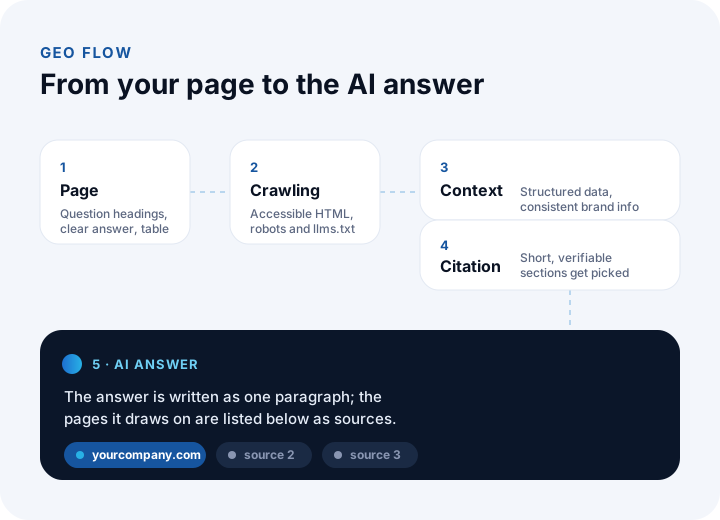
In classic search the user sees a list of links and clicks one. In AI search the system reads several sources, writes an answer and shows the pages that answer is based on. The goal of GEO is for your page to be one of those sources and for your brand to be described correctly in the answer.
What Is the Difference Between GEO and SEO?
SEO aims for your page to rank high in search results and get clicked; GEO aims for your content to be used inside the AI answer and cited as a source. The two share the same foundation but measure success in different places.
| Topic | SEO | GEO |
|---|---|---|
| Goal | High position in search results and clicks | Being included in the AI answer and cited as a source |
| What the user sees | A list of titles, descriptions and links | A written answer with sources beneath it |
| Content structure | Pages organised around a keyword | Quotable sections that answer the question in the first sentence |
| Trust signal | Links, content quality, user behaviour | Consistent, verifiable information and a known brand |
| Technical foundation | Crawlability, speed, structured data | The same foundation; plus access for AI crawlers and llms.txt |
| Measurement | Impressions, clicks, rankings | Citations as a source, traffic from AI, brand searches |
What Do AI Search Engines Look At When Choosing Sources?
AI systems prefer sources that give the clearest and most reliable answer to the question, and that are easy to read and verify. Each system has its own method and these methods change often; the common points that stand out are these:
- Accessibility: The page must be crawlable, and the main content must not become visible only through a script running in the browser.
- A clear answer: The answer to the question should come right under the heading, in a short and clear sentence.
- Structure: Subheadings, lists and tables make it easier to split the content into parts and quote it.
- Consistency: The company name, address, services and contact details should be the same on the site and in other sources.
- Freshness: Content with a clear date that is updated regularly looks more reliable.
- Verifiability: The source of numbers and claims should be clear; unsourced exaggeration loses trust.
What Should You Do on Your Site for GEO?
GEO work runs on two tracks: content and technical infrastructure. Most of the steps below also strengthen classic SEO.
On the content side
- Use question-style headings. Turn the questions users and AI ask into subheadings: "What is X?", "How is X done?", "What is the difference between X and Y?".
- Answer in the first sentence. Under each heading write the clear one- or two-sentence answer first, then the detail.
- Write with definitions, tables and lists. Present comparisons as tables and steps as numbered lists.
- Cite sources, do not exaggerate. If you use numbers, state their source; avoid claims that cannot be verified.
- Add a frequently asked questions section. Collect real customer questions with short answers.
On the technical side
- Add structured data. Schemas such as Organization, Service, FAQPage, HowTo, Article and BreadcrumbList tell machines clearly what the page is about.
- Render content on the server. The main text should arrive inside the HTML when the page loads; content created only by scripts running in the browser may not be readable by every crawler.
- Be fast and error-free. Pages that load slowly or return errors stay in the background both in search and in AI crawling.
- Decide on crawler access deliberately. Check whether your robots.txt file blocks AI crawlers.
- Publish an llms.txt file. Present a summary of your site and its important pages to AI as plain text.
We recommend reading: How do we build SEO and GEO into the infrastructure from the very start?
How Do You Rewrite a Page for GEO? Before and After
Rather than writing new content from scratch for GEO, reorganizing an existing page is usually enough. The difference lies in the order and clarity of information: the answer comes first and the detail follows.
As an example, take the introduction of a page about "what is accounting software":
| Intro paragraph | Problem or gain | |
|---|---|---|
| Before | "In today's world, where digital transformation is gaining speed, businesses are turning to various solutions to adapt to changing competitive conditions. One of these solutions is accounting software..." | No definition even three sentences in; an AI system finds no clear sentence to quote |
| After | "Accounting software is a program that brings a business's invoices, customer accounts, collections and payments, and cash and bank movements into one system. Below we explain what it covers and how to choose it." | The first sentence is the definition itself; quotable and readable on its own |
Apply the same method to headings: instead of "Features," write "What features should accounting software have?" and put the short answer first, then the detail. Turn the comparisons on the page into tables and the steps into numbered lists.
How Do You Check a Page's GEO Readiness?
You can audit every important page with a ten-question list. Each "yes" is a point:
- Does the page have one clear subject and one main heading?
- Does the first paragraph define the subject?
- Are most subheadings phrased as questions?
- Under each heading, does the first sentence answer directly?
- Is there at least one table or numbered list?
- Is there an FAQ section with matching FAQPage structured data?
- Is the source or context of figures and claims clear?
- Does the page show a visible update date?
- Is the main text inside the HTML, readable without scripts running?
- Are the company name, address and contact details the same as on other pages?
What Is llms.txt and Is It Necessary?
llms.txt is a file placed in the root directory of a site that tells large language models, in plain text, what the site is and which pages matter. It is not yet an official standard that all systems follow; but it is easy to prepare and lets you present a summary of your site in your own words.
A good llms.txt contains a short description of the company, the services with a one-sentence explanation of each, the important guide articles and the contact details. The file's content should be consistent with the site and should refresh itself as the site is updated. This site's llms.txt file is also generated automatically from the content.
How Are GEO Results Measured?
Measuring GEO is not as settled as classic SEO, so you need to watch several indicators together.
- Visits from AI: In Google Analytics 4, track traffic coming from AI assistants as a separate group among the referring sites.
- Search Console: Impressions and clicks from Google's AI features are reported within overall web search performance; watch the impression trend of your important pages.
- Brand searches: Over time, brands mentioned in AI answers get searched for directly more often.
- Regular checks: At set intervals, ask AI assistants the core questions your customers ask; note whether your brand appears and whether it is described correctly.
How Do You Prepare a Question List for GEO Tracking?
The most practical way to measure visibility in AI assistants is to ask, at regular intervals, the questions your customers really ask. Start with a list of 15-20 questions, drawing on customer conversations, support requests and the queries in Search Console.
Ask the list to the same assistants every month and record the results in a table:
| Question | Was your brand mentioned? | Is the information correct? | Was your site cited as a source? |
|---|---|---|---|
| "How do you get custom software developed?" | Yes / No | Correct / Incomplete / Wrong | Yes / No |
| "How do you choose pre-accounting software?" | Yes / No | Correct / Incomplete / Wrong | Yes / No |
If your brand is described wrongly or incompletely in an answer, make sure that information is written clearly and consistently on your site, and update the relevant page. The question list also shows where your content has gaps.
Common Mistakes in GEO
- Keyword stuffing: AI looks for a clear and meaningful answer, not repeated words.
- Hiding the answer at the end: An answer that comes after a long introduction is less likely to be quoted.
- Inconsistent company information: Different addresses, phone numbers or service descriptions on different pages lose trust.
- Showing content only through scripts: Content created in the browser may stay invisible to some crawlers.
- Doing it once and leaving it: Content that is not updated slips back over time, both in search and in AI answers.
We recommend reading: How to Do SEO? A Step-by-Step Practical Guide with Examples
How to Build a Corporate Website: A Step-by-Step Guide from Planning to Launch
SEO and GEO with İnovabil
The websites and e-commerce infrastructures we develop are built with SEO and GEO in mind: content is rendered on the server, pages load fast, and structured data and llms.txt come ready from the start. We apply the same approach on this site. You can check how your page titles look in search results with our free title and meta description preview tool (Turkish interface).
If you wonder where your existing site stands in this respect, write to us; let us review the technical infrastructure and content structure together.
Frequently Asked Questions
Will GEO replace SEO?
No. GEO is built on top of SEO. Crawlability, speed, structured data and quality content are the foundation in both fields; GEO adds being quotable in AI answers on top of these.
Do you need to write separate content for GEO?
Usually not. Reorganising existing content with question-style headings, clear answers in the first sentence, tables and frequently asked questions is often enough.
Is the llms.txt file mandatory?
It is not mandatory, and it is not yet an official standard that all systems follow. However, it is easy to prepare and lets you present a summary of your site in your own words, so adding it is recommended.
Should I block AI crawlers?
That is a business decision. If you block them, your content will not be cited as a source in AI answers; if you allow them, you gain visibility. Review the existing rules in your robots.txt file deliberately.
When will the effect of GEO work be seen?
Technical fixes take effect as pages are re-crawled; content and brand trust build up over time. That is why GEO is not a one-off job but a process followed regularly.