

A sale is made, the invoice goes out, and the customer says payment will come "next week". Three months later you are asking who owes what, which receivables are overdue and why cash is so tight. Tracking customer accounts means keeping a clear record of what customers owe you and what you owe suppliers, watching due dates, and putting collection on a steady routine. This guide shows how to do it step by step.
We go in order: the account card, aging analysis, days sales outstanding (DSO), credit limits, reminder flow, reconciliation, partial payments, foreign-currency accounts and the KPIs that tell you whether it works. All example figures are illustrative; they are not an industry average or real company data. For tax and accounting rules, consult your financial advisor (certified accountant) and the Revenue Administration (GİB) sources.
What Is a Customer Account (Current Account)?
A customer or supplier account (called a current account, or "cari hesap", in Turkey) is the single record of every sale, purchase and payment between you and one counterparty. Each entry goes to the debit or credit side, and the difference is the balance.
Read it from the customer's side like this: an invoice you issue increases what the customer owes (debit side); a payment or a returned item reduces it (credit side). Example: a ₺120,000 invoice, ₺20,000 of returns and ₺50,000 of payments leave a balance of 120,000 − 20,000 − 50,000 = ₺50,000 debit, meaning the customer still owes you ₺50,000. For a supplier the direction is reversed. We cover the wider picture of day-to-day bookkeeping and invoicing (pre-accounting) in our pre-accounting guide.
We recommend reading: Our accounting software service
What Information Should an Account Card Hold?
More than a name and a phone number: the card should carry the rules that drive collection. If the payment term and limit are not written on the card, there is nothing to measure against.
| Field group | Content | What it is for |
|---|---|---|
| Identity | Legal name, tax details, address | Correct invoices and reconciliation |
| Contacts | Finance contact, email, phone | Reminders reaching the right person |
| Commercial terms | Payment term in days, method, currency | Calculating the due date |
| Risk | Credit limit, risk score, collateral | Shipping decisions |
| Movements | Invoices, payments, returns, offsets | Balance and open items |
| Notes | Promises made, disputes, call log | Collection history, handover |
How Do You Run an Accounts Receivable Aging Analysis?
Group open receivables by the age of the invoice, then mark the part of each group that is past its due date. The goal is not the total but the old money: the older a receivable gets, the less likely it is to be collected.
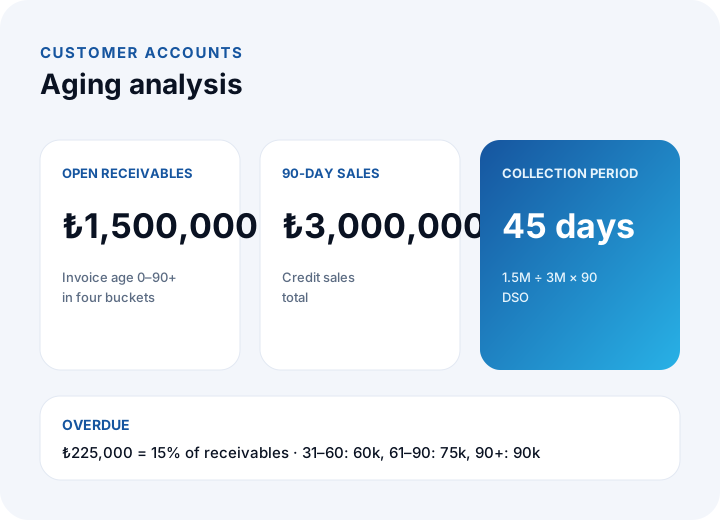
In our illustrative example, open receivables are ₺1,500,000 and customers have different terms (30, 45 or 60 days). An invoice of a given age is therefore not automatically late; the overdue part is flagged against each customer's own term.
| Invoice age | Open receivable | Share | Of which overdue |
|---|---|---|---|
| 0–30 days | ₺780,000 | 52% | ₺0 |
| 31–60 days | ₺450,000 | 30% | ₺60,000 |
| 61–90 days | ₺180,000 | 12% | ₺75,000 |
| Over 90 days | ₺90,000 | 6% | ₺90,000 |
| Total | ₺1,500,000 | 100% | ₺225,000 |
Check: 780,000 + 450,000 + 180,000 + 90,000 = ₺1,500,000; overdue 60,000 + 75,000 + 90,000 = ₺225,000, so 225,000 ÷ 1,500,000 = 15%. The real alarm is not the overall percentage but the last two rows: receivables older than 60 days are ₺270,000 (18%), and more than half of that is already past due.
How Do You Calculate Days Sales Outstanding (DSO)?
DSO tells you how many days of sales are sitting in unpaid invoices, which is roughly how long collection takes. The formula: DSO = open receivables ÷ credit sales in the period × days in the period.
Example: open receivables of ₺1,500,000 and credit sales of ₺3,000,000 over the last 90 days give DSO = 1,500,000 ÷ 3,000,000 × 90 = 45 days. How much of those 45 days is lateness? For the overdue ₺225,000: 225,000 ÷ 3,000,000 × 90 = 6.75 days. The remaining 38.25 days come from the payment terms themselves. If all overdue money were collected, DSO would fall to 38.25 days.
Four things move DSO: the terms you grant, how late customers pay, how fast you invoice (an invoice issued days after shipment starts the clock late) and disputes. A busy sales month also pushes DSO up temporarily, so look at a three-month trend rather than a single month.
How Do You Set Credit Limits and Risk Scores?
With a simple points table: score each customer on four criteria, attach a multiplier to the score and derive the limit from average sales. The inputs come from your own records, not from guesses.
| Criterion | Scoring | Max | Example customer |
|---|---|---|---|
| Payment history | Share of the last 12 invoices paid on time × 40 | 40 | 9 ÷ 12 × 40 = 30 |
| Average delay | 0 days: 25; 1–7 days: 18; 8–15 days: 10; over 15 days: 0 | 25 | 10 days: 10 |
| Relationship length | Under 1 year: 5; 1–3 years: 10; over 3 years: 15 | 15 | 2 years: 10 |
| Financial standing and collateral | 0–20 based on documents and collateral obtained | 20 | 14 |
| Total | 100 | 30 + 10 + 10 + 14 = 64 |
| Score | Limit multiplier | Treatment |
|---|---|---|
| 80–100 | 1.5 | Standard terms, annual review |
| 60–79 | 1.0 | Standard terms, quarterly monitoring |
| 40–59 | 0.5 | Short terms, monthly monitoring |
| 0–39 | 0 | Prepayment or secured sales |
Limit = average monthly sales × (payment term in days ÷ 30) × multiplier. For a customer with average monthly sales of ₺200,000, a 30-day term and a score of 64 (multiplier 1.0): 200,000 × 1 × 1.0 = ₺200,000. When an order exceeds the limit, it should drop into an approval step automatically; quietly shipping past the limit is the most expensive mistake in account tracking.
How Do You Set Up Due-Date Reminders and a Collection Flow?
By defining fixed steps relative to the due date. If reminders depend on individuals, they go to whoever someone happened to think of; a rule reaches every customer at the same time in the same tone.
| When | Step | Channel |
|---|---|---|
| 3 days before due | Reminder with invoice and payment details | |
| Due date | Due notice, payment link or bank details | |
| +7 days | First warning; ask about a payment plan | |
| +15 days | Phone call; get a commitment and log it | Phone |
| +30 days | Decision to hold new shipments; written notice | Written |
| +60 days | Senior management and legal review | Meeting |
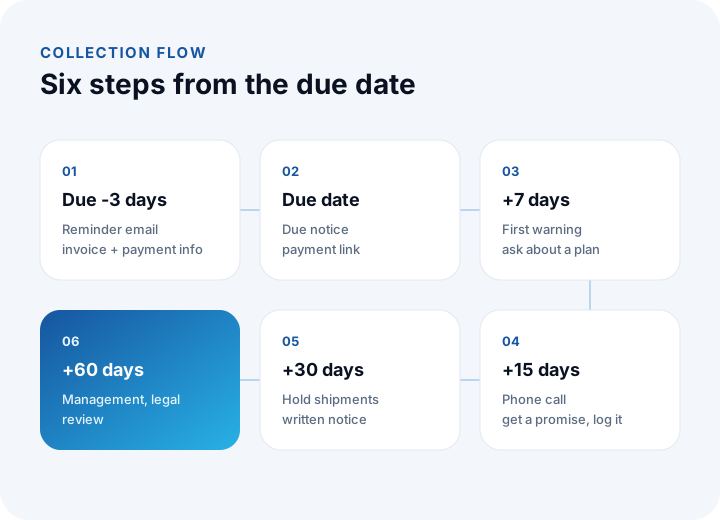
The form of legal steps and formal notices should be set with your legal counsel. The outcome of each contact goes onto the account card; if a promise is broken, the next step starts.
Which Overdue Account Should You Chase First?
The one that is both large and old. As a starting point, use a priority score: amount × days overdue, where days overdue is the invoice age minus the customer's term.
| Account | Amount | Overdue | Score (amount × days) | Rank |
|---|---|---|---|---|
| B | ₺30,000 | 65 days | 1,950,000 | 1 |
| C | ₺50,000 | 32 days | 1,600,000 | 2 |
| A | ₺80,000 | 18 days | 1,440,000 | 3 |
The score gives an order, not a decision: a disputed invoice is resolved first, and the salesperson handles the conversation with a strategic customer. This is why sales and finance should see the same customer record; we explain the split in our CRM vs ERP article.
How Does Account Reconciliation Work?
You send your balance to the counterparty at set intervals and get it confirmed. Reconciliation proves that both ledgers show the same figure and catches disagreements before the receivable ages.
- Take a cut-off: Freeze the period-end balance and open invoices.
- Send it: Send the statement in writing to the finance contact.
- Wait for the reply: Allow a deadline; follow up by phone on those who do not answer.
- Resolve differences: Compare invoice by invoice and find the cause.
- Correct and record: Issue any missing document and get the new balance confirmed.
Illustrative example: your books show the customer owing ₺420,000; the customer says ₺405,000. The difference is ₺15,000; comparing invoices, ₺9,000 is a return you have not recorded yet and ₺6,000 is a bank transfer still in transit: 9,000 + 6,000 = 15,000. For the formalities and obligations around reconciliation letters, consult your financial advisor (certified accountant).
How Do You Handle Partial Payments, Offsets and Returns?
By tying every movement to an invoice. If a payment is dropped onto the balance, you lose track of which invoice is still open; with open-item matching, each payment settles specific invoices.
- Partial payment: Say ₺130,000 arrives against invoices of ₺100,000 and ₺60,000. Applied oldest first, the first invoice closes, ₺30,000 is taken off the second, and ₺30,000 stays open (60,000 − 30,000).
- Offset: If the same company is both customer and supplier, a ₺80,000 receivable and a ₺50,000 payable net to ₺30,000. Ask your financial advisor (certified accountant) about the conditions and paperwork.
- Returns and corrections: A return is entered as a credit linked to the original invoice, so the balance falls but the history is preserved.
How Do You Track Foreign-Currency Accounts?
Keep the account in both the foreign currency and its local-currency value. You track the invoice in the foreign currency; its lira value moves with the exchange rate, and the difference appears as a separate item.
Illustrative example: a €10,000 invoice issued at a rate of 40 is ₺400,000; if the rate is 41.5 on the payment day, you collect ₺415,000 and 415,000 − 400,000 = ₺15,000 of exchange difference arises. At period end, open foreign-currency receivables are revalued at the current rate. For how the exchange difference is booked and taxed, consult your financial advisor (certified accountant). Taking rates from the same source and date for every transaction keeps differences traceable.
How Does Account Tracking Connect to e-Invoicing and Other Systems?
Through a single flow: invoice, payment and order should come from the same record. If invoices live in one place and accounts in another, every invoice is entered twice and differences appear. An e-invoice (e-Fatura) sent and its status should land on the account automatically, and bank movements should match open invoices; see our e-invoice integration guide.
On the supplier side the same logic works through purchasing: request, order, goods receipt and payment in one flow also produce payables aging on their own; see our procurement software article. If customers can see their own balances, questions do not turn into phone calls; our customer portal guide covers that.
Which KPIs Should You Track for Customer Accounts?
Four are enough: DSO, overdue ratio, the share of old receivables in the aging report and collection effectiveness. To bring them onto one dashboard, see our business intelligence guide.
| KPI | Formula | Example |
|---|---|---|
| DSO | Open receivables ÷ period sales × days | 1,500,000 ÷ 3,000,000 × 90 = 45 days |
| Overdue ratio | Overdue ÷ open receivables | 225,000 ÷ 1,500,000 = 15% |
| Share older than 60 days | (61–90 + 90+) ÷ open receivables | 270,000 ÷ 1,500,000 = 18% |
| Collection effectiveness | (Opening + sales − closing total) ÷ (opening + sales − closing not yet due) | 900,000 ÷ 1,125,000 = 80% |
Collection effectiveness example (one month): opening receivables ₺1,400,000, credit sales in the month ₺1,000,000, closing total receivables ₺1,500,000, of which not yet due 1,500,000 − 225,000 = ₺1,275,000. Numerator: 1,400,000 + 1,000,000 − 1,500,000 = 900,000. Denominator: 1,400,000 + 1,000,000 − 1,275,000 = 1,125,000. Effectiveness = 900,000 ÷ 1,125,000 = 80%; that is, 80% of what could have been collected was collected.
When Does Automating Account Tracking Pay Back?
Add the time saved on manual reminders, statements and matching to the financing gain from collecting earlier. The figures below are illustrative; recalculate with your own data.
- Time saved: Manual follow-up takes 80 hours a month and automation removes 60% of it: 80 × 60% = 48 hours × ₺300 = ₺14,400.
- Financing gain: If DSO falls from 45 to 40 days, tied-up cash drops by 5 × (3,000,000 ÷ 90) = 5 × 33,333 ≈ ₺166,667. At an assumed 36% annual financing cost, 166,667 × 36% = ₺60,000 a year, ₺5,000 a month.
- Running cost: ₺3,400 a month.
Monthly net benefit: 14,400 + 5,000 − 3,400 = ₺16,000. With an investment of ₺300,000, payback is 300,000 ÷ 16,000 = 18.75, about 19 months. If DSO does not improve, only the time saving remains: 14,400 − 3,400 = ₺11,000 and 300,000 ÷ 11,000 ≈ 27 months. Base the budget on the second case, not on a promised DSO improvement.
How Do You Set Up Customer Account Tracking in Six Steps?
- Clean the account cards: Merge duplicates and fix cards with incomplete names or no contact details.
- Write the term and limit rules: Standard term, points table and limit formula on one page.
- Extract open items: List every invoice's balance and age and run the first aging report.
- Define the collection flow: Steps, owner and channel are clear.
- Set a reconciliation calendar: Monthly or quarterly; start with your ten largest customers.
- Read the KPIs monthly: DSO, overdue ratio and effectiveness; if the trend worsens, revisit the rules.
You can run these steps in an off-the-shelf program; for selection criteria, see our pre-accounting software selection guide.
What Are the Most Common Mistakes in Account Tracking?
- Dropping payments onto the balance: You lose which invoice was settled and the aging analysis breaks.
- Not keeping terms on the card: Terms live in people's heads and there is nothing to measure against.
- Shipping past the limit: If the limit is not tied to the shipping decision, it stays on paper.
- Leaving reminders to individuals: When someone is on leave, their customers get no reminder.
- Postponing reconciliation to year end: The older a receivable gets, the harder it is to find the cause of a difference.
- Looking only at the total: A 15% overdue ratio says little on its own; you need the age and the accounts behind it.
Customer Account Tracking and Collection with İnovabil
At İnovabil our focus is building software from scratch for your company: custom software, ERP, CRM, e-commerce, web, mobile and integrations. If your needs for account tracking, collection flow and invoicing go beyond what an off-the-shelf accounting program covers, we suggest comparing the two in writing during requirements analysis.
We have built CRM, purchasing and mobile for Avcılar İnşaat; a purchasing system for İZBAN; logistics and shipment planning with wholesale order management for Karyak; and warehouse management plus a complaint and support management system for Sleepy. Describe your current process briefly and we will pin down terms, limits and collection steps together.
We recommend reading: Our software development process: from analysis to launch
Frequently Asked Questions
What is customer account tracking?
It is recording receivables and payables by counterparty, watching balances and due dates, and putting collection on a steady routine. The aim is to know at any moment who owes what and to forecast cash.
Is a customer account the same as pre-accounting?
No. The account ledger is the part of pre-accounting that holds customer and supplier balances; pre-accounting also covers invoices, cash, bank and stock records.
How often should you run an aging analysis?
Weekly, or at least monthly. The collections team should work from a weekly list, while management reviews a monthly summary and the trend.
What is a good DSO?
There is no single right number; it depends on your terms and industry. In the example, terms account for about 38 days while DSO is 45, so the gap comes from lateness. Aim for a trend that moves toward your own terms and keeps falling.
When should accounts be reconciled?
Monthly or quarterly depending on volume, and always at year end. For the formalities and obligations, consult your financial advisor (certified accountant).