

If most of your revenue comes from six or seven customers, treating them "like everyone else" is an expensive habit. A written plan for each large customer makes the relationship independent of any single person and makes growth opportunities visible. Key account management is the discipline of serving a small number of strategic customers account by account, with a plan and a team; the account plan is the written output of that discipline.
This guide explains how to choose key accounts, what an account plan contains, how to build a stakeholder map, how to calculate share of wallet, how to score account health, how to run the meeting rhythm, how to handle special pricing and renewals, how many accounts one manager can carry, and what the return looks like. All figures are representative; they are not industry averages or real customer data.
How Do You Choose Key Accounts?
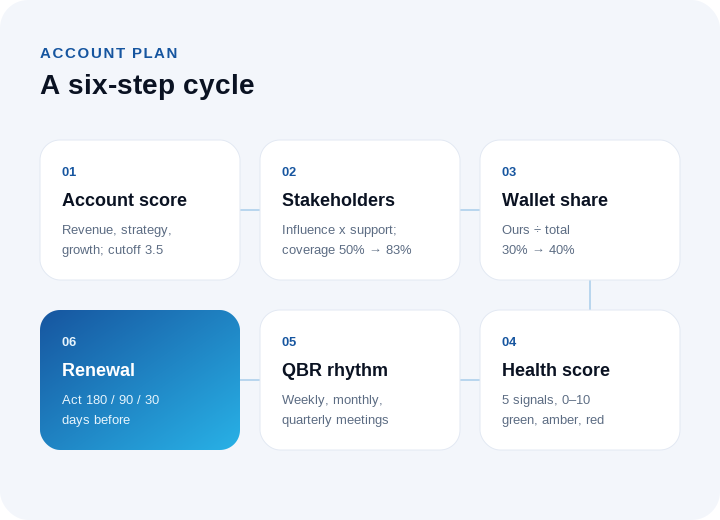
If selection looks only at revenue, the biggest customer gets in automatically, yet a large customer with no growth potential may not deserve intensive account management. Three criteria are weighted: revenue share (40%), strategic value (30%) and growth potential (30%). Strategic value is the contribution beyond revenue, such as reference power or access to a new sector. Each criterion is scored 1 to 5, and the total is the weighted average.
| Candidate | Revenue (40%) | Strategic (30%) | Growth (30%) | Score | Decision |
|---|---|---|---|---|---|
| B | 4 | 5 | 4 | 4.3 | Key account |
| A | 5 | 4 | 3 | 4.1 | Key account |
| D | 3 | 4 | 5 | 3.9 | Key account |
| G | 3 | 5 | 3 | 3.6 | Key account |
| F | 4 | 3 | 3 | 3.4 | Watch list |
| C | 5 | 2 | 2 | 3.2 | Standard account, efficient service |
| E | 2 | 3 | 4 | 2.9 | Growth candidate, standard |
| H | 1 | 2 | 2 | 1.6 | Standard |
For B: 0.40 × 4 + 0.30 × 5 + 0.30 × 4 = 1.6 + 1.5 + 1.2 = 4.3. With a cutoff of 3.5, four customers become key accounts. Notice that C has the top revenue score but stays at 3.2: a large but static customer is served through an efficient, low-cost model instead of a dedicated account manager.
To see whether a customer really leaves profit behind, read our customer profitability and cost-to-serve guide; a profitability signal can be added to the selection score.
What Does an Account Plan Contain?
A good account plan is short and readable by everyone on the team. Each section answers one question.
| Section | Question it answers |
|---|---|
| Customer profile | Who is this customer, how do they make money, what are their yearly goals? |
| Decision-maker map | Who decides, who influences, who can block? |
| Usage and gaps | What do they buy from us, and what share of their need do they buy elsewhere? |
| Goals | What revenue, wallet share and relationship goals should we hit in 12 months? |
| Opportunities | Which cross-sell, new unit or new project candidates exist? |
| Risks | What can we lose, and which signals warn us? |
| Action plan | Who does what, by when? |
| 12-month calendar | When are renewals, budget cycles and meetings? |
Each section needs an owner and an update date; a section with an old date is a guess, not information.
How Do You Build a Stakeholder Map, and Why Not Rely on One Person?
A customer is not one person but a decision group. On the map, every critical person is placed on two axes: influence (power over the decision) and support (attitude toward us). High influence with low support is the priority work area; high influence with high support is the sponsor to protect; low influence with support is a channel for information.
The relationship coverage ratio measures how widely the relationship is spread: critical stakeholders with an established relationship ÷ all critical stakeholders. In the example there are six critical people and regular contact with three: 3 ÷ 6 = 50%. The target is 5 ÷ 6 = 83.3%.
The cost of single-person dependence looks like this. Say account revenue is ₺2,400,000. If the sponsor leaves or changes priorities, the relationship fades with a representative probability of 15%, and half the revenue is expected to go. Expected loss = 0.15 × ₺2,400,000 × 0.50 = ₺180,000. If coverage rises to five people and the probability falls to 7%, expected loss is 0.07 × ₺2,400,000 × 0.50 = ₺84,000, a difference of ₺96,000.
We recommend reading: How to analyze and prevent customer churn
How Do You Calculate Share of Wallet?
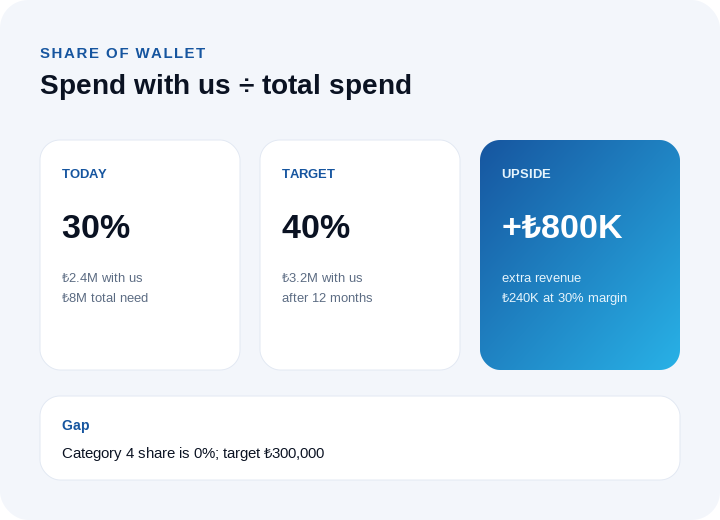
Share of wallet is how much of the customer's total spend in the relevant category stays with you: spend with us ÷ customer's total spend. Revenue growth can simply be market growth; share of wallet shows whether you are really gaining ground.
In the example the customer's yearly need is ₺8,000,000 and they buy ₺2,400,000 from us: share = 2.4 ÷ 8.0 = 30%. Looking by category exposes the gap.
| Category | Total need | With us | Share | Target |
|---|---|---|---|---|
| Category 1 | ₺3,000,000 | ₺1,500,000 | 50.0% | Protect |
| Category 2 | ₺2,500,000 | ₺600,000 | 24.0% | ₺900,000 (36.0%) |
| Category 3 | ₺1,500,000 | ₺300,000 | 20.0% | ₺500,000 (33.3%) |
| Category 4 | ₺1,000,000 | ₺0 | 0.0% | ₺300,000 (30.0%) |
| Total | ₺8,000,000 | ₺2,400,000 | 30.0% | ₺3,200,000 (40.0%) |
The targets add up to 900 + 500 + 300 + 1,500 = ₺3,200,000, which is 40%. The opportunity is ₺800,000 in extra revenue. At a 30% contribution margin, the yearly contribution is 0.30 × ₺800,000 = ₺240,000. You usually only estimate the customer's total spend, so ask for it in meetings and refresh it each quarter.
We recommend reading: How to calculate customer lifetime value (CLV)
How Do You Measure Account Health?
Customers change behavior before they leave. Five signals are each scored 0 to 2: product and service usage, order frequency, support escalations, payment delays and sponsor changes. The total is read out of 10: 8 to 10 green, 5 to 7 amber, 4 or below red. Writing the thresholds down is what matters.
| Account | Usage | Order frequency | Escalations | Payment | Sponsor | Total | Light |
|---|---|---|---|---|---|---|---|
| B | 2 | 2 | 2 | 1 | 2 | 9 | Green |
| G | 2 | 2 | 1 | 2 | 2 | 9 | Green |
| A | 2 | 1 | 1 | 2 | 1 | 7 | Amber |
| D | 1 | 1 | 0 | 2 | 0 | 4 | Red |
A red account gets a recovery plan within 10 business days; an amber account is raised at the next monthly meeting. Usage and order data should come from the system rather than the manager's impression. For the satisfaction signal, the closed-loop approach in our NPS guide also works at account level.
How Many Accounts Can One Account Manager Handle?
The answer comes from the person's weekly time. If 70% of a 40-hour week goes to account management, that is 28 hours. At an average of 4 hours per account per week, capacity is 28 ÷ 4 = 7 accounts. Accounts are not equal: if a large account takes 6 hours and a mid-size one 3, then 3 × 6 + 3 × 3 = 27 hours fits 6 accounts. In practice, six to eight accounts per manager is a reasonable starting point; the real limit depends on how intense your accounts are.
Yearly view: 28 × 46 weeks = 1,288 hours; divided across 7 accounts, that is 184 hours per account. If the number of accounts exceeds capacity, raise the cutoff or consider another manager.
How Do You Set Up the Meeting Rhythm and QBR?
A three-layer rhythm is enough.
- Weekly internal meeting (30 minutes): The account team reviews open work, escalations and opportunities.
- Monthly operational meeting (60 minutes, with the customer): Delivery, support requests and upcoming orders.
- Quarterly business review (QBR, 90 minutes): Strategic results and the next quarter with senior stakeholders.
The QBR agenda has four parts: last quarter's results, listening to the customer's new priorities, our proposals, and decisions with owners. Five measures are shown in every QBR: share of wallet, open opportunity pipeline, service-level compliance (were promised times met), a usage or satisfaction indicator, and time remaining to renewal. Preparation is not ignored: 12 hours per QBR is 48 hours for four QBRs a year.
How Do You Manage Special Pricing and Terms?
Key accounts often ask for special pricing. Discounts given without rules quietly erode margin, so a frame is drawn in advance: a tiered discount table and a margin floor.
Example: annual list value is ₺2,500,000 and cost is 70% of list (₺1,750,000). Tiered discount: 0% on the first ₺1,000,000, 6% on the next ₺1,000,000, 8% on the remaining ₺500,000. Discount = 0 + 60,000 + 40,000 = ₺100,000; net = ₺2,400,000; margin = (2,400,000 − 1,750,000) ÷ 2,400,000 = 27.1%. With a 25% margin floor, the lowest net amount is 1,750,000 ÷ 0.75 = ₺2,333,333, so the maximum discount is ₺166,667 (6.7% of list). Requests beyond the limit go up the approval chain; combine this with the approval matrix in our quote management guide.
The second risk is scope creep: "just this once" free extras become a permanent expectation. In the same example, 40 hours of free work at ₺1,200 cost per hour costs ₺48,000. Profit falls to 650,000 − 48,000 = ₺602,000 and margin to 25.1%, right near the floor.
How Do You Plan Multi-Year Contracts and Renewals?
A renewal should never be a surprise; the calendar section of the account plan holds date-based actions for every contract. Three milestones are counted back from contract end: 180 days before, a value summary and satisfaction meeting; 90 days before, the renewal proposal and terms discussion; 30 days before, signature preparation. A multi-year contract gives predictable revenue; price-update and exit terms must be written clearly. To track dates and notice periods in a system, see our contract management software guide. Contract clauses are settled with legal counsel.
Account Team, Responsibilities and Escalation
The team should speak to the customer with one voice; clarify roles with a short RACI table (R: does the work, A: accountable, C: consulted, I: informed).
| Task | Account manager | Technical | Support | Finance |
|---|---|---|---|---|
| Update account plan | A / R | C | C | I |
| QBR preparation | A | R | R | C |
| Escalation resolution | A | R | R | I |
| Pricing and collections | A | I | I | R |
Define three escalation levels for disputes (times are representative): account manager 2 business days, sales director 5 business days, executive team 10 business days. At each level the customer is told who owns the issue and when to expect an answer. Keep early-warning signals as a checklist: the sponsor leaving or changing role, an announced budget cut, signs of talks with a competitor, a new person entering the decision process, slow replies to meeting requests. A single signal does not mean loss; several together put the account in red.
How Do You Keep the Account Plan in a CRM?
If the plan travels as a document in email, it will not be updated. These fields are added to the account record in the CRM: key account flag and score, health score and light, share of wallet (total need, spend with us), contract end and notice dates, and yearly target. Stakeholders are entered as contact records with influence, support and last contact date; the coverage ratio is computed from them. The action plan is assigned as tasks, and QBR dates land in the calendar. For the selection process, see how to choose a CRM.
How Do You Measure a Key Account Program and What Is the Return?
Six measures are enough: share of wallet (30% to 40%), relationship coverage (50% to 83.3%), renewal rate, account revenue growth, QBR completion and the distribution of health scores. Example: if portfolio revenue was ₺13,200,000 last year and ₺14,520,000 this year, growth is 1.32 ÷ 13.2 = 10.0%; if 21 of 24 planned QBRs were held, completion is 87.5%; if ₺6,800,000 of ₺8,000,000 in expiring contracts renewed, revenue-based renewal is 85.0%.
Return calculation: the account manager is already on the team, so the incremental cost is only the work the program adds. For six accounts, QBR preparation is 6 × 4 × 16 = 384 hours and plan writing and updating is 6 × 40 = 240 hours; total 624 hours × ₺450 = ₺280,800 per year. Setting up CRM fields is a one-off investment of ₺150,000.
Benefit: if each account holds an ₺800,000 wallet opportunity, six accounts hold ₺4,800,000. If 60% materializes, that is ₺2,880,000 in revenue and, at a 30% contribution margin, ₺864,000. Net yearly benefit is 864,000 − 280,800 = ₺583,200; payback is 150,000 ÷ (583,200 ÷ 12) ≈ 3.1 months. If realization drops to 30%, revenue is ₺1,440,000, contribution ₺432,000, net ₺151,200 and payback about 11.9 months. To bring forecasting down to account level, use the methods in our sales forecasting guide.
We recommend reading: What is a sales funnel? Stages, conversion and measurement
We recommend reading: What is a dealer management system? Targets, bonuses and performance
We recommend reading: How to plan sales territories
CRM and Custom Software with İnovabil
At İnovabil our focus is building custom software from scratch for your company: custom software, CRM, ERP, e-commerce, web, mobile and integration. We built CRM, purchasing and mobile for Avcılar İnşaat; a purchasing system for İZBAN; logistics and shipment planning plus wholesale order management for Karyak; and warehouse management plus a complaint and support management system for Sleepy. We clarify together, in the requirements phase, how account plan fields, health indicators and the meeting calendar connect to the CRM, and we deliver that in writing.
We recommend reading: Our software development process: from analysis to launch
Frequently Asked Questions
What is key account management?
It is the approach of serving a small number of customers with high revenue, strategic value and growth potential through planned, team-based, long-term account work. A written account plan is its core tool.
What should an account plan include?
Customer profile, decision-maker map, usage and gap analysis, goals, opportunities, risks, action plan and a 12-month calendar. Each section needs an owner and an update date.
How is share of wallet calculated?
The amount the customer buys from us is divided by their total spend in the relevant category. In the example, 2.4 ÷ 8.0 = 30%; reaching 40% means ₺800,000 of extra revenue. Total spend is refreshed by talking to the customer.
How many accounts should one account manager handle?
With 28 hours of weekly account time and 4 hours per account, the answer is 7 accounts; if large accounts take more time, 6 may fit. Recalculate with your own account intensity.
What should be shown in a QBR?
Share of wallet, open opportunity pipeline, service-level compliance, a usage or satisfaction indicator, and time to renewal. Emphasize the contribution to the customer's goals, not only our own results.