

Your forty dealers' targets, payment terms, credit limits and bonus rules live in separate spreadsheets. At quarter end the bonus calculation takes days, and a dealer who has exceeded its limit still gets a shipment. A dealer management system is software that keeps your dealer network in a single record and calculates targets, bonuses, performance and credit risk by the same rules. Its subject is not order taking; it is managing the network.
In this guide we walk through the dealer record, targets and tiered bonuses, the performance score, credit limits, visibility, integration, payback and a six-step setup, using a representative network of 40 dealers. All figures are representative; they are not data from any specific business or industry.
What Is a Dealer Management System?
A dealer management system is an application that manages a manufacturer's or wholesaler's relationship with its dealer network. It holds the dealer record, contract and target, discount and bonus, credit limit and payment term, performance measurement, stock and order visibility, and field visits in one place. The goal is to apply the same rule to every dealer.
In most businesses the system is a combination of the dealer area of a CRM, the customer-account and stock data of an ERP, and a portal. See how to choose a CRM and CRM vs ERP.
We recommend reading: Our CRM development service
How Does Dealer Management Differ from a Dealer Portal and Account Tracking?
A dealer portal is the screen where dealers place orders; dealer management is the layer where headquarters looks at the network.
| Topic | Main question | User | Our detailed guide |
|---|---|---|---|
| Dealer portal | How does a dealer place an order? | Dealer | B2B e-commerce |
| Order management | How is an order fulfilled? | Operations | Order management system |
| Account tracking | What will be collected from the dealer? | Finance | Customer account tracking |
| Customer analytics | What should we do for which customer group? | Marketing | RFM analysis |
| Dealer management | Is the network on target, and are bonus and limit correct? | Sales management | This article |
This article does not cover the order screen, collections or the end-customer portal (what is a customer portal); it only brings their data together for network management.
What Information Does a Dealer Record Hold?
The dealer record is where every dealer rule is attached.
- Identity and region: Legal name, contact person, region and city.
- Segment: A group by size (A, B, C); the key to target and discount tables.
- Contract: Start and end date, product scope, territory rights, discount table, payment term in days, bonus rule version.
- Target: Annual, quarterly and monthly sales target.
- Finance: Credit limit, open balance, overdue amount, collateral details.
- Relationship: Visit history, tasks, complaints, portal users.
The contract version matters: if a rule changes mid-year, the earlier period must still be calculable under the earlier rule.
How Are Dealer Targets and Attainment Tracked?
Attainment is period sales divided by the target: attainment = sales ÷ target. The three representative dealers below fall into different tiers against their annual targets.
| Dealer | Annual target (₺) | Actual sales (₺) | Attainment | Tier |
|---|---|---|---|---|
| Dealer A | 1,200,000 | 1,380,000 | 115.0% | 100–120 |
| Dealer B | 800,000 | 744,000 | 93.0% | 90–100 |
| Dealer C | 1,000,000 | 850,000 | 85.0% | Below 90% |
Calculation: 1,380,000 ÷ 1,200,000 = 1.15; 744,000 ÷ 800,000 = 0.93; 850,000 ÷ 1,000,000 = 0.85. A target should not be a number you look at once a year; tracked monthly, a gap shows up early (what is a KPI).
What Does the Regional Share Show?
The 40 dealers of the representative network are spread across four regions; each dealer's target is assumed to be ₺1,000,000.
| Region | Dealers | Dealer share | Sales (₺) | Sales share | Attainment |
|---|---|---|---|---|---|
| Marmara | 14 | 35.0% | 15,680,000 | 39.5% | 112.0% |
| Aegean | 9 | 22.5% | 8,640,000 | 21.8% | 96.0% |
| Central Anatolia | 9 | 22.5% | 8,100,000 | 20.4% | 90.0% |
| Mediterranean | 8 | 20.0% | 7,260,000 | 18.3% | 90.8% |
| Total | 40 | 100% | 39,680,000 | 100% | 99.2% |
Marmara holds 35% of the dealers but brings 39.5% of sales; three regions stay around 90%. Sales share = regional sales ÷ network sales (15,680,000 ÷ 39,680,000 = 39.5%); network attainment is 39,680,000 ÷ 40,000,000 = 99.2%.
How Are Tiered Bonuses and Discounts Calculated?
A tiered bonus is a percentage of the dealer's sales paid according to its attainment. The tiers below are representative; real rates come from the contract.
| Attainment | Bonus rate (on sales) |
|---|---|
| Below 90% | 0% |
| 90% – 100% (100 excluded) | 1% |
| 100% – 120% (120 excluded) | 2% |
| 120% and above | 3% |
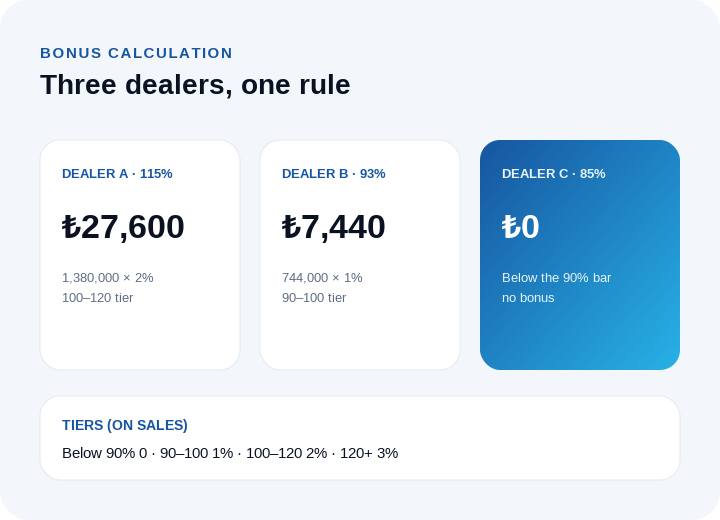
Bonus = sales × tier rate. Dealer A: 1,380,000 × 2% = ₺27,600. Dealer B: 744,000 × 1% = ₺7,440. Dealer C: at 85% there is no bonus (₺0).
How Do You Prevent the Cliff Effect?
In the method above the tier rate applies to all sales, which creates a jump at the threshold. A dealer with a ₺1,000,000 target receives ₺0 at ₺899,000 of sales and 900,000 × 1% = ₺9,000 at ₺900,000: a ₺1,000 sales difference means a ₺9,000 bonus difference.
The alternative is to apply each rate only to its own slice. For Dealer A: up to 90% (1,080,000) ₺0; between 1,080,000 and 1,200,000, 120,000 × 1% = ₺1,200; between 1,200,000 and 1,380,000, 180,000 × 2% = ₺3,600; total ₺4,800. The same dealer earned ₺27,600 on the all-sales basis. For Dealer B: (744,000 − 720,000) × 1% = ₺240. The sliced method removes the jump but lowers the bonus; the rates must be set accordingly. The choice is contractual; consult your legal counsel.
How Large Is the Network's Total Bonus Burden?
Say the attainment of the 40 dealers is distributed as follows; each dealer's target is ₺1,000,000 and each tier's average attainment is the stated value.
| Tier | Dealers | Avg. attainment | Sales (₺) | Rate | Bonus (₺) |
|---|---|---|---|---|---|
| Below 90% | 12 | 82% | 9,840,000 | 0% | 0 |
| 90–100% | 10 | 95% | 9,500,000 | 1% | 95,000 |
| 100–120% | 13 | 108% | 14,040,000 | 2% | 280,800 |
| Above 120% | 5 | 126% | 6,300,000 | 3% | 189,000 |
| Total | 40 | 99.2% | 39,680,000 | 564,800 |
The total bonus is ₺564,800, which is 564,800 ÷ 39,680,000 = 1.42% of sales. Even though the network stays at 99.2% of target, 28 of the 40 dealers (10 + 13 + 5) earn a bonus. That is why the bonus budget is tracked together with the network target, with a cap if needed.
How Is a Dealer Performance Score Calculated?
A performance score shows in one number how healthily a dealer operates, regardless of its sales volume. Each component is converted to 0–100 and weighted: score = 0.40 × sales target + 0.25 × collection + 0.20 × stock turnover + 0.15 × portal usage.
- Sales target score: the attainment percentage, capped at 100.
- Collection score: the percentage of the amount due that was collected on time.
- Stock turnover score: the dealer's turnover rate ÷ the target rate (target 6), capped at 100.
- Portal usage score: the percentage of orders placed through the portal.
| Dealer | Sales (×0.40) | Collection (×0.25) | Stock turnover (×0.20) | Portal (×0.15) | Score |
|---|---|---|---|---|---|
| Dealer A | 100 | 88 | 90 (5.4 ÷ 6) | 70 | 90.5 |
| Dealer B | 93 | 96 | 100 (7.2 ÷ 6, capped) | 90 | 94.7 |
| Dealer C | 85 | 70 | 60 (3.6 ÷ 6) | 40 | 69.5 |
Calculation: A: 0.40 × 100 + 0.25 × 88 + 0.20 × 90 + 0.15 × 70 = 40 + 22 + 18 + 10.5 = 90.5. B: 37.2 + 24 + 20 + 13.5 = 94.7. C: 34 + 17.5 + 12 + 6 = 69.5.
The result: Dealer A, which earns the largest bonus, ranks second on score, and the steady Dealer B ranks first. The score makes visible the behavior a bonus does not reward. The weights reflect company priorities and are not changed mid-period. Three bands are enough: 90 and above full support, 75–90 development plan, below 75 action plan.
How Are Dealer Credit Limits and Payment Risk Calculated?
A credit limit is the highest balance a dealer may leave open at one time. A simple, explainable formula: limit = average monthly purchases × payment term ÷ 30 × risk factor. The term is in days; the risk factor depends on collection discipline: 1.2 for collection at 95% and above, 1.0 for 80–95%, 0.7 below 80% (representative).
| Dealer | Monthly purchases (₺) | Term (days) | Risk factor | Limit (₺) | Open balance (₺) | Utilization |
|---|---|---|---|---|---|---|
| Dealer A | 115,000 | 45 | 1.0 | 172,500 | 140,000 | 81.2% |
| Dealer B | 62,000 | 30 | 1.2 | 74,400 | 52,000 | 69.9% |
| Dealer C | 70,833 | 45 | 0.7 | 74,375 | 110,000 | 147.9% |
Calculation: A: 1,380,000 ÷ 12 = 115,000; 115,000 × 45 ÷ 30 × 1.0 = ₺172,500. B: 744,000 ÷ 12 = 62,000; 62,000 × 1.0 × 1.2 = ₺74,400. C: 850,000 ÷ 12 ≈ 70,833; 70,833 × 1.5 × 0.7 ≈ ₺74,375. Dealer C's open balance is ₺110,000 − ₺74,375 = ₺35,625 above its limit, a utilization of 147.9%. The system routes a new order to manager approval or blocks it. Overdue amounts are tracked too (customer account tracking).
Why Do Dealer Stock and Order Visibility and Field Visits Matter?
Targets and bonuses look at sell-in; the health of the network shows in dealer stock and in visits. Once stock levels are known, an overstocked dealer is not pushed for extra orders and a dealer running out is noticed early; open orders also appear on the dealer record (order management system).
A field visit finds the reason the numbers cannot explain: why did collections fall, which product did a competitor bring in? Visit frequency is tied to the segment (an A dealer monthly, a C dealer every two weeks), notes are written to the dealer record, and tasks are tracked with a date and an owner.
How Do the Dealer Portal and Integrations Connect to This System?
The system does not create data, it collects it: customer-account balance, invoices and stock come from the ERP; order count and channel from the portal; visits, tasks and complaints from the CRM, all matched by dealer code. The limit, discount and bonus tables are written back from here. See API integration for the transfer, role-based access control for permissions, and quote management software for discount approval.
We recommend reading: Our integration service
How Is the Payback of a Dealer Management System Calculated?
In the representative network the bonus calculation is done by hand once a quarter, the performance report monthly and the limit review quarterly; an hour costs ₺300; the system cuts the time by 75%.
| Task | Manual (h/year) | With system (h/year) | Saving (h) |
|---|---|---|---|
| Bonus calculation | 120 | 30 | 90 |
| Performance report | 240 | 60 | 180 |
| Limit review | 40 | 10 | 30 |
| Total | 400 | 100 | 300 |
Calculation: 40 × 45 × 4 = 7,200 min = 120 h; 40 × 30 × 12 = 14,400 min = 240 h; 40 × 15 × 4 = 2,400 min = 40 h; total 400 h. 300 h × ₺300 = ₺90,000 per year. Error cost: 40 dealers × 4 quarters = 160 bonus calculations, of which 5% (8) are wrong and cause an average ₺2,500 overpayment: 8 × ₺2,500 = ₺20,000. Annual running cost is ₺30,000.
Time and error savings: 90,000 + 20,000 − 30,000 = ₺80,000 per year (₺6,667 per month). With an investment of ₺240,000 the payback is 240,000 ÷ 6,667 = 36 months; looking only at time makes the system look expensive, and the real value is in cash. If limit alerts and reminders shorten collection by an average of 3 days, then with daily sales of 39,680,000 ÷ 365 ≈ ₺108,712, 3 × 108,712 ≈ ₺326,137 arrives earlier; at a 36% annual financing cost (representative) that is worth ₺117,409. Net benefit is 80,000 + 117,409 = ₺197,409 per year, ₺16,451 per month; payback is 240,000 ÷ 16,451 ≈ 14.6 months.
If the benefit comes in 30% lower, 36 months becomes 51.4 and 14.6 becomes 20.8; build the case on collection and limits.
How Is a Dealer Management System Set Up in Six Steps?
The setup writes the rules down first, connects the data next and automates last.
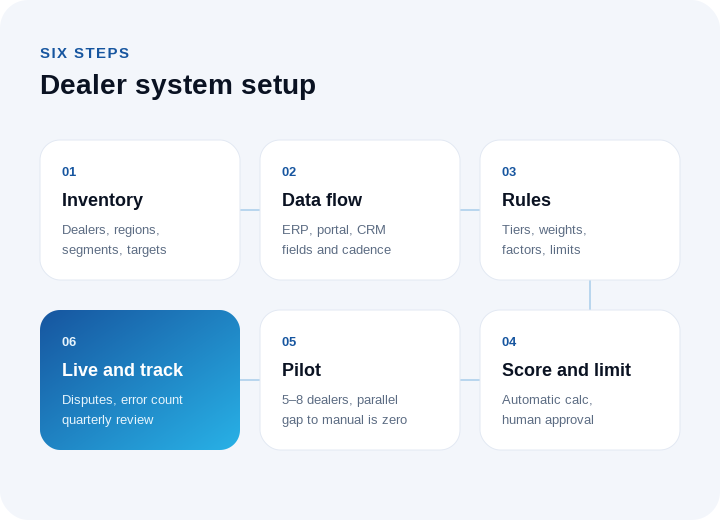
- Take inventory: Collect dealers, regions, segments, contracts and targets in one list.
- Build the data flow: Decide which field comes from the ERP, portal and CRM, and how often.
- Write the rules: Write down tiers, weights, risk factors and the limit formula; verify them by hand with sample dealers.
- Automate score and limit: Run the calculations in the system; limit changes go through human approval.
- Run a pilot: Work in parallel for one period with 5–8 dealers in one region; bring the gap between manual and system results to zero.
- Go live and track: Open it to the whole network; watch disputes and error counts, and review the rules in the first quarter.
What Are Common Mistakes in Dealer Management?
- Asking for software before writing the rules: An unclear rule only speeds up the confusion.
- Leaving a cliff at the threshold: A ₺1,000 difference producing a ₺9,000 bonus difference drives unwanted behavior.
- Not being transparent: If the score and bonus calculation are not explained, disputes increase.
How Are Bonus, Contract and Tax Matters Handled?
Bonus, discount and target rules are part of the contract; their validity, amendment and dispute procedures, as well as personal data, are matters for your legal counsel. Invoicing and tax treatment of the bonus belong to your financial advisor (certified accountant). The software applies the rule; the contract determines its legal correctness.
We recommend reading: How to Calculate Customer Lifetime Value (CLV): Formula, Cohort and CAC Ratio Guide
We recommend reading: What Is NPS (Net Promoter Score) and How Is It Calculated?
We recommend reading: What Is a Sales Funnel? B2B Stages, Conversion Rates, Pipeline Velocity and CRM Setup Guide
We recommend reading: How to Manage B2B Price Lists: Dealer Pricing, Tiered Discounts, Margin Floors and Bulk Updates
We recommend reading: What Is a Field Sales Mobile Order App? Visit Planning, Offline Mode, Credit Limits and Payback Guide
We recommend reading: How to Build a Customer and Dealer Onboarding Process: Document Tracking, Time to First Order, First 90 Days and Payback Guide
We recommend reading: How to Manage Consignment Inventory: Consumption Notices, Reconciliation and Tied-Up Capital Guide
We recommend reading: How to Do Customer Profitability and Cost-to-Serve Analysis: Net Contribution, the Whale Curve and Action Guide
We recommend reading: How to Set Up Sales Commission Calculation Software: Quota, Tiers, Clawbacks and Cost Guide
We recommend reading: How to Plan Sales Territories: Workload Balance, Rep Headcount, Account Transitions and Quota Fairness
We recommend reading: How to Manage Credit Limits and Order Holds: A Credit Hold Process Guide
Dealer Networks and Custom Software with İnovabil
At İnovabil our focus is building software from scratch, specific to each company: custom software, CRM, ERP, e-commerce, web, mobile and integration. We do not have a ready-made product called dealer management; we recommend building the rules and data flow specific to your network, around your existing CRM, ERP and portal.
We built CRM, purchasing and mobile for Avcılar İnşaat; a purchasing system for İZBAN; logistics and shipment planning with wholesale order management for Karyak; warehouse management and a complaint and support management system for Sleepy; shipment planning for Bofigo; and a prepaid cargo system for Kredili Kargo. Briefly describe your dealer network and your current systems, and we will assess it together.
We recommend reading: Our software development process: step by step from analysis to launch
Frequently Asked Questions
What is a dealer management system, in short?
It is software that keeps the dealer network in a single record and calculates targets, bonuses, performance and credit limits by the same rules.
Is a dealer management system the same as a dealer portal?
No. A dealer portal is the screen where dealers place orders; a dealer management system is the layer where headquarters manages targets, bonuses, performance and limits. Both share the data on the same dealer record.
How is a dealer bonus calculated?
Attainment (sales ÷ target) is found, a rate is chosen from the tier table and multiplied by sales. In the example a dealer at 115% earns 2%, or ₺27,600; the rate can apply to all sales or only to its own slice.
How is a dealer credit limit determined?
The simple formula is average monthly purchases × payment term ÷ 30 × risk factor. A dealer with ₺115,000 monthly purchases, a 45-day term and a factor of 1.0 gets a limit of ₺172,500; it takes effect with human approval.
Which criteria measure a dealer performance score?
Common components are sales target, collection discipline, stock turnover and portal usage. In the example the weights are 40%, 25%, 20% and 15%.