

A customer asks for a price. The sales rep opens an Excel file copied from an old quote, updates unit prices by hand, guesses that the manager will accept the discount and emails the file. Two days later the same customer receives a second quote with a different price. Quote management software (quoting software) runs the preparation, approval, sending, follow-up and conversion of a sales quote into an order in a single record, bound by rules.
In this guide we explain what quote management software is, the problems of quotes built in Excel and Word, the quote life cycle, pricing rules, the discount approval matrix and margin protection, follow-up and metrics, the link to CRM and ERP, the payback calculation and the off-the-shelf versus custom decision. The example figures are representative; they are not a specific product's price or an industry average.
What Is Quote Management Software?
Quote management software is an application that builds a sales quote from a product and price list, applies discount and approval rules, tracks sending and acceptance, and passes the accepted quote on as an order. It comes sometimes as a CRM module, sometimes as a separate application and sometimes as a custom-built component.
This article covers only the pre-order stage. For customer and opportunity management as a whole, see our what is CRM guide; for criteria when picking a CRM, see how to choose a CRM. What happens after acceptance, fulfilling the order, is the subject of our order management system guide.
We recommend reading: Our CRM software service
What Are the Problems With Building Quotes in Excel and Word?
A quote process that starts in a spreadsheet and a document works at low volume; as volume and team grow, the same five problems appear.
- Price inconsistency: The list price in each rep's copied file may date from a different time; the same product goes to two customers at two prices.
- Uncontrolled discounts: The discount is typed into a cell and sent; whether it went below margin is noticed after the sale, often never.
- Formula and copy errors: A broken total formula or a previous customer's name can survive into a new quote.
- Version chaos: Nobody knows which of the files named "quote_final_v3_fixed" is with the customer.
- No follow-up and double entry: A sent quote is forgotten; when it is accepted, the same data is typed again for the order.
We described the general path from spreadsheets to software in our guide on moving from Excel to software; the quote is the typical candidate on the sales side of that move.
How Does the Quote Life Cycle Work?
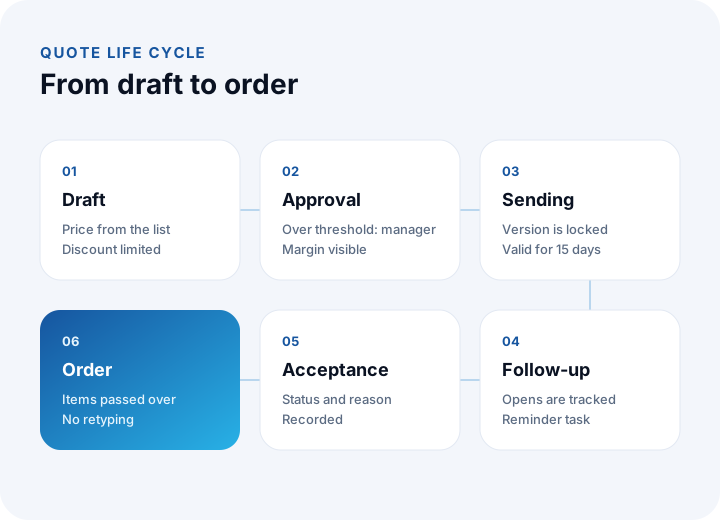
A quote passes through six stages, and each stage should have an owner, a rule and a record. The table below shows a representative flow.
| Stage | What happens? | The system's job |
|---|---|---|
| Draft | The rep opens a quote from the opportunity and picks line items | Pulls price from the list, limits discount by rule |
| Internal approval | A discount above the threshold goes to a manager | Finds the approver, shows margin, records the decision |
| Sending | A link or PDF goes to the customer | Locks the version, writes the validity date |
| Follow-up | The customer opens the quote, asks questions, requests changes | Tracks opens, creates reminder tasks |
| Acceptance | The customer accepts or declines | Records status and the reason for a decline |
| Conversion to order | The accepted quote becomes an order | Passes items and price to the order without retyping |
What Rules Calculate the Quote Price?
The price comes from defined rules, not from a rep's memory. That way two reps give the same price for the same product under the same terms.
- List price: The product and price list comes from a single source and has a validity date.
- Discount: Applied per line or on the total as a percentage; its ceiling depends on role.
- Bundles and services: Bundle prices and attached service lines (installation, training) are defined for products sold together.
- Exchange rate: If the list is in a foreign currency, the quote states which rate and which date it used; the rate is fixed with the quote or limited by its validity period.
- Validity period: In our example it is 15 days: a quote sent on March 1 is valid until March 16; once it lapses it cannot be accepted without re-validating the price.
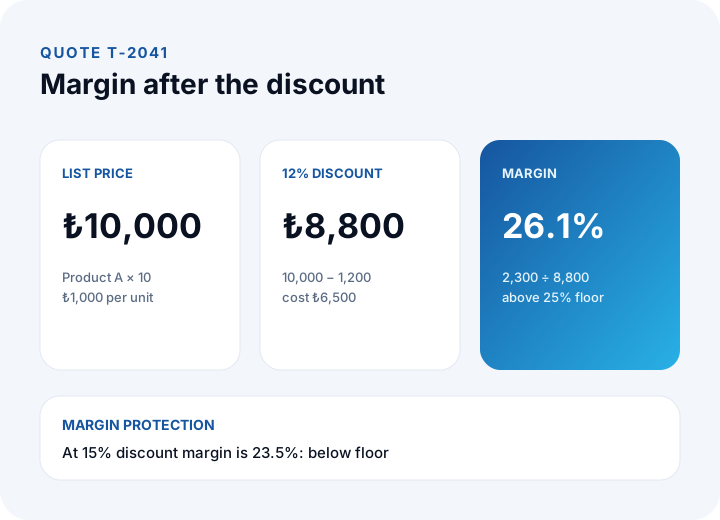
In the sample quote T-2041, Product A has 10 units × ₺1,000 = ₺10,000 list price; a 12% discount removes ₺1,200 and the total is ₺8,800. The product's cost is ₺6,500. Tax detail is not included in this example; consult your financial advisor (certified accountant) on how tax applies.
How Do You Set Up a Discount Approval Matrix and Margin Protection?
Discount is tied to both authority and margin. First a percentage threshold is set; then a margin floor protects the lower bound whatever the threshold. In the example the rule is: up to 10% the rep decides, above 10% a manager approves, above 15% senior management approves; in addition the margin floor is 25%.
Margin = (selling price − cost) ÷ selling price. With a total of ₺8,800: (8,800 − 6,500) ÷ 8,800 = 2,300 ÷ 8,800 = 26.1%. With a 15% discount the price would be ₺8,500 and margin falls to 2,000 ÷ 8,500 = 23.5%, below the 25% floor.
| Discount | Price | Margin | Approval |
|---|---|---|---|
| 10% | ₺9,000 | 2,500 ÷ 9,000 = 27.8% | Rep |
| 12% | ₺8,800 | 2,300 ÷ 8,800 = 26.1% | Manager |
| 13.3% | ₺8,667 | 25.0% (floor) | Manager, at the limit |
| 15% | ₺8,500 | 2,000 ÷ 8,500 = 23.5% | Senior management and a margin exception |
The maximum discount is back-calculated from the floor: price ≥ cost ÷ (1 − 0.25) = 6,500 ÷ 0.75 ≈ ₺8,667; discount ≤ (10,000 − 8,667) ÷ 10,000 ≈ 13.3%. A below-floor quote goes out only with a reason and senior approval. We explained the difference between margin and markup in our product costing guide.
How Are Quote Versions and Revisions Managed?
Customers revise most quotes. The system stores each revision as a new version and treats only the latest as valid.
- Version number: T-2041 v1, v2, v3; old versions are never deleted and stay readable.
- Change summary: What changed in v2, by whom and why is visible.
- Invalidation: When a new version is sent, the previous link shows an "out of date" notice.
- Re-approval: If a revision pushes discount or margin past a threshold, approval starts again.
What Does a Good Quote Template Contain?
The template carries everything a rep should not retype: company details, a customer-specific introduction, line items, totals, delivery and payment terms, the validity date and the acceptance step. Instead of one template, a few are kept per product or service group. Terms come from a shared library; for contract and liability wording, use text approved by your legal counsel.
How Is a Sent Quote Followed Up?
Sending the quote does not finish the job; the real waiting begins. When follow-up rules are defined in the system, nobody has to remind anybody.
- Open notification: When the customer opens the quote the rep is notified; that is the right moment to call.
- Reminder task: If there is no reply 3 days after sending, a task is created; a final reminder arrives before the validity ends.
- Decline reason: Chosen from a fixed list such as price, lead time, competitor or budget; free text cannot be reported on.
- No quote without an owner: One person is responsible for every quote; if a rep leaves it is reassigned.
How Does Quote Management Connect to CRM and ERP?
The quote is not an island; it is the bridge between CRM and ERP. The opportunity starts in CRM, the quote is born from the opportunity, and once accepted the order goes to ERP. For the division of labor between CRM and ERP, see our CRM vs ERP article; our ERP guide covers what comes after the order.
| Data | Source | Use in the quote |
|---|---|---|
| Customer and contact person | CRM | Fills the quote header automatically |
| Opportunity and stage | CRM | Quote status updates the opportunity stage |
| Product, price list, cost | ERP | Price and margin are calculated from it |
| Stock and lead time | ERP | Shown as delivery time and stock warning |
| Accepted quote | Quote system | Passed to ERP as an order record |
When building the connection, the basic concepts in our API integration guide, such as repeated events and half-finished transfers, will help. To let customers follow status once the order exists, see also our customer portal article.
How Are Digital Acceptance and E-Signature Used in a Quote?
The customer opens the quote from a link, reviews it and says "I accept" or "request changes"; the system records who accepted which version and when. Where stronger evidence is needed, an e-signature or similar verification can be added. For the legal validity and evidential value of digital acceptance and e-signatures, take your legal counsel's view; this article is not legal advice.
Which Metrics Measure the Quote Process?
The quote funnel shows where a sale stalls. Representative monthly data: 40 quotes sent, 28 opened, 18 turned into meetings, 12 accepted.
| Stage | Count | Rate from the previous stage |
|---|---|---|
| Sent | 40 | — |
| Opened | 28 | 28 ÷ 40 = 70% |
| Turned into meetings | 18 | 18 ÷ 28 = 64.3% |
| Accepted | 12 | 12 ÷ 18 = 66.7% |
The acceptance rate is 12 ÷ 40 = 30%; measured against opened quotes it is 12 ÷ 28 = 42.9%. The product of the stage rates gives the same result: 0.70 × 0.643 × 0.667 ≈ 0.30. Other metrics: quote preparation time (45 min → 12 min), first response time (2 days → 4 hours), average discount and the number of below-floor quotes. Read the metrics to improve the process, not to judge people; a low acceptance rate alone may come from price, competitors or lead quality.
How Is the Payback of Quote Management Software Calculated?
Payback comes from two items: time saved in preparation and prevented price errors. Representative assumptions follow.
- Time saved: 40 quotes a month × 33 min (45 − 12) = 1,320 min = 22 hours; at ₺300 an hour, 22 × ₺300 = ₺6,600.
- Price errors: 3 errors a month × ₺2,000 = ₺6,000 lost; if half are prevented, ₺3,000.
- Gross benefit: ₺6,600 + ₺3,000 = ₺9,600; with ₺1,600 software running cost, ₺8,000 net a month.
| Item | Monthly |
|---|---|
| Time saved | ₺6,600 |
| Prevented price errors | ₺3,000 |
| Running cost | −₺1,600 |
| Monthly net benefit | ₺8,000 |
With an investment of ₺160,000, payback is ₺160,000 ÷ ₺8,000 = 20 months. Some effects are outside the calculation: faster replies and protected margin influence acceptance, but putting a number on that takes measurement with your own data. Recalculate with your own quote volume, times and error losses.
Off-the-Shelf Quoting Tool or Custom Software?
For most businesses the first stop is the quote module of a CRM or an off-the-shelf quoting tool. If your price structure is simple and your catalog small, that is enough. Custom software comes into play when price rules are complex (volume tiers, bundles, customer-specific lists, exchange rates), when the approval chain is unique to the company, when the quote must connect live to cost and stock in ERP, or when the post-acceptance order flow is too frequent to do by hand. We covered the cost structure of the two paths in off-the-shelf vs custom software, and what custom software is in our custom software guide.
How Do You Set Up Quote Management in Six Steps?
Setup starts with writing the rules before choosing software. Instead of loading every rule at once, pilot with a single product group.
- Map the current process: List the duration, discount, outcome and errors of the last 20 quotes.
- Write the price and discount rules: Decide list, tiers, exchange rate, validity period, approval thresholds and margin floor.
- Prepare templates and term texts: Build a legally approved text library.
- Design the CRM and ERP connection: Set the direction of price, cost, stock and order flow.
- Run a pilot: Work 4–6 weeks with one product group and a few reps; measure time and error counts.
- Launch and follow up: Train people, review the metrics monthly and update the rules based on results.
We recommend reading: What is procurement software? Process, approval matrix and quote scoring guide
Quote and Sales Process Software with İnovabil
At İnovabil our focus is building software from scratch, specific to your company: custom software, CRM, ERP, e-commerce, web, mobile and integration. We suggest treating your quote process either as part of your CRM or as a separate application, and writing down price rules, the approval chain and the ERP connection at the requirements stage; if an off-the-shelf tool is enough, we say so, with its cost.
We built CRM, purchasing and mobile for Avcılar İnşaat; a purchasing system for İZBAN; and logistics and shipment planning with wholesale order intake and management for Karyak. Send us a short description of how quoting works today; together we will extract the requirements and prepare a written assessment.
We recommend reading: Our software development process: step by step from analysis to launch
Frequently Asked Questions
What is quote management software and what is it for?
It is software that builds a sales quote from a product and price list, binds discount approval and margin to rules, tracks sending and acceptance, and passes the accepted quote on as an order. It brings speed, price consistency and margin control.
Is quoting software the same as a CRM?
No. A CRM manages the whole record of customers, opportunities and conversations; quote management is only its pricing and approval stage. Many CRMs include a quote module; if price rules are complex, a separate or custom solution may be needed.
How do you set a discount approval matrix?
First percentage thresholds are tied to roles (for example up to 10% the rep, above that a manager), then a margin floor is added. In the example, with cost ₺6,500 and a 25% floor, the maximum discount is about 13.3%; below-floor goes out only with a reason and senior approval.
How long should a quote stay valid?
It depends on product, exchange rate and supply volatility; in the example it is 15 days. Once it lapses, the quote cannot be accepted without re-validating the price; the system enforces this rule by date.
When does quote management software pay for itself?
In the representative example, with 40 quotes a month the net benefit is ₺8,000 and the investment ₺160,000, so payback is 20 months. Recalculate with your own quote volume, preparation time and price error losses.