

At month end the sales manager opens a spreadsheet, matches orders one by one and subtracts returns by hand. One rep disputes a figure, the calculation is redone, and someone else's commission changes too. Sales commission calculation software puts that calculation under written rules, so every rep is paid by the same method and every result can be traced. This guide explains how to set up a commission plan in a system.
The topic is the commission of your own salaried sales reps, not a dealer network's bonus; for the dealer side see our dealer management system guide. All amounts, rates and headcounts in this article are representative; they are not a real plan or a market rate.
What Components Make Up a Sales Commission Plan?
A commission plan is built from several separate decisions, and each one changes both the math and the behavior.
| Component | What it does | Data the system stores |
|---|---|---|
| Quota | Sets the period target | Rep, period, amount |
| Rate and tiers | Gives the commission percentage by attainment | Tier limits and rates |
| Accelerator | Raises the rate above quota | Threshold and new rate |
| Cap | Holds period commission at an upper limit | Amount or percent of quota |
| Collection condition | Ties the right to cash received | Invoice and payment records |
| Margin multiplier | Reduces commission on low-margin sales | Cost and margin on the sale line |
| Split | Shares one sale among several people | Share percentages, total 100% |
Launching with quota, rate and a collection condition and adding the margin multiplier later is easier to manage. For target setting, see our guides to OKRs and KPIs.
When Is Commission Earned: Order, Invoice or Payment?
The trigger event is the most important choice in the plan, and each option carries a different risk.
| Event | Advantage | Risk |
|---|---|---|
| Order received | Fast feedback for the rep | Cancellations and returns come later, clawbacks multiply |
| Invoice issued | The sale is formalized | Commission may be paid on a sale never collected |
| Payment received | The company has the cash | The rep suffers from a customer's late payment |
A common middle path counts quota attainment on invoices and pays in proportion to collections. In the example rep's period, invoices total ₺620,000 and ₺496,000 has been collected, so the collection rate is 80%. If the calculated commission is ₺14,800, the earned part is ₺14,800 × 0.80 = ₺11,840 and ₺2,960 stays pending. That is why the commission system should use the same customer record as customer account tracking, which supplies the payment data.
Should Tiered Commission Be Calculated by Slice or on the Whole Amount?
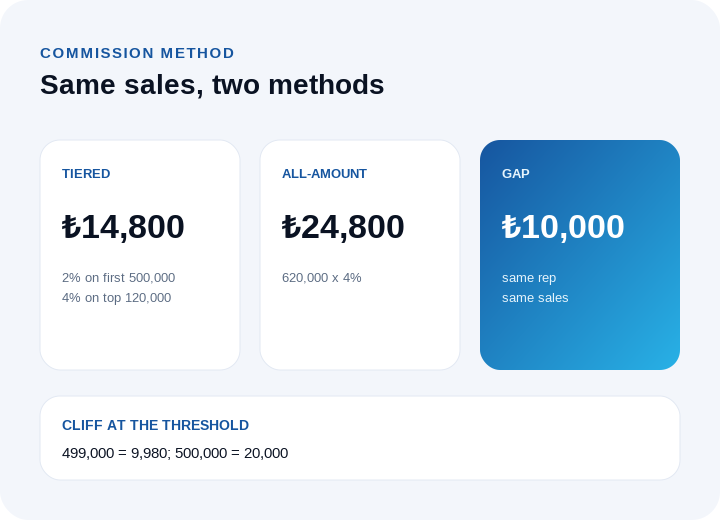
The two methods turn the same plan into different results. In slice (marginal) calculation each rate applies only to the amount inside its own band; in the all-amount method the rate of the tier reached applies to the entire attainment.
Example rep: quota ₺500,000, attainment ₺620,000, which is 124%. The rate is 2% within quota and 4% above it.
| Method | Calculation | Commission |
|---|---|---|
| Slice | 500,000 × 2% + 120,000 × 4% = 10,000 + 4,800 | ₺14,800 |
| All-amount | 620,000 × 4% | ₺24,800 |
The effective rate under the slice method is 14,800 ÷ 620,000 ≈ 2.39%. The all-amount method looks generous but creates a cliff at the threshold: at ₺499,000 the commission is ₺499,000 × 2% = ₺9,980, while at ₺500,000 it is ₺500,000 × 4% = ₺20,000. A ₺1,000 difference moves commission by ₺10,020, which invites pulling sales forward or pushing them back at period end. Slice calculation or a transition band avoids the cliff.
How Do You Reduce Commission on Low-Margin Sales?
Rewarding a high-revenue, low-margin sale at the same rate encourages discounting more than profit. A margin multiplier corrects this: the commission is multiplied by a factor based on the margin band of the sale line.
Example bands: 1.00 for margin of 30% and above; 0.75 for 20–30%; 0.50 below 20%. The rep's ₺620,000 of revenue comes from three groups, and the slice base commission (₺14,800) is distributed by revenue share.
| Group | Revenue | Margin | Base commission | Multiplier | Commission |
|---|---|---|---|---|---|
| A | ₺300,000 | 32% | ₺7,161 | 1.00 | ₺7,161 |
| B | ₺200,000 | 24% | ₺4,774 | 0.75 | ₺3,581 |
| C | ₺120,000 | 15% | ₺2,865 | 0.50 | ₺1,432 |
| Total | ₺620,000 | ₺14,800 | ₺12,174 |
Commission falls from ₺14,800 to ₺12,174, a reduction of ₺2,626 or 17.7%. If cost records are unreliable, the multiplier becomes arbitrary. For discount and margin control, see our quote management software guide.
How Is Commission Split When Several Reps Share a Sale?
A split rule sets each contributor's share as a percentage and requires the total to equal exactly 100%. If the total exceeds 100%, the company pays commission on the same sale twice.
Example: on a ₺180,000 order two reps share 60% and 40%. One is credited ₺108,000 toward quota attainment and the other ₺72,000; the total is still ₺180,000. Had both received 100% credit, recorded sales would be ₺360,000 and, at a 4% rate, commission would be ₺14,400 instead of ₺7,200. The system should reject a record whose shares do not total 100% and should also record who set the shares and why.
How Do Returns, Cancellations and Clawbacks Work?
A clawback recalculates commission when a sale is returned or cancelled after payout and deducts the difference.
Three decisions are needed: the clawback window (for example 60 days from invoice), which events trigger it (return, cancellation, non-collection) and how the correction is made. The cleanest approach is to update attainment, recalculate commission from scratch and write the difference between old and new commission as an adjustment line.
| Return amount | New attainment | Slice commission | Slice clawback | All-amount clawback |
|---|---|---|---|---|
| ₺50,000 | ₺570,000 | ₺12,800 | ₺2,000 | ₺2,000 |
| ₺150,000 | ₺470,000 | ₺9,400 | ₺5,400 | ₺15,400 |
For a small return that leaves attainment above quota, both methods give the same result. When a return pulls attainment below quota the gap opens: ₺14,800 − ₺9,400 = ₺5,400 is clawed back under the slice method, and ₺24,800 − ₺9,400 = ₺15,400 under the all-amount method. This outcome should be seen in advance when the plan is designed.
What Happens When Quota Changes Mid-Quarter?
A mid-period quota change is prorated; the new quota is not applied retroactively but from the change date.
Example: the monthly quota is ₺500,000 and rises to ₺600,000 at the start of month two. The quarterly quota is 500,000 + 600,000 + 600,000 = ₺1,700,000. With attainment of ₺1,800,000, the quota percentage is 1,800,000 ÷ 1,700,000 ≈ 105.9%. Keeping the quota at ₺1,500,000 would show the same sales as 120%; that difference changes the commission tier and the cost. The old quota value should not be deleted but stored with its date range. To link quota to forecasts, see our sales forecasting guide.
Disputes and Corrections: Why Should the Commission Record Never Be Edited?
The commission record is a ledger that cannot be changed once a period closes, and corrections are added only as new lines. If a calculation changes silently afterward, reps stop trusting the system and question every number.
The process works like this: a rep disputes a line on the statement, the responsible person reviews it, and if there is an error an adjustment line with a stated reason is added that both sides can see. The correction does not touch the closed record of the erroneous period; it appears as a separate line in the current period. Every line records who calculated it, when and by which rule. For the approval steps, our workflow and approval software guide applies.
Transparency is part of the same rule: a rep should be able to see at any time a statement with revenue by line, margin band, split share, collection status, rate and quota percentage.
What Bad Incentives Can a Commission Plan Create?
Every plan produces the behavior that follows the shortest path the rule allows.
| Behavior | How it appears | Control |
|---|---|---|
| Inflating sales with discounts | Revenue-based commission ignores margin | Margin floor, margin multiplier |
| Pushing deals at period end | Sales are deferred once quota is met | Gradual decline instead of a hard cap |
| Quarter-end shifting | Orders are invoiced early and cancelled later | Clawback window, cancellation analysis |
| Drifting to easy customers | Repeat orders are chased, not growth | New-customer multiplier or separate quota |
The discount risk is simple arithmetic. On a job with a ₺200,000 list price and ₺130,000 cost, a 5% discount gives revenue of ₺190,000 and gross profit of ₺60,000; a 15% discount gives revenue of ₺170,000 and gross profit of ₺40,000. If commission is 4% of revenue it falls from ₺7,600 to ₺6,800; the rep loses only 10.5% while the company loses a third of its gross profit (33.3%). If commission is 10% of gross profit it falls from ₺6,000 to ₺4,000, and the incentive points the same way as the company's interest.
How Do You Simulate the Cost of a Commission Plan in Advance?
Before the plan goes live, calculate total commission and the commission-to-revenue ratio under assumed quota distributions.
Example team: 20 reps, each with a ₺500,000 quota. Attainment distribution: 4 reps at 70% (₺350,000), 6 at 90% (₺450,000), 6 at 110% (₺550,000), 4 at 140% (₺700,000). Slice plan: 2% on the first ₺500,000 and 4% above.
| Scenario | Total commission | Revenue | Commission ÷ revenue |
|---|---|---|---|
| Base plan | ₺226,000 | ₺10,200,000 | 2.22% |
| Accelerator 5% instead of 4% | ₺237,000 | ₺10,200,000 | 2.32% |
| Cap: ₺16,000 per rep | ₺218,000 | ₺10,200,000 | 2.14% |
| Everyone sells 10% more | ₺258,600 | ₺11,220,000 | 2.30% |
Base plan total: 4 × 7,000 + 6 × 9,000 + 6 × 12,000 + 4 × 18,000 = 28,000 + 54,000 + 72,000 + 72,000 = ₺226,000; revenue is 1,400,000 + 2,700,000 + 3,300,000 + 2,800,000 = ₺10,200,000. With a 5% accelerator only the ten reps above quota earn more: +₺11,000, or 4.9%. The cap trims 4 × ₺2,000 = ₺8,000 from the top four sellers. When everyone sells 10% more, revenue rises 10% but commission rises 14.4%; an accelerator makes cost grow faster than revenue.
Payout, Payroll and Legal Matters
Calculating commission and paying it are separate jobs. The system produces the entitlement and the amount; payment, tax withholding, social security and payroll processing belong to your accountant and HR.
How the commission plan is written into the employment contract, whether the plan can be changed mid-period and the employment-law consequences are matters for your legal counsel. This article is not legal advice. The software stores the plan version and its effective date and calculates each period with the plan in force at that time.
How Do You Measure the Success of a Commission System?
Three measures are enough: dispute rate, calculation time and commission-to-revenue ratio. The first two show how reliable the system is, the third shows what the plan costs.
- Dispute rate: Disputed calculations ÷ total calculations. Example: 6 disputes across 60 rep-period calculations = 10%; the target is at most 2 disputes in 60 calculations (3.3%).
- Calculation time: Time from period close until statements reach reps. In the example, 24 hours in a spreadsheet and 4 hours in the system.
- Commission ÷ revenue: Total commission ÷ total revenue. In the example, 2.22%.
What Is the Payback of Moving From Spreadsheets to Commission Software?
Payback is found by comparing the cost of calculation effort, error losses and dispute handling with the automated alternative. The assumptions below are representative: 20 reps, labor cost ₺300 per hour.
- Monthly cost in spreadsheets: calculation effort 24 h × ₺300 = ₺7,200; erroneous calculations 4 lines × ₺1,500 = ₺6,000; dispute handling 4 × 3 h × ₺300 = ₺3,600. Total ₺16,800.
- Monthly cost in the system: calculation effort 4 h × ₺300 = ₺1,200; erroneous calculations 1 line × ₺1,500; dispute handling 1 × 2 h × ₺300 = ₺600. Total ₺3,300.
- Gross benefit: 16,800 − 3,300 = ₺13,500; with ₺3,000 a month in running costs, net ₺10,500 a month.
With an investment of ₺252,000, payback is 252,000 ÷ 10,500 = 24 months. If the benefit halves, net becomes ₺3,750 and payback is about 67 months; recalculate with your own line and hour data.
How Do You Set Up Sales Commission Software in Six Steps?
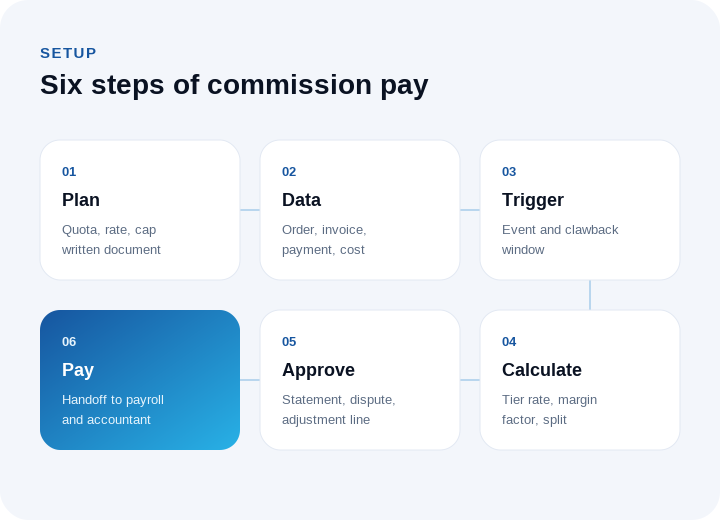
- Write the plan: Put quota, rate, accelerator, cap, collection condition and margin multiplier in one document, together with the method (slice or all-amount).
- Connect the data sources: Read order, invoice, payment and cost data from CRM and ERP; customer and product codes should be single and shared.
- Encode the trigger rule: The event that counts as attainment, the clawback window and the return rule should live in the system.
- Run the calculation: First calculate the last three periods in parallel with the old method and the new system, and examine the differences.
- Publish statements and approval: Show each rep a line-by-line statement; set up the approval and dispute flow.
- Measure and review: Track dispute rate, calculation time and commission-to-revenue ratio; re-evaluate the plan at period end with a simulation.
If you have a field team, see our field sales app guide; an order taken on a visit flows straight into quota attainment.
We recommend reading: What is a sales funnel? Stages, conversion and measurement guide
We recommend reading: How to Plan Sales Territories: Workload Balance, Rep Headcount, Account Transitions and Quota Fairness
Sales Commission and Compensation Processes With İnovabil
İnovabil focuses on building software from scratch, tailored to the company: CRM, ERP, e-commerce, web, mobile and integration. Commission calculation is not a product of its own; at the requirements stage we suggest writing down the quota, trigger event and clawback rules and treating it as a module tied to CRM and ERP data.
We have built CRM, procurement and mobile for Avcılar İnşaat; a procurement system for İZBAN; logistics and shipment planning with wholesale order management for Karyak; and warehouse management plus a complaint and support management system for Sleepy. Send a short summary of your sales team structure and current calculation method; let us clarify the scope together in the analysis step of our process.
Frequently Asked Questions
What is sales commission calculation software?
A system that automatically calculates reps' commission from order, invoice and payment data using written plan rules (quota, rate, accelerator, collection condition, margin multiplier) and records every line.
What is the difference between slice commission and the all-amount method?
In the slice method each rate applies only to its own band; in the all-amount method the rate of the tier reached applies to the entire attainment. In the example the same attainment gives ₺14,800 versus ₺24,800; the all-amount method creates a cliff at the threshold.
Why is a clawback needed?
A return or cancellation removes the basis of commission already paid. If the clawback window and the recalculation rule are written down, the difference is added as an adjustment line, so the argument is settled in advance.
Can a commission record be changed afterward?
A closed period's record should not be changed; if there is an error, add an adjustment line with a stated reason. That way reps and management can trace every number.
How do you forecast the cost of a commission plan?
Simulate total commission and the commission-to-revenue ratio under an assumed quota distribution. In the example, with 20 reps the base plan costs ₺226,000, or 2.22%; a 5% accelerator raises it to ₺237,000. Recalculate with your own distribution.