

The supplier's proforma invoice says the unit price is $30, yet the goods cost you far more by the time they reach your warehouse. Freight, insurance, customs, port and storage charges, domestic haulage and bank fees all pile on, so the landed cost of imported goods ends up well above the invoice price. A business that does not spread that gap across products correctly prices from the wrong cost.
This guide covers the cost components, the allocation keys for shared charges, a three-product shipment example, exchange-rate timing, estimated versus final cost, the effect of container fill, and how to apply it all in an ERP. Every figure is representative, not a real freight, duty or exchange rate. For tax, customs and currency accounting, consult your customs broker and financial advisor (certified accountant).
What Is Landed Cost?
Landed cost is the unit cost of imported goods once every charge incurred up to warehouse receipt is added to the goods value. The formula is simple: unit landed cost = (goods value + external charges + duties and taxes + internal charges) ÷ quantity.
Manufacturing cost rests on bill of materials, labor and overhead, which we covered in our product cost guide. This article is about the warehouse-receipt cost of goods that you buy and import. That cost is the input to whichever method values the stock later (FIFO or weighted average): a valuation method does not fix a wrong cost, it only spreads it.
We recommend reading: Our ERP development service
Which Components Make Up Landed Cost?
Eight components cover most imports. Not all of them are known at the same time: the goods value is known at order, duties on the declaration day, and the freight invoice sometimes only a month later.
| Component | Example (representative) | Usually final when? |
|---|---|---|
| Goods value | $50,000 = ₺2,000,000 | Order and invoice |
| International freight | ₺100,000 | After loading |
| Insurance | ₺8,000 | Before loading |
| Customs duties and additional taxes | ₺220,000 | Declaration day |
| Port, storage, customs brokerage | ₺30,000 | After clearance |
| Domestic haulage | ₺20,000 | After delivery |
| Bank and letter-of-credit fees | ₺12,000 | Payment day |
| Exchange difference | Separate entry | Payment day |
Who bears which charge depends on the delivery terms in your contract. If the supplier pays freight up to the destination port, that line is not yours; if you pay, it enters landed cost. The booking rules for exchange differences are in our multi-currency and exchange difference guide; here we only look at how the timing of the rate affects cost.
Which Key Should Shared Charges Be Allocated By?
Each charge has its own key: pick the measure closest to what drives the charge. Applying one key to everything looks practical, but it creates systematic error between heavy, cheap goods and light, expensive goods.
| Component | Suitable key | Reason |
|---|---|---|
| Customs duties | Direct; the product's own tax base | Calculated per line on the declaration, no allocation needed |
| International freight | Volume (or the larger of volume and weight) | Containers and carriers charge for space occupied |
| Port and storage | Volume | Related to area and time occupied |
| Domestic haulage | Weight | Vehicle loads are planned by tonnage |
| Insurance, bank fees | Value | Risk and transaction size follow goods value |
| Brokerage (fixed fee per line) | Number of lines, or equal | Related to the declaration's line count |
To see the difference, let us spread the same shared pool across three products with three different keys. The shipment contains the following (rate 40.00, representative):
- Product A: 2,000 units, $5.00; 5,000 kg, 8 m³. Heavy and cheap. Goods value ₺400,000.
- Product B: 1,000 units, $30.00; 400 kg, 5 m³. Light and expensive. Goods value ₺1,200,000.
- Product C: 500 units, $20.00; 600 kg, 7 m³. In between. Goods value ₺400,000.
Total goods value ₺2,000,000, weight 6,000 kg, volume 20 m³. The shared pool: freight ₺100,000 + port ₺30,000 + domestic haulage ₺20,000 = ₺150,000.
| Key | A (₺ and per unit) | B (₺ and per unit) | C (₺ and per unit) |
|---|---|---|---|
| Value (20% / 60% / 20%) | ₺30,000 · ₺15.00 | ₺90,000 · ₺90.00 | ₺30,000 · ₺60.00 |
| Weight (83.3% / 6.7% / 10%) | ₺125,000 · ₺62.50 | ₺10,000 · ₺10.00 | ₺15,000 · ₺30.00 |
| Volume (40% / 25% / 35%) | ₺60,000 · ₺30.00 | ₺37,500 · ₺37.50 | ₺52,500 · ₺105.00 |
The same ₺150,000 pool loads B with ₺90.00 by value and ₺10.00 by weight: a ninefold gap. For A it is the reverse: ₺15.00 by value, ₺62.50 by weight. No key is right on its own; each charge should be allocated by its own driver.
How Do You Calculate Unit Cost for a Three-Product Shipment?
With the right keys the calculation takes five steps: freight and port by volume, domestic haulage by weight, insurance and bank fees by value; duties are entered directly from the declaration; everything is added to the goods value.
- Freight + port: ₺100,000 + ₺30,000 = ₺130,000, by volume share (A 40%, B 25%, C 35%).
- Domestic haulage ₺20,000, by weight share.
- Insurance ₺8,000 + bank ₺12,000 = ₺20,000, by value share (A 20%, B 60%, C 20%).
- Duties from the declaration (representative): A ₺40,000, B ₺150,000, C ₺30,000.
| Component | Product A | Product B | Product C | Total |
|---|---|---|---|---|
| Goods value | ₺400,000 | ₺1,200,000 | ₺400,000 | ₺2,000,000 |
| Freight + port (volume) | ₺52,000 | ₺32,500 | ₺45,500 | ₺130,000 |
| Domestic haulage (weight) | ₺16,667 | ₺1,333 | ₺2,000 | ₺20,000 |
| Insurance + bank (value) | ₺4,000 | ₺12,000 | ₺4,000 | ₺20,000 |
| Duties (direct) | ₺40,000 | ₺150,000 | ₺30,000 | ₺220,000 |
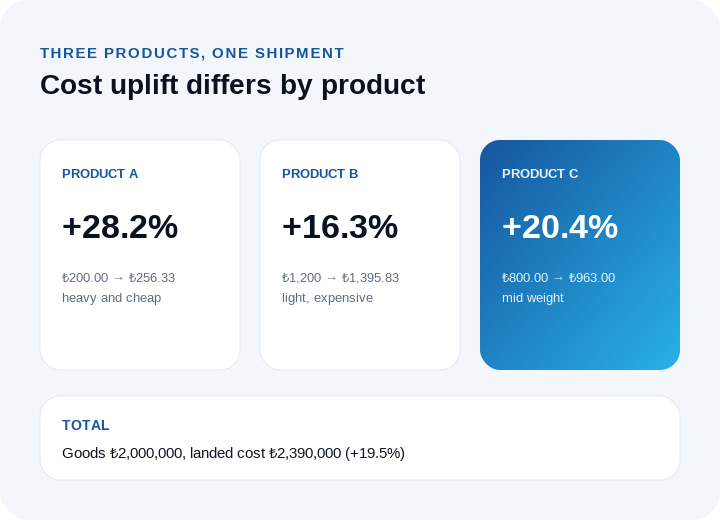
| Landed cost | ₺512,667 | ₺1,395,833 | ₺481,500 | ₺2,390,000 |
| Unit cost | ₺256.33 | ₺1,395.83 | ₺963.00 | — |
| Uplift on goods value | 28.2% | 16.3% | 20.4% | 19.5% |
Total extra cost is ₺390,000: ₺170,000 of indirect charges plus ₺220,000 of duties, or 19.5% of goods value. By product, though, it is 28.2% for A and 16.3% for B. Had we allocated all indirect charges by value alone, A's unit cost would be ₺237.00: ₺19.33 below the true figure, or 7.5% too low.
How Do the Exchange Rate and Payment Date Affect Cost?
The date whose rate converts the foreign-currency goods value into lira changes unit cost directly. Order, customs declaration and payment fall on different days; which rate is booked to cost is a matter of accounting policy and regulation, so ask your financial advisor.
It is still useful to know the sensitivity. If the rate is 40.80 instead of 40.00 in the example (+2%), goods value rises from ₺2,000,000 to ₺2,040,000: +₺40,000. Product B's unit goods value goes from ₺1,200 to ₺1,224 (+₺24) and its unit landed cost from ₺1,395.83 to ₺1,419.83 (+1.7%). The duty base also depends on the declaration-day rate, so the true effect is slightly larger; leave that calculation to your customs broker. The system should state clearly which date's rate it used.
How Is Estimated Cost Converted to Final Cost?
Receive the goods at an estimated cost and correct it as invoices arrive. Waiting to book the receipt hides the stock; booking without an estimate records zero cost.
In the example, at receipt freight is estimated at ₺90,000 and port at ₺25,000; the final invoices come in at ₺100,000 and ₺30,000. The difference is ₺15,000 and is spread by the same key (volume): A ₺6,000, B ₺3,750, C ₺5,250. If 700 of Product B's 1,000 units have been sold, the difference is booked in two places: ₺1,125 to the 300 units still in stock and ₺2,625 to the 700 units sold. The first raises stock value, the second raises cost of goods sold. The split method is accounting policy; consult your financial advisor.
A freight invoice can arrive a month later; the system should separate provisional from final cost and flag provisional lines in reports.
How Do Container Fill and Minimum Order Quantity Change Unit Cost?
If the container has a fixed price, every half-empty cubic meter loads the cost of the empty space onto the full ones. Say the container freight is ₺100,000 and capacity 25 m³ (representative): a full container costs ₺4,000 per m³. If the load is 20 m³, fill is 80% and the cost is ₺100,000 ÷ 20 = ₺5,000 per m³. The ratio is 1 ÷ 0.8 = 1.25: unit freight rises 25%.
Filling the missing 5 m³ adds no freight. For example, 1,250 more units of Product A would fit (5 ÷ 0.004); that is ₺250,000 of extra goods value, meaning extra stock. The decision compares the freight saving with the cost of the tied-up capital. A supplier's minimum order quantity works the same way: a larger quantity lowers the fixed cost per unit but raises the stock and financing burden. For models where the supplier holds the stock, see our vendor managed inventory article.
Import or Buy Local? Break-Even and In-Transit Financing
Importing beats a local source when the quantity is large enough to absorb the fixed charges per shipment. A representative comparison for a new Product D:
- Import variable cost: goods ₺1,000 + duties ₺125 + freight and haulage ₺60 = ₺1,185 per unit.
- Fixed charges per shipment: port, brokerage and bank ₺42,000.
- Local quote: ₺1,325 per unit.
Ignoring in-transit financing, break-even is 42,000 ÷ (1,325 − 1,185) = 300 units. If the goods value is paid up front and the goods arrive 45 days later, at a representative 48% annual financing cost unit cost rises by ₺1,000 × 0.48 × 45 ÷ 365 ≈ ₺59.18. The gap is now 1,325 − (1,185 + 59.18) = ₺80.82 and break-even rises to 42,000 ÷ 80.82 ≈ 520 units. Whether financing cost is booked into landed cost is an accounting decision; but ignoring it in the buying decision makes importing look cheaper than it is.
For the whole chain, see our supply chain management guide; for running the ordering process, see our procurement software article.
How Does Landed Cost Affect Selling Price and Margin?
If the price list is built on goods value, margin looks higher than it is. Say Product B lists at ₺2,200. On goods value alone (₺1,200) margin is (2,200 − 1,200) ÷ 2,200 = 45.5%. With landed cost (₺1,395.83) it is (2,200 − 1,395.83) ÷ 2,200 = 36.6%. The gap is 8.9 points. For a 30% margin, the lowest price is 1,395.83 ÷ 0.70 ≈ ₺1,994.05.
Landed cost also changes with every shipment: B's cost may be ₺1,395.83 this month and ₺1,419.83 next. Rules that update price for that swing are in our price optimization guide. For the role of cost in exporting, see our e-export article.
How Do You Apply Landed Cost in an ERP?
The system must attach each charge to a document, allocate it by key and write it to the stock card. Six steps are enough.
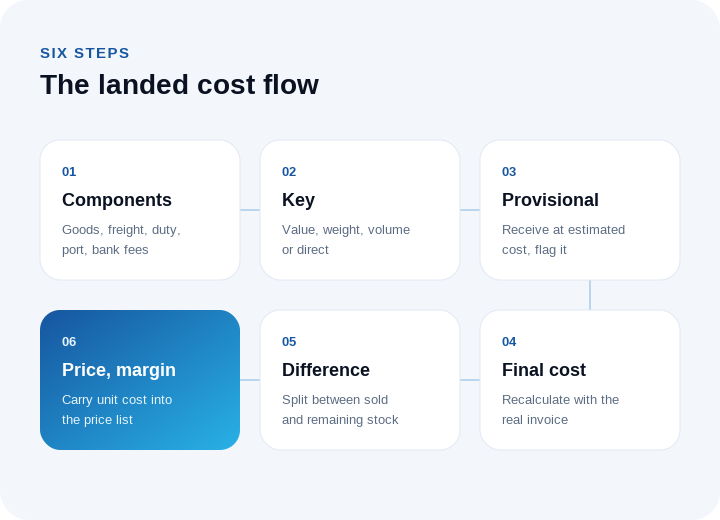
- Define the cost component types: Each charge is its own component and carries a default allocation key.
- Attach the charges to the shipment: Every expense invoice links to its shipment or goods receipt; an unlinked charge appears in an "unallocated" list.
- Receive at provisional cost: The known information produces an estimated cost, flagged as provisional.
- Finalize when the invoice arrives: A landed cost document redistributes the amount; the difference is split between sold and remaining units.
- Record the rate date: The foreign-currency amount, rate and rate date are stored together.
- Carry unit cost into pricing: The new cost flows to the price list and margin report; a threshold breach asks for approval.
This flow joins purchasing, warehouse and accounting data, which is why it is natural ERP work. For connecting declaration and bank data, see our integration service.
Which Measures Track Landed Cost, and What Is the Payback?
Two measures show the health of the process. The first is the deviation between estimated and final cost: in the example, final extra cost is ₺390,000 and the estimate ₺375,000, so the deviation is 15,000 ÷ 390,000 = 3.8%. The second is cost update delay: the time between the last invoice date and the day cost becomes final. A sample target: a median of 5 days instead of 21.
Here is a representative payback calculation. The business ships 12 times a year; in each shipment ₺170,000 of indirect charges never reach the price list, ₺2,040,000 a year. Once landed cost feeds pricing, 10% of that (₺204,000) is recovered through price or product choice. Calculation effort falls by 108 hours a year (₺32,400); annual running cost is ₺60,000.
- Annual net: ₺204,000 + ₺32,400 − ₺60,000 = ₺176,400, or ₺14,700 a month.
- With an investment of ₺330,000, payback is 330,000 ÷ 14,700 ≈ 22.4 months.
- If recovery were 20%: annual ₺380,400, monthly ₺31,700, payback ≈ 10.4 months.
What Are the Common Mistakes in Landed Cost Calculation?
- Using only the goods value: The price list, margin report and decisions all come out too optimistic.
- One key, no correction: Heavy, cheap goods carry a systematic error, and the difference quietly slides into overhead.
- Forgetting financing: Transit time and prepayment make imports look cheaper than they are.
We recommend reading: How to Do a Procurement Spend Analysis: Data Cleaning, Tail Spend, Price Variance and Savings Tracking Guide
Custom ERP and Software with İnovabil
At İnovabil our focus is building custom software from scratch: custom software, ERP, CRM, e-commerce, web, mobile and integration. If you want to manage import costs in a system, we suggest writing down the cost components, allocation keys and the provisional-to-final cost flow in the requirements analysis; which part standard ERP covers and which needs custom development becomes clear at that stage.
We built CRM, purchasing and mobile for Avcılar İnşaat; a purchasing system for İZBAN; logistics and shipment planning with wholesale order management for Karyak; and warehouse management plus a complaint and support management system for Sleepy. Send us a short summary of your processes and we will scope it together.
We recommend reading: Our software development process: from analysis to launch
Frequently Asked Questions
What is landed cost?
It is the per-unit total of every cost incurred up to warehouse receipt: goods value, freight, insurance, duties, port, storage, haulage and bank fees. It differs from the invoice price and is the right base for pricing.
Which components go into a landed cost calculation?
Goods value, international freight, insurance, customs duties and additional taxes, port and storage, customs brokerage, domestic haulage and bank fees. The delivery terms in your contract decide which ones are yours; ask your customs broker about duty details.
How are freight and other shared charges allocated to products?
Each by its own driver: freight and port by volume, domestic haulage by weight, insurance and bank fees by value, duties directly to the product. In the example, allocating the same ₺150,000 pool by value loads Product B with ₺90 per unit, but by weight only ₺10.
How is cost corrected when an invoice arrives later?
The goods are received at estimated cost, and when the invoice arrives the difference is redistributed by the same key. The sold share goes to cost of goods sold and the remaining share to stock value; settle the method with your financial advisor.
When is importing better than buying local?
When the fixed charges per shipment are spread over enough units. In the example, break-even is 300 units without financing and 520 units with 45 days of in-transit financing; recalculate with your own charges.