

The warehouse reports a missing material by phone, purchasing emails three suppliers, the quotes arrive in different formats, the approval waits on a manager's desk, and when the goods arrive the invoice shows a different amount. Every step looks reasonable on its own, but together they cost time, money and control. Procurement software, also called a purchasing management system, brings this chain from request to payment into a single record.
In this guide we explain what procurement software is, which steps it covers, how an approval matrix is built, how supplier quotes are compared with weighted scoring, how three-way matching catches errors, how supplier performance is measured, what the payback looks like and how to choose one. The example figures are illustrative; they are not a real price or market-data claim.
What Is Procurement Software?
Procurement software is a system in which a business manages the purchase of goods and services through request, approval, quote, order, goods receipt, invoice and payment in a single application. This flow is often called procure-to-pay. The system makes it possible to trace back who bought what, why, from which supplier and at what price.
It can be a standalone program or the purchasing module of an ERP. We explained how it relates to the other ERP modules in our what is ERP guide; in this article we focus on the purchasing process.
We recommend reading: Our ERP software service and its purchasing module
What Steps Does the Purchasing Process Include?
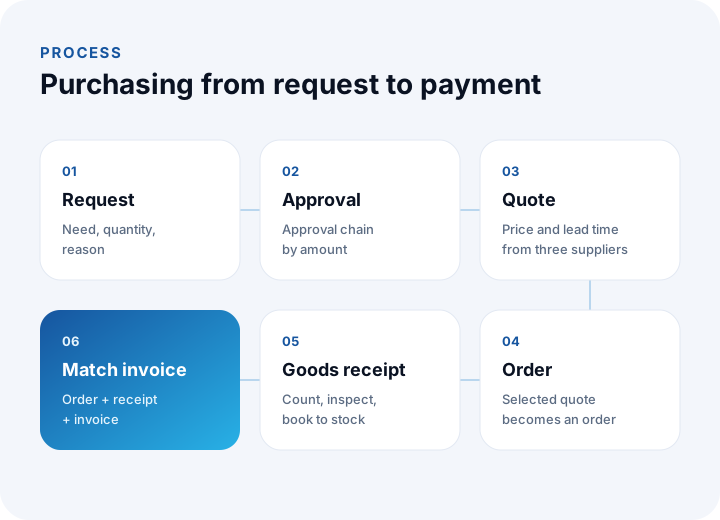
The process has eight steps: request, approval, quote collection, comparison, order, goods receipt, invoice matching and payment. Every step needs an owner and a record; a step with no record is a step that cannot be proven later.
| Step | What happens? | Record kept in the system |
|---|---|---|
| 1. Request | The person in need asks for the material or service with a quantity and reason | Request number, requester, department, quantity, required date |
| 2. Approval | An authorized person approves or rejects by amount and department | Approver, date, note, approval chain |
| 3. Quote | Price, lead time and payment terms are collected from chosen suppliers | Supplier, unit price, lead time, terms, validity |
| 4. Comparison | Quotes are scored on the same criteria and the choice is justified | Score table, selected quote, selection note |
| 5. Order | The selected quote becomes a purchase order sent to the supplier | Order number, lines, delivery address |
| 6. Goods receipt | Incoming goods are counted, inspected and booked into stock | Accepted quantity, rejection and reason, date |
| 7. Invoice matching | The invoice is compared with the order and the receipt record | Match result, difference and reason |
| 8. Payment | Payment is scheduled by due date and closed | Payment date, amount, remaining balance |
How Is an Approval Matrix Built for Purchasing?
An approval matrix is a table that states in advance whose approval an amount needs. The goal is not to slow everyone down, but to keep small purchases fast and large ones controlled.
| Amount range (illustrative) | Approver | Extra condition |
|---|---|---|
| Up to ₺10,000 | Department manager | One quote is enough, a reason is written |
| ₺10,001 – ₺100,000 | Department manager + purchasing lead | At least three quotes |
| Above ₺100,000 | Senior management + finance | Three quotes, contract and budget check |
Set the thresholds to match the scale of your business. The system notifies the approver of a waiting request, measures the waiting time and, if needed, allows a delegate, so approval does not get stuck on one person's desk.
How Are Supplier Quotes Compared with Weighted Scoring?
The cheapest quote is not always the best one. Weighting price together with lead time, quality and payment terms into one score speeds up the decision and makes it defensible.
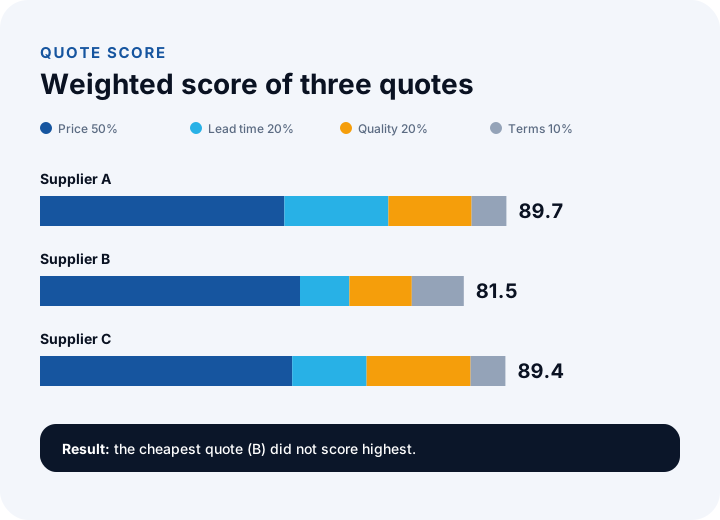
Example (illustrative): weights are price 50%, lead time 20%, quality 20% and terms 10%. Three suppliers quote for the same item:
| Criterion | Supplier A | Supplier B | Supplier C |
|---|---|---|---|
| Quoted price | ₺100,000 | ₺94,000 | ₺97,000 |
| Lead time | 10 days | 21 days | 14 days |
| Quality (1–5) | 4 | 3 | 5 |
| Payment terms | 30 days | 45 days | 30 days |
| Price score | 94.0 | 100.0 | 96.9 |
| Lead-time score | 100.0 | 47.6 | 71.4 |
| Quality score | 80.0 | 60.0 | 100.0 |
| Terms score | 66.7 | 100.0 | 66.7 |
| Total score | 89.7 | 81.5 | 89.4 |
Supplier B, which quotes the lowest price, finishes last because it falls behind on lead time and quality; A and C are almost level. When the gap is that small, the decision looks at additional criteria such as past performance and reliability. Because the score table is stored in the system, the answer to "why this supplier?" is still clear months later.
We recommend reading: How to choose pre-accounting software: a weighted scoring and cost guide
What Is Three-Way Matching and Why Does It Matter?
Three-way matching compares the invoice with the purchase order and the goods receipt before it is paid. If all three documents agree, payment is approved; if not, the difference is investigated. This prevents paying for goods that never arrived or missing a price difference.
Example (illustrative): the order is 100 units × ₺85 = ₺8,500. At goods receipt 96 units are counted. The supplier invoices 100 units for ₺8,500. The amount payable is 96 × 85 = ₺8,160; the difference is 4 × 85 = ₺340. The system flags the difference automatically and puts the invoice into "review"; the supplier is asked either to ship the missing goods or to issue a correction invoice.
| Check | What is compared | Example mismatch |
|---|---|---|
| Quantity | Order ↔ goods receipt ↔ invoice | Short or excess delivery |
| Unit price | Order ↔ invoice | A price higher than agreed |
| Amount and tax | Calculated ↔ invoice total | Total or tax error |
| Supplier and item | Order ↔ invoice | A line that is not on the order |
For importing e-invoice records into the system and feeding them to matching, see our e-invoice integration guide.
How Does Purchasing Connect to Stock and the Reorder Point?
When the purchasing system is fed by the stock record, a request can be suggested automatically the moment a need arises. The reorder point is the quantity consumed during the supply lead time plus the safety stock.
Example (illustrative): daily consumption is 40 units, lead time 7 days and safety stock 80 units. The reorder point is 40 × 7 + 80 = 360 units. When stock falls below 360, the system suggests a request automatically. For stock and turnover calculations see our inventory tracking guide.
Which Indicators Measure Supplier Performance?
Choosing a supplier is not a one-time decision but one that is evaluated continuously. The system accumulates data from every delivery and produces a supplier scorecard at the end of the period.
| Indicator | How it is calculated | Example (illustrative) |
|---|---|---|
| On-time delivery rate | Orders delivered on time ÷ total orders | 46 ÷ 50 = 92% |
| Acceptance rate | Units accepted without defects ÷ units received | 1,940 ÷ 2,000 = 97% |
| Price variance | (Invoice price − order price) ÷ order price | ₺85 → ₺86 = 1.2% |
| Average lead time | Average days from order to receipt | 8.4 days |
Share the targets with suppliers; what is measured and discussed improves. Define a warning and re-evaluation rule for low-performing suppliers.
How Much Can a Procurement System Save?
Savings come from two sources: better prices and terms (competitive quotes, less off-contract buying) and shorter manual handling time. Calculate the payback by dividing the investment by the monthly net benefit.
Example (illustrative): annual purchasing volume is ₺12,000,000. If off-contract ("maverick") spend is ₺2,400,000, its share is 2,400,000 ÷ 12,000,000 = 20%. If competitive quotes and contracts save 3% of volume, the annual gross benefit is ₺360,000; with an annual running cost of ₺90,000, the monthly net benefit is (360,000 − 90,000) ÷ 12 = ₺22,500. In addition, 50 requests a month with 25 minutes saved per request is 50 × 25 = 1,250 minutes, about 20.8 hours; at ₺300 an hour that is ₺6,250 more. The total monthly net benefit is ₺28,750, and the payback on a ₺540,000 investment is 540,000 ÷ 28,750 ≈ 19 months.
This is an example calculation; recalculate it with your own volume, maverick-spend share and time savings. Update the savings percentage with measurements from the first period, not with guesses.
We recommend reading: How to choose an ERP: process map, module priority and payback
What Should You Look for When Choosing Procurement Software?
Six questions are enough for most businesses. Evaluate an off-the-shelf program and a custom solution with the same questions.
- Is the approval flow flexible? Can different chains be defined by amount, department and item group?
- Is there quote comparison? Can quotes be scored in one table and the reason for the choice stored?
- Does it do three-way matching? Is a difference flagged automatically?
- Is it connected to stock and accounting? Does goods receipt update stock and the invoice update the account on their own?
- Is there mobile approval? Can a manager approve from a phone? Waiting time for approval is often the biggest loss.
- How deep is the reporting? Are spend by supplier, maverick spend and pending approvals reports ready?
For the decision logic between off-the-shelf and custom, see our off-the-shelf vs custom software guide.
What Are Common Mistakes in Purchasing Processes?
- Taking requests verbally: A request with no record loses its owner and reason later.
- Depending on a single supplier: Buying without competition raises both price and risk.
- Skipping approval: Leaving the process out because it is "urgent" increases maverick spend.
- Paying the invoice independently of goods receipt: This risks paying for goods that never came.
- Keeping supplier data scattered: Several records for the same supplier break the reports.
- Not measuring: A supplier whose on-time delivery and acceptance rates are not tracked does not improve.
We recommend reading: What is shipment planning software? Routes, vehicle load and proof of delivery
Recommended reading: What Is a Barcode System and How Do You Set One Up?
Recommended reading: How to Do Production Planning
Recommended reading: How to Track Customer Accounts
Purchasing Systems with İnovabil
At İnovabil we move purchasing processes into software according to your own flow: request and approval chain, quote comparison, ordering, goods receipt, invoice matching, stock and accounting connections, and mobile approval. We start a project with a process map and requirements analysis, and move forward with development in parts and acceptance testing.
We built a purchasing system for İZBAN and, for Avcılar İnşaat, a purchasing system together with CRM and a mobile application; we also moved shipment and warehouse processes into software for businesses such as Karyak and Sleepy. Describe your current purchasing flow and the step you struggle with in a few sentences, and we will first put the process map and priorities in writing.
We recommend reading: Our software development process: step by step from analysis to release
Frequently Asked Questions
What is procurement software, in short, and what does it do?
Procurement software manages request, approval, quote, order, goods receipt, invoice and payment in a single application. It records who bought what at which price, organizes approval and invoice checks, and makes savings and supplier performance measurable.
What is three-way matching?
It is comparing the invoice with the purchase order and the goods receipt. If quantity, unit price and amount agree, payment is approved; if not, the difference is investigated. In the example, the order and invoice are for 100 units and the receipt for 96, so a difference of 4 × ₺85 = ₺340 is flagged.
How are supplier quotes compared?
Price, lead time, quality and payment terms are weighted into a single score. In the example, the cheapest quote finishes last because it falls behind on lead time and quality, while two quotes with 89.7 and 89.4 points come out almost level.
Is procurement software different from an ERP?
Purchasing can be one module of an ERP, or it can run as a standalone program. In an ERP, stock, accounting and production share the same data structure, so integration effort is lower; if purchasing is your only problem, a narrower solution may be enough.
How is the payback of a purchasing system calculated?
The total investment is divided by the monthly net benefit. The benefit comes from price savings through competitive quotes plus the time saved on manual handling. In the example, a ₺540,000 investment with a monthly net benefit of ₺28,750 pays back in about 19 months.