

A buyer orders raw materials or spare parts according to its own plan; the supplier sees only the incoming order, not the real consumption behind it. Vendor-managed inventory (VMI) turns this around: the buyer shares stock and usage data with the supplier, and the supplier makes the replenishment decision against target levels both sides have agreed in writing.
In this guide we cover how VMI differs from standard ordering and consignment, the minimum data to share, the min–max and replenishment calculations, what stale data does, the receipt and invoice flow, the risks, the metrics, a pilot with the first 10 items and the payback calculation. All figures are representative examples.
What Is Vendor-Managed Inventory (VMI)?
VMI is a collaboration model in which the buyer regularly shares its stock level and usage with the supplier, and the supplier decides how much to ship and when, within agreed lower and upper limits.
The model has three parts: shared data, written target levels, and a contract that sets who holds decision authority. If one is missing, VMI drifts into excess stock or stockouts. We explained the stock record that sits on the buyer's side in our inventory tracking guide; VMI depends on that record being right.
We recommend reading: Our ERP development service
How Does VMI Differ from Standard Ordering and Consignment?
Three questions separate the models: who makes the decision, who owns the stock, and who carries the stock risk. VMI and consignment are often confused, but they sit on different axes: consignment is about ownership, VMI is about decision authority.
| Topic | Standard ordering | VMI | Consignment |
|---|---|---|---|
| Who decides replenishment? | Buyer | Supplier | Buyer or supplier; not defined by the model |
| Who owns the stock? | Buyer on delivery | Usually the buyer on delivery; by contract it can be on consumption | Supplier until consumption |
| Who carries excess-stock risk? | Buyer | Shared according to target levels; overshoot must be written down | Supplier until consumption |
| When is it invoiced? | On shipment or receipt | On the receipt notice | On the consumption notice |
| Does it need buyer data? | No, only the order | Yes, daily stock and usage | Consumption notice |
The two can be combined: when the supplier both makes the replenishment decision and remains the owner until the stock is used, it is called consignment VMI. We covered how ownership and tied-up capital are tracked in our consignment inventory guide; this article focuses on decision mechanics, not ownership.
What Data Does the Buyer Share with the Supplier in VMI?
The minimum is five fields the supplier needs to run the replenishment calculation. Sharing more is unnecessary; cost, price and customer information stay out of scope.
| Field | Meaning | Why it is needed |
|---|---|---|
| Item code | One shared code | A mismatched code means a wrong shipment |
| Warehouse | Where the stock sits | In multi-warehouse setups replenishment goes to a specific site |
| On hand | Usable physical stock | The main input of the calculation |
| In transit | Shipped but not yet received | Prevents double replenishment |
| Daily usage | Consumption or sales of the last day | Shows the usage rate |
The data can travel in three ways: a file the buyer enters or uploads in a supplier portal, an API feed between systems, or standard electronic document exchange. We described the portal side in our supplier portal guide and standard document exchange in our EDI guide. For the conditions of using commercially sensitive data, consult your legal advisor.
How Are Min–Max Target Levels Set?
The lower limit (min) is the level that triggers the supplier to ship; the upper limit (max) is the level a replenishment should reach. The lower limit must cover usage during the replenishment time plus a safety margin.
Min = daily usage × (lead time + review interval) + safety stock
How to calculate safety stock is in our safety stock guide; here we take a ready value. Example item K-204 (gasket set): daily usage 40 units, lead time 3 days, review interval 1 day because data arrives daily, safety stock 60 units.
- Min = 40 × (3 + 1) + 60 = 220 units.
- Max = min + replenishment lot. Let the smallest economic shipment be 3 days of usage, 120 units: 220 + 120 = 340 units.
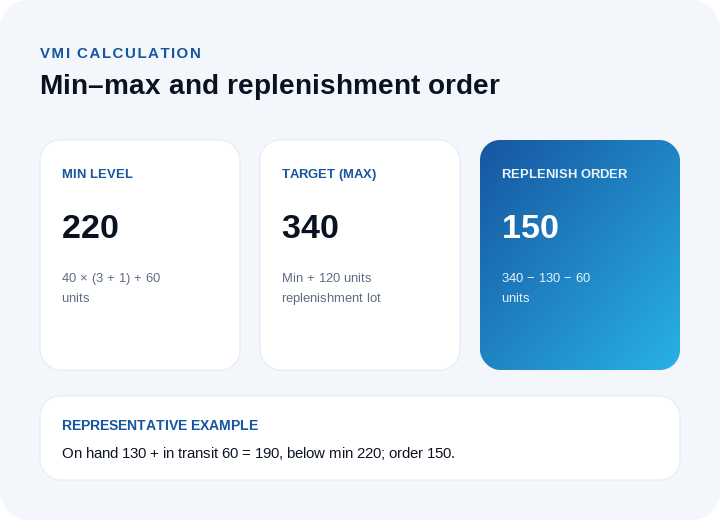
These two numbers are the "target level agreement" the parties sign. When demand changes, for example daily usage rising from 40 to 50, min becomes 50 × 4 + 60 = 260; levels are recalculated every three months. For ways to estimate the usage rate, see our demand forecasting guide.
How Is the Replenishment Proposal Calculated?
Every day the supplier checks the inventory position (on hand plus in transit); if it has fallen to min or below, the supplier proposes enough to bring the position up to max.
Replenishment proposal = max − on hand − in transit (only if on hand + in transit ≤ min)
Today's data for K-204: on hand 130, in transit 60. The position is 130 + 60 = 190, below the min of 220. Proposal = 340 − 130 − 60 = 150 units. Had in-transit stock been ignored, 210 units would be proposed and the 60 units already on the way would be requested twice.
At the start the buyer approves the proposal; once data quality settles, approval remains only for unusually large proposals.
How Does Stale Data Break the Replenishment Decision?
A correct calculation still gives a wrong decision on stale data; the lag either delays replenishment or generates unnecessary replenishment.
Case A: usage data is 24 hours old. The supplier sees yesterday's on-hand of 170; with 60 in transit the position is 230, above min 220, so no proposal appears. In reality on hand is 130 today, the position is 190 and 150 units are needed. Because the decision comes a day late, the replenishment arrives in 4 days instead of 3. Safety stock of 60 units equals 60 ÷ 40 = 1.5 days of usage; the delay eats 40 units, leaving 20 units, or 0.5 day.
Case B: the receipt record is 24 hours old. A shipment of 150 units has been received at the dock but not booked; the record shows on hand 130 and in transit 0. The system counts the position as 130 and produces a proposal of 340 − 130 = 210 units. In reality on hand is 130 + 150 = 280 and no order is needed. If the proposal is approved, stock rises to 280 + 210 = 490 units, 150 units above the max of 340.
There are two remedies. The first is a data freshness target: for example, stock and usage data are sent within 4 hours and receipts are booked the same day. The second is to build the lag into min: it becomes 260 instead of 220 (an 18.2% higher lower limit, that is, more stock cost). Data freshness is usually cheaper.
How Do Receipt and Invoicing Work?
In VMI the basis of the invoice is the buyer's receipt notice, not the shipping note. This way the buyer does not pay for goods that never arrived or arrived damaged.
Example: the supplier ships 150 units of K-204 at a unit cost of ₺45. At receipt the buyer finds 3 units damaged and accepts 147. An invoice based on shipment is 150 × ₺45 = ₺6,750; based on receipt it is 147 × ₺45 = ₺6,615. The variance is ₺135, or 2.0%. The variance code (damaged, short, excess) is reviewed with the supplier in the monthly reconciliation.
When ownership and risk pass, and how e-documents and delivery notes flow, are contract and tax matters; consult your legal advisor and financial advisor (certified accountant) for details.
How Does VMI Reduce the Bullwhip Effect?
The buyer's order batches are far more volatile than real consumption; the supplier mistakes that volatility for demand and inflates its own production and stock. In VMI the supplier sees consumption directly, so the distortion shrinks. We explained the mechanism in our supply chain management guide; here is a new, small example.
Four weeks of consumption are 270, 290, 280 and 280 units (total 1,120, average 280). Under standard ordering the buyer orders by batch size: 400, 0, 400, 320 (again 1,120 in total). The standard deviation of consumption is about 7.1 and that of the order series about 164.9, so the supplier sees a signal roughly 23 times more volatile than consumption. In VMI the supplier ships 260, 300, 280 and 280 units a week according to daily usage; the standard deviation is about 14.1, roughly 2 times consumption.
The real reduction depends on the item and batch size; the direction is clear: the closer the signal is to consumption, the calmer the supplier's plan.
What Are the Benefits of VMI for Buyer and Supplier?
The benefit reaches both sides, but it shows up in different line items.
- Buyer: Stockouts and ordering effort fall, and average stock drops. In the example K-204's average stock is 350 units under standard ordering, or 350 ÷ 40 = 8.75 days; in VMI it is roughly (min + max) ÷ 2 = 280 units, or 7 days. The difference is 20%.
- Supplier: It sees demand, plans production and combines items into one shipment. In the example 10 separate weekly shipments drop to 4; at a representative ₺900 per shipment that saves (10 − 4) × ₺900 = ₺5,400 per week.
What Are the Risks of VMI, and Who Carries Stock Above the Upper Limit?
The biggest risk is data quality; the second is leaving responsibility for excess stock vague. The table below summarizes the risks and countermeasures.
| Risk | Symptom | Countermeasure |
|---|---|---|
| Data quality | Records and counts do not match | Monthly count reconciliation, daily automatic feed |
| Single-supplier dependence | Production stops if the supplier fails | Second source and minimum buffer for critical items |
| Upper-limit overshoot | Stock rises above max | Owner and cost of overshoot written down |
| Outdated target levels | Min–max no longer fits demand | Recalculate every three months |
| Commercial data sensitivity | Data used for other purposes | Usage limits in the contract |
If the owner of an overshoot is not written down in advance, a dispute follows. A sensible rule looks at the cause: if the overshoot came from the supplier's calculation or shipping error, the excess units go back to the supplier or the payment term does not start until they are used; if it came from the buyer's data error, the buyer carries it. The 150-unit overshoot in Case B came from the buyer's late receipt booking, so it belongs to the buyer: stock worth 150 × ₺45 = ₺6,750 costs about ₺6,750 × 0.22 ÷ 12 = ₺123.75 a month at a representative annual carrying rate of 22%.
Which Clauses Should the Contract Contain?
Your legal advisor writes the clause text; the commercial side makes sure these topics are explicit. This is not legal advice.
- Target levels: Min, max and the review routine.
- Data obligation: Fields, frequency, freshness and who is responsible for a data error.
- Decision authority: When a proposal becomes an automatic shipment.
- Ownership and risk transfer: On delivery, on receipt or on consumption.
- Overshoot and shortage: Responsibility and the remedy.
- Invoicing and reconciliation: Receipt notice, variance codes, monthly reconciliation.
- Exit: What happens to remaining stock and data when it ends.
Which Metrics Show Whether VMI Is Working?
Five metrics are the shared language of both sides and are read together. The example pilot covers 10 items for 30 days.
| Metric | Calculation | Example (before → after) |
|---|---|---|
| Stockout rate | Stockout item-days ÷ total item-days | 12 ÷ 300 = 4.0% → 3 ÷ 300 = 1.0% |
| Days of stock | Average stock ÷ daily usage | 8.75 days → 7.0 days |
| Fill rate | Fulfilled ÷ requested | 1,164 ÷ 1,200 = 97.0% |
| Replenishment frequency | Shipments per week | 2 shipments a week |
| Data freshness | Delay in sending data | Target at most 4 hours |
How Is a VMI Pilot Set Up?
Start with the first 10 items. Pick pilot items that turn quickly, come from a single supplier, have fairly stable demand and a reliable stock record; do not put the most critical or most erratic item in the first pilot.
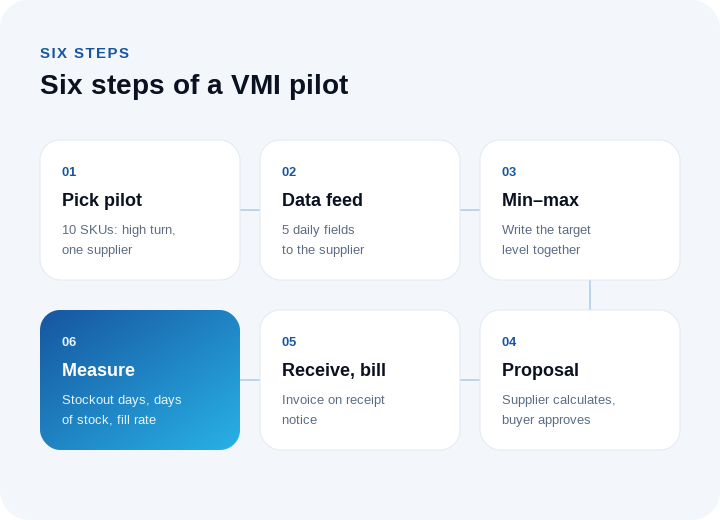
- Pick the pilot: 10 items, one supplier, one warehouse.
- Data feed: Five fields, daily frequency, one send each morning.
- Min–max: Calculate and sign the target level for each item together.
- Replenishment proposal: For the first two weeks the buyer approves each proposal; record the variances.
- Receipt and invoice: Invoice on the receipt notice, variance codes and monthly reconciliation.
- Measurement: Track the five metrics weekly; decide on expansion after 8 to 12 weeks.
How Is the Payback of VMI Calculated?
The annual benefit has three lines: the carrying cost of the stock reduction, the drop in stockout loss and the effort difference. New effort (data checks, reconciliation) is deducted from it. Representative assumptions: the average stock value of the 10 pilot items falls from ₺1,200,000 to ₺960,000; the annual carrying rate is 22%; the loss per stockout item-day is ₺1,200; 4 orders per item per month at 20 minutes of effort each, at ₺300 per hour; in VMI, 6 hours of data checks a month; setup investment ₺180,000.
| Line | Calculation | Annual |
|---|---|---|
| Carrying cost saving | (₺1,200,000 − ₺960,000) × 22% | ₺52,800 |
| Lower stockout loss | (12 − 3) item-days × ₺1,200 × 12 months | ₺129,600 |
| Ordering effort difference | (10 × 4 × 20 ÷ 60 = 13.3 h × ₺300 = ₺4,000) − (6 h × ₺300 = ₺1,800) = ₺2,200 a month × 12 | ₺26,400 |
| Total annual benefit | ₺208,800 |
Payback = ₺180,000 ÷ (₺208,800 ÷ 12) ≈ 10.3 months. If the stockout gain halves, the annual benefit is ₺52,800 + ₺64,800 + ₺26,400 = ₺144,000 and payback stretches to 15 months, so measure your stockout loss with your own data.
We recommend reading: How to manage multi-warehouse inventory
We recommend reading: How to Calculate Landed Cost of Imported Goods: Charge Allocation, Exchange Rate and Margin Guide
Stock, Purchasing and Supplier Integration with İnovabil
At İnovabil our focus is building software from scratch, tailored to the company: custom software, ERP, CRM, e-commerce, web, mobile and integration. If you are considering VMI, the accuracy of the stock record, the data feed with the supplier and the receipt-and-invoice steps should be written down in requirements analysis; we treat them as part of our process and integration work.
We built a purchasing system for İZBAN; CRM, purchasing and mobile for Avcılar İnşaat; logistics and shipment planning with wholesale order management for Karyak; and warehouse management plus a complaint and support management system for Sleepy. We do not have a ready-made VMI product; send a short summary of your processes and data flows and we will outline a suitable scope together.
We recommend reading: Our software development process: step by step from analysis to launch
Frequently Asked Questions
What is vendor-managed inventory (VMI) and how does it work in short?
The buyer shares stock and usage data; the supplier decides how much to ship and when, against jointly written min and max levels.
Are VMI and consignment the same thing?
No. Consignment means the supplier owns the stock until it is used; VMI means the supplier makes the replenishment decision. They can be used together, but neither requires the other.
Who owns the stock in VMI?
It depends on the contract. In most setups ownership passes to the buyer on delivery or receipt; passing on consumption is also possible. Ownership and risk transfer should be settled with your legal advisor.
What is the minimum data needed for VMI?
Item code, warehouse, on-hand quantity, in-transit quantity and daily usage. Price, cost and customer information are not shared. The data should be daily and fresh.
Which items should a VMI pilot start with?
Ten items that turn quickly, come from a single supplier, have stable demand and a reliable stock record. Run the pilot for 8 to 12 weeks; expand if the metrics improve.