

A company that imports pays its supplier in euros, one that exports collects in dollars or euros, yet both keep their books and tax records in the local currency. Between the day an invoice is issued and the day the money lands, the exchange rate moves, and the gap shows up as a gain or loss that appears on no purchase order. Multi-currency and exchange difference management means tracking foreign-currency purchases, sales, customer and supplier accounts and bank movements in two amounts (the foreign amount and its local equivalent) and separating the exchange difference at the right moment and in the right place.
This guide covers keeping transaction and functional currency together, the rate source and date rule, realized and unrealized exchange differences, period-end revaluation, matching partial payments with FIFO, exchange-rate risk in price lists, natural hedging, the exchange difference report and the cost of moving from spreadsheets to a system. All rates and amounts are representative; they are not today's rates or market data.
What Is Multi-Currency and Exchange Difference Management?
It is recording every foreign-currency transaction both in its own currency (the transaction currency) and in the local currency in which the books are kept (the functional currency), and tracking the difference between the two amounts. The transaction currency is what the invoice says, for example euros; the functional currency is the one used for financial statements.
In a system, this means a €15,000 invoice is not stored as just "570,000" but as "€15,000, rate 38.00, ₺570,000". When that invoice is paid, part-paid or left open at period end, every calculation relies on those three values. We covered the general side of account tracking in our customer/supplier account (current account) tracking guide and consolidation across companies with different currencies in our multi-company ERP article; here we focus on how a single company runs foreign-currency transactions.
We recommend reading: What is e-export?
How Are Transaction and Functional Currency Kept Together in a System?
Every foreign-currency line carries four fields: foreign amount, currency, rate and local amount. The local amount is the foreign amount times the rate, and it is fixed when the entry is made; even if the rate table changes later, the old entry's amount does not.
- Invoice: The foreign amount, the transaction-day rate and the local equivalent are written together. Example: €15,000 × 38.00 = ₺570,000.
- Bank movement: The incoming or outgoing amount is recorded in the foreign currency, with the local equivalent at that day's rate.
- Account balance: A customer or supplier balance appears in two columns: the foreign balance and its local equivalent.
For foreign-currency purchasing flows see our procurement software article, and for the e-document side our e-invoice (e-Fatura) integration article.
How Do You Set the Exchange Rate Source and Date Rule?
Write the rule down once: which source, which rate type and which day's rate. If one person enters the morning rate and another the evening rate for the same invoice, one transaction produces two amounts.
| Decision | Options | How it sits in the system |
|---|---|---|
| Source | One designated rate publisher | The rate is fetched automatically each day and stored with its source |
| Rate type | Buying, selling, average or cash rate | One type is chosen per transaction type |
| Which day's rate? | Invoice day, transaction day, period end | Each document type has a defined date field |
| Day with no published rate | Example rule: previous business day's rate | The rule is fixed in the system; a manual change is logged with a reason |
| Manual rate entry | A contractual or bank-quoted rate | An authorized user enters it; the source is flagged as "manual" |
Which rate may legally be used, and what the rule is for each document type, is your financial advisor's (certified accountant's) domain; the system simply applies the rule they set in the same way every time.
How Is a Realized Exchange Difference Calculated?
A realized exchange difference arises when a payment or collection is actually made: the foreign amount paid times (payment-day rate minus recorded rate). On a sale, a rising rate is a gain and a falling one a loss; on a purchase, the reverse.
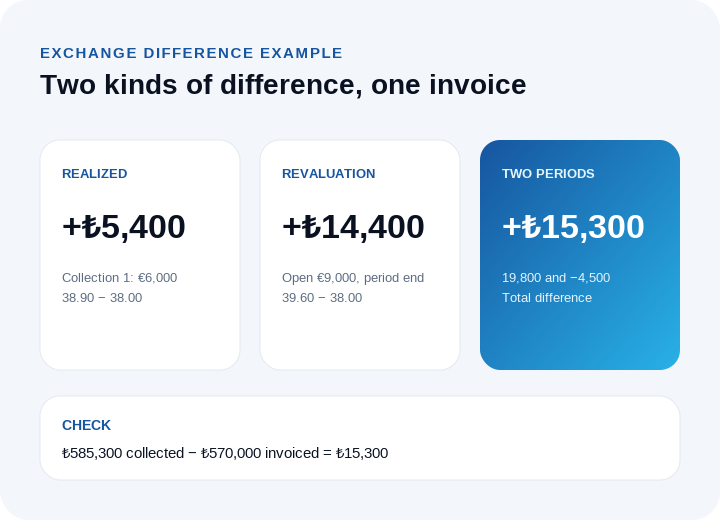
Representative example: a €15,000 export invoice was issued at a rate of 38.00, a local equivalent of ₺570,000. The first collection is €6,000 at a rate of 38.90. The amount received is 6,000 × 38.90 = ₺233,400; the recorded value of that portion is 6,000 × 38.00 = ₺228,000. The realized exchange difference is 233,400 − 228,000 = +₺5,400 (the same as 6,000 × 0.90 = 5,400).
What Are Unrealized Exchange Differences and Period-End Revaluation?
An unrealized exchange difference comes from revaluing foreign-currency items that have not yet been collected or paid at the period-end rate; there is no cash movement, but it changes the period-end balance.
In the same example €9,000 is still open at period end. Its recorded value is 9,000 × 38.00 = ₺342,000; with a period-end rate of 39.60 its value is 9,000 × 39.60 = ₺356,400. The unrealized difference is 356,400 − 342,000 = +₺14,400.
In the next period the remaining €9,000 is collected at a rate of 39.10, so the receipt is 9,000 × 39.10 = ₺351,900. Because the revalued carrying value is ₺356,400, the second period's difference is 351,900 − 356,400 = −₺4,500 (9,000 × (39.10 − 39.60)). Cross-check: total collected 233,400 + 351,900 = ₺585,300; invoice ₺570,000; difference ₺15,300. Split by period: first period 5,400 + 14,400 = ₺19,800, second period −₺4,500; 19,800 − 4,500 = ₺15,300. If the revaluation difference is not reversed in the next period, the difference is counted twice; the system should run this logic by itself.
| Open item | Foreign amount | Recorded rate | Recorded local amount | Revalued (rate 39.60) | Difference |
|---|---|---|---|---|---|
| Invoice B remainder | €4,000 | 38.40 | ₺153,600 | ₺158,400 | +₺4,800 |
| Invoice C | €8,000 | 38.80 | ₺310,400 | ₺316,800 | +₺6,400 |
| Total | €12,000 | - | ₺464,000 | ₺475,200 | +₺11,200 |
This table also shows how a foreign-currency account balance looks: the customer's balance is €12,000; its local equivalent is ₺464,000 at recorded value and ₺475,200 at the period-end rate. The two columns are read together: the foreign balance is the basis for reconciliation with the customer, the local equivalent for the financial statements.
How Do Partial Payments Match Against Open Items?
A payment can close several invoices or only part of one, so without a matching rule the exchange difference cannot be calculated correctly. The most common rule is FIFO: a payment closes the oldest open invoice first.
Representative example: Invoice A €5,000 at rate 37.50 (₺187,500), Invoice B €5,000 at rate 38.40 (₺192,000). A €6,000 collection arrives at rate 39.00 (₺234,000).
| Closed | Foreign amount | Recorded rate | Payment rate | Exchange difference |
|---|---|---|---|---|
| Invoice A (in full) | €5,000 | 37.50 | 39.00 | 5,000 × 1.50 = +₺7,500 |
| Invoice B (part) | €1,000 | 38.40 | 39.00 | 1,000 × 0.60 = +₺600 |
| Total | €6,000 | - | - | +₺8,100 |
Cross-check: collection ₺234,000, recorded value closed 187,500 + 38,400 = ₺225,900, difference ₺8,100. €4,000 stays open on Invoice B (₺153,600). The matching rule may vary by contract or customer agreement; manually linking a payment to a specific invoice should also be possible, and that choice must be visible in the record.
How Do You Manage Exchange-Rate Risk in a Price List?
A product with a foreign-currency cost and a local-currency selling price quietly loses margin when the rate rises. The answer is not to change the price at every rate move but to set a threshold: when the rate drifts from the rate the list was built on by more than a set percentage, the list is updated. For managing the list itself see our B2B price list article; here we cover only the exchange-rate effect.
Representative example: unit cost €20, list rate 38.00, selling price ₺1,000. Unit cost is 20 × 38.00 = ₺760, margin ₺240, which is 24.0% of the selling price.
| Rate | Unit cost | Margin (at ₺1,000 price) | Margin % |
|---|---|---|---|
| 38.00 (list rate) | ₺760.00 | ₺240.00 | 24.0% |
| 39.14 (3% threshold) | ₺782.80 | ₺217.20 | 21.7% |
| 41.80 (10% rise) | ₺836.00 | ₺164.00 | 16.4% |
With a 3% threshold the list is updated when the rate reaches 38.00 × 1.03 = 39.14. If the rate climbs to 41.80 and the price stays put, the margin falls from ₺240 to ₺164. To hold the margin at ₺240 the price must be 836 + 240 = ₺1,076, a 7.6% increase (1,076 ÷ 1,000 = 1.076). The threshold and update frequency are commercial decisions; for price-fixing clauses in contracts, consult your legal advisor.
How Do Natural Hedging and Netting Reduce Exchange-Rate Risk?
If you have receivables and payables in the same currency, a rate move works in both directions and the risk shrinks to the difference. This is called natural hedging or netting.
Representative example: you have €80,000 in receivables and €50,000 in payables, so the net open position is €30,000. If the rate rises from 38.00 to 39.90 (5%), the receivables gain 80,000 × 1.90 = ₺152,000 and the payables lose 50,000 × 1.90 = ₺95,000; the net effect is 152,000 − 95,000 = +₺57,000 (30,000 × 1.90). If the rate falls to 36.10, the same calculation gives −₺57,000. Netting does not remove the risk, but it cuts a gross swing of ₺152,000 down to ₺57,000.
The limit of netting is maturity: if receivables and payables fall on different dates, the gap between them stays open. For the remaining open position, banks offer tools such as forward foreign-exchange contracts; whether they suit you and what they cost is a matter to assess with your bank and financial advisor (certified accountant) for your own situation. This article is not investment or hedging advice. The system's job is to make the open position visible: receivables, payables and net amount by currency, plus the maturity profile.
We recommend reading: How to manage cash flow
How Do You Read an Exchange Difference Report?
A good report separates the amount along three axes: realized or unrealized, gain or loss, and which currency and which account. A single "exchange difference" total is no decision tool because it does not show the cause.
| Item (monthly, representative) | Gain | Loss | Net |
|---|---|---|---|
| Realized exchange difference | ₺38,400 | ₺21,900 | +₺16,500 |
| Unrealized (revaluation) | ₺14,700 | ₺6,200 | +₺8,500 |
| Total exchange difference effect | - | - | +₺25,000 |
Cross-check: 38,400 − 21,900 = 16,500; 14,700 − 6,200 = 8,500; 16,500 + 8,500 = ₺25,000. If monthly euro sales are ₺2,000,000, the total effect is 25,000 ÷ 2,000,000 = 1.25% of turnover. The unrealized part can reverse in the next period (like the +₺14,400 turning into −₺4,500 above). How an exchange difference is classified in the financial statements and its tax consequences are decisions for your financial advisor (certified accountant) and independent auditor; your pre-accounting (day-to-day bookkeeping and invoicing) setup is built around those decisions.
What Does Moving From Spreadsheets to a System Cost, and When Does It Pay Back?
As foreign-currency transactions multiply, looking up rates in a spreadsheet, revaluing at period end and fixing errors take time. The real risk is not time but error: entering 38.50 instead of 38.00 on a €15,000 invoice creates a 15,000 × 0.50 = ₺7,500 gap that spreads into the account, the exchange difference and the financial statements.
Representative monthly calculation: 60 foreign-currency transactions a month, an hour costs ₺300.
- In a spreadsheet: rate lookup 60 × 6 min = 360 min = 6 h (₺1,800); period-end revaluation 4 h (₺1,200); 3 errors a month × 2 h to correct = 6 h (₺1,800). Total 16 h and ₺4,800.
- In a system: rates and revaluation are automatic; review 1 h (₺300); 0.5 errors a month × 2 h = 1 h (₺300); running cost ₺1,000. Total ₺1,600.
Net monthly benefit is 4,800 − 1,600 = ₺3,200. With a ₺60,000 investment, payback is 60,000 ÷ 3,200 = 18.75, about 19 months. If the spreadsheet cost turns out 20% lower (4,800 × 0.8 = 3,840), the net benefit is 3,840 − 1,600 = ₺2,240 and payback stretches to 60,000 ÷ 2,240 ≈ 27 months. Recalculate with your own transaction count; a company with 10 foreign-currency transactions a month may do fine with a spreadsheet.
How Do You Set Up Multi-Currency Management in Six Steps?
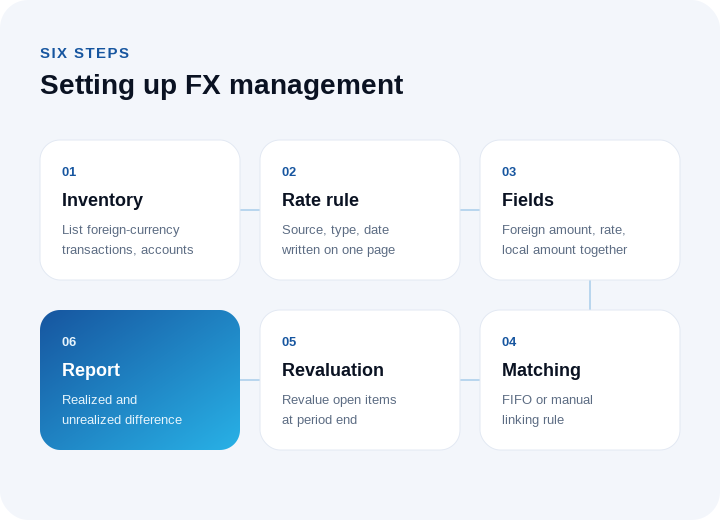
- Take an inventory: Which currencies and which transactions and accounts: sales, purchases, bank, customer and supplier accounts. Write down the monthly transaction count.
- Write the rate rule: Source, type, date and weekend behavior on one page, approved by your financial advisor (certified accountant).
- Define the fields: Foreign amount, currency, rate and local amount on every record; the rate table feeds automatically.
- Choose the matching rule: FIFO or manual linking, including partial payments and advances.
- Build the revaluation process: A step that revalues open items at period end and reverses them next period; test it on a copy of real data.
- Switch on the reports: Realized and unrealized exchange difference, foreign-currency balances and net open position, read monthly.
For the accounting side of the setup see our accounting software and ERP development pages; the broader framework for ERP decisions is in our what is ERP guide.
What Mistakes Are Common in Exchange Difference Management?
- Changing rates after the fact: If updating the rate table also changes old records, the historical record breaks. The local amount must be fixed at entry.
- Not reversing period-end revaluation: The difference is counted twice in the next period.
- Treating a part-payment as one line: If it is unclear how much of which invoice was closed, the exchange difference lands on the wrong invoice.
- Not tying the price list to the rate: Margin erodes before anyone notices.
We recommend reading: How to Do Software Localization: i18n, l10n, Translation Workflow and Cost Guide
We recommend reading: What Are Inventory Valuation Methods? FIFO, Weighted Average and Standard Cost Explained
We recommend reading: How to Prevent Money and Rounding Errors in Software: Cent Differences, Decimal Types and Allocation Guide
We recommend reading: How to Calculate Landed Cost of Imported Goods: Charge Allocation, Exchange Rate and Margin Guide
We recommend reading: How to Speed Up the Month-End Close: Calendar, Checklist and Automatic Reconciliation Guide
Multi-Currency Accounting and ERP With İnovabil
At İnovabil our focus is building software from scratch for your company: custom software, ERP, CRM, e-commerce, web, mobile and integration. We recommend writing down your foreign-currency transaction setup during requirements analysis, together with the rate source, the matching rule and the reports you need; these decisions should be taken with your financial advisor (certified accountant).
We built CRM, purchasing and mobile for Avcılar İnşaat; a purchasing system for İZBAN; logistics and shipment planning with wholesale order management for Karyak; and warehouse management plus a complaint and support management system for Sleepy. Send us a short summary of your foreign-currency transactions and we will take the inventory together and prepare a written assessment.
We recommend reading: Our software development process: from analysis to launch
Frequently Asked Questions
What is multi-currency and exchange difference management?
It is recording foreign-currency transactions in both the foreign and the local currency and tracking the difference caused by rate changes separately. Each record carries its foreign amount, rate and local equivalent.
What is the difference between a realized and an unrealized exchange difference?
A realized difference arises when a payment or collection is made. An unrealized difference arises from revaluing open foreign-currency receivables and payables at the period-end rate; there is no cash movement. In the example the first is +₺5,400 and the second +₺14,400.
How is the exchange difference calculated on a partial payment?
The payment is linked to open items by a matching rule (often FIFO, which starts with the oldest open invoice). For each closed portion, the foreign amount times (payment rate minus recorded rate) is calculated. In the example a €6,000 payment yields +₺7,500 and +₺600, a total of +₺8,100.
Do you have to update the price list at every rate change?
No. A threshold that triggers an update once the rate drifts a set percentage from the list rate is enough. In the example, the 3% threshold rate is 39.14; if the rate rises 10% and the price stays, the margin falls from 24.0% to 16.4%.
Who decides the accounting and tax treatment of an exchange difference?
Your financial advisor (certified accountant) and independent auditor. The software applies the rate source and recording rules they set consistently; it does not decide which rate, which account or which tax treatment applies.