

A leather handbag, a bottle of olive oil or a home textile product made in Türkiye can now be sold not only to a customer down the street, but to a customer in Berlin, Dubai or New York with a single click. E-export means selling your products to customers abroad over the internet and recording that sale as an export. With the right infrastructure, you can reach the world without a large export department, a foreign branch or a distributor network.
In this guide we explain what e-export is, how it differs from traditional export, the two core models (your own site and overseas marketplaces), micro export and the customs process, operational topics such as payment, shipping, returns and language, the steps to follow when you start, and the mistakes we see most often.
What Is E-Export?
E-export is when a business sells its products to customers in other countries through its own e-commerce site or overseas marketplaces and declares the shipment as an export. What separates it from traditional export is that the sale happens online and the shipment usually reaches the customer directly by courier or post.
In e-export the buyer is mostly a consumer rather than a company. Orders arrive one by one and in small volumes, and each leaves as its own parcel. For that reason e-export is closer to the operational language of retail e-commerce (product page, cart, payment, shipment tracking and returns) than to the world of containers, letters of credit and distributors that defines traditional export.
E-export is not limited to selling to end consumers. B2B portals where dealers and corporate customers abroad place orders online are also part of e-export.
We recommend reading: What is B2B e-commerce? A guide to dealer and wholesale sales
What Is the Difference Between E-Export and Traditional Export?
Traditional export sends large lots to a small number of corporate buyers through long commercial processes. E-export delivers many small orders directly to end users over the internet. The table below compares the two models on the main points.
| Topic | Traditional export | E-export |
|---|---|---|
| Buyer | Importer, distributor, retail chain | Mostly the end consumer; dealers on B2B portals |
| Order size | Large lots, containers or pallets | Single small parcels |
| Sales channel | Trade fairs, agents, direct negotiation | Your own e-commerce site and overseas marketplaces |
| Payment | Advance payment, documents against payment, letter of credit | Card and digital payment methods at the time of order |
| Logistics | Freight, customs broker, warehouse | International courier and post |
| Brand relationship | Product is often sold under the buyer's brand | The customer knows your brand |
| Getting started | Market research, finding an agent, sampling | Open a site or marketplace store and test on a small scale |
The two models are not alternatives to each other. Many manufacturers who export the traditional way use e-export as an additional channel, both to build their brand abroad and to earn better margins from retail sales.
What Are the Ways to Do E-Export?
There are two basic ways to do e-export: open a store on overseas marketplaces, or build your own multilingual e-commerce site. Most successful brands use both. Marketplaces bring fast demand, while your own site lets you own the brand and the customer relationship.
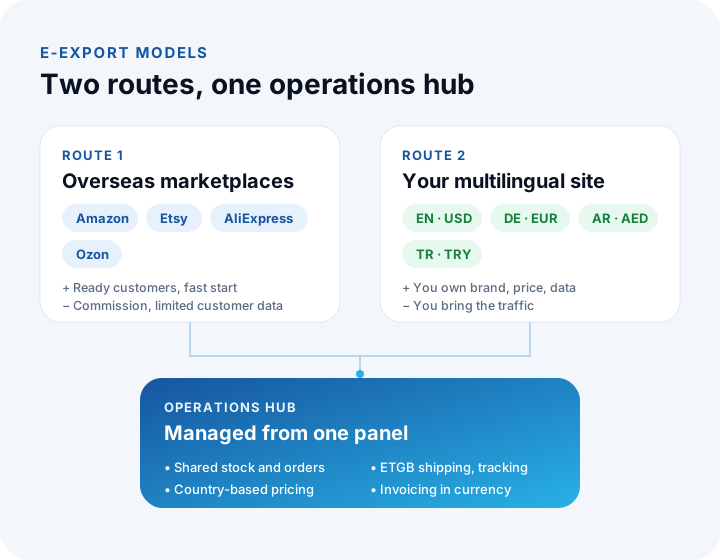
Overseas marketplaces
Marketplaces such as Amazon, Etsy, AliExpress and Ozon offer a ready customer base, a trusted payment infrastructure and a familiar shopping experience. A business can list its products on these marketplaces and receive its first overseas orders without investing in promoting its own site.
The price of a marketplace is commission, the obligation to follow its rules and limited access to customer data. Price competition is intense and the customer remembers the marketplace, not you. That is why marketplaces are a fast way in, but leaving them as your only channel makes your brand dependent on them.
Your own multilingual e-commerce site
On your own site, price, campaigns, brand experience and customer data are entirely under your control. You pay no commission and you build a direct relationship with repeat customers. In return, bringing traffic to the site is your job: you need search engine optimization, advertising and social media work in the target country.
A site built for e-export differs from a domestic site in that each country can have its own language, currency, price, shipping rules and payment methods. When these features are bolted on later they usually fall short, so the choice of infrastructure should be made with them in mind from the start.
What Is Micro Export and How Does It Work in E-Export?
Micro export means shipping consignments below certain value and weight limits in a simplified way, using an electronic commerce customs declaration (ETGB) instead of a full export declaration. Most of the small parcels in e-export are sent this way.
In practice the process usually runs through courier and postal companies authorized for ETGB: you issue the sales invoice and hand the parcel to the carrier, and the carrier files the declaration electronically on your behalf. You do not have to run a separate customs broker process for every small parcel, and the sale is recorded as an export.
The value and weight limits of micro export, document requirements and the incentives available for exports are set by legislation and may change over time. We recommend confirming the current rules from the Ministry of Trade announcements, from the carrier you work with and from your financial advisor (certified accountant).
We recommend reading: What is pre-accounting? A guide to invoices, accounts and e-documents
What Infrastructure Does E-Export Require?
E-export requires a multilingual, multi-currency e-commerce platform, international payment and shipping integrations, overseas marketplace connections, and order and stock management that runs every channel from a single panel. The table below summarizes why each component matters.
| Component | Why it is needed | What to watch for |
|---|---|---|
| Multilingual site | Customers want to shop in their own language | Translation by someone who knows the product and the industry, not machine translation |
| Multiple currencies | Customers who cannot see prices in their own currency give up | How prices will be updated when exchange rates move |
| Country-specific pricing | Shipping, tax and market conditions differ by country | Being able to set prices independently of currency conversion |
| International payment | Foreign cards and local payment habits | Fraud prevention and 3D Secure |
| Country-based shipping | Delivery time and cost vary by country | ETGB-authorized carrier, tracking number, free shipping threshold |
| Marketplace integration | Products, stock and orders are managed from one center | Marketplace-specific category and field mappings |
| Country-based SEO | Traffic from searches in the target country | A separate address and hreflang tags for each language |
| Invoicing and accounting | The sale is recorded correctly as an export | Invoicing in foreign currency and e-document processes |
We recommend reading: What is API integration? Marketplace and shipping integrations
How Do You Start E-Export? A Step-by-Step Roadmap
The healthiest way to start e-export is to test with one or two target countries and a limited product group, then expand based on data. A typical start follows six steps.
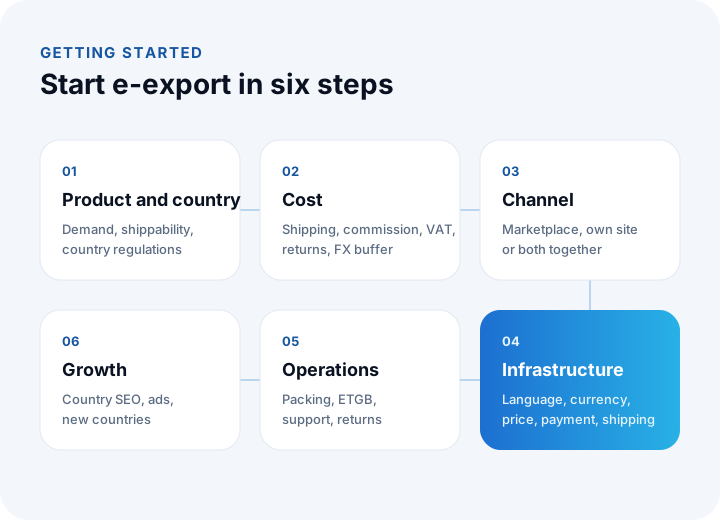
- Product and country selection: Decide which of your products can compete abroad, whether they suit shipping by courier (weight, volume, fragility) and in which countries there is demand. Check whether your product needs a special regulation or certificate in the target country.
- Cost and price calculation: Add international shipping, payment commission, marketplace commission, tax and customs burden in the target country, return cost and advertising spend to the product cost. Set your margin so it leaves a buffer against exchange rate movements.
- Channel selection: Decide whether to start with a marketplace, with your own site, or with both.
- Infrastructure setup: Set up the multilingual site, currencies, country-based price and shipping rules, payment methods, and marketplace and shipping integrations. Have product content professionally translated into the target language and adapt size and measurement information to local standards.
- Operations: Define order handling, packing, shipping with ETGB, tracking number notification, customer service and the returns process. How returns from abroad will be handled must be decided before the first sale.
- Promotion and growth: Start search engine optimization, advertising and social media work in the target country. Track sales, returns and profitability by country and product, and add new countries and products as the data supports it.
How Are Payment, Shipping and Returns Managed in E-Export?
Customer satisfaction in e-export is largely decided by three operational areas: a secure payment the customer is used to, a predictable delivery time and an easy return. All three should be designed correctly from the start.
Payment
Customers abroad want to pay with the method they are used to in their own country. A payment infrastructure that accepts international cards is the basic requirement, and the digital wallets and local payment methods common in the target country noticeably affect the conversion rate. Because fraud risk is higher with foreign cards, 3D Secure verification and suspicious-order checks should not be neglected.
Shipping
Customers want to see in the cart when the product will arrive and how much shipping will cost. Rules such as country-based shipping fees, estimated delivery time and free shipping above a certain cart value should be shown clearly on the site. Whether import duty or tax will be collected from the recipient in the target country should also be communicated before the sale; an unexpected charge at delivery is one of the main causes of returns and negative reviews.
Returns
A return from abroad is both more expensive and slower than a domestic one. Size charts, detailed product photos and clear product descriptions are the most effective way to reduce returns. For low-value products, rules such as refunding the money instead of taking the item back can lower total cost. The return policy should be written clearly in every language you sell in.
What Are the Most Common E-Export Mistakes?
The cause of failure in e-export is usually not the product but carrying domestic habits abroad unchanged. The most common mistakes are these:
- Settling for machine translation: Faulty, artificial language damages trust at first glance. Product pages, the return policy and payment steps should be checked by someone who speaks the language.
- Setting prices only by currency conversion: Dividing the domestic price by the exchange rate ignores differences in shipping, tax and commission. Country-based prices should be defined.
- Surprising the customer with shipping and tax: Shipping fees not shown in the cart and taxes charged at delivery are the main reasons for abandoned carts and returns.
- Opening to the whole world at once: Every country is a separate market and a separate operation. Starting with one or two countries speeds up learning and keeps costs under control.
- Managing channels separately: Running each marketplace and site from a different panel leads to stock errors and overselling. Stock and orders should be managed from one center.
- Neglecting country-based SEO: A single English page does not appear in every country. Each language needs its own address, correct hreflang tags and content that matches local search habits.
We recommend reading: What is GEO? A guide to being visible in AI search
Off-the-Shelf E-Commerce Platform or Custom Development?
For businesses starting e-export for the first time and selling through a standard retail flow, a ready-made multilingual, multi-currency e-commerce platform is the fastest route. If you need distinctive pricing, a dealer network, ERP integration or country-specific business rules, custom development or custom modules on top of a ready platform are more suitable.
Ready platforms provide the basic e-export needs such as language, currency, payment and shipping out of the box and let you start selling within a few weeks. Custom development stands out for needs specific to your business, such as separate price lists for dealers abroad, delivery dates tied to production planning, or a live connection to stock and cost data in your ERP.
We recommend reading: Off-the-shelf or custom software? A decision guide
Starting E-Export with Faprika
For businesses that want to start e-export quickly on a ready platform, we recommend our own e-commerce platform, Faprika. The Faprika e-export solution brings the core needs of e-export together in one panel:
- Unlimited languages and currencies: Publish the site in the language of each target country and show prices in the local currency.
- Country-based pricing: Define a separate price for the same product in each country.
- Regional shipping management: Shipping rules by country and region.
- Country-based design: Storefronts and looks tailored to different markets.
- Overseas marketplaces: Product and order integration with overseas marketplaces.
- SEO-friendly structure: Pages suited to search engines for every language and country.
When you start with Faprika and special needs arise as you grow, we at İnovabil can build custom modules on top of the platform, ERP and accounting integrations, or a B2B portal for your dealers abroad. That way a fast start and flexibility specific to your business live in the same structure.
We recommend reading: How to Set Up a Shopify Store: A Step-by-Step Guide, Including Selling from Turkey
We recommend reading: What Is Shipping Integration and How Is It Done? A Guide to Shipments, Labels and Tracking for E-commerce
We recommend reading: How to Build an E-commerce Website: Platform, Legal Requirements, Cost and Break-Even Guide
E-Export Infrastructure with İnovabil
At İnovabil we begin e-export projects with the decisions on target country, product and channel. For standard needs we recommend Faprika; for processes specific to your business we build multilingual, multi-currency e-commerce sites, overseas dealer portals, and marketplace, shipping, payment and ERP integrations. Because we have built integrations with overseas marketplaces such as Amazon, Etsy, AliExpress and Ozon in our own products, we know the technical side of e-export from the inside.
Tell us in a few sentences which products you want to sell to which countries, and we will prepare an e-export roadmap for you.
We recommend reading: Our e-commerce software service
Frequently Asked Questions
What is e-export, in short?
E-export is when a business sells its products to customers in other countries through its own e-commerce site or overseas marketplaces and declares the shipment as an export. Orders are usually sent as small parcels directly to the customer by courier or post.
Do I need to set up a company to do e-export?
To have the sale recorded as an export and to issue invoices, you need to be a taxpayer. For which company type is suitable, export records and the conditions for incentives, we recommend consulting your financial advisor (certified accountant) and the current regulations of the Ministry of Trade.
Are micro export and e-export the same thing?
They are not the same, but they overlap. E-export refers to selling over the internet. Micro export is shipping consignments below certain value and weight limits in a simplified way with an electronic commerce customs declaration (ETGB). Most e-export orders are sent through micro export.
Should I start e-export with a marketplace or my own site?
Marketplaces give a fast start and demand testing thanks to a ready customer base; your own site gives full control over brand, price and customer data. For many businesses the healthiest path is to test demand on a marketplace and then grow on your own site in the countries and products that have proven themselves.
Can I do e-export with Faprika?
Yes. The Faprika e-export solution offers unlimited languages and currencies, country-based pricing, regional shipping management, country-based design and overseas marketplace integrations in one panel. For needs specific to your business, İnovabil can build custom modules and integrations on top of this platform.