

Setting up a loyalty program for an online store or a dealer network looks simple at first: customers who spend earn points, and points buy a discount. The real work sits behind that sentence. How do you take points back after a return, in what order do expiring points disappear, and what does the points balance in circulation cost you? How to design a loyalty points program comes down to getting the points ledger and the calculation rules right, far more than the campaign screen.
This guide walks through program types, the earn rule and point value, an immutable points ledger, expiry, tier calculation, abuse defenses, points liability and the economics of the program, all with one running example. Every figure is representative; none of it is real data from a company or an industry.
What Types of Loyalty Programs Exist and Which Should You Choose?
There are four basic types, and most programs mix them. The right choice depends on how often your customers buy and how much engineering effort you can spend.
| Type | How it works | Strength | Watch out for |
|---|---|---|---|
| Points | Spending earns points; points are redeemed for discounts or rewards | Flexible; managed with campaigns and multipliers | Needs a ledger, expiry and liability calculation |
| Tiers | Period spending sets the member tier, and the tier brings benefits | Rewards the biggest spenders | Promotion and demotion rules must be explicit |
| Cashback | A share of spending returns directly as balance | Easiest to understand | Fixed value; little campaign flexibility |
| Club (paid membership) | A membership fee buys a fixed set of benefits | Upfront revenue; high commitment | Benefit cost must not exceed the fee |
This article is built around points and tiers. Basket discounts and coupon logic are a separate topic; for ordering rules and margin protection, see our promotion and coupon engine guide.
We recommend reading: Our CRM development service
How Do You Set the Earn Rule and Point Value?
Two numbers drive the whole economy of the program: how many points a purchase earns, and what one point is worth. In the example, ₺100 of spending earns 12 points and 1 point = ₺0.10. The base give-back rate is 12 × ₺0.10 ÷ ₺100 = 1.2%.
- Calculation base: Points are calculated on the amount actually paid, excluding shipping, tax and any part paid with points. For tax and accounting detail, ask your financial advisor (certified accountant).
- Rounding: Calculate points once per order and round down; rounding line by line creates drift.
- Multipliers: The tier multiplier and the campaign multiplier are added, not multiplied. Total multiplier = 1 + (tier − 1) + (campaign − 1).
- Stable point value: Changing it forces a liability recalculation, so changes should be rare and announced.
| Example | Calculation | Result |
|---|---|---|
| Silver member (×1.25), ₺1,250 order | 1,250 ÷ 100 × 12 = 150 × 1.25 = 187.5 | 187 points |
| Gold member (×1.5), ₺800, all in a 2× campaign, additive | 96 × (1 + 0.5 + 1) = 96 × 2.5 | 240 points |
| Same order, multiplicative | 96 × 2 × 1.5 | 288 points |
The gap between additive and multiplicative is 48 points, or ₺4.80; on the ₺800 order the cost is 3.0% against 3.6%. Whichever you choose, write the rule down. Many programs also keep earned points "pending" until the order is delivered and the return period ends. The return period is set by regulation, so confirm it with your legal counsel (in the example the policy period is 14 days, which is representative).
How Do You Keep a Points Ledger?
Storing the balance as a single number and overwriting it is the shortest path to inconsistency. The right method is to record every points movement as an immutable row and to derive the balance from the sum of those rows.
- Movement types: earn, redeem, expiry, return reversal and manual adjustment.
- Required fields: member, amount (positive or negative), type, linked order, timestamp and reason.
- A correction is a new row: Instead of deleting a wrong entry, add an opposite-signed correction row.
- Reconciliation: Every day, the sum of all member balances is compared with the sum of movements; the difference must be zero.
Spending the same points twice is usually a concurrency bug: two orders read the balance at the same moment. We cover the fix in our concurrency control guide; the redeem row should be written in one transaction together with the balance check. For the question of who added which row, the event schema in our audit log guide applies directly.
What Happens to Points When an Order Is Returned?
On a return, the points issued for that order are taken back, and for a partial return the reversal is proportional. If the member has already spent the points, the balance can go negative, and that is a deliberate rule rather than a bug.
| Row | Event | Points | Balance |
|---|---|---|---|
| 1 | Order #1001, ₺1,250, Silver member: earn | +187 | 187 |
| 2 | Reward redeemed on order #1002 | −150 | 37 |
| 3 | ₺400 of #1001 returned: 400 ÷ 100 × 12 × 1.25 | −60 | −23 |
Balance = 187 − 150 − 60 = −23. A negative balance is handled in two ways: the member cannot redeem until the balance is positive again, and later earnings first close the gap. This rule also shuts down the "earn, spend, return" loop. For the order-side handling of partial returns, see our returns management guide.
How Do Points Expire?
Expiry shapes both the cost of the program and how customers perceive it. Compare the three common methods.
| Method | Rule | Advantage | Risk |
|---|---|---|---|
| Per earn batch | Each batch of points expires 12 months after it was earned | Fair; expiry is gradual | Batches must be tracked |
| Inactivity based | The whole balance is wiped after 12 months with no activity | Simple; protects active members | One purchase extends the entire balance |
| Year-end reset | The balance is wiped on a fixed date every year | Easiest to compute | Customer backlash; spending piles up before the date |
With per-batch expiry, redemption follows FIFO: points are taken from the oldest batch first. In the example there are batches of 200 points from January, 300 from March and 100 from June. A redemption of 350 points consumes the 200 January points and 150 of the March points, leaving 150 + 100 = 250. Because the January batch was used before it expired, no points are lost. Every expiry row is written to the ledger, and reminder messages should respect channel-level permissions as in our customer consent management guide. For the legal limits of expiry, consult your legal counsel.
How Is the Member Tier Calculated?
The tier is set from spending over the last 12 months, using a rolling window: each month the oldest month drops out and the new month comes in.
| Tier | 12-month spending (representative) | Points multiplier |
|---|---|---|
| Bronze | ₺0 – ₺9,999 | ×1.00 |
| Silver | ₺10,000 – ₺24,999 | ×1.25 |
| Gold | ₺25,000 and above | ×1.50 |
Two rules must be explicit. Promotion is immediate: a Silver member at ₺24,200 who places a ₺1,000 order reaches ₺25,200 and moves to Gold at once. Demotion is delayed: if an old ₺3,000 purchase leaves the window next month, the total drops to ₺22,200; rather than demoting the member that same day, evaluate at month end and allow a 30-day grace period. Keep the tier history with dates on the member record.
Tier multipliers also raise cost, and the average multiplier depends on the share of sales per tier. If sales are split Bronze 25%, Silver 50% and Gold 25%, the average multiplier is 0.25 × 1 + 0.50 × 1.25 + 0.25 × 1.5 = 1.25, and the 1.2% base rate becomes an effective 1.5%. That is why cost calculations use the weighted average, not the base rate.
How Do You Calculate Points Liability?
Every point in circulation is a debt you may have to pay. Expected cost is not the full face value but the portion expected to be redeemed: points in circulation × unit value × redemption rate. The portion that is never redeemed is known as breakage.
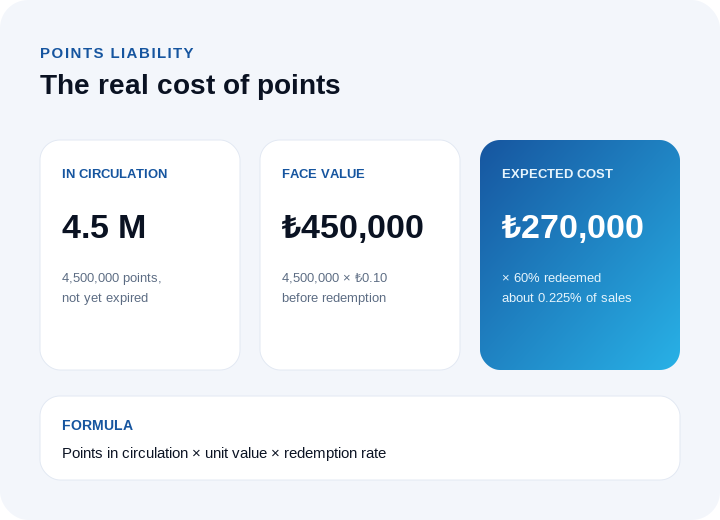
In the example, 4,500,000 points are in circulation. The face value is 4,500,000 × ₺0.10 = ₺450,000. If past cohorts show that 60% of issued points were redeemed and 40% expired, the expected cost is ₺450,000 × 60% = ₺270,000. With annual sales of ₺120,000,000, liability as a share of sales is ₺270,000 ÷ ₺120,000,000 = 0.225%.
- The redemption rate is an estimate: It comes from past cohorts and must be re-measured whenever the rules change.
- A change in unit value changes the liability: If the point value rises from ₺0.10 to ₺0.12, liability becomes 4,500,000 × ₺0.12 × 60% = ₺324,000, an increase of ₺54,000.
- Accounting entry: How the liability appears in the books depends on accounting standards and tax rules; this article recommends no method, so consult your financial advisor (certified accountant).
How Do You Protect Margin on Rewards?
Redeeming points is a discount, and on a low-margin product it can turn into a loss. A simple protection rule: the discount paid in points cannot exceed half of the product's margin.
On a ₺1,000 basket with a 30% margin, the margin is ₺300; by the rule, at most ₺150 can be paid in points and the remaining profit is ₺150 (a margin of ₺150 ÷ ₺850 ≈ 17.6%). On a product with a 15% margin the cap is ₺75 and ₺75 of profit remains. An unlimited ₺200 discount would leave ₺800 of revenue against ₺850 of cost, a ₺50 loss. The ordering and margin-protection approach for stacked discounts is the same one described in our coupon engine article.
How Do You Prevent Abuse?
Every reward system gets tested sooner or later. Build the defense at a general level.
- Pending points: Points become usable only after delivery and the return period, which closes the order-return-reorder loop.
- Caps: Daily and monthly limits on earning and redeeming catch unusual speed.
- Multiple account checks: Accounts that converge around the same person or address raise a flag.
- Manual review: Suspicious movements go to a queue; manual corrections are written to the ledger with a reason.
How Do You Calculate the Economics and Payback of a Loyalty Program?
A program creates value only if it brings incremental sales. "Members spend more" is not enough, because customers who are already loyal are more likely to join. Without a randomly assigned control group, the incremental effect cannot be measured.
Representative example: 20,000 members; average annual spending of ₺6,000 per member in the test group and ₺5,700 in the control group. Annual sales are 20,000 × ₺6,000 = ₺120,000,000. Points issued are 120,000,000 ÷ 100 × 12 × 1.25 = 18,000,000 points, a face value of ₺1,800,000 (1.5% of sales). With a 60% redemption rate, the expected points cost is ₺1,080,000.
| Item | Calculation | Amount |
|---|---|---|
| Incremental sales | (₺6,000 − ₺5,700) × 20,000 | ₺6,000,000 |
| Incremental contribution (30% gross margin) | ₺6,000,000 × 0.30 | ₺1,800,000 |
| Expected points cost | 18,000,000 × ₺0.10 × 60% | ₺1,080,000 |
| Annual running cost | Maintenance, support, messaging | ₺180,000 |
| Annual net | ₺1,800,000 − ₺1,080,000 − ₺180,000 | ₺540,000 |
If the development investment is 60 person-days × ₺9,000 = ₺540,000, payback is ₺540,000 ÷ (₺540,000 ÷ 12) = 12 months. Sensitivity matters too: if the uplift is ₺150 per member instead of ₺300, incremental contribution falls to ₺900,000 and the annual result is ₺900,000 − ₺1,260,000 = −₺360,000, so the program loses money. The break-even uplift is (₺1,080,000 + ₺180,000) ÷ 0.30 ÷ 20,000 = ₺210 per member. For a broader view of customer value, see our customer lifetime value guide, and for segment-based campaigns our RFM analysis article.
Which Metrics Should You Track?
Four metrics summarize the health of the program. The values below continue the example and are representative.
| Metric | Calculation | Example |
|---|---|---|
| Active member rate | Members with at least one order in 12 months ÷ total members | 12,000 ÷ 20,000 = 60% |
| Point redemption rate | Redeemed ÷ issued, in a cohort whose expiry has completed | 10,800,000 ÷ 18,000,000 = 60% |
| Liability ÷ sales | Expected cost ÷ annual sales | ₺270,000 ÷ ₺120,000,000 = 0.225% |
| Repeat order gap | Share placing a second order in a year, members versus control | 9,600 ÷ 20,000 = 48%; 8,400 ÷ 20,000 = 42%; gap 6 points |
If you want to feed these metrics into messaging flows, our marketing automation guide describes the setup.
How Do You Build the Loyalty Program Software?
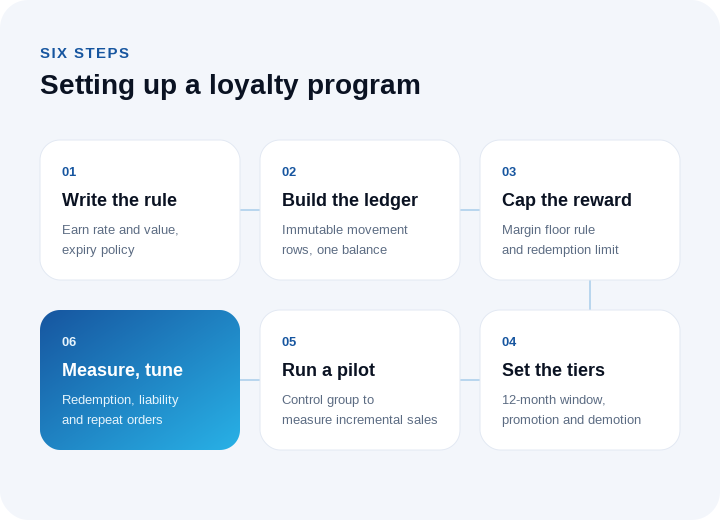
The six steps rest on putting the rules on paper before writing code.
- Write the rule: Earn rate, unit value, calculation base, multipliers and expiry on a single page.
- Build the ledger: Immutable movement rows, a balance check in one transaction and daily reconciliation.
- Cap the reward: A margin floor rule, a redemption limit and excluded product groups.
- Set the tiers: A 12-month window, promotion and demotion rules and a tier history.
- Run a pilot: Measure incremental sales with a randomly assigned control group.
- Measure and tune: Track redemption, liability and the repeat order gap every month.
Member data, messaging permissions and the announcement of program terms fall under KVKK (Turkey's personal data protection law) and commercial messaging rules; consult your legal counsel. For tax and accounting, work with your financial advisor (certified accountant).
We recommend reading: How to Manage Ecommerce Product Reviews and Ratings: Collection, Moderation, Weighted Averages and Metrics
Custom Software and CRM Development with İnovabil
At İnovabil our focus is building company-specific software from scratch: custom software, ERP, CRM, e-commerce, web, mobile and integration. If you need a customer program that fits your own sales channel and business rules, we recommend writing the rules and the ledger structure down in a requirements analysis.
We built CRM, purchasing and mobile for Avcılar İnşaat; a purchasing system for İZBAN; logistics and shipment planning with wholesale order management for Karyak; and warehouse management plus a complaint and support management system for Sleepy. We do not have a separate loyalty product; send us a short summary of your customer database, your orders and your rules, and we will define the scope together.
We recommend reading: Our software development process: from analysis to launch
Frequently Asked Questions
How do you design loyalty program software?
First write down the earn rate, point value, expiry and tier rules; then build a points ledger made of immutable movement rows, margin protection and a pilot with a control group. The balance should always be derived from the sum of movements.
How is points liability calculated?
Points in circulation × unit value × expected redemption rate. In the example, 4,500,000 × ₺0.10 × 60% = ₺270,000. The redemption rate is estimated from past cohorts; consult your financial advisor (certified accountant) for the accounting entry.
What happens to the points of a returned order?
The points issued for that order are taken back in proportion to the returned amount with a negative row in the ledger. If the member has already spent the points, the balance can go negative, and later earnings first close the gap.
In what order do points expire?
With per-batch expiry, redemption uses FIFO from the oldest batch, and expiry also starts with the oldest batch.
When does a loyalty program pay for itself?
When incremental contribution exceeds points cost and running cost. In the example, annual net is ₺540,000 and the investment is ₺540,000, so payback is 12 months; if the uplift falls to ₺150 per member, the program loses money. Calculate with your own numbers and a control group.