

A customer puts a product in the cart and leaves. Another fills in a form and is never seen again. A dealer has not placed an order in six months. For all three, the right message at the right time would help; but doing it by hand means working through people one at a time, every day, and it usually gets forgotten. Marketing automation is the practice of sending emails, SMS messages and similar communications automatically, by pre-designed rules, based on the customer data and behavior held in your CRM.
In this guide we explain how marketing automation differs from a campaign, what a flow is made of, three flows that pay off, segments and dynamic content, handing leads to sales through scoring, consent management, deliverability, measurement, the payback calculation and a six-step setup. The example figures are representative; they are not an industry average or the result of any particular tool.
What Is Marketing Automation?
Marketing automation is a system in which an event (a form submission, an abandoned cart, a first order, a long period of inactivity) starts a predefined flow that moves through wait, condition and branch steps and sends the right message on the right channel at each step. A person designs and monitors the flow once; they do not send messages one by one.
The system needs two kinds of data: who the person is and what they did. The first comes from the CRM record, the second from site, order and email activity. We covered the general structure of a CRM in our guide to what a CRM is; automation is the communication layer that runs on top of those records.
We recommend reading: Our CRM software service
What Is the Difference Between a Campaign and an Automated Flow?
A campaign goes out once, on a set date, to an audience; an automated flow runs continuously, person by person, after each person's own event.
| Topic | Campaign | Automated flow |
|---|---|---|
| Start | Calendar (a set day and time) | The person's own event |
| Audience | The whole selected segment | Each person who has the event |
| Duration | One-off | Continuous, until the rule changes |
| Timing | Everyone at the same moment | Per person (1 hour later, 3 days later) |
| Effort | Again with every send | Built once, reviewed regularly |
| Typical example | Seasonal discount announcement | Abandoned cart reminder |
Neither replaces the other. Announcements and the campaign calendar belong in campaigns; individual journeys belong in flows.
What Is an Automated Flow Made Of?
Every flow can be described with the same six parts; where one is missing, mistakes start there.
- Trigger: The event that starts the flow: a form submission, an abandoned cart, a first order, 180 days without an order.
- Wait: The gap between messages, such as 1 hour in an abandoned cart flow or 2 days in a welcome flow.
- Condition: A yes/no question such as "Did they place an order?" or "Did they click the email?"
- Branch: The path that splits on the condition. Someone who clicked gets closer-to-purchase content; someone who did not gets a different message.
- Exit condition: Removes the person from the flow when the goal is met. Sending a cart reminder to someone who has already ordered is the most common mistake.
- Goal: The single result the flow is measured on: an order, an appointment, a reply.
| Trigger | Flow | First message |
|---|---|---|
| Form submission | Welcome | Immediately |
| Abandoned cart (no activity for 60 min) | Cart reminder | 1 hour later |
| First order delivered | Post-purchase and review | 5 days after delivery |
| No order for 180 days | Win-back | When inactivity is detected |
| Dealer application | Post-application update | Immediately |
Getting trigger events from the site into the CRM is an integration job; we covered how events are passed in our API integration guide.
Which Flows Should You Start With?
Three flows give a quick return in most businesses: abandoned cart, welcome and win-back. Each has a different purpose.
Abandoned Cart Flow
It reminds a customer who put items in the cart but did not finish, in three steps. The moment they place an order, they leave the flow.
| Step | Timing | Condition | Content |
|---|---|---|---|
| Trigger | No cart activity for 60 min | Has email consent | Flow starts |
| Message 1 | After 1 hour | No order | The cart item and its image |
| Message 2 | After 24 hours | No order | "Need help?": shipping, returns and payment questions |
| Message 3 | After 72 hours | No order, message 1 or 2 clicked | Last reminder; a short SMS if SMS consent exists |
Welcome Flow
It gives the first impression to someone who arrives through a form or a sign-up. On day 0 it says what to expect, on day 2 it shows the most-read content, it branches by interest, and on day 10, if there is still no order, it sends a low-pressure reminder. In B2B the same flow starts with "your application is received, our team will call you" and opens a task for sales.
Win-Back Flow
For a consenting customer who has not ordered in 180 days, it presents what is new, 14 days later asks a short "why the pause?" question, and 14 days after that asks them to update their communication preferences. If there is no response, it moves the person to a passive list and stops sending; continuing to send irrelevant messages damages both complaints and deliverability.
How Are Segments and Dynamic Content Used?
A segment decides who enters a flow and which branch they take; dynamic content means the same template fills with each person's own data. Name, last viewed product, dealer tier and last order date are typical fields. If a field is empty, define a fallback value (starting with "Hello" is better than sending "Hello ,").
The RFM approach is a good base for building behavior-based segments; details are in our RFM analysis guide. Data quality matters too: if a person has two records, they get two messages. In the example the flows send 6,600 messages a month (2,400 cart, 1,200 welcome, 3,000 win-back), and if 4% of records are duplicates, 6,600 × 0.04 = 264 messages go to the same person a second time. For the cleanup method, see our master data management guide.
How Do You Hand Leads to Sales with Lead Scoring?
A nurture flow scores a person's behavior and, at a set threshold, hands the record to the sales team as a task; so the salesperson calls someone who has shown interest, not a cold record. We explained how scoring relates to stages in our sales funnel guide; here we cover only the automation side.
| Behavior | Points |
|---|---|
| Demo or quote form | +30 |
| Visit to a pricing or service page | +20 |
| Click on a link in an email | +5 |
| 30 days of inactivity | −10 |
With a threshold of 50, person A (demo form 30 + pricing page 20 + two clicks 10 = 60) is handed to sales and a task opens; person B (three clicks 15 + pricing page 20 = 35) stays in nurturing. The points are representative; tune them on your own sales data, by looking at which behaviors actually end in a sale.
How Do You Set Up Consent and Contact Frequency?
A marketing message goes only to people who have given consent; consent is recorded per channel, and every message offers a way to opt out. In the example every one of the 10,000 people on the list has email consent, but only 35% (3,500 people) have SMS consent; of the 800 people in the cart flow, 800 × 0.35 = 280 can receive SMS, and the rest proceed by email only.
- Consent record: Who gave consent, when, through which form and for which channel; the record sits in the CRM.
- Opt-out: Unsubscribing works in one click and is reflected in other flows immediately.
- Transactional versus marketing messages: An order confirmation and a campaign are not bound by the same rule; clarify the distinction with your legal counsel.
- Frequency cap: Set a ceiling such as at most 3 marketing messages per person in 7 days. For someone who is in the cart flow, the welcome flow and a campaign in the same week, set a priority order: transactional, cart, welcome, win-back, campaign.
KVKK (Turkey's personal data protection law) and commercial electronic message consent details vary by business and sector; this article is not legal advice, so consult your legal counsel.
What Is Deliverability and Why Does It Matter?
Deliverability is the likelihood that a message reaches the inbox instead of the spam folder. It is shaped by verification of the sending domain (technical settings such as SPF, DKIM and DMARC), list hygiene, how rarely irrelevant messages go out and a gradual rise in sending volume.
- Remove bounced (invalid) addresses from the list automatically.
- On a new sending domain, raise volume in stages; do not send to the whole list on day one.
- Stop sending to people who have not opened or clicked for a long time.
- Watch complaint and unsubscribe rates; a sudden rise is a sign of a content or list problem.
If a user is asking a question on a conversational channel, chat suits better than an automated email; we covered that distinction in our chatbot article.
How Is Marketing Automation Measured?
Metrics are chosen by the purpose of the flow; the most reliable is incremental result measured against a control group. First, the basic indicators for a single campaign (representative figures).
| Indicator | Calculation | Example |
|---|---|---|
| Delivery rate | Delivered ÷ sent | 9,700 ÷ 10,000 = 97.0% |
| Bounce rate | Bounced ÷ sent | 300 ÷ 10,000 = 3.0% |
| Open rate | Opened ÷ delivered | 2,910 ÷ 9,700 = 30.0% |
| Click rate | Clicked ÷ delivered | 291 ÷ 9,700 = 3.0% |
| Orders | Orders ÷ clickers | 29 ÷ 291 ≈ 10% |
| Unsubscribes | Unsubscribed ÷ delivered | 20 ÷ 9,700 ≈ 0.2% |
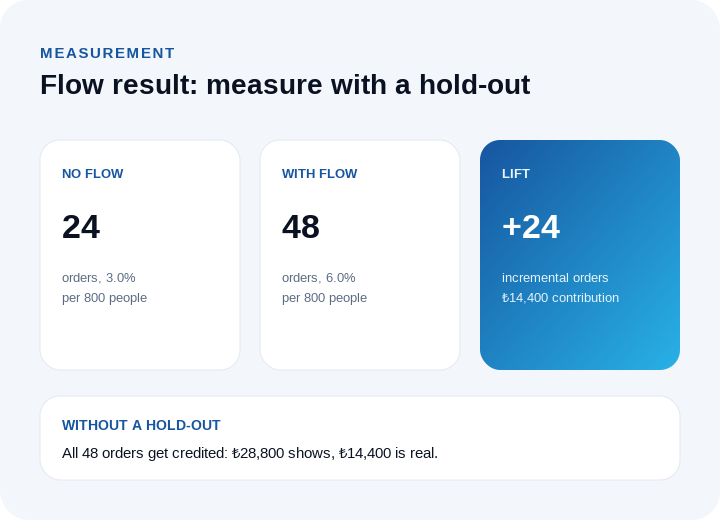
The real question is, "would these orders have come without the flow?" To answer it, leave 10% of the audience (80 of the 800-person abandoned cart group) out of the flow and compare results.
How Much Does Marketing Automation Return?
The return is the contribution from incremental orders minus running cost; payback is the setup cost divided by monthly net gain. The assumptions are representative: average basket ₺2,000, gross margin 30%, so ₺600 contribution per order.
| Flow | People entering/month | Orders without flow | Orders with flow | Incremental |
|---|---|---|---|---|
| Abandoned cart | 800 | 24 (3%) | 48 (6%) | 24 |
| Welcome | 300 | 18 (6%) | 30 (10%) | 12 |
| Win-back | 1,000 | 10 (1%) | 30 (3%) | 20 |
| Total | 56 |
- Monthly contribution: 56 × ₺600 = ₺33,600 (revenue 56 × ₺2,000 = ₺112,000).
- Monthly running cost: platform and sending ₺6,000 + maintenance of 1 person-day a month ₺9,000 = ₺15,000.
- Monthly net: ₺33,600 − ₺15,000 = ₺18,600.
- Setup: 8 person-days per flow × 3 flows = 24 person-days; shared data and event connection 10 person-days; total 34 × ₺9,000 = ₺306,000.
- Payback: ₺306,000 ÷ ₺18,600 ≈ 16.5 months.
The 8 person-days per flow break down as: strategy and rules 1, copy 2, template design 1.5, data and trigger connection 1.5, testing 1, measurement dashboard 1. If volume is small, the result changes fast: if incremental orders halve (28), the contribution is ₺16,800, net is ₺1,800 and payback stretches to ₺306,000 ÷ ₺1,800 = 170 months. To cover running cost you need ₺15,000 ÷ ₺600 = 25 incremental orders a month; below that volume, a few hand-targeted sends make more sense than building automation. Without a control group, on the other hand, all 48 cart-flow orders get credited to the flow; ₺28,800 appears, when the real figure is ₺14,400.
To balance customer value against communication spend, see our customer lifetime value guide; to connect satisfaction measurement to a flow, see our NPS guide.
How Do You Set Up Marketing Automation? Six Steps
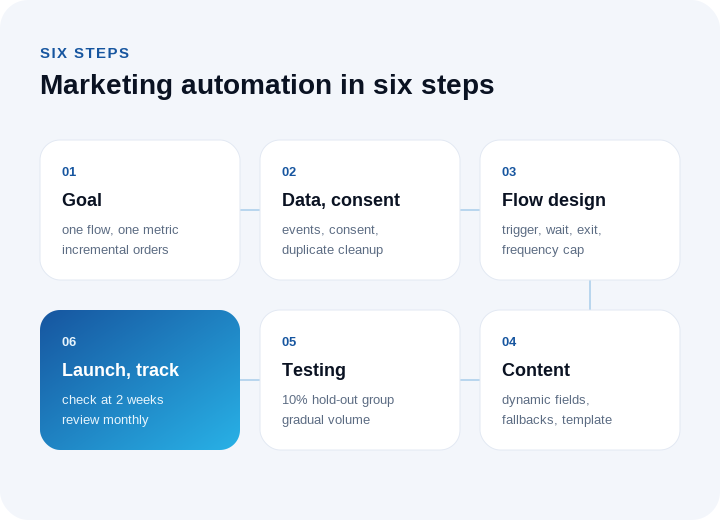
- Goal: Pick one flow and one metric; for example the abandoned cart flow, with incremental orders as the goal.
- Data and consent: Confirm that trigger events reach the CRM reliably, that consent fields are filled and that duplicate records are cleaned.
- Flow design: Write the trigger, wait times, conditions, exit condition and frequency cap on one page.
- Content and template: Define the dynamic fields and fallback values; keep the message readable on mobile.
- Testing: Trigger the flow end to end with test addresses, confirm the exit condition works, set aside the control group and raise sending volume gradually.
- Launch and measurement: After two weeks check unsubscribes and complaints, after a month read the incremental result, then move to the second flow.
What Are Common Mistakes in Marketing Automation?
- Forgetting the exit condition: A cart reminder reaching a customer who already ordered damages trust.
- Not building a control group: Orders that would have come anyway get credited to the flow and the result is inflated.
- Turning on all flows at once: One mistake multiplies across five flows; start with one, then the next.
- Setting no frequency cap: Someone who gets five messages in the same week unsubscribes.
- Starting without cleaning data: Duplicate and stale records produce both complaints and delivery problems.
- Setting it and forgetting it: Flows go stale when products, prices and policies change; a monthly review is needed.
We recommend reading: What is business process automation? Priority score, savings and payback guide
We recommend reading: What Is Appointment Booking Software? Calendar Model, Double-Booking Prevention, No-Show Rate and Payback Guide
We recommend reading: What Is Customer Journey Mapping and Behavior Analytics? Events, Funnel, Drop-off and Cohort Guide
We recommend reading: How to Design Mobile Push Notifications: Types, Permission, Frequency Caps and Measurement Guide
We recommend reading: How to Ensure Transactional Email Deliverability: Authentication, Warm-Up, Bounces and Monitoring Guide
We recommend reading: How to Build Customer Consent Management: Channel-Level Records, Double Opt-In and Sync Guide
We recommend reading: How to Design Transactional SMS and OTP Messages: Segments, Pumping Defense and Cost Guide
We recommend reading: How to Manage and Score Sales Leads: Source Quality, Fit and Interest Scoring, and Handoff Guide
CRM and Integration Foundations with İnovabil
At İnovabil our focus is building bespoke software from scratch: custom software, CRM, ERP, e-commerce, web, mobile and integration. We do not have a marketing automation product; but we build the two things automation depends on: the CRM where customer data lives, and the integrations that connect order, stock and site events. In the requirements stage we write down together which event, which data and which consent each flow rests on.
We have built CRM, purchasing and mobile for Avcılar İnşaat; a purchasing system for İZBAN; logistics and shipment planning with wholesale order management for Karyak; and warehouse management plus a complaint and support management system for Sleepy. Send us a short summary of the systems you want your communication flows to connect to, and we will work out together where event and consent data will come from.
We recommend reading: Our software development process: from analysis to launch, step by step
Frequently Asked Questions
What is marketing automation, in short, and what is it for?
It is the automatic sending of emails, SMS messages and similar communications by pre-designed rules, based on CRM data and customer behavior. It runs repeating journeys such as abandoned cart, welcome and win-back at the right time without manual effort.
Is marketing automation the same as a bulk email campaign?
No. A campaign goes once, on one date, to a selected audience; an automated flow runs continuously, timed per person after their own event. The two complement each other.
Which flow should you start marketing automation with?
In most businesses, the abandoned cart flow, followed by the welcome and win-back flows. Each is tied to one event and one measurable result. Build one first, measure it with a control group, then move to the next.
Do you need consent for marketing automation?
The basic principle is to obtain consent per channel for marketing messages and to offer an opt-out in every message. The distinction between transactional and marketing messages, and KVKK (Turkey's personal data protection law) details, vary by business; consult your legal counsel.
When does marketing automation pay for itself?
It depends on volume. In the representative example, when three flows bring 56 incremental orders a month, payback is about 16.5 months; if incremental orders halve it stretches to about 170 months, and at least 25 incremental orders a month are needed. Recalculate with your own basket size, margin and volume.