

A customer opens a return request saying the product "is not what I expected." The request arrives by email, the warehouse is never told the parcel is on its way, accounting does not know when to refund, and nobody decides whether the item goes back on the shelf or into the bin. Returns management (RMA, short for return merchandise authorization) is the work of running that whole chain, from request through refund and back into stock, under a single record. Returns are unavoidable. What separates businesses is whether they know what each return costs and why it happened.
In this guide we explain how to manage returns: the process stages, approval rules, warehouse receiving and condition grading, putting items back into stock, refunds and marketplace returns, how to calculate the return rate and its cost, how to turn return reasons into root-cause actions, abuse signals, the payback of software, and a six-step setup. The sample figures are illustrative; they are not any company's data or an industry average.
What Is Returns Management (RMA)?
Returns management is the tracking, in a system, of a process that starts when a customer asks to send a product back and ends when the item is restocked, repaired or scrapped and the money is refunded. RMA is the form of that process in which every return receives an authorization number: a parcel that arrives without a number is a parcel without a record.
Returns are not one team's job. Customer service handles the request, logistics the shipping, the warehouse the receiving, and finance the money; the system's task is to show all four the same status. We covered the layer that follows the whole order in our order management system guide, where returns appear only as a short table. Here we go into the detail.
We recommend reading: Our ERP software service
What Stages Does the Returns Process Go Through?
The returns process runs through six stages, and each stage has an owner and an output.
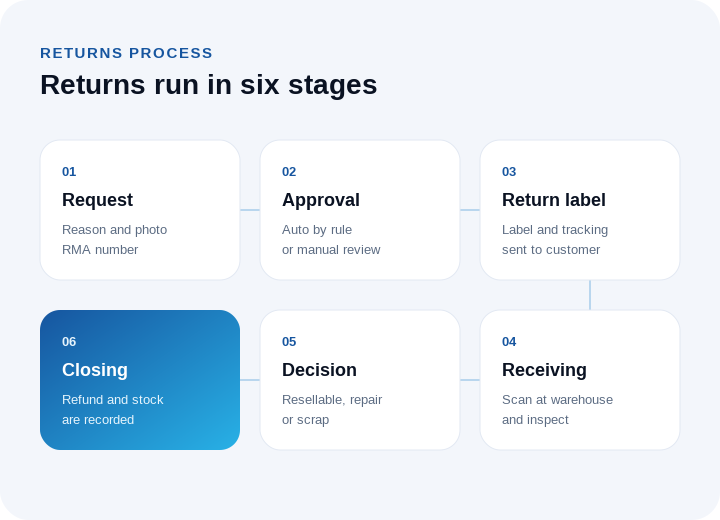
| Stage | What happens? | Owner |
|---|---|---|
| 1. Request | The customer opens a request with a reason and, where relevant, a photo; an RMA number is generated | Customer service |
| 2. Approval | Automatic approval or manual review, according to rules | System, support |
| 3. Return shipping | A return label and tracking number go to the customer | Logistics |
| 4. Receiving | The parcel is scanned with its RMA number at the warehouse, opened and inspected | Warehouse |
| 5. Condition decision | Resellable, repair, or scrap | Warehouse, quality |
| 6. Closing | Money or credit is refunded, stock is updated, the record closes | Finance, warehouse |
At the shipping stage a return label must be generated and tracking information must flow back into the system; how that is built is covered in our shipping integration guide.
How Do You Approve a Return Request?
You approve returns faster by writing the rules down: a request with a clear rule is approved automatically, and an unclear one goes to a person. The thresholds below are illustrative.
| Condition | Outcome |
|---|---|
| Within the return period, amount ₺2,000 or less, risk score below 5 | Automatic approval; return label is sent |
| Damaged or defective report, with a photo | Automatic approval; the seller covers shipping |
| Amount above ₺2,000, or risk score of 5 or more | Manual review |
| Outside the return period | Decline per policy or a documented exception; a record is kept |
| Set or promotional bundle | Items are assessed together |
The details of the return period and withdrawal rights depend on legislation, so we do not state periods or exceptions as figures here; set your policy with your legal counsel. The system's job is to apply the policy you define to every request in the same way.
How Do You Receive Returned Goods and Put Them Back into Stock?
A returned item does not enter sellable stock until it has been inspected; it waits in a separate "returns receiving" location. At receiving, the parcel is scanned by RMA number and product barcode, opened, and given one of three decisions. We covered scanning practice in our barcode system guide and warehouse locations in our warehouse management system guide.
In the example, 160 returns arrive each month. The grading split and the value loss are below; the product cost is ₺600.
| Condition | Share | Units | Decision | Loss per unit | Total |
|---|---|---|---|---|---|
| Resellable | 70% | 112 | Back to shelf | ₺0 | ₺0 |
| Repair or refurbish | 20% | 32 | Repaired, sold at a discount | ₺350 (₺150 repair + ₺200 discount) | ₺11,200 |
| Scrap | 10% | 16 | Written off | ₺600 | ₺9,600 |
The total value loss is ₺11,200 + ₺9,600 = ₺20,800. Taking items into stock before inspection creates overselling risk. Suppose sellable stock is 75 and 20 items come back: if 14 prove sellable, 4 need repair and 2 are scrap, the correct stock is 75 + 14 = 89. If you add all of them at once, the system shows 95, which is a 6-unit overselling risk. The sellable-stock calculation is explained in our inventory tracking guide.
Speed matters too. If the 112 sellable returns each month wait an average of 10 days between receiving and restocking, the waiting stock is 112 × 10 ÷ 30 ≈ 37.3 units, or 37.3 × ₺600 = ₺22,400. If the wait falls to 3 days, it is 112 × 3 ÷ 30 = 11.2 units and ₺6,720; the difference is ₺15,680 of tied-up capital.
How Do You Manage Refunds, Credit Notes and Marketplace Returns?
The money should be refunded once, and only after the condition decision. There are three routes: refund to the original payment method, store credit, or exchange. Partial refunds and deductions are a legal matter; settle your policy with legal counsel.
- Double-refund protection: A second refund instruction for the same RMA is rejected; duplicate protection by event ID is built the way our order management article describes.
- Credit note and return invoice: How the sales invoice is corrected and which document is issued is a matter for your financial advisor (certified accountant); the e-document side is covered in our e-invoice (e-Fatura) integration guide.
- B2B returns: A dealer's or wholesale customer's return is usually deducted from the customer/supplier account (current account); the receivable shrinks instead of cash leaving.
- Marketplace returns: The marketplace runs the return request under its own rules; your system should record the condition decision and the stock update when the item arrives and notify every channel. For commission and shipping refund terms, read the marketplace's official seller agreement; the general operation of channels is in our marketplace integration guide.
- Keeping evidence: Photos and notes taken at receiving are your basis if the marketplace or the customer disputes the outcome.
How Do You Calculate the Return Rate and Return Cost?
The return rate is the number of returned orders divided by total orders; the cost is not just the product price but the sum of handling and value loss.
In the example there are 2,000 orders a month, the average basket is ₺1,000, and gross profit is 40%, so ₺400 per order. The return rate is 160 ÷ 2,000 = 8%. The handling items per return are as follows.
| Item | Per return | 160 returns |
|---|---|---|
| Outbound shipping lost (the first delivery fee) | ₺80 | ₺12,800 |
| Return shipping | ₺90 | ₺14,400 |
| Warehouse receiving and inspection (10 min × ₺300 ÷ 60) | ₺50 | ₺8,000 |
| Customer service (12 min × ₺300 ÷ 60) | ₺60 | ₺9,600 |
| Packaging and labels | ₺20 | ₺3,200 |
| Payment processing loss | ₺20 | ₺3,200 |
| Handling total | ₺320 | ₺51,200 |
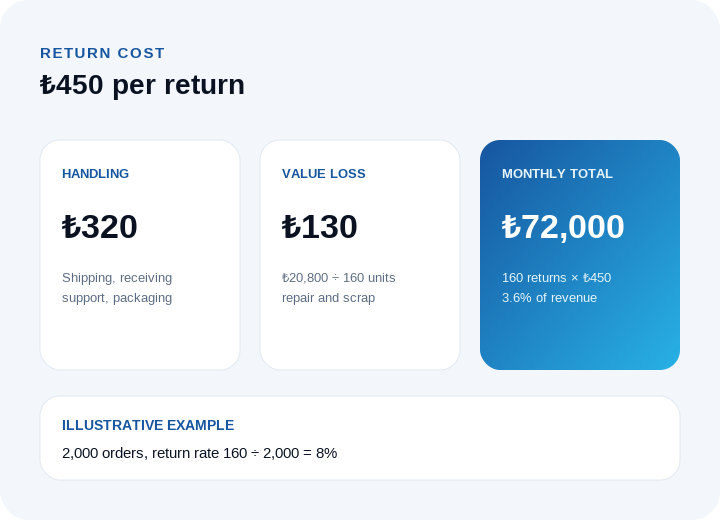
The value loss is ₺20,800 ÷ 160 = ₺130. The total per return is ₺320 + ₺130 = ₺450, and the monthly total is ₺51,200 + ₺20,800 = ₺72,000, which is ₺72,000 ÷ ₺2,000,000 = 3.6% of revenue. One return costs more than the ₺400 gross profit of an order: ₺450 ÷ ₺400 ≈ 1.1 orders' worth of profit goes to cover a single return. That figure is the foundation for the decision "should returns be free?"
How Do You Turn Return Reasons into Root-Cause Actions?
A return reason should be a code picked from a short list, not free text; otherwise it cannot be counted. Reason codes are the only data source for reducing returns.
| Reason | Count | Share | Action | Target |
|---|---|---|---|---|
| Size or fit | 48 | 30% | Size chart, fit note; monitor | 48 |
| Not as described | 32 | 20% | Fix description and photos | 20 |
| Damaged or defective | 24 | 15% | Packaging and outbound check | 16 |
| Wrong item sent | 16 | 10% | Barcode picking and verification | 4 |
| Changed mind | 24 | 15% | Not a policy problem; monitor | 24 |
| Late delivery | 16 | 10% | Carrier performance; monitor | 16 |
Description, damage, wrong item and late delivery (32 + 24 + 16 + 16 = 88 returns, 55%) are errors of the business and its shipping process. With three actions, returns fall from 160 to 20 + 16 + 4 + 48 + 24 + 16 = 128: 32 fewer returns, and a rate of 128 ÷ 2,000 = 6.4%. At the average cost of ₺450, that is 32 × ₺450 = ₺14,400 a month. Because cost varies by reason, this is an approximation, but it shows which action to start with. For barcode verification at outbound, see our barcode system guide.
How Do You Spot Return Abuse?
Abuse means using the right to return for sending back a used item, an empty box or a different product. A single signal is not proof; signals are scored, and a person reviews anything over the threshold. The points below are illustrative.
| Signal | Points |
|---|---|
| Return rate of 50% or more over 12 months (at least 5 orders) | 3 |
| Serial or lot number of the arriving item does not match what was shipped | 5 |
| New account, amount above ₺2,000 | 2 |
| "Delivered but not received" claim repeats for the same customer | 2 |
The threshold is 5 or more. An example customer returned 6 of 10 orders (60%, 3 points) and the serial number of the returned item does not match (5 points): 8 points, so a review is needed. If 5 requests are flagged in a month and 2 are confirmed on review, precision is 2 ÷ 5 = 40%; that is, 60% of the flagged customers were wrongly suspected. This is why the threshold should trigger a review, not an automatic decline. When scoring with personal data, have your obligations under KVKK (Turkey's personal data protection law) reviewed by legal counsel.
What Is the Payback of Returns Management Software?
Payback is the sum of time savings, fewer errors and root-cause actions, divided into the investment. The assumptions below are illustrative.
- Time savings: Customer service 12 → 4 min (−8 min), receiving and inspection 10 → 6 min (−4 min): 12 min × 160 = 1,920 min = 32 h; 32 × ₺300 = ₺9,600 a month.
- Errors and abuse: From duplicate and unauthorized refunds, 3 × ₺1,000 = ₺3,000 a month.
- Running cost: ₺2,100 a month.
- Investment: 28 person-days × ₺9,000 = ₺252,000.
With efficiency alone, the monthly net benefit is ₺9,600 + ₺3,000 − ₺2,100 = ₺10,500, and payback is ₺252,000 ÷ ₺10,500 = 24 months. If the ₺14,400 from root-cause actions is added, the net benefit becomes ₺24,900 and payback drops to ₺252,000 ÷ ₺24,900 ≈ 10.1 months. The second figure holds only if you actually carry out the actions; software supplies the data, and teams make the fixes. At a small volume such as 40 returns a month, the time savings fall to 12 min × 40 = 8 h × ₺300 = ₺2,400 and nearly cancel the ₺2,100 running cost; there, staying with an off-the-shelf panel or a spreadsheet may make more sense.
We recommend reading: What is an order management system? OMS, lifecycle and payback guide
How Do You Set Up Returns Management? Six Steps
- Write the policy: Return period, conditions, who pays for shipping and any deductions should be in writing and reviewed by legal counsel.
- Define reason codes: A short list of 6–8 codes instead of free text.
- Set approval rules: Define the automatic-approval threshold and the review conditions.
- Set up the receiving area and condition decision: A separate location, RMA scanning, three condition decisions.
- Connect refunds and stock: After the decision, a single refund plus stock and channel updates.
- Hold a monthly metrics review: Return rate, cost per return, cycle time and reason split.
To combine returns with the support request queue, see our help desk software guide.
What Mistakes Are Common in Returns Management?
- Restocking before inspection: It leads to overselling and to selling damaged goods.
- Not recording the reason: If the reason is unknown, returns are only managed, never reduced.
- Counting only the product price as cost: In the example, handling and value loss come to ₺450.
- Approval without rules: Approving every request by hand is slow; approving every request automatically is risky.
- Refunding twice: A second refund for the same RMA must be blocked.
- Keeping channels apart: If a marketplace return does not reach stock, stock across channels goes wrong.
We recommend reading: What Is a Chatbot? Customer Service Bot Types, Human Handoff, Cost and Setup Guide
We recommend reading: What Is Quality Management Software? Inspection Plans, Nonconformance, CAPA, Traceability and Payback Guide
We recommend reading: How to Reduce Shipping Costs in E-Commerce: A Shipping Cost Optimization Guide
We recommend reading: What Is Warranty and After-Sales Service Management? Serial Tracking, Coverage Checks, Supplier Claims and Cost Guide
We recommend reading: What Is Dropshipping and How Do You Run It? Supplier Feeds, Unit Economics and Automation
We recommend reading: How to Do Customer Profitability and Cost-to-Serve Analysis: Net Contribution, the Whale Curve and Action Guide
We recommend reading: How to Design an E-Commerce Promotion and Coupon Engine: Order, Margin Floor and Abuse Prevention Guide
We recommend reading: How to Design a Loyalty Points Program: Earn Rules, Ledger, Expiry and Liability Guide
We recommend reading: How to Manage Ecommerce Product Reviews and Ratings: Collection, Moderation, Weighted Averages and Metrics
We recommend reading: How to Reconcile Online Payments: Order, Provider and Bank Matching, Net Payout and Chargeback Guide
We recommend reading: How to Manage Backorders: Line Status, Priority, Split Shipments and Fill Rate Guide
We recommend reading: How to Analyze Product Profitability and Rationalize SKUs: Contribution Margin, Carrying Cost and Pruning Guide
We recommend reading: How to Set Up Omnichannel Inventory: Click and Collect and Ship-from-Store for Stores and E-Commerce
We recommend reading: How to Prevent E-Commerce Order Fraud: Risk Scoring, Threshold Selection and Manual Review
Returns, Orders and Warehouse Processes with İnovabil
At İnovabil our focus is building bespoke software from scratch for your company: custom software, ERP, CRM, e-commerce, web, mobile and integration. We do not have a registered returns management product; we recommend designing returns together with order, warehouse, shipping and finance flows during requirements analysis, and writing down the rules and the cost calculation.
We built logistics and shipment planning with wholesale order management for Karyak, warehouse management and a complaint and support management system for Sleepy, a prepaid cargo system for Kredili Kargo, and shipment planning for Bofigo. Send us a short summary of your returns process and monthly volume; let us map it together and produce a written scope.
We recommend reading: Our software development process: from analysis to launch, step by step
Frequently Asked Questions
What is returns management (RMA)?
It is running the process, from a customer's return request to the item going back into stock or being scrapped and the refund being paid, in a single record under an RMA number issued for each return. It covers the request, approval, shipping, receiving, condition decision and refund steps.
How is the return rate calculated?
Divide the number of returned orders by total orders. In the example, 160 ÷ 2,000 = 8%. Track the value-based rate as well and put the cost per return next to it; the rate alone does not show the cost.
How much does a return cost a business?
In the example it is ₺450 per return: ₺320 of handling and ₺130 of value loss. The items are outbound and return shipping, receiving and support labor, packaging, payment loss, repair and scrap. Recalculate with your own figures.
Should a returned item go straight back into stock?
No. It is inspected in the receiving area first; resellable items return to stock, and repair and scrap items are set aside. Restocking without inspection creates overselling risk; in the example, 6 units.
How should return periods and withdrawal rights be applied?
Periods and exceptions depend on legislation, and we give no figures in this article. Set your policy with legal counsel and consult your financial advisor (certified accountant) on tax and document matters; the software applies the rule you set to every request in the same way.