

A cart has 10% off, a ₺50 coupon has just been entered, shipping should be free, and one item sits in a "buy 3, pay for 2" offer. Which discount applies first, which ones combine, and what happens when the customer returns something? The answers do not live in the page template. They live in a layer that calculates prices from rules. An e-commerce promotion and coupon engine is the component that calculates cart discounts, coupons, free gifts and "buy X pay for Y" rules in one place, in a consistent order, and limits abuse.
This guide covers promotion types, how application order changes the result, allocating discounts to lines, margin protection, coupon limits, general defences against abuse, reversing promotions after a return, cost simulation, calendar conflicts, test coverage and a payback calculation. All example figures are illustrative; they are not real store data or industry averages. For rules on announcing discounts and displaying prices, consult your legal advisor.
What Is a Promotion and Coupon Engine, and Which Promotion Types Does It Calculate?
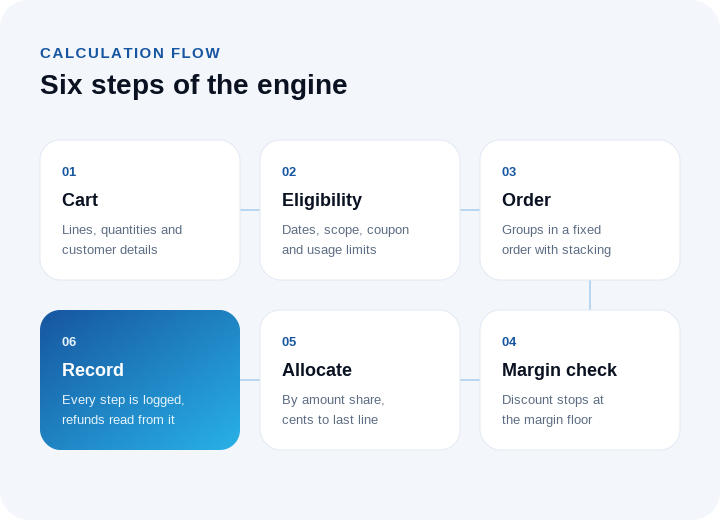
The engine takes a cart and a customer as input, picks the eligible promotions, applies them in sequence and returns a discounted cart with line-level detail. The general idea of rule evaluation is covered in our business rules engine guide.
| Promotion type | How it is calculated | Watch out for |
|---|---|---|
| Cart percentage | A percentage of the subtotal is deducted | Which amount it applies to (shipping included? after earlier discounts?) |
| Fixed amount | A fixed sum is deducted (₺50) | Cannot exceed the cart; no negative totals |
| Buy X pay for Y | Cheapest item(s) free or discounted | Which item counts as free; the return rule |
| Tiered | Rising rate by amount or quantity | Is the threshold checked before or after discounts |
| Free shipping | Shipping fee set to zero | Threshold changes with the discounted cart |
| Free gift | A zero-price line is added | Stock and cost tracked separately |
In What Order Are Promotions Applied, and Do They Stack?
No, promotions do not combine automatically; the stacking rule must be written down, and application order changes the result. The same two discounts applied in reverse order give different totals.
Take a ₺1,000 cart with a 10% discount and a ₺50 discount. 10% first: 1,000 − 100 = 900, then ₺50: ₺850. ₺50 first: 1,000 − 50 = 950, then 10%: 950 − 95 = ₺855. The gap is only ₺5, but if the order is left to chance, budget and customer experience fluctuate across thousands of orders.
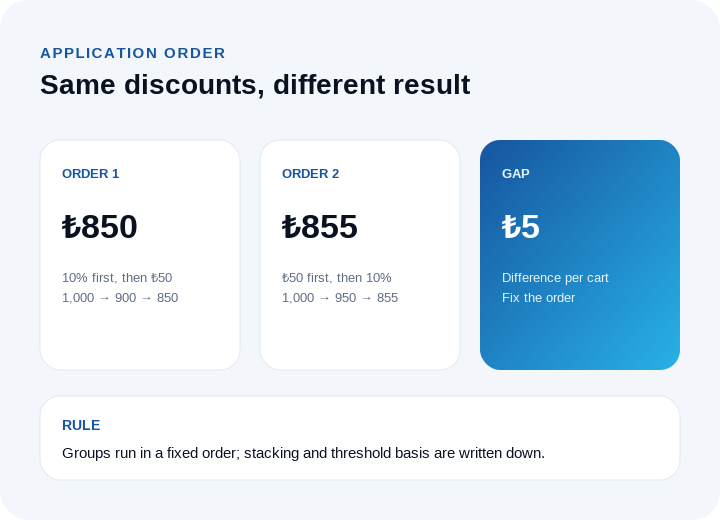
Three rules are enough. First, promotions are split into groups (item discount, cart discount, coupon, shipping) and groups run in a fixed order. Second, each group states whether promotions combine or "best one wins", and a cap can limit the total discount. Third, threshold checks say exactly which amount they read. For example, free shipping starts at ₺1,000 and a cart of ₺1,050 receives a ₺100 discount: if the threshold reads the amount before discounts, shipping stays free; if it reads the discounted ₺950, shipping is charged. Both are defensible, but one must be chosen and documented.
How Is a Discount Allocated to Order Lines?
A cart-level discount is allocated to product lines in proportion to their amount, because returns, tax and cost reports work line by line. An unallocated discount leaves the question "how much of this item should be refunded" without an answer.
Example: the cart has item A at ₺600, item B at ₺300 (2 × ₺150) and item C at ₺100; the total is ₺1,000 and a ₺150 coupon applies. The shares are 60%, 30% and 10%, so discounts are ₺90, ₺45 and ₺15. Leftover cents (₺10 over 3 lines: 3.33 + 3.33 + 3.34) go to the last line.
| Line | List | Discount share | Net | VAT rate (illustrative) | VAT inside net |
|---|---|---|---|---|---|
| A | ₺600 | ₺90 | ₺510 | 20% | ₺85.00 |
| B | ₺300 | ₺45 | ₺255 | 10% | ₺23.18 |
| C | ₺100 | ₺15 | ₺85 | 20% | ₺14.17 |
| Total | ₺1,000 | ₺150 | ₺850 | ₺122.35 |
If item B is returned, the customer receives the ₺255 actually paid, not ₺300. VAT rates differ by product; ask your financial advisor (certified accountant) about current rates and document rules. We cover the return process itself in our returns management guide.
How Does a Margin Floor Work?
If the margin after discount would fall below the set threshold, the engine caps the discount or skips it. Margin (excluding VAT) = (net amount − cost) ÷ net amount.
Example: a cart of ₺1,000 with a cost of ₺700 (excluding VAT) has a 30% margin. With a 25% floor, the minimum net amount is 700 ÷ 0.75 = ₺933.33, so the maximum discount is ₺66.67 (6.67%). A 10% promotion giving ₺100 would leave net ₺900 and a margin of (900 − 700) ÷ 900 = 22.2%: below the floor. The engine either cuts the discount at ₺66.67 or does not apply the promotion to this cart; the choice is a business decision and should be shown to the customer.
The check can run at cart level (fast, but it may hide a low-margin line) or at line level (safer for free gifts). A stale cost makes the guard misleading; use the same data as the margin-floor logic in our price optimization guide.
What Coupon Types and Usage Limits Exist?
A coupon is a key that triggers a promotion with a code, and it comes in three forms: single-use, multi-use and personal. Each is managed with different limits.
| Coupon type | Use | Typical limit |
|---|---|---|
| Single-use code | Each code works once | 1 use per code |
| Multi-use code | The same code for everyone | Total, daily and per-person limits |
| Personal code | Bound to a customer identity | Account-bound, time-limited |
Limits are set on three axes: total uses (say 1,000), uses per person (say 1) and customer status (first order, a given segment). Define "first order" clearly: a new account from the same person, or the same address and phone, does not count as a first order. Sending coupons may count as a commercial message; see our consent management guide and consult your legal advisor for details.
What Measures Prevent Coupon Abuse?
The goal is to make guessing, sharing and multi-account reuse expensive. Here is the general defence level.
- Code length and rate limit: With a 32-character alphabet, 6 characters give 32⁶ ≈ 1.07 billion possibilities and 8 characters 32⁸ ≈ 1.10 trillion. Finding one of 1,000 valid codes takes about 1.07 million attempts (6 characters) or 1.10 billion (8 characters). At 100 attempts a minute that is about 7.5 days for 6 characters and about 21 years for 8.
- Binding and verification: A personal code does not work on another account; phone or email verification slows multi-account creation.
- Anomaly alarm: Daily usage jumping from 40 to 400 may mean a code has reached a coupon site; an upper limit contains the damage.
Device and address signals can be personal data; consult your legal advisor about KVKK (Turkey's personal data protection law). The approach in our audit log guide also applies to promotion changes.
How Is a Promotion Reversed After a Return?
When an item is returned, the remaining cart must be re-evaluated against the promotion condition; otherwise "buy X pay for Y" offers get abused. Three policies exist: proportional refund, re-evaluating the rule and non-returnable promotional items.
Example: three items at ₺200 are bought and ₺400 is paid under "buy 3, pay for 2". A proportional refund returns ₺133.33 per item. Re-evaluation reprices the remaining items according to what is left.
| Items returned | Proportional refund | Rule re-evaluation | What the customer keeps |
|---|---|---|---|
| 1 | ₺133.33 | ₺0.00 (2 items left = ₺400, paid ₺400) | 2 items, ₺400 |
| 2 | ₺266.67 | ₺200.00 (1 item left = ₺200) | 1 item; under proportional refund it cost ₺133.33 |
| 3 | ₺400.00 | ₺400.00 | No items |
When two items are returned, proportional refund lets the customer keep the remaining item at ₺133.33, 33.3% below list. Which policy to use is a business decision; write the terms on the promotion page in advance and consult your legal advisor about withdrawal and return rights.
How Do You Simulate Promotion Cost in Advance?
Cost = orders × participation rate × discount per order.
Plan: 12,000 orders a month, 25% participation, a ₺1,000 promotional cart and a 10% (₺100) discount. Promotional orders are 3,000 and cost is 3,000 × ₺100 = ₺300,000. Actual: 32% participation (3,840 orders), a ₺1,150 promotional cart and a ₺115 discount. Cost is 3,840 × ₺115 = ₺441,600. The ratio is 441,600 ÷ 300,000 = 1.472, which is 1.28 (participation) × 1.15 (cart). Two small deviations overshoot the budget by 47.2%. That is why you should run three scenarios (base, high participation, high cart) and let a promotion close when its budget is used up.
How Are Promotion Calendar Conflicts Detected?
Two promotions conflict if they cover the same scope (product, category, customer group) and their date ranges overlap: start1 ≤ end2 and start2 ≤ end1.
Example: P1 runs 1–15 November, P2 10–20 November and P3 18–30 November, all in one category. P1 and P2 overlap (10–15, 6 days), P2 and P3 overlap (18–20, 3 days), P1 and P3 do not. With twelve promotions there are 66 pairs, which cannot be checked by hand. The engine lists conflicts at save time and rejects a record if no stacking rule is defined for an overlapping pair.
How Many Scenarios Does a Promotion Engine Need?
The number of tests drops sharply once the order rule is fixed. Assume six promotion types and at most three combining in one cart.
| Order rule | Single | Pairs | Triples | Total |
|---|---|---|---|---|
| Fixed order | 6 | C(6,2) = 15 | C(6,3) = 20 | 41 |
| Free order | 6 | 15 × 2 = 30 | 20 × 6 = 120 | 156 |
Free order multiplies testing by 156 ÷ 41 ≈ 3.8. With three cart shapes (single line, multiple lines, threshold edge), a fixed order gives 41 × 3 = 123 scenarios. Write the expected totals by hand into automated tests; see our software testing guide for method. Always test cent rounding and amounts just above and below a threshold.
Which Metrics Measure Promotion Performance?
Four metrics are enough. Illustrative month: 12,000 orders, list revenue ₺12,000,000, cost ₺7,440,000 (62%), total discount ₺780,000, 4,200 promotional orders, 6,000 coupons issued and 1,080 redeemed.
| Metric | Calculation | Value |
|---|---|---|
| Promotional order share | 4,200 ÷ 12,000 | 35.0% |
| Discount ÷ revenue | 780,000 ÷ 12,000,000 | 6.5% |
| Margin before discount | (12,000,000 − 7,440,000) ÷ 12,000,000 | 38.0% |
| Margin after discount | (11,220,000 − 7,440,000) ÷ 11,220,000 | 33.7% |
| Coupon redemption rate | 1,080 ÷ 6,000 | 18.0% |
The discount looks like a 6.5% revenue loss but cuts margin by 4.3 points (38.0 to 33.7). A team that does not track margin may mistake higher revenue for success. Read coupon redemption by source; see our KPI guide for the principles.
How Fast Does a Promotion Engine Pay Back?
Payback depends on how much the engine reduces the error and labour cost of manual handling. Illustrative assumptions: 12 promotion setups a month, 5 hours each by hand and 2 hours with the engine, at ₺300 an hour. Manual handling produces on average 3 faulty discounts a month (wrong date, wrong amount, forgotten closing), each costing ₺24,000 on average: ₺72,000 a month. The engine cuts faulty-discount loss by 80%.
- Error loss reduction: 72,000 × 0.80 = ₺57,600; labour saving: 12 × (5 − 2) = 36 hours × ₺300 = ₺10,800
- Gross ₺68,400; maintenance and infrastructure ₺8,000; net ₺60,400 a month
- Investment: 48 person-days × ₺9,000 = ₺432,000; payback 432,000 ÷ 60,400 ≈ 7.2 months
If error loss halves (₺36,000), net is 28,800 + 10,800 − 8,000 = ₺31,600 and payback stretches to 432,000 ÷ 31,600 ≈ 13.7 months. The decision depends on how many faulty discounts you actually suffer; measure past losses before investing. For where it sits in the flow, see our order management system guide.
How Do You Set Up a Promotion Engine?
First list last year's promotions by type, and write order, stacking, threshold basis, rounding and return policy in one document. Build a single function that calculates the cart line by line and have every screen call it. Turn hand-verified scenarios into automated tests, then open with one category and compare calculated against actual discounts.
We recommend reading: How to manage B2B price lists
We recommend reading: How to build an e-commerce website
We recommend reading: How to Design a Loyalty Points Program: Earn Rules, Ledger, Expiry and Liability Guide
We recommend reading: How to Prevent Money and Rounding Errors in Software: Cent Differences, Decimal Types and Allocation Guide
We recommend reading: How to Improve Ecommerce Checkout: Step Conversion, Form Fields, Payment Errors and Payback Guide
We recommend reading: How to Manage Bot Traffic and Automated Abuse: Signal Scoring, Rate Limits and Payback Guide
We recommend reading: How to Prepare an E-Commerce Store for Peak Campaign Season: Demand, Stock, Capacity and Live Control Guide
We recommend reading: How to Build an Ecommerce Product Recommendation Engine: Bought Together, Similar Items, Lift, Filters and Measurement Guide
We recommend reading: Bundle Inventory Management: How to Handle Kits, Virtual Bundles, Price Allocation and Partial Returns
We recommend reading: How to Prevent E-Commerce Order Fraud: Risk Scoring, Threshold Selection and Manual Review
E-Commerce and Rule-Based Custom Software with İnovabil
At İnovabil our focus is building company-specific software from scratch: e-commerce, custom software, ERP, CRM, web, mobile and integration. If your promotion and coupon rules are specific to your business, such as promotions by dealer group or tied to ERP stock, we recommend writing these rules down during requirements analysis and turning order and stacking decisions into test scenarios.
We built CRM, purchasing and mobile for Avcılar İnşaat; a purchasing system for İZBAN; logistics and shipment planning with wholesale order management for Karyak; and warehouse management plus a complaint and support management system for Sleepy. Send us a short summary of your promotion rules and we will prepare a written assessment together.
We recommend reading: Our software development process: from analysis to launch
Frequently Asked Questions
What is an e-commerce promotion and coupon engine?
It is the component that calculates cart discounts, coupons, free gifts and "buy X pay for Y" rules in one place, in a consistent order and at line level, and enforces margin and usage limits.
Why does promotion order matter?
Discounts apply on top of each other, so order changes the result. On a ₺1,000 cart, 10% first then ₺50 gives ₺850, while ₺50 first then 10% gives ₺855. Fixing the order makes prices predictable.
Why allocate a discount to lines?
Returns, tax and cost reports work line by line. An unallocated cart discount leaves the refund amount unclear; in the example, item B is refunded ₺255, not ₺300.
How is coupon abuse limited?
With long random codes, a rate limit on wrong attempts, binding codes to customers, verification, total and daily usage limits and an anomaly alarm. Consult your legal advisor about personal-data signals.
How is a "buy X pay for Y" return handled?
Check whether the remaining cart still meets the promotion condition. In the buy 3 pay for 2 example, returning one item refunds ₺133.33 proportionally or ₺0 if the rule is re-evaluated. Write the policy in advance and settle it with your legal advisor.