

After a shopper looks at the photo and the price, the next place they scroll to is usually the reviews. That is why how to manage ecommerce product reviews and ratings is not just a question of whether to show stars: when a review is requested, which reviews get published, how the average is calculated and what you learn from negative reviews all shape the sales outcome.
This guide covers the review and rating system on your own store's product pages: collection, rating math, moderation, replies, the data model and measurement. Every number in the examples is representative; none is the average of a real store or an industry. We give no unsourced figure for the sales effect of reviews; use your own A/B measurement instead.
When and How Should You Ask for a Product Review?
A review is valuable when it is requested after the buyer has actually used the product. A request that comes too early gets "I haven't tried it yet"; one that comes too late is forgotten. Set up a request email tied to the delivery date and adjust the timing by product type.
| Product type | Request timing (after delivery) |
|---|---|
| Tried immediately (accessory, cosmetics) | 3–5 days |
| Understood through use (device, furniture) | 10–14 days |
| Durability matters | 30 days plus a second request |
| Returned order | No request; handled in the returns flow |
These days are a starting assumption; find the right one by splitting requests into two groups. The response rate is simple: reviews ÷ delivered orders. In a representative example, 900 of 1,000 orders have been delivered. A first request on day 7 gets a 10% response: 900 × 0.10 = 90 reviews; a reminder on day 14 adds 900 × 0.02 = 18 more. That is 108 reviews, or 108 ÷ 900 = a 12% review rate. At 4,500 deliveries a month, the same rate gives 540 reviews.
Whether the request counts as a transactional or a marketing message, and what commercial electronic message consent requires, are questions for your legal counsel; for consent records see our guide to customer consent management.
We recommend reading: How to build customer consent management
Why Does the Verified Buyer Badge Matter?
The badge shows that the review comes from a customer who actually bought and received the product. Technically you tie the review to the order line: the order and line ID are stored when the review is written, delivery status is checked, and a review that meets the condition receives the "verified" badge. If you allow reviews not tied to an order, show them separately and decide with a written rule whether they count toward the average. The badge alone does not stop fake reviews, but it is the strongest first filter; keep moderation decisions in an audit log.
Why Does the Rating Average Mislead, and How Do You Calculate a Confidence-Weighted Average?
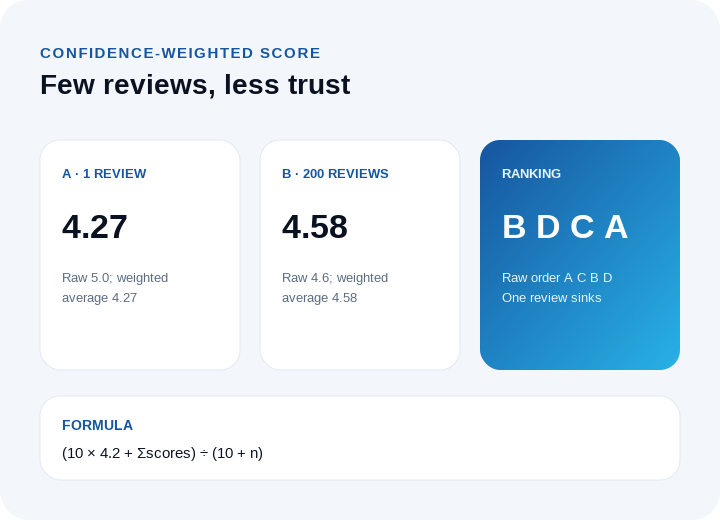
The weakness of a plain average is a small sample. A product with a single 5-star review shows 5.0; a product with 200 reviews averaging 4.6 looks lower, yet the second is a far more reliable signal. If you sort by the raw average, new and low-volume products jump to the top at random. The fix is to pull the average toward the site-wide average:
Confidence-weighted average = (C × m + Σscores) ÷ (C + n)
C is the prior weight (10 reviews' worth in the example), m is the site-wide average (4.2), Σscores is the product's total score and n is the number of reviews. As reviews accumulate, the product's own data gains weight. Four representative products:
| Product | n | Raw average | Σscores | Calculation | Confidence-weighted |
|---|---|---|---|---|---|
| A | 1 | 5.0 | 5 | (42 + 5) ÷ 11 | 4.27 |
| B | 200 | 4.6 | 920 | (42 + 920) ÷ 210 | 4.58 |
| C | 5 | 4.8 | 24 | (42 + 24) ÷ 15 | 4.40 |
| D | 30 | 4.5 | 135 | (42 + 135) ÷ 40 | 4.43 |
By raw average the order is A, C, B, D; by confidence-weighted average it is B, D, C, A. The single-review product drops to the bottom, while the product with hundreds of reviews stays almost at its own average. The value of C is a design decision: a small C gives new products a chance, a large C makes the ranking cautious. On screen, show the raw average with the review count; use the weighted value only for sorting.
Why Does the Rating Distribution Say More Than the Average?
Real distributions often look like a J curve: many 5-star ratings, few middle ones and a relatively high 1-star tail, because the very happy and the very angry are the ones who write. Take a representative product with 200 reviews: 120 five-star, 30 four-star, 12 three-star, 8 two-star and 30 one-star. The total is 600 + 120 + 36 + 16 + 30 = 802, so the average is 802 ÷ 200 = 4.01. The average looks "good", yet 60% of reviewers gave 5 and 15% gave 1. The problem is not "average quality" but a clear disappointment in one group. A percentage distribution bar shows that split to the buyer too.
In What Order Should Reviews Be Shown?
The default order is a product decision; leave the options open to the buyer. "Most helpful" surfaces informative reviews but can keep old ones on top; "newest" reflects current experience but one bad day can skew the result. A practical default is a blended order that gives new reviews a short initial boost and promotes those that rise through helpful votes; add a "Was this review helpful?" vote under every review. For how to feed review scores into search, see our site search guide.
How Do You Set Up Review Moderation?
The purpose of moderation is not to prettify reviews but to remove what is unsuitable. Unsuitable and negative are not the same thing. The core principle: a genuine negative review is not deleted.
| Situation | Decision |
|---|---|
| Negative but genuine | Publish and support with a seller reply |
| Contains personal data (phone, address) | Mask the relevant part and publish; record the reason |
| Profanity, abuse | Reject, or return to the customer to edit |
| Competitor link, advertising | Reject |
| Off-topic (shipping complaint in a product review) | Separate and route to the support queue; exclude from the product score |
The workflow has two layers. An automatic filter looks at word lists, links, phone patterns and duplicate text; only flagged reviews go to a person. In the representative example, 15% of 540 monthly reviews, or 81, are flagged. On review, 49 are published as they are, 20 have personal data masked and 12 are rejected (49 + 20 + 12 = 81). At 2 minutes each, 81 × 2 = 162 minutes, or 2.7 hours. Reading every review by hand would take 540 minutes, or 9 hours, even at 1 minute each; the filter saves 6.3 hours. Check the false-alarm rate (49 ÷ 81 ≈ 60%) monthly and loosen the rules accordingly.
Set a publishing-time target: for example, 90% of reviews published within 24 hours. Tell the customer why a review was rejected.
How Do You Manage the Risk of Fake and Incentivized Reviews?
Fake reviews come in two directions: making a product look better than it is, and smearing a competitor. Whether reviews written in exchange for a discount or gift must be disclosed is a legal question; leave it to your legal counsel. The general technical defence looks like this:
- Tie to the order: The verified buyer rule is the strongest first filter.
- Rate limits and spikes: Flag reviews that pile up in a short time.
- Duplicate text: Queue identical text repeated across several products for review.
- Transparency: Disclose incentivized reviews clearly and never make the incentive conditional on a positive review.
No filter is perfect; the aim is to make fake reviews expensive, and a person makes the call on a suspicious review.
How Should Seller Replies Be Handled?
A reply to a negative review speaks not only to its author but to the next buyer reading the page. Define a service level (SLA): reply to 1- and 2-star reviews within 2 business days. A good reply has three parts: a short thanks or apology, the concrete name of the problem and the way to fix it. Do not share personal data in the reply; move the details to a private channel. In the representative example, 48 of 540 monthly reviews (8.9%) are 1- or 2-star. At 6 minutes per reply, 48 × 6 = 288 minutes, or 4.8 hours.
How Do You Catch Product Problems from Negative Reviews?
Reviews are feedback in the customer's own words. Give each negative review one or two tags: size and fit, quality, packaging and shipping, expectation mismatch, other.
| Tag | Negative reviews | Share |
|---|---|---|
| Size and fit | 19 | 39.6% |
| Quality | 13 | 27.1% |
| Packaging and shipping | 8 | 16.7% |
| Expectation mismatch | 5 | 10.4% |
| Other | 3 | 6.3% |
The total is 19 + 13 + 8 + 5 + 3 = 48. The top two tags, 32 ÷ 48 = 66.7%, explain two-thirds of the problems. If adding a size chart to the product page cuts these reviews from 19 to 12, that is (19 − 12) ÷ 19 = a 36.8% reduction; this too is a representative target. Reading tags next to return reasons confirms the problem from two channels.
We recommend reading: How to manage returns (RMA)
How Do Reviews Appear as Stars in Search Results?
If you mark up reviews and ratings as structured data, search engines may show stars in results when they see fit. The marked-up rating must be visible on the page, belong to that product and be calculated from genuine reviews. Marking up a rating that is not shown, was taken from another site or is higher than the real one violates the rules; display is never guaranteed either. For the general approach, see our SEO guide.
How Is a Question-and-Answer Section Different from Reviews?
A review covers the buyer's experience; a question-and-answer section covers the information a shopper needs before buying. Questions do not count toward the score; the source of each answer is labelled; frequent questions move into the product description.
What Should the Review Data Model Look Like?
Storing a review as just text and stars is not enough; to manage moderation, measurement and deletion requests you need these fields:
| Field | Purpose |
|---|---|
| Review, product and variant ID | Ties the review to the product, and to a size or colour if needed |
| Order line ID, verification flag | Produces the verified buyer badge |
| Score, title, text, media | The review itself |
| Status (pending, published, rejected, deleted), reason, decision maker | Moderation flow and audit trail |
| Tags, seller reply and its time | Problem analysis and reply SLA measurement |
| Version, created and published time | Edit history and publishing time |
A review is personal data: agree with your legal counsel which name is displayed, whether a deletion request means deleting or anonymizing the review, and retention periods. What makes this technically possible is designing the review so it can be detached from the customer record.
Which Metrics Measure Review Management?
| Metric | Calculation | Representative value |
|---|---|---|
| Review rate | Reviews ÷ delivered orders | 540 ÷ 4,500 = 12% |
| Negative review share | 1–2 stars ÷ all reviews | 48 ÷ 540 = 8.9% |
| Reply to negative | Share answered within 2 business days | Target 90% |
| Publishing time | Submission to publication, 90th percentile | Target 24 hours |
Do not assume the sales effect from an unsourced rate; compare pages with and without reviews in similar product groups.
When Does a Review System Pay Back?
Take a representative investment of ₺150,000 (form, request flow, moderation panel, data model). Suppose the review-bearing pages get 60,000 visitors a month and your own A/B measurement shows conversion rising from 2.0% to 2.3% (this rate is fictional). Extra orders are 60,000 × 0.003 = 180; at a ₺150 contribution per order, the monthly contribution is 180 × 150 = ₺27,000.
Monthly running cost: moderation 2.7 hours and replies 4.8 hours, 7.5 hours × ₺300 = ₺2,250, plus ₺1,500 for request emails and infrastructure, a total of ₺3,750. Net benefit is 27,000 − 3,750 = ₺23,250, so payback is 150,000 ÷ 23,250 ≈ 6.5 months. If the uplift halves to 90 extra orders, the contribution is ₺13,500, the net ₺9,750 and payback ≈ 15.4 months. For general cost items see our ecommerce website guide, and for measuring satisfaction by survey see our NPS guide.
We recommend reading: How to design a loyalty points program
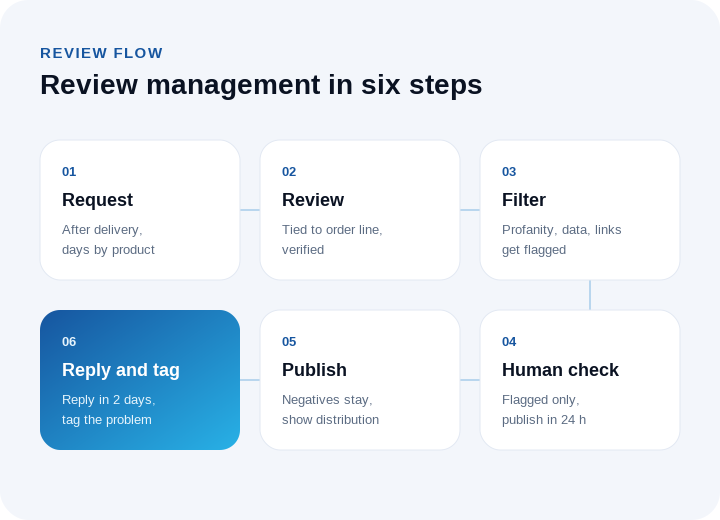
What Are the Six Steps to Set Up a Review System?
- Write the rules: who may write, what is not published, negative reviews are not deleted.
- Build the data model: tied to the order line, with status and versions.
- Open the request flow: a request by product type and one reminder.
- Run moderation: filter plus human check, with a publishing-time target.
- Set up replies and tags: 2 business days for negatives, a tag for each.
- Measure and fix: review the rate, reply time and tags monthly.
We recommend reading: How to Build an Ecommerce Product Recommendation Engine: Bought Together, Similar Items, Lift, Filters and Measurement Guide
Custom Software and Ecommerce with İnovabil
At İnovabil our focus is building software from scratch, specific to each company: custom software, ecommerce, ERP, CRM, web, mobile and integration. We recommend settling in the requirements analysis how the review system will connect to your store platform, orders and customer data; tying a review to an order line, moderation roles and record keeping are the natural territory of custom software. We do not claim to offer a ready-made review product.
We built CRM, purchasing and mobile for Avcılar İnşaat; a purchasing system for İZBAN; logistics and shipment planning with wholesale order management for Karyak; and warehouse management plus a complaint and support management system for Sleepy. Describe your review flow in a short summary and we will write the requirements together.
We recommend reading: Our software development process: from analysis to launch
Frequently Asked Questions
How do you manage product reviews in ecommerce?
Collect reviews with a request after delivery, tie each review to a verified order line, remove only unsuitable content through an automatic filter plus human check, never delete negative reviews, and reply as the seller.
Why is a 5.0 rating on a product with few reviews not reliable?
A single review is a random experience. A confidence-weighted average, (C × m + Σscores) ÷ (C + n), pulls a thinly reviewed product toward the site-wide average. In the example, a 5.0 product with 1 review scores 4.27, while a 4.6 product with 200 reviews scores 4.58.
Is it right to delete negative reviews?
No. A genuine but negative review stays published and is supported with a seller reply; only profanity, personal data, competitor links or off-topic content is edited or rejected. For legal detail, consult your legal counsel.
Is it allowed to give a discount or gift in exchange for a review?
This is a legal question; consult your legal counsel about disclosure and limits for incentivized reviews. Technically, label incentivized reviews clearly and never make the incentive conditional on a positive review.
How do you measure the effect of reviews on sales?
Measure it on your own site: compare conversion of pages with and without reviews in similar product groups, or open reviews gradually in one product group.