

A campaign list was built on Friday and sent on Monday. In between, a customer said over the weekend, "I no longer want messages." The call center noted it, the online store never heard about it, and the message went out anyway. The problem is not bad intent; it is that customer communication consent management was never built as a system: consent lives as a checkbox in one place, a column in another and a note in a third. This guide explains, from a software design point of view, how to record consent per channel in your CRM and marketing systems and how to enforce it at the moment of sending.
Rules on commercial messages, retention periods and KVKK (Turkey's personal data protection law) details are for your legal counsel; this article is not legal advice. All example figures are representative.
What Is Customer Communication Consent Management?
It is the software layer that records which channel (email, SMS, phone call, push notification) and for which purpose a person agreed to receive messages and since when, applies withdrawals, and checks that record on every send. The record lives in one place; the CRM, the online store and the call center connect to it.
This layer is separate from marketing automation: automation answers "what is sent and when," while the consent layer answers "are we allowed to send." Deduplicating the person record is the job of master data management; consent attaches to that single person.
We recommend reading: Our CRM development service
How Should the Consent Record Data Model Look?
The model answers "is there consent?" instantly and "why is there?" with proof. The status is not one column but append-only event rows (never deleted or updated); the current status is the latest row for a given person, channel and purpose.
| Field | What it holds | Why it matters |
|---|---|---|
| Person ID | Deduplicated person number | The same person maps to one record across CRM, site and call center |
| Channel | Email, SMS, call, push | Consent is per channel; email consent is not SMS consent |
| Purpose | Campaign, newsletter, product announcement | Consent given for one purpose does not carry over to another |
| Status | Pending, active, withdrawn, expired | Sending happens only on an "active" row |
| Timestamp | Event time in UTC | Decides which of two conflicting events is newer |
| Source and proof | Form, portal, call center, import; a reference to the event record | Shows where consent came from; manual entries are flagged explicitly |
| Text version | Version number of the notice that was shown | You know exactly what the person agreed to |
The size is small. 100,000 people × 4 channels × an average of 2 purposes = 800,000 states; at an average of 2.5 events per state that is 2,000,000 rows. At 300 bytes per row, 2,000,000 × 300 = 600 MB. For immutable records, the principles in our audit log guide apply.
How Do You Separate Transactional and Commercial Messages in Software?
Every template gets a message type tag, and the sending service reads the type from a table that maps it to the consent purpose it requires. A template without a type is not sent; the default is the strictest rule.
| Message type | Example | Consent required | Rule in software |
|---|---|---|---|
| Transactional | Order confirmation, shipping update, password reset | No commercial consent required | Bypasses the consent filter; content is strictly about the transaction |
| Commercial | Campaign, discount, product recommendation, newsletter | Active consent per channel and purpose | Passes the filter; an unsubscribe link is a required field |
| Mixed | An order confirmation with a cross-sell block added | Treated as commercial | Template validation warns; remove the block or change the type to commercial |
Mixed messages are the case teams miss most often. In the example, 9 of 70 transactional templates carried a cross-sell block: 9 ÷ 70 = 12.9%. Those templates are either cleaned up or moved to the commercial type. The reverse is also costly: if the consent filter is applied to transactional messages, people who withdrew commercial email consent will not receive order confirmations. With 5,000 orders a month and 3,100 ÷ 88,000 = 3.5% of addresses withdrawn, about 5,000 × 0.0352 ≈ 176 confirmations would not go out. For the infrastructure side, see our guide on transactional email deliverability.
How Do You Build a Double Opt-In Flow and Calculate the Confirmation Rate?
In double opt-in, a verification link is emailed after the form is submitted; consent becomes "active" only when the link is clicked. Until then the status stays "pending" and no commercial message goes out. The gain is proof that the address really belongs to the person.
Representative flow: 10,000 form submissions arrive and 96% of the addresses accept mail, so 9,600 verification emails are delivered. Of those, 70% click the link: 9,600 × 0.70 = 6,720 active consents. The confirmation rate relative to submissions is 6,720 ÷ 10,000 = 67.2%. Three days later a reminder goes out; 10% of the 9,600 − 6,720 = 2,880 people who have not confirmed, that is 288, click. The total becomes 6,720 + 288 = 7,008, and the rate rises to 70.1%.
| Measure | Single opt-in | Double opt-in |
|---|---|---|
| Addresses entering the list | 10,000 | 7,008 (with reminder) |
| Addresses with a verified owner | Unknown | 7,008 |
| Bounced (invalid) addresses | 400 (4%) | Never enter the list |
| Mistyped addresses belonging to someone else | About 100 (1%) | No message, because they never confirm |
| Extra cost | — | ₺500 + ₺144 reminder |
The cost is small: 10,000 verification emails × ₺0.05 = ₺500, which is ₺500 ÷ 6,720 ≈ ₺0.074 per consent in the first round. The reminder costs 2,880 × ₺0.05 = ₺144 and wins 288 consents, ₺0.50 each. The list is 29.9% smaller than with single opt-in, but every row is verified. Pending records get a deadline (for example 7 days); when it passes, the status becomes "expired" and the record is kept.
How Do You Apply Opt-Out on Every Channel?
Withdrawal should be as easy as granting, recorded as one event and propagated to every system. Whichever channel it arrives on, the matching channel and purpose close; if the person has active consent on another channel, that channel stays open.
- Email: A one-click unsubscribe link in every commercial message, with no login and no reason required.
- SMS: A "stop" reply becomes an event; the provider's reply queue is wired to the consent service.
- Phone: A "declined calls" option on the call center screen produces the same event.
- Push: Preference-screen and device-permission changes become events; see our mobile push notification guide.
Two measures are worth tracking. Opt-out rate: 150 withdrawals on 58,310 sends is 0.26%; 0.5% (about 292 people) can serve as an alert threshold because it points to a frequency or content problem. Propagation time: the time from recording the event to enforcing it in every system should be measured in minutes.
How Does the Last-Moment Consent Filter Work at Send Time?
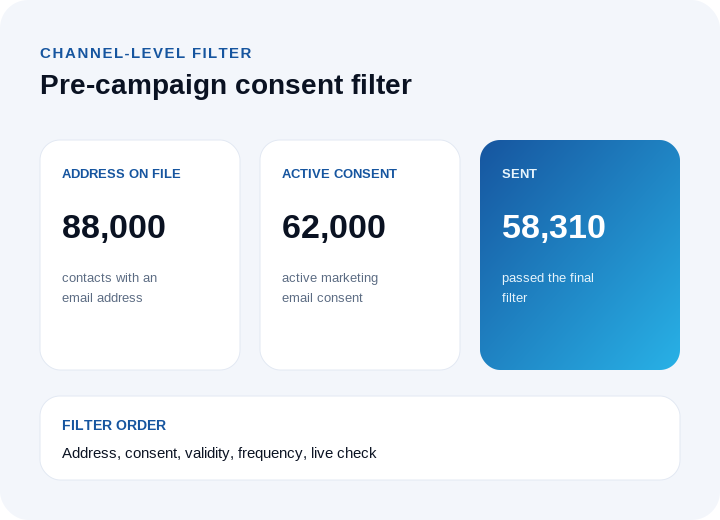
The target list is built at send time by querying the consent service live; a stale list is never used. In the example, a base of 100,000 people narrows to the sendable audience in five steps.
| Step | Rule | People left |
|---|---|---|
| 1. Base | Target segment | 100,000 |
| 2. Address | Email address on file | 88,000 |
| 3. Consent | Active consent for the commercial purpose | 62,000 |
| 4. Validity | Permanent bounces (−1,200) | 60,800 |
| 5. Frequency | Already got 2 commercial messages this week (−2,400) | 58,400 |
| 6. Live check | Withdrawn at send time (−90) | 58,310 |
The sent audience is 58.3% of the base and 58,310 ÷ 62,000 = 94.0% of active consents. Had the list been pulled 3 days earlier, with 40 withdrawals a day (all channels, representative), 40 × 3 = 120 people would have received a message without consent; the live check brings that close to zero.
The channel view (representative):
| Channel | Address or device on file | Active consent | Withdrawn | No consent or unclear |
|---|---|---|---|---|
| 88,000 | 62,000 | 3,100 | 22,900 | |
| SMS | 70,000 | 35,000 | 2,800 | 32,200 |
| Phone | 55,000 | 12,000 | 1,500 | 41,500 |
| Push | 40,000 | 28,000 | 4,200 | 7,800 |
Consent rates are computed against addresses or numbers on file: email 62,000 ÷ 88,000 = 70.5%; SMS 50.0%; phone 12,000 ÷ 55,000 = 21.8%; push 70.0%. In a two-channel campaign each person is counted once: if 20,000 people have both email and SMS consent, the reachable audience is 62,000 + 35,000 − 20,000 = 77,000, or 77.0% of the base. With channel priority (email first, SMS only to people whose email is closed), SMS goes to 35,000 − 20,000 = 15,000 people; at ₺0.25 per message that costs ₺3,750 instead of ₺8,750, saving ₺5,000 per campaign.
How Do You Manage Sync and Conflicts Between Systems?
If the CRM, the online store and the call center each keep their own copy of consent, the copies drift apart. The right model is a single consent service: systems write events to it and read status from it. The event-based approach in our integration service applies here.
The cost of delay can be calculated. Assume 40 withdrawals a day and a weekly campaign; in the worst case, as many withdrawals as the sync delay allows have not yet been seen at send time. Complaint probability is 3% and handling effort per complaint is 1.5 hours × ₺300 = ₺450 (representative).
| Sync delay | Unconsented messages / campaign | Per year (52 campaigns) | Complaints (3%) | Handling effort |
|---|---|---|---|---|
| 24 hours | 40 | 2,080 | 62.4 | ₺28,080 |
| 1 hour | 40 ÷ 24 ≈ 1.67 | ≈ 86.7 | ≈ 2.6 | ₺1,170 |
| 5 minutes | 40 × 5 ÷ 1,440 ≈ 0.14 | ≈ 7.2 | ≈ 0.2 | ≈ ₺98 |
Conflict rules:
- The newest event wins: For the same person, channel and purpose, the row with the latest timestamp is valid; clocks are kept in UTC.
- Withdrawal wins ties: If two events conflict within a few minutes, the withdrawal prevails.
- A bulk import cannot override a withdrawal: A "granted" row loaded from a file cannot reopen a person's own withdrawal; renewed consent requires a new, evidenced action by the person.
How Does Consent Get Lost When You Merge Lists?
Rules such as "treat as consented if either list says so" silently erase withdrawals during a merge. The right method is to merge the event histories and apply the rule to the combined history.
Representative example: list A has 40,000 people, list B has 25,000, and 8,000 are in both; the merged count is 40,000 + 25,000 − 8,000 = 57,000. In A, 24,000 people have email consent; in B, 15,000. The 8,000 shared people break down as follows:
| Status in A | Status in B | People | "Either says yes" | "Withdrawal wins" |
|---|---|---|---|---|
| Consented | Consented | 4,800 | Consented | Consented |
| Consented | Withdrawn | 600 | Consented (error) | Closed |
| Consented | No record | 700 | Consented | Consented |
| No record | Consented | 900 | Consented | Consented |
| Withdrawn | Consented | 300 | Consented (error) | Closed |
| Other combinations | Other | 700 | Closed | Closed |
Among shared people, consented counts are 4,800 + 600 + 700 + 900 + 300 = 7,300 under the first rule and 7,300 − 900 = 6,400 under the second. Outside the overlap, 24,000 − 6,100 = 17,900 (A) and 15,000 − 6,000 = 9,000 (B) people are consented. The total is 17,900 + 9,000 + 7,300 = 34,200 under the first rule and 33,300 under the second. The gap is 900 people: 2.6% of those who look consented under the first rule actually do not want messages. There is a purpose issue too: consent in A was given for A's purpose and text. Confirm with your legal counsel whether that purpose fits the merged list, and keep the source and text version in the record.
How Do You Keep an Audit Trail and a Consent Reference?
Every commercial send carries a reference to the consent record at that moment, so the question "why did this person get this message?" leads from the send log to the consent event in one step. In the example, 596,400 of last month's 600,000 commercial sends carried a reference: 99.4%. The missing 3,600 sends (0.6%) are an error indicator; the target is 100%. To protect consent records in test environments, use the methods in our data masking guide.
How Do You Calculate the Payback of Consent Management?
Only measurable items go into the calculation; possible legal consequences and reputation effects are left out. Representative items:
- Handling unconsented sends: ₺28,080 − ₺97.5 = ₺27,982.5 a year.
- Manual reconciliation: From 6 hours a week to 1 hour: 260 hours × ₺300 = ₺78,000.
- SMS deduplication: 12 campaigns × ₺5,000 = ₺60,000.
Annual gross benefit is ₺27,982.5 + ₺78,000 + ₺60,000 = ₺165,982.5. Investment: 30 person-days × ₺9,000 = ₺270,000 for the consent service, three system connections and migration; maintenance is 15% a year = ₺40,500. Net benefit is ₺165,982.5 − ₺40,500 = ₺125,482.5 a year, or about ₺10,457 a month. Payback is 270,000 ÷ 10,457 ≈ 25.8 months. If SMS campaigns drop to 6 a year, payback stretches to about 33.9 months. The real justification is lower risk of unconsented sending and a lighter burden of proof.
How Do You Set Up Consent Management? Six Steps
Start with a pilot on one channel, usually email.
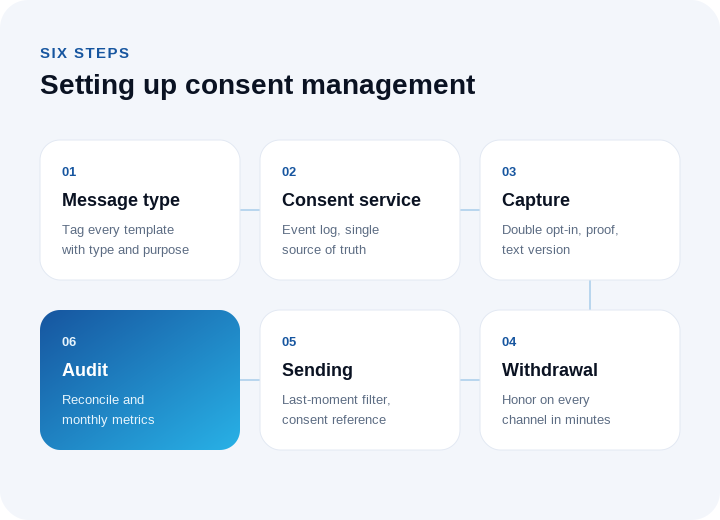
- Message types and purposes: List all templates, give each a type and purpose, and separate the mixed ones.
- Consent service: Build a single source of truth on event-based, immutable records.
- Capture points: Forms, the portal and the call center write to the same service; add double opt-in.
- Withdrawal: Build a one-step exit on every channel and measure propagation time.
- Send integration: The campaign tool queries live and writes a consent reference.
- Audit: Report reference coverage and opt-out rate monthly.
To measure how people use preference screens, see our guide to customer journey mapping and behavior analytics.
We recommend reading: What Is CRM? Customer Records, the Funnel and Sales Forecasting Guide
We recommend reading: How to Design an E-Commerce Promotion and Coupon Engine: Order, Margin Floor and Abuse Prevention Guide
We recommend reading: How to Design a Loyalty Points Program: Earn Rules, Ledger, Expiry and Liability Guide
We recommend reading: How to Manage Ecommerce Product Reviews and Ratings: Collection, Moderation, Weighted Averages and Metrics
We recommend reading: How to Design Transactional SMS and OTP Messages: Segments, Pumping Defense and Cost Guide
We recommend reading: How to Build a Customer 360 View: Customer Card, Data Freshness and Access Guide
We recommend reading: How to Handle Data Subject Requests (Access, Correction, Deletion) in Software: Data Map, Verification and Proof Guide
We recommend reading: How to Set Up Cookie Consent Management: Cookie Policy, Banner, Tag Loading and Measurement Impact Guide
Consent Management with İnovabil
At İnovabil our focus is building software from scratch, tailored to each company: CRM, ERP, e-commerce, web, mobile and integrations. We recommend settling layers like consent management at the requirements stage: which channels, which message types, which systems will connect to consent. Legal aspects are determined with your own legal counsel.
We built CRM, purchasing and mobile for Avcılar İnşaat; a purchasing system for İZBAN; logistics and shipment planning with wholesale order management for Karyak; and warehouse management plus a complaint and support management system for Sleepy. Send us a short note on your channels and systems, and let us map your consent flow together.
We recommend reading: Our software development process: step by step from analysis to launch
Frequently Asked Questions
What is customer communication consent management?
It is the software layer that records which channel and purpose a person agreed to receive messages for and since when, applies withdrawals, and checks every send.
Which fields should a consent record have?
Person ID, channel, purpose, status, UTC timestamp, source and proof, text version. Records are never deleted; each change is a new event row.
Is double opt-in mandatory?
That is a legal question; ask your legal counsel. In software, double opt-in verifies the address owner; in the example, 67.2% of submissions confirm, 70.1% with a reminder.
How fast should a withdrawal be applied?
For the legal deadline, consult your legal counsel. The technical target is minutes: in the example, cutting sync delay from 24 hours to 5 minutes drops unconsented messages from 40 to about 0.14.
Does the consent filter apply to transactional messages?
Generally no; classify with your legal counsel. Every template gets a type tag, and mixed templates that carry commercial content are treated as commercial.