

As your store grows, a small share of orders turns out to be orders that should never have shipped: placed with a stolen card, opened from someone else's account, or disputed after delivery with "I never ordered this". Ecommerce order fraud prevention aims to spot and set aside those orders before shipping without blocking honest customers along the way. The practical route is not a single yes-or-no verdict on a person but a weighted risk score built from several signals, with the score steering each order down one of three paths: pass, review or hold.
This article covers the defensive side, setting up risk score rules in your own store, and does not go into attack techniques. To deal with automated traffic at the network layer, read our bot traffic guide; for the technical design of taking payments, see our payment gateway guide. The subject here is judging the intent behind a single order. All figures are illustrative; they are not data from any real store, provider or industry.
What Types of Order and Payment Fraud Do Stores See?
Separating the types matters because each enters through a different door and is caught by different signals. The table below is conceptual; you fill in the detail from your own records.
| Type | In short | Who bears the loss | First defense |
|---|---|---|---|
| Stolen card use | Someone other than the cardholder places an order | Mostly the merchant (after a dispute) | 3D verification, address and amount signals |
| Account takeover | A real customer's account is in someone else's hands | Customer and merchant | Extra verification on a new device or address change |
| Return and promotion abuse | Repeated returns or misuse of coupons | Merchant | Account history, coupon limits, return-rate monitoring |
| Friendly fraud | The real buyer receives the order and then disputes the payment | Merchant | Keeping delivery proof and the order record |
For the promotion side, see our promotion and coupon engine guide, and for returns our returns management guide. This article focuses mainly on payment risk and the decision mechanism covered by the first two rows.
Which Signals Point to Risk?
No single signal is guilty by itself. A loyal customer sending a gift also ships to a different address. So each signal gets a weight and the weights add up to 100 points. The weights below are illustrative; you tune them with your own data.
| Signal | What it measures | Weight |
|---|---|---|
| Repeated payment attempts in a short time | 3 or more attempts within 10 minutes | 20 |
| Billing and delivery address mismatch | Different city or country | 15 |
| Amount deviation | More than 3 times the customer's or the store's average | 15 |
| Delivery address repetition | Several unrelated accounts using the same address | 15 |
| Provider signal | 3D verification failure or the provider's own risk flag | 15 |
| First order | New account, no history | 10 |
| Disposable email | A domain that hands out temporary addresses | 10 |
| Total | 100 |
The largest single weight is 20, which is below 30, the point where review begins. So no single signal can push an order into review or hold by itself. At least two signals are needed: the smallest pair, 10 + 10 = 20, still passes, while 15 + 15 = 30 lands in review.
How Is a Weighted Risk Score Calculated?
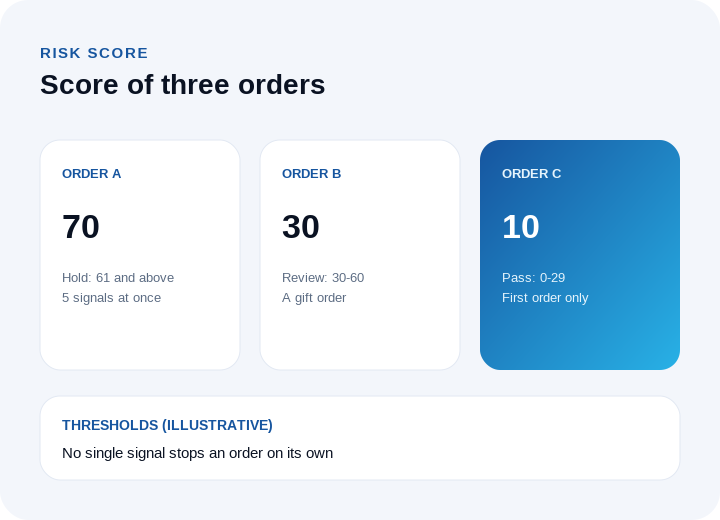
The score is the sum of the weights of the signals that fired. Let's work through three example orders; the bands are illustrative: 0 to 29 pass, 30 to 60 review, 61 and above hold.
| Order | Signals fired | Calculation | Score | Decision |
|---|---|---|---|---|
| A | New account, amount deviation, 4 attempts, disposable email, address mismatch | 10 + 15 + 20 + 10 + 15 | 70 | Hold |
| B | Loyal customer; different address for a gift and an unusually high amount | 15 + 15 | 30 | Review |
| C | First order only | 10 | 10 | Pass |
Order B shows the value of scoring: the system does not reject it, it asks a human. During review, the customer history and the order note will probably reveal a gift. Some situations are better handled by a rule than by a score; a definitive decline from the provider or a delivery address on a block list can decide directly. Keep rules few and make the score the main mechanism.
How Do You Choose the Threshold?
Choosing a threshold is a trade-off. Take an illustrative case: of 1,000 orders, 6 are fraudulent, and the average basket is ₺900. A fraudulent order that slips through costs the product value plus dispute, shipping and operations overhead: ₺900 + ₺120 = ₺1,020. An honest order wrongly declined costs the lost margin: at a 30% margin, ₺900 × 0.30 = ₺270 (the customer's later orders are not counted here; in reality the cost is higher).
Assume orders above a given score are declined automatically. Suppose the labeled breakdown of past orders looks like this:
| Threshold (decline above) | Fraud caught | Fraud missed | False declines | Net gain per 1,000 orders |
|---|---|---|---|---|
| >80 | 1 | 5 | 0 | 1 × 1,020 − 0 = ₺1,020 |
| >70 | 2 | 4 | 1 | 2,040 − 270 = ₺1,770 |
| >60 | 4 | 2 | 8 | 4 × 1,020 − 8 × 270 = 4,080 − 2,160 = ₺1,920 |
| >50 | 5 | 1 | 20 | 5,100 − 5,400 = −₺300 |
| >40 | 6 | 0 | 32 | 6,120 − 8,640 = −₺2,520 |
The net gain peaks at a threshold of 60 (₺1,920). Moving to a tighter threshold catches more fraud, but false declines grow much faster; at 50 the system turns loss-making. Two extra measures help when deciding: precision (how many of the declined orders were truly fraudulent) and recall (how many of the fraudulent orders were declined). At 60, the 4 + 8 = 12 declined orders include 4 fraudulent ones, so precision is 4 ÷ 12 = 33.3% and recall is 4 ÷ 6 = 66.7%. At 50, precision is 5 ÷ 25 = 20.0% and recall 83.3%.
This table is a template, not a fact: the fraud rate, basket size and margin vary from store to store, and so does the threshold. You should build your own table from your own past orders and labels.
How Do You Plan Manual Review Capacity?
The 30 to 60 band is not declined; it goes to human review. Work out the volume first: with 10,000 orders a month and 4% landing in review, that is 400 orders, and at 3 minutes each, 400 × 3 = 1,200 minutes = 20 hours, or about 20 ÷ 22 ≈ 55 minutes per working day. If you widen the band to 20 to 60 and the share rises to 12%, that is 1,200 orders × 3 min = 3,600 minutes = 60 hours, three times the load. So size the band to the reviewer hours you actually have.
In the same 1,000-order example, say 40 orders (4%) fall in the review band, of which 2 are fraudulent and 38 honest. The reviewer catches half of the fraud (1 order) and wrongly declines 1 of the honest ones (the catch rate is illustrative). The band's contribution is 1 × 1,020 − 1 × 270 = ₺750. The review cost is 40 × 3 = 120 minutes = 2 hours, at ₺300 an hour, ₺600. Net contribution: 750 − 600 = ₺150 per 1,000 orders. Manual review is a small gain and is very sensitive to the reviewer's accuracy, the hourly cost and the basket value. It becomes more worthwhile on high-value orders. In review, look at: customer history, address history, the order note, the sequence of payment attempts and, where needed, contact with the customer.
| Review practice | How to apply it |
|---|---|
| Decide before dispatch | Stock is reserved during review and dispatch waits; a target time such as 2 hours |
| Ordering | Highest score and highest amount first |
| Decision record | Approve, decline or ask the customer to verify, with a reason note |
What Do 3D Verification and Provider Signals Do?
3D verification asks the cardholder's bank for an extra check during payment; someone holding a stolen card finds it harder to get past this step. Providers also return their own risk assessments as signals. Feed these into your score: a failed 3D check or a provider risk flag adds 15 points. Who bears the loss, meaning how verification protects you in the event of a dispute, depends on the contract with your provider; this article promises no protection, so ask your provider and legal counsel for the details. The technical side of the 3D redirect is covered in our payment gateway guide.
How Do You Manage Chargebacks?
If a customer disputes a payment through their bank, the provider asks you for a defense. Filing deadlines and rules depend on the provider and your contract; learn them from your provider and legal counsel. What you can do is keep the evidence from the start:
- Order record: Time, amount, product, customer account and the order of payment attempts.
- Verification result: The 3D result and the provider response.
- Delivery proof: The shipment tracking record and delivery information.
- Communication log: Messages with the customer and review notes.
Use disputes as labels too: an order that draws a dispute is the most valuable feedback your scoring data can get. For matching after payment, see our payment reconciliation guide.
How Do You Avoid Losing Honest Customers to False Declines?
A false decline is not only ₺270 of lost margin; it is a lost customer. So build a "second chance" flow before declining: on a held order, offer the customer extra verification (for example a repeat 3D check or another payment route) and explain the reason politely. The person behind a fraudulent order usually cannot pass this step; an honest customer can.
In the example, assume half of the 8 honestly placed orders that were declined (4 of them) are rescued by the second chance, and that fraudulent orders cannot pass the extra verification: the gain rises by 4 × 270 = ₺1,080 per 1,000 orders and the threshold's net value becomes 1,920 + 1,080 = ₺3,000. This assumption is optimistic; measure your own second-chance rescue rate and use that. We leave this figure out of the payback calculation below. Do not use accusing language in the message: "extra verification is needed for security reasons" is enough.
How Do You Set Up the Feedback Loop?
A rule set is not built once and left alone, because fraud patterns and customer behavior change. Keep an outcome label for every order: fraudulent (by dispute or review outcome), honest (delivered, no dispute) or unknown. Weekly tasks:
- Labeling: Label the week's reviewed and disputed orders.
- Table refresh: Rebuild the threshold table with the labels from the last 8 to 12 weeks.
- Signal review: How often did each signal fire on fraudulent orders, and how often on honest ones?
- Change log: Record threshold and weight changes with dates; for that record, see our audit log guide.
If the fraud rate changes, the threshold must change too. In the example, if the rate falls from 6 to 3 per 1,000, the same thresholds catch 2 × 1,020 = ₺2,040; the review band contributes half of 1 fraudulent order, 0.5 × 1,020 = ₺510; false declines come to (8 + 1) × 270 = ₺2,430, and review costs ₺600. Net 2,040 + 510 − 2,430 − 600 = −₺480 per 1,000 orders: the system turns loss-making. If the fraud rate drops and the threshold is not recalibrated, scoring can become harmful.
How Is Payback Calculated?
With the threshold of 60 and the review band, leaving out the second chance, per 1,000 orders: automatic contribution ₺1,920, review contribution ₺750, review cost −₺600 = ₺2,070. To check: with no system the fraud loss is 6 × 1,020 = ₺6,120; with the system the remaining loss is 1 × 1,020 (the 1 fraud missed) + 9 × 270 (false declines) + 600 (review) = 1,020 + 2,430 + 600 = ₺4,050; the difference is 6,120 − 4,050 = ₺2,070 ✓.
At 10,000 orders a month that is ₺20,700. If setup is ₺180,000 (signal collection, scoring, a review panel, shadow mode and testing) and monthly upkeep is ₺4,500 (threshold and label review, 15 hours × ₺300), the monthly net is 20,700 − 4,500 = ₺16,200, and payback is 180,000 ÷ 16,200 ≈ 11.1 months. If the fraud rate halves and the threshold is not updated, the result turns negative as we saw above, so payback depends on regular tuning. Real figures vary with your fraud rate, basket and margin.
| Item | Calculation | Amount |
|---|---|---|
| Automatic blocking contribution | 4 × 1,020 − 8 × 270 | ₺1,920 |
| Review contribution | 1 × 1,020 − 1 × 270 | ₺750 |
| Review cost | 2 hours × ₺300 | −₺600 |
| Net per 1,000 orders | ₺2,070 | |
| Monthly (10,000 orders) | 2,070 × 10 | ₺20,700 |
| Monthly upkeep | 15 h × ₺300 | −₺4,500 |
| Payback | 180,000 ÷ 16,200 | ≈ 11.1 months |
How Do You Set Up Fraud Prevention in Six Steps?
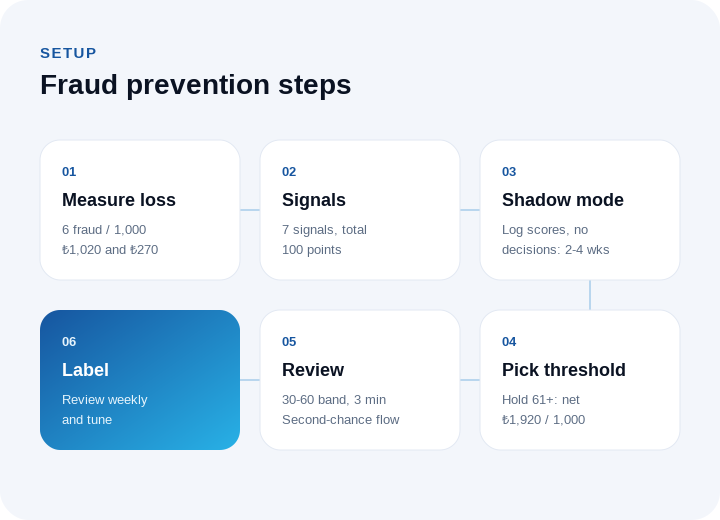
- Define and measure the loss: Work out the fraud rate, the cost of a missed fraud (₺1,020 in the example) and the cost of a false decline (₺270).
- Collect and score the signals: Seven signals and 100 points in total; no single signal should stop an order on its own.
- Run in shadow mode: For 2 to 4 weeks, write scores without affecting decisions, then compare against real labels.
- Choose thresholds with a table: Turn caught, missed and falsely declined counts at each threshold into net gain.
- Set up a review queue and a second chance: Calculate capacity in hours; offer extra verification before declining.
- Label and tune weekly: Turn disputes and review outcomes into labels and keep thresholds current.
What Common Mistakes Do Teams Make in Fraud Prevention?
- Declining on a single signal: Shipping to a different address or a first order is not a crime in itself.
- Looking only at fraud that slipped through: The cost of false declines stays invisible, so the threshold ends up tighter than it should be.
- Choosing the threshold once and leaving it: Fraud rates and customer behavior change; if the table is not refreshed, scoring loses money.
- Skipping shadow mode: Putting rules straight into production blocks honest customers in the first weeks.
- Not calculating review capacity: The queue builds up, orders wait for days and customers give up.
- Keeping personal data indefinitely: Data used in scoring is personal data too; ask legal counsel about retention periods and scope.
We recommend reading: How to improve ecommerce checkout
We recommend reading: What is an order management system?
E-Commerce and Integration with İnovabil
At İnovabil our focus is building custom software from scratch for your company: custom software, e-commerce, CRM, ERP, web, mobile and integration. Within our e-commerce and integration services we design order, payment, shipping and ERP connections around your workflow; order decision steps such as risk scoring and a review flow can also be written down together during requirements. You handle your payment provider's risk tools and contract terms with your own provider; we do not offer a fraud prevention product or any accuracy guarantee.
We have built CRM, purchasing and mobile for Avcılar İnşaat; a purchasing system for İZBAN; a prepaid cargo system for Kredili Kargo; logistics and shipment planning with wholesale order management for Karyak; and warehouse management with a complaint and support management system for Sleepy. Send a short summary of your current order flow and the dispute and fraud examples you have seen; let's work out the signals and the decision flow together.
We recommend reading: Our e-commerce development service
Frequently Asked Questions
What is ecommerce order fraud prevention?
It is the process of assessing orders before dispatch and setting aside or reviewing those likely to be fraudulent. Signals are weighted into a risk score, and the score decides whether an order is passed, reviewed or held.
How do you choose a risk score threshold?
For each threshold, take the number of fraudulent orders caught, fraudulent orders missed and honest orders wrongly declined from your own labeled history, multiply them by their costs and compare the net gain. Lowering the threshold catches more fraud but grows false declines much faster; the best net gain is usually somewhere in the middle.
When does manual review create value?
When the fraud rate in the reviewed orders is high, baskets are large and the reviewer is accurate. With small baskets and low accuracy, review cost can eat the gain, so size the band to your review hours.
If I use 3D verification, does the provider bear the loss?
That depends on your contract with the provider, and no promise can be given here. 3D verification reduces risk, but ask your provider and legal counsel which conditions determine liability in a dispute.
Does risk scoring raise personal data issues?
The address, email and device information used in scoring is personal data, and there may be obligations around profiling and automated decisions. Consult your legal counsel on data protection and automated decision details; this article is not legal advice.