

"How much does a mobile app cost?" has no single answer, because a mobile app is not a product but a scope. The same phrase "an ordering app" can mean a three-screen storefront or a system with ERP integration, notifications and an admin panel. Mobile app development cost is the scope turned into effort, and the effort multiplied by the team rate to become money; the upkeep and infrastructure after launch are part of the same calculation.
In this guide we explain what mobile app cost consists of, how to calculate it, the three-year total cost, the single-platform versus two-platform decision, the difference between a mobile app and a mobile-friendly website, how an MVP lowers cost, and the hidden costs. All figures are illustrative; they are not real prices or market-rate claims.
What Does Mobile App Cost Consist Of?
Eight factors decide the cost. Write down your decision on each before collecting quotes; this lets quotes be compared on the same scope.
| Factor | What it changes |
|---|---|
| Platform | iOS only, Android only or both; doing both together raises effort |
| Number of screens and functions | Every screen and business rule means design, development and testing effort |
| Backend and admin panel | The system where data is kept and managed; in most projects one of the biggest items |
| Design | User flows, screen drafts and visual design |
| Integrations | Connections with ERP, payment, maps, shipping and other systems |
| Notification, map and payment services | Setup of external services and their usage fees |
| Testing and launch | Testing on different devices, store accounts and the release process |
| Upkeep | Keeping up with system versions, bug fixing and improvements |
How Is Mobile App Cost Calculated?
The calculation is simple: the scope is split into work items, each item gets an effort in person-days, the total is enlarged by an uncertainty buffer and multiplied by the daily team rate. We explained the general method for software project cost in our cost guide; here we apply the same method to a mobile app.
Example (illustrative): suppose the scope of an ordering app is as follows:
| Work item | Effort (person-days) |
|---|---|
| Login and profile | 5 |
| Product list and search | 8 |
| Cart and orders | 10 |
| Notifications | 4 |
| Backend and admin panel | 15 |
| ERP integration | 10 |
| Testing and launch | 8 |
| Total | 60 |
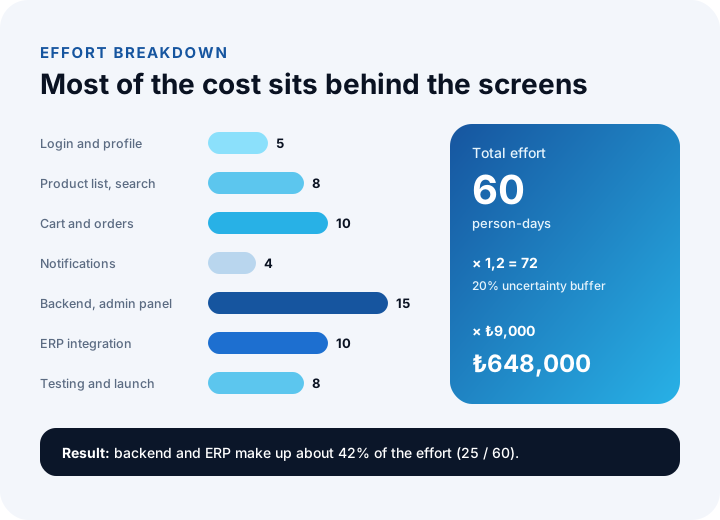
With a 20% buffer the effort is 60 × 1.2 = 72 person-days. At a daily team rate of ₺9,000 the development fee is 72 × 9,000 = ₺648,000. The backend and admin panel plus the ERP integration make up 25 person-days of the total effort, about 42%; in other words, most of the cost sits in the system outside the screens.
What Is the Three-Year Total Cost of a Mobile App?
Cost does not end when the app goes live; upkeep, infrastructure and updates continue every year. Make the comparison on a three-year total.
In the example, let yearly upkeep be 15% (648,000 × 0.15 = ₺97,200) and yearly infrastructure ₺36,000 (illustrative):
| Item | Calculation | Amount |
|---|---|---|
| Development | 72 × ₺9,000 | ₺648,000 |
| Upkeep (3 years) | 3 × ₺97,200 | ₺291,600 |
| Infrastructure (3 years) | 3 × ₺36,000 | ₺108,000 |
| Three-year total | ₺1,047,600 |
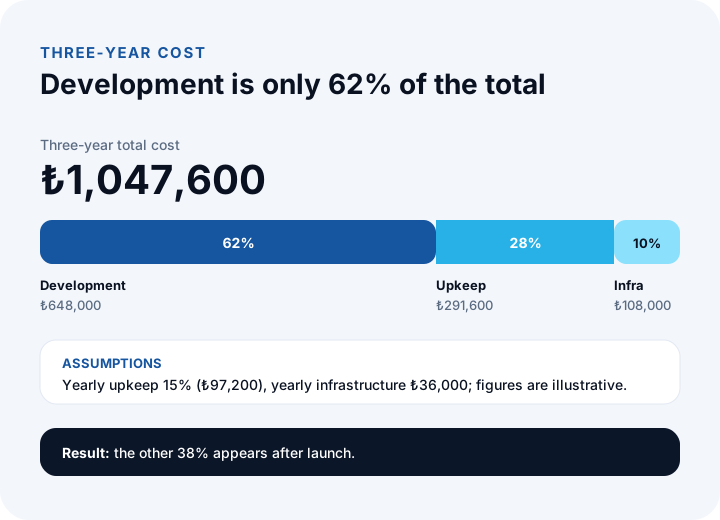
The development fee is about 62% of the total; the other 38% appears after launch. That is why building the budget only on the development quote is incomplete.
When choosing the upkeep percentage, think about how much the app will change. A lower rate is realistic for a calm internal tool, and a higher one for a multi-user app that keeps receiving new features. Upkeep is not just bug fixing; it also covers keeping up with system versions, security updates, monitoring and small improvements. Compare the percentage together with the scope written in the quote, not by guesswork.
Single Platform or Two Platforms?
Look at which devices your users use; starting with one platform is often less risky than doing both. If you will target both platforms together, the approach is the real decision that sets the effort.
| Approach | Upside | Watch out for |
|---|---|---|
| Single platform | Lower effort and a faster first release | Users on the other platform are left out |
| Two platforms, separate code | Full fit with each platform's habits | Effort and upkeep can approach double |
| Two platforms, shared codebase | One team, lower total effort | Some platform-specific features need extra work |
Which approach suits is decided at the analysis stage according to the app's features and your target audience.
Mobile App or Mobile-Friendly Website?
You do not always need an app for phone access; usage frequency and device features decide. An app suits a job that is used daily and benefits from notifications and device features (camera, location); for a rarely used, content-heavy job a mobile-friendly website is often enough.
| Topic | Mobile app | Mobile-friendly website |
|---|---|---|
| Cost | Usually higher; includes stores and upkeep | Usually lower |
| Notifications and device features | Full support | Limited |
| Access | Installed from a store | Opened by address and search |
| Offline use | Strong | Limited |
| Best suited to | Field teams, frequently used ordering and tracking apps | Content, promotion, rarely used forms |
We recommend reading: How to build a mobile app: from idea to launch
How Does an MVP Lower Mobile App Cost?
An MVP (minimum viable product) puts only the core functions in the first release; the remaining features are added according to user feedback. This approach lowers both cost and risk.
In our example, if notifications and the ERP integration are left to a second phase, effort becomes 60 − 4 − 10 = 46 person-days. With a 20% buffer that is 46 × 1.2 = 55.2 person-days, and 55.2 × 9,000 gives a development fee of ₺496,800. Compared with the full scope, the difference is 648,000 − 496,800 = ₺151,200, about 23%. Notifications and the integration are added once the core works and real use has been seen.
How Is a Mobile App Budget Split into Phases?
Splitting the budget into phases ties spending to user feedback. The first phase releases the core, and later phases are planned according to the need real use shows.
| Phase | Scope | Calculation | Amount |
|---|---|---|---|
| Phase 1 (MVP) | Login, product list, cart and orders, backend, testing and launch | 46 × 1.2 × ₺9,000 | ₺496,800 |
| Phase 2 | Notifications and ERP integration | 14 × 1.2 × ₺9,000 | ₺151,200 |
| Total | ₺648,000 |
The total does not change; but after the first phase you have seen real users and the scope of the second phase may change. Some features may turn out to be unnecessary, in which case that part of the budget is never spent.
What Information Should You Prepare to Get a Good Quote?
The clearer the scope a quote rests on, the sounder the estimate. Before sending it to a company, prepare a one-page scope summary:
- Users and devices: Who will use the app, on iOS or Android, and how often?
- Main tasks: Which three or four jobs will the user do in the app?
- Existing systems: Which systems need to exchange data (ERP, accounting, website)?
- Management need: Who will manage the data, and from which panel?
- Timeline and budget range: By when, and in what range are you thinking?
A quote that arrives without this information rests on the company's assumptions. Be sure to ask which assumptions are written into the quote.
What Are the Hidden Costs of a Mobile App?
- Store accounts and release: Developer accounts are needed to publish on the app stores and are renewed regularly; verify current fees on the stores' official pages.
- External service fees: Services such as notifications, maps, SMS and payments can be charged as usage grows.
- System version compatibility: Phone operating systems are updated every year, and keeping the app compatible needs upkeep effort.
- Store review process: Releases and updates are subject to store review; the timeline must allow for it.
- Support and training: User support and team training are separate work.
- New features: Requests that arrive once use begins usually mean new effort.
Why Do Quotes Differ So Much from One Another?
Quotes for the same app can come in at half, or even double, one another. The difference usually comes not from pricing policy but from what the quote covers:
- One covers the backend and admin panel, the other only the mobile screens.
- One has calculated for a single platform, the other for two.
- One has included testing and store release in its effort, the other has left them out.
- One has no uncertainty buffer, the other has 20%.
- Upkeep and infrastructure are included in one quote and a separate yearly item in the other.
How Are Mobile App Quotes Compared?
Compare quotes on the same scope, not on the amount: which platforms, screens and integrations are included, is the backend and admin panel in the quote, and what is the scope of testing, release and upkeep? Remember that the lowest quote often leaves out the backend, testing or upkeep. We covered quote comparison and contract clauses in detail in our how to get custom software developed guide.
What Mistakes Are Common in Calculating Mobile App Cost?
- Looking only at the screen count: Most of the cost sits in the system behind the screens.
- Forgetting the backend: Without a panel and a server where data is managed, the app does not work.
- Leaving upkeep out of the budget: About 38% of the three-year total appears after launch.
- Fitting everything into the first release: An MVP approach lowers both risk and cost.
- Taking the uncertainty buffer as zero: Leaving a buffer for every unclear work item gives a realistic budget.
We recommend reading: What Is a Software Maintenance and Support Agreement (SLA)? Scope, Response Times and Fees
Recommended reading: What Is an MVP?
Mobile App Development with İnovabil
At İnovabil we build mobile apps for iOS and Android that talk to your backend systems. The mobile applications that work alongside the CRM and purchasing systems we built for Avcılar İnşaat are examples of this kind of app used by field teams and customers.
We give a price not as a fixed list in advance but as a written quote split into work items at the end of the analysis, and we set the MVP scope together with you. Describe your app idea in a few sentences, and we will first send you the scope and our approach.
We recommend reading: Our mobile app development service
Frequently Asked Questions
How is mobile app cost calculated?
The scope is split into work items, each gets an effort in person-days, the total is enlarged by an uncertainty buffer and multiplied by the daily team rate. Upkeep and infrastructure after launch are added to reach the three-year total cost.
What determines the cost of a mobile app the most?
Not the number of screens but the backend system, the admin panel and the integrations. In the example calculation, the backend and the ERP integration make up about 42% of the total effort.
How much is the yearly upkeep cost of a mobile app?
Upkeep is often planned as a percentage of the development fee; 15% was used in the example. The real rate depends on the scope and the contract, so the upkeep scope should be written in the quote.
How much does an MVP lower the cost?
Starting with core functions and leaving features such as notifications and integration to a second phase reduces effort. In the example calculation a 60 person-day scope falls to 46 person-days and the development fee drops about 23%.
Should I build a mobile app or a mobile-friendly website?
For jobs that are used daily and benefit from notifications and device features, an app; for rarely used, content-heavy jobs, a mobile-friendly website is often enough. The decision depends on usage frequency and the device features you need.