

"We want to commission a piece of software, but we do not know where to start." Most custom software projects begin with that sentence, and the trouble that follows usually comes not from the code but from the uncertainty at the start: an unclear scope, quotes that cannot be compared, missing contract clauses and surprises at handover. Getting custom software developed is a predictable job when the preparation is done properly.
This guide is written from the side of the party commissioning the software, which is you. We cover the preparation before you start, how to choose the right company, how to compare quotes, the clauses a contract should contain, the payment plan, what is expected of you during the project, the handover check and the common mistakes. Example figures are illustrative, and this article is not legal advice.
How Do You Get Custom Software Developed?
In six steps: first the need and the goal are written down, then a suitable company is chosen, quotes are compared against the same scope, a contract is signed, the software is built and accepted in parts, and support and upkeep continue after release.
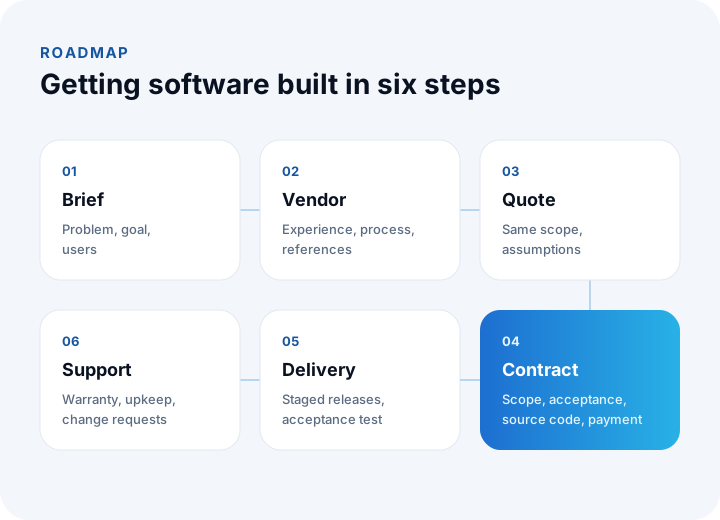
We covered what custom software is and how it differs from off-the-shelf software in our decision guide. This article is for businesses that have chosen custom software and want to know how to manage the process.
We recommend reading: Our custom software development service
What Preparation Should You Do Before Commissioning Software?
First, write a one-page brief. A brief tells the company not "what you want" but "which problem you want to solve"; how the solution looks is designed together.
- Problem and goal: Which job do you do by hand or with errors today, and how much should the software improve it? Write it measurably if you can: "order entry should drop from 12 minutes to 3."
- Users: Who will use the software, on which devices and how often?
- Existing systems: Which software and files do you work with, and which of them will need to exchange data?
- Timeline and budget range: What do you need by what date, and what is your upper limit? Giving a range makes it easier for the company to propose a fitting solution.
- Decision maker and owner: Who has the last word on the project, and who is the day-to-day contact?
The brief may well be incomplete; the aim is not a perfect document but a shared starting point. Drawing out and prioritizing requirements in detail is the job of the analysis stage you carry out with the software company.
We recommend reading: How to do software requirements analysis: a guide with templates
Should You Build In-House, Hire an Independent Developer or Use a Software Company?
There are three routes and none is right for every business; the choice depends on the size and continuity of the project and the management capacity you have.
| Route | Strength | Watch out for |
|---|---|---|
| In-house team | The team knows the business best; continuous development and fast changes | Hiring, management and the risk of the team leaving are your responsibility |
| Independent developer | Flexible and fast on small, well-defined jobs | The work depends on one person; design, testing and upkeep need separate thought |
| Software company | A team takes on analysis, design, development, testing and upkeep; less dependence on individuals | Scope, contract and communication style must be settled up front |
For projects that join several systems, must last for years and need maintenance, a software company is the more predictable route for most businesses. For a small, short-lived tool, an independent developer may be enough. Whichever route you take, the preparation, quote and contract steps in this article apply in full.
How Do You Choose the Right Custom Software Company?
Before price, look at six areas: relevant experience, process, team, communication, support after delivery and ownership. You can ask about all of them in one meeting.
| Area | Question to ask |
|---|---|
| Experience | Has it done similar work before? Can you see a live example and speak with that customer? |
| Process | Can it explain its analysis, design, development and testing steps? What will you see, and when? |
| Team | Who will work on it, and who is the project lead? Does the work depend on a single person? |
| Communication | Are there weekly updates and demos? Whom do you reach, and through which channel, when there is a problem? |
| Support and upkeep | How does it handle bugs and change requests after release? Is the upkeep scope written down? |
| Ownership | Who owns the source code, the design and the data? What will be delivered to you? |
A reference is the most reliable signal. If the company has products that run live and that it has kept running for years, that suggests it knows not only how to deliver software but also how to operate it. Ask to speak with customers to verify reference claims.
How Do You Compare Software Quotes?
Compare quotes on the same scope, not on the amount. When three different quotes arrive for the same brief, the differences are usually in the assumptions rather than the price.
| Topic | What to check |
|---|---|
| Scope | Which modules and screens are included, and which are explicitly out of scope? |
| Effort and timeline | How many person-days and weeks? How was the estimate made, and is there a buffer for uncertainty? |
| Assumptions | Which data and access is assumed to come from you? |
| Testing and acceptance | Is testing in the quote, and how will acceptance criteria be set? |
| Hosting and infrastructure | Are servers, backup and monitoring included, or a separate yearly item? |
| Upkeep and support | What is the warranty period, and what are the upkeep fee and scope afterwards? |
| Change pricing | How will changes in scope be priced? |
The lowest quote is often not the most complete one; missing testing, upkeep or infrastructure items come back to you as extra cost at the end of the project. To set the budget correctly, it helps to know what software project cost is made of.
We recommend reading: How to estimate software development cost
Which Clauses Should a Software Contract Contain?
A contract exists not out of distrust but to put shared understanding in writing. The eight clauses below are where custom software contracts most often run into trouble; settle the details with your legal advisor.
| Clause | Why it matters |
|---|---|
| Scope and exclusions | Prevents "that was included" arguments; everything is tied to a written list |
| Timeline and milestones | Ties progress and payments to objective points |
| Acceptance criteria | Defines "done" up front; it must be measurable |
| Intellectual property and source code | Explains who owns the software and the code, and what will be handed over to you |
| Confidentiality and personal data | Regulates the protection of your data and KVKK (Turkey's personal data protection law) obligations |
| Warranty and support | Sets how fast and at what fee defects are fixed after delivery |
| Change management | Defines how a scope change is requested and priced |
| Termination and transfer | Sets how work done so far is handed over to you if the job stops midway |
Source code ownership is the most commonly overlooked clause. Whether the code stays with you or with the company, how the license is granted and whether the code is handed over must be written out clearly. Left vague, this clause becomes the biggest obstacle when you want to part ways with the company.
How Is the Payment Plan Tied to Milestones?
Tie payment to approved deliveries, not to dates. That way every payment corresponds to work you have seen and accepted.
Example: for a project with a total development fee of ₺657,000 (illustrative; the dealer portal example from our cost article), a plan could look like this:
| Milestone | Share | Amount |
|---|---|---|
| Analysis approval | 20% | ₺131,400 |
| Design approval | 15% | ₺98,550 |
| Interim release approval (working core) | 30% | ₺197,100 |
| Release after acceptance testing | 25% | ₺164,250 |
| End of warranty period | 10% | ₺65,700 |
| Total | 100% | ₺657,000 |
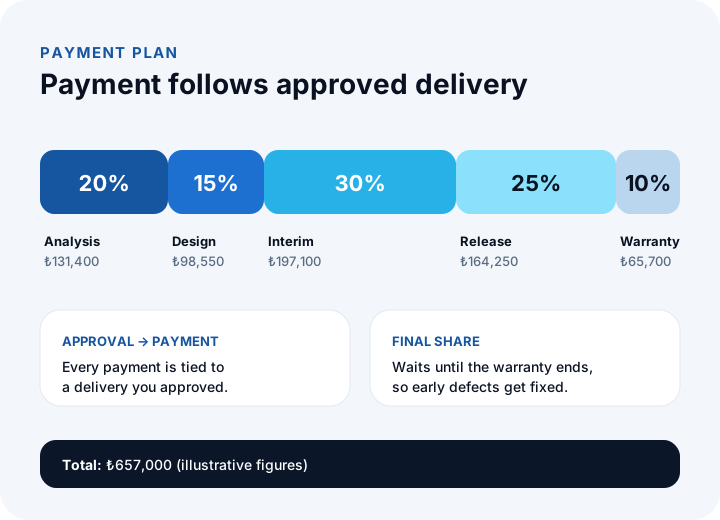
Leaving the last share until the end of the warranty period secures the fixing of issues that appear in the first weeks. The percentages vary by project; the principle is that every payment is tied to an output you have approved.
What Does the Customer Do During the Project?
The commissioning party is not a spectator but a partner in the project. Three duties decide the pace of most projects:
- Name a single decision maker. Conflicting requests from several people are the most common cause of delay.
- Give feedback quickly. Approve what you see in the weekly demo, or ask for a fix, in the same week; an unanswered question stops progress.
- Involve a real user. If the person who will use the software sees the screens during development, there are fewer surprises at delivery.
We recommend reading: What is the software development life cycle (SDLC)?
What Is Checked at Delivery and Acceptance Testing?
Acceptance is the verification that the agreed criteria are met with real data. If the criteria were written at the start, acceptance is a checklist rather than a debate.
- Acceptance criteria are tried one by one: each is run with your own data and a real user.
- Edge cases are tested: behavior in cancellations, returns, bad data and unauthorized access.
- Permissions and logs are checked: do role-based permissions and audit logs work as expected?
- Deliverables are completed: the source code named in the contract, environment details, admin accounts and documentation are handed over in full.
- Backup and rollback are verified: a data backup is taken before release and you know how to go back.
- User training is given: the team that will use the software is trained before go-live.
We recommend reading: How to do software testing: cases, boundary values and bug reports
What Happens After Delivery?
The work does not end when the software goes live; small fixes brought by real use arrive in the first weeks, and new needs emerge over time. That is why the warranty period, bug fixing and upkeep are discussed up front.
A warranty period is usually the time in which defects found after delivery are fixed free of charge; requests for new features are outside the warranty and priced separately. An upkeep agreement covers updates, monitoring, backup and small improvements within a regular framework. Keeping a written record of which job falls under which scope prevents arguments later.
We recommend reading: How to back up business data: RPO, RTO and the 3-2-1 rule
What Mistakes Are Common When Commissioning Software?
- Looking only at price. Choosing the cheapest quote without comparing scope and assumptions creates extra cost later.
- Not putting the scope in writing. Things agreed verbally are remembered differently as the project moves on.
- Not asking about source code ownership. Code that is not handed over creates dependence on the company.
- Expecting all the software in one delivery. Delivery in parts is the only way to catch defects early.
- Leaving users out of the process. What management wants and what the people in the field need can differ.
- Ignoring upkeep. The yearly upkeep and infrastructure cost of the software is part of the total budget.
We recommend reading: What Is Custom Software? Types, Examples, Advantages and Which Businesses It Suits
We recommend reading: Mobile App Development Cost: A Guide to Effort, Scope, MVP and Three-Year Total Cost
We recommend reading: What Is a Software Maintenance and Support Agreement (SLA)? Scope, Response Times and Fees
We recommend reading: How to choose a CRM: criteria, scoring, cost and demo guide
We recommend reading: What is procurement software? Process, approval matrix, quote scoring and three-way matching guide
We recommend reading: What is help desk software? Ticket life cycle, priority matrix, SLA compliance and team sizing guide
We recommend reading: How to move from Excel to software: signs, cost and data migration
We recommend reading: What is shipment planning software? Routes, vehicle load and proof of delivery
We recommend reading: What is low-code? Limits, risks and cost of low-code development
Recommended reading: What Is Technical Debt?
Getting Custom Software Developed with İnovabil
At İnovabil we run a project in six steps: analysis, design, development, testing, release, and upkeep and support. The first step is the analysis in which we clarify your need together; then come user flows and screen drafts, a clickable prototype and development in parts. We share the output of every step with you and move forward with your approval.
We have developed custom software projects such as CRM, purchasing and a mobile application for Avcılar İnşaat, a purchasing system for İZBAN and the prepaid shipping system for Sürat Kargo (Kredili Kargo), and we also run our own products Faprika, NetKasam and Shopiyz, which work live every day. Describe what you want in a few sentences, and we will first send you the scope and our approach in writing.
We recommend reading: Our software development process: step by step from analysis to release
Frequently Asked Questions
How do you get custom software developed, and where do you start?
First write the problem you face, your goal, the users and the existing systems into a one-page brief. Then do an analysis with a suitable company, evaluate quotes against the same scope, sign a contract, and have the software built and accepted in parts.
What is the most important criterion when choosing a software company?
There is no single criterion; experience with similar work, a clear process, the way of communicating, support after delivery and source code ownership are weighed together. Seeing live examples and speaking with those customers is the most reliable signal.
Who owns the source code of the software?
That is set by the contract. Ownership of the code, how the license is granted and whether the source code is handed over to you must be written down up front; settle the details with your legal advisor.
How should payment be planned?
Tie payment to approved deliveries, not dates: milestones such as analysis, design, interim release, release after acceptance testing and the end of the warranty period. Leaving the last share until the end of the warranty secures the fixing of early defects.
What is needed after the software goes live?
During the warranty period, defects found after delivery are fixed; afterwards an upkeep service covers updates, monitoring, backup and small improvements. New features are planned and priced separately, so keep the upkeep scope in writing from the start.