

Company vehicles usually live in three different places: registration papers and policies in a folder, fuel receipts in accounting, service records in a workshop logbook. Ask what a single vehicle really costs per month and the answer means merging three people's spreadsheets. Fleet management software brings the vehicle record, document expiry dates, driver assignment, fuel and mileage logs, maintenance and cost of light commercial vehicles, trucks and company cars into one system.
In this guide we explain what a vehicle record holds, how document and service alerts work, how fuel deviation is detected, how cost per vehicle and cost per kilometre are calculated, how to read the utilization rate, how to decide when to replace a vehicle, and how to set the system up in six steps. All figures belong to a hypothetical 25-vehicle fleet and are representative; the fuel unit price is not a current market price.
What Is Fleet Management Software?
Fleet management software is a business application that records the inventory, use and cost of the vehicles a company owns or leases, and raises alerts for expiring documents and upcoming service. It answers three questions: which vehicle is where and with whom, which document or service falls due when, and what each vehicle costs.
Its scope differs from neighbouring topics. Route and loading plans belong to shipment planning; the upkeep of machines on a factory floor is covered in maintenance management (CMMS); work orders in the field fall under field service management. Fleet software exchanges data with these, but the vehicle is at its centre.
We recommend reading: What is ERP? Modules, how it works and a selection guide
What Information Does a Vehicle Record Hold?
The vehicle record is a single entry tied to the licence plate, and every other record (fuel, service, fines, documents) attaches to it. The more complete the record, the more reliable the reports.
| Data group | Example fields | Used for |
|---|---|---|
| Identity | Plate, chassis no., make/model, type, year | Unique identification, vehicle ageing |
| Ownership | Owned, leased, purchase price and date | Depreciation, lease expense |
| Documents | Registration, inspection, insurance, tax | Expiry alerts |
| Usage | Current km, assigned driver, department | Assignment, cost allocation |
| Technical | Fuel type, reference consumption (L/100 km), tyre status | Fuel deviation, service plan |
| Cost | Fuel, service, insurance, tolls, fines | Cost per vehicle and per km |
How Do You Track Documents and Expiry Dates?
Every document gets an end date and every date gets an alert, so a vehicle is never taken out of service by surprise when a deadline passes.
- Inspection, compulsory insurance, comprehensive cover, registration and tax: the end date is kept on the record and tiered alerts are set up. A representative tiering: 30 days before expiry to the responsible person, 7 days before to the manager, a red status once it lapses.
- Driving licence: licence class and validity must match the vehicle type; the system should flag a mismatch when an assignment is made.
- Service: time- or mileage-based planned entries list upcoming work on the vehicle record.
Legal intervals and obligations vary by regulation and policy; confirm them with the relevant authority or insurer before entering them. A sample measure: with four document types, 25 vehicles carry 100 documents; if 96 are valid, document currency is 96%. The target is 100%, and a vehicle with an invalid document should not leave the yard.
How Are Driver Assignment and Custody Managed?
A custody (assignment) record shows which vehicle was with whom on which date. With start and end dates, tolls, fines and damage can be tied to the right person and department. For pool vehicles the record is kept per day or per shift, with mileage and vehicle condition entered at handover.
Passing a fine on to the driver depends on the employment contract and legal conditions, so settle it with HR and your legal counsel; the system's job is to show beyond dispute who had the vehicle at that moment.
How Do You Keep Fuel and Mileage Records and Find Fuel Deviation?
Fuel consumption is litres filled divided by kilometres driven, times 100: L/100 km = litres ÷ km × 100. Deviation is how far actual use is from the vehicle's reference consumption: deviation = (actual litres − expected litres) ÷ expected litres.
Three rules protect data quality: mileage cannot be lower than the previous entry, litres cannot exceed tank capacity, and a second fuel entry for the same vehicle on the same day raises a warning. Data can arrive by manual entry, by importing fuel card or station statements, or automatically from an in-vehicle device; the checks are the same whatever the source.
| Vehicle | Monthly km | Reference (L/100 km) | Expected litres | Actual litres | Actual (L/100 km) | Deviation |
|---|---|---|---|---|---|---|
| A | 3,000 | 10 | 300 | 310 | 10.3 | +3.3% |
| B | 2,800 | 9 | 252 | 260 | 9.3 | +3.2% |
| C | 3,200 | 12 | 384 | 480 | 15.0 | +25.0% |
| D | 2,500 | 8 | 200 | 205 | 8.2 | +2.5% |
With a 10% threshold only vehicle C raises an alert. The extra 96 litres at a representative ₺40 per litre come to ₺3,840 a month and ₺46,080 a year. The leak continues until the cause is found: a fault, wrong tyre pressure, driving habits or a data-entry error. Deviation is not an accusation; it is a trigger for inspection.
How Do You Calculate Cost per Vehicle and per Kilometre?
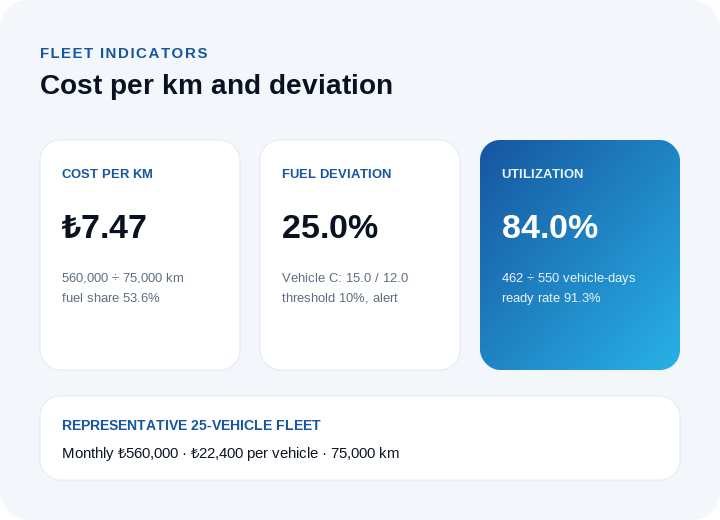
Cost per kilometre is the total vehicle expense of a period divided by the total distance driven in the same period: cost per km = total cost ÷ total km. Cost is not fuel alone; depreciation and insurance count too. The same logic applies to products in our product costing guide.
Example fleet: 25 vehicles at 3,000 km per vehicle per month, 75,000 km in total; average consumption 10 L/100 km and a representative fuel price of ₺40 per litre.
| Item | Calculation | Monthly amount | Share |
|---|---|---|---|
| Fuel | 75,000 × 10 ÷ 100 = 7,500 L × ₺40 | ₺300,000 | 53.6% |
| Service and tyres | Annual expense ÷ 12 | ₺60,000 | 10.7% |
| Insurance, inspection, tax | Annual expense ÷ 12 | ₺45,000 | 8.0% |
| Depreciation | Value loss ÷ 12 | ₺140,000 | 25.0% |
| Tolls and fines | Period records | ₺15,000 | 2.7% |
| Total | ₺560,000 | 100% |
Cost per vehicle is ₺560,000 ÷ 25 = ₺22,400 and cost per kilometre is ₺560,000 ÷ 75,000 ≈ ₺7.47. If we treat fuel, service and tolls (₺375,000) as variable and insurance plus depreciation (₺185,000) as fixed, the variable part is ₺5.00 per km and the fixed part is ₺7,400 per vehicle per month. That is why cost per km falls as usage rises:
- 2,000 km per vehicle a month (50,000 total): (₺250,000 + ₺185,000) ÷ 50,000 = ₺8.70 per km
- 3,000 km (75,000 total): ₺560,000 ÷ 75,000 ≈ ₺7.47 per km
- 4,000 km (100,000 total): (₺500,000 + ₺185,000) ÷ 100,000 = ₺6.85 per km
How Do You Manage the Service Plan, Breakdowns and Downtime Cost?
Vehicle service is done when whichever comes first, the mileage or the time condition, is reached. Take a representative interval of 10,000 km or 6 months: a vehicle driving 3,000 km a month reaches the km limit in 10,000 ÷ 3,000 ≈ 3.3 months; one driving 1,000 km a month would need 10 months, so the time limit (6 months) comes first. The system must watch both conditions together. We described the general service plan and work order logic in our maintenance management article; the difference here is that records attach to the vehicle record.
The real price of a breakdown is not only the invoice but the days the vehicle does not work. At a representative replacement-vehicle rental of ₺2,400 per day, with 8 breakdowns a month averaging 4 days and 16 planned services taking 1 day each, downtime is 8 × 4 + 16 × 1 = 48 vehicle-days. If planned service improves so that breakdowns fall to 4 and planned services rise to 20, downtime is 4 × 4 + 20 × 1 = 36 vehicle-days; 12 days × ₺2,400 = ₺28,800 less downtime cost a month.
How Do You Calculate the Fleet Utilization Rate?
Utilization shows on how many of the days a vehicle was available it actually worked: utilization = active vehicle-days ÷ available vehicle-days. In the example there are 22 working days a month; of 25 × 22 = 550 available vehicle-days, 462 are active, 48 are in breakdown or service and 40 are idle.
- Utilization: 462 ÷ 550 = 84.0%
- Technical readiness: (550 − 48) ÷ 550 = 502 ÷ 550 ≈ 91.3%
- Idle: 40 ÷ 550 ≈ 7.3%, roughly 1.8 vehicles of capacity
40 idle vehicle-days make it worth discussing a pooling arrangement and one vehicle fewer; if a vehicle is sold, the fixed cost of ₺7,400 a month goes away. For choosing indicators and thresholds, see our KPI guide.
What Does GPS and Telematics Data Add to Fleet Management?
Location, mileage and engine-hour records from an in-vehicle device reduce manual entry and verify data: the km on a fuel entry is compared with the device's km. On the dispatch side the same data shows delivery time and route deviation. Device choice and integration are a separate decision; the software should be device-independent and designed to take data through an API.
Tracking a driver's location is personal data processing. For notice, retention, off-duty tracking and employment law aspects of KVKK (Turkey's personal data protection law) and labour law, consult your legal counsel.
When Should an Old Vehicle Be Replaced?
Compare the annual total cost of ownership of the old and the new vehicle. In the representative case the vehicle drives 36,000 km a year; the new one costs ₺1,500,000 and is assumed to be worth ₺700,000 after 5 years (annual value loss 800,000 ÷ 5 = ₺160,000); the old vehicle loses ₺40,000 a year.
| Annual item | Old vehicle | New vehicle |
|---|---|---|
| Fuel (12.5 / 10 L/100 km × ₺40) | ₺180,000 | ₺144,000 |
| Service and tyres | ₺110,000 | ₺20,000 |
| Breakdown downtime (18 / 2 days × ₺2,400) | ₺43,200 | ₺4,800 |
| Insurance, inspection, tax | ₺20,000 | ₺35,000 |
| Value loss | ₺40,000 | ₺160,000 |
| Annual total | ₺393,200 | ₺363,800 |
The ₺29,400 difference, 7.5%, favours the new vehicle; cost per km is ₺10.92 against ₺10.11. But the result depends on the value-loss assumption: if the value after 5 years is 500,000, the new vehicle's annual value loss rises to ₺200,000, its total becomes ₺403,800 and the old vehicle is ₺10,600 cheaper. The value at which the decision flips is 1,500,000 − 5 × ₺189,400 = ₺553,000. Cost of capital and tax effects must be added separately; consult your financial advisor (certified accountant).
How Are Fines and Tolls Recorded?
Each fine or toll is recorded with date, time, plate and amount, and tied through the custody record to the driver and department at that moment. It then enters cost per vehicle, repeat patterns become visible, and payment and objection deadlines are not missed. Deadlines and procedures follow the relevant authority's announcements; the system only keeps a follow-up date. If tolls are allocated by shipment or customer, trip cost becomes clear as well.
How Much Does Moving from Spreadsheets to Fleet Software Save?
The gain comes from three places: labour, early detection of fuel deviation and reduced downtime. Representative labour: 200 fuel receipts a month × 3 minutes = 600 minutes = 10 hours; merging km and reports 14 hours; document follow-up 6 hours; 30 hours in total. With the system this falls to 8 hours. The 22 hours saved × ₺300 = ₺6,600.
- Labour saving: ₺6,600
- Fuel deviation caught early (one vehicle): ₺3,840
- 25% of the downtime reduction (₺28,800 × 25%): ₺7,200
- Gross monthly benefit: ₺17,640; running cost ₺4,000; net ₺13,640
With an investment of ₺240,000, payback is 240,000 ÷ 13,640 ≈ 17.6 months. If the downtime saving never materialises, net falls to ₺6,440 and payback stretches to about 37.3 months; build the case on downtime and deviation. For the general steps of moving off spreadsheets, read our guide on moving from Excel to software.
How Is Fleet Management Software Set Up in Six Steps?
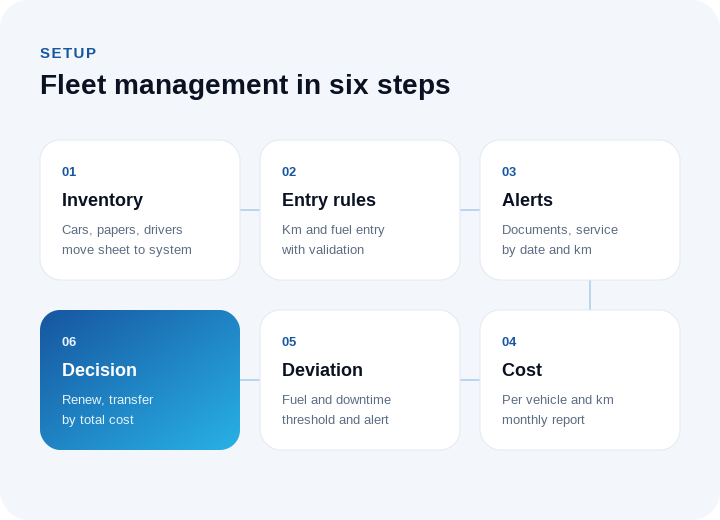
- Inventory: Move all vehicle, document and driver data from spreadsheets to the system, completing gaps as you go.
- Entry rules: Decide who enters km and fuel, and set the validation rules.
- Alerts: Set up tiered alerts for documents and service.
- Cost: Attach each cost item to a vehicle and produce a monthly cost per vehicle and per km report.
- Deviation: Set thresholds for fuel and downtime; review vehicles above them monthly.
- Decision: Use annual total cost of ownership to decide on renewal, transfer and fleet size.
We covered how cost items and scope trade-offs affect a software project in our software project cost guide.
Fleet and Operations Software with İnovabil
At İnovabil our focus is building software from scratch, tailored to the company: custom software, ERP, CRM, e-commerce, web, mobile and integration. How fleet data should talk to your ERP, accounting or dispatch system is settled during requirements analysis; if an off-the-shelf solution is enough, we suggest comparing it in writing as well.
We built logistics and shipment planning with wholesale order management for Karyak, shipment planning for Bofigo and a Sürat Kargo prepaid cargo system for Kredili Kargo; we also built CRM, purchasing and mobile for Avcılar İnşaat and a purchasing system for İZBAN. These are not fleet management products; they show our experience with operations and data flows. Send a short summary of your fleet processes and we will scope it together first.
We recommend reading: Our software development process: step by step from analysis to launch
Frequently Asked Questions
What is fleet management software and what is it for?
It is software that brings a company's vehicle records, document expiry dates, custody, fuel and km logs, service and cost into one place. It alerts you to expiring documents and upcoming service and shows cost per vehicle and per kilometre.
How is cost per kilometre calculated?
Fuel, service, insurance, depreciation, tolls and fines are added up and divided by the total kilometres of the same period. In the example ₺560,000 ÷ 75,000 km ≈ ₺7.47; as usage rises, fixed costs spread over more kilometres and the figure falls.
How is fuel deviation detected?
Actual litres are compared with the expected litres calculated from km and the vehicle's reference consumption. If the difference exceeds a set threshold (10% in the example) an alert is raised; the cause may be a fault, driving habits or a bad entry.
Is GPS tracking mandatory, and what legal points matter?
It is not required for fleet management; manual entries or fuel card data also work. If a driver's location is tracked, personal data and employment law obligations apply; consult your legal counsel for the details.
When should an old vehicle be replaced?
Compare annual total cost of ownership (fuel, service, downtime, insurance and value loss) for the old and new vehicle. The result is very sensitive to the expected resale value; in the example, below 553,000 keeping the old vehicle is cheaper.