

A business that sells air conditioners, elevators, safes, industrial machines or network equipment does not finish its job at the sale; the real customer experience starts when the technician knocks on the door. The fault call arrives by phone, the job is typed into a spreadsheet, passed to the technician in a message, the van goes back to the warehouse if a part is missing, the customer's signature stays on paper and the invoice goes out days later. Field service management software pulls this chain into one work order: it takes the request, picks the right technician and route, ties the part to the van, collects evidence on site and prepares the invoice at closure.
In this guide we cover the work order life cycle, dispatch and route calculations, van stock, offline mobile work, the metrics to track, the payback calculation and a six-step rollout. The example figures are representative; they are not the average of any real business or sector.
What Is Field Service Management Software?
Field service management software is the system that plans, runs and records installation, maintenance, repair and inspection work done at the customer's location, from request to invoice. It has a planning screen in the office, a mobile app on the technician's phone and a shared work order record between them.
The core of the system is the work order: customer, address, asset history, fault description, priority, required skill, parts used, time spent, photos and signature sit in one record. Office, technician and customer therefore look at the same information.
We recommend reading: Our ERP development service
How Does It Differ from Help Desk, Shipment Planning and a Maintenance Agreement?
Four concepts are often confused; what sets field service apart is that the work happens at the customer's site.
| Topic | Field service management | Help desk | Shipment planning | Maintenance agreement (SLA) |
|---|---|---|---|---|
| What is managed? | Work done on site | Desk-based support requests | Moving and delivering goods | Maintenance of software |
| Core record | Work order | Ticket | Trip and stop | Contract clause |
| Critical resource | Skills and spare parts | Knowledge base | Vehicle capacity | Response time |
| Main metric | First-time fix | First-contact resolution | On-time delivery, load factor | Uptime |
A request usually arrives by phone or portal and is tried at the desk first; if it cannot be solved remotely, it becomes a work order. We covered the desk side in our help desk software guide, delivery routes and load factor in our shipment planning article and the software's own maintenance commitment in our maintenance agreement guide.
How Does the Work Order Life Cycle Work?
A work order passes through nine states from request to closure, and every transition has an owner and a measured duration.
| State | Who moves it? | Measured time | Next step |
|---|---|---|---|
| Request received | Call centre, portal | Logging to assignment | Planned |
| Planned | Dispatcher or rule | Appointment window | Assigned |
| Assigned | System, technician accepts | Assignment to departure | En route |
| En route | Technician | Travel time | On site |
| On site | Technician | Job time | Completed or waiting for parts |
| Waiting for parts | Technician, warehouse | Waiting time | Rescheduled |
| Completed | Technician, customer sign-off | Job end to sign-off | Invoiced |
| Invoiced | System, accounting | Closure to invoice | Closed |
| Closed | System | Total resolution time | Satisfaction survey |
"Waiting for parts" is the most important warning light: every record there means a second visit.
How Are Technicians Dispatched and Routes Planned?
Dispatch first removes candidates who fail the mandatory conditions, then scores the rest. The mandatory condition is skill: a technician who cannot do the job is not a candidate however close they are. When an SLA deadline is near, arrival time is also an exclusion rule.
An example score for the remaining candidates: Score = 0.5 × proximity + 0.3 × load + 0.2 × part. Proximity score is 100 × (1 − travel minutes ÷ 40), load score is 100 × (1 − assigned jobs ÷ 6), and the part score is 100 if the required part is in the van, otherwise 0. The weights are representative.
| Candidate | Skill | Travel | Assigned jobs | Part | Score |
|---|---|---|---|---|---|
| T1 | Yes | 10 min | 4 | In van | 0.5 × 75 + 0.3 × 33.3 + 0.2 × 100 = 67.5 |
| T2 | No | 5 min | 1 | In van | Excluded |
| T3 | Yes | 25 min | 2 | No | 0.5 × 37.5 + 0.3 × 66.7 + 0 = 38.8 |
| T4 | Yes | 15 min | 3 | In van | 0.5 × 62.5 + 0.3 × 50 + 0.2 × 100 = 66.3 |
The job goes to T1; because T4 is almost equal, the dispatcher can override after looking at load and the day's route. The score does not decide, it recommends.
The route gain is a direct calculation. Say a technician does 5 jobs a day, works 45 minutes per job, spends 40 minutes travelling between jobs and loses 55 minutes a day to admin and waiting. The day: 5 × (45 + 40) + 55 = 480 minutes. Travel share is 200 ÷ 480 = 41.7% and the productive-work share (technician utilization) is 225 ÷ 480 = 46.9%. If grouped routes cut travel between jobs from 40 to 28 minutes (−30%), travel becomes 5 × 28 = 140 minutes and 60 minutes a day are freed. That time is either counted as a cost gain or given to new work: a job takes 45 + 28 = 73 minutes, so 60 ÷ 73 ≈ 0.82 more jobs fit and utilization rises to 5.82 × 45 ÷ 480 = 54.6%. It is never counted both ways.
We recommend reading: What is business process automation? Priority score, steps and payback
How Are First-Time Fix and Van Stock Managed?
First-time fix rate is the share of all jobs finished in one visit. With 12 technicians doing 5 jobs a day each, that is 60 a day and 60 × 22 days = 1,320 jobs a month; if 1,056 are finished on the first visit, the rate is 1,056 ÷ 1,320 = 80.0%, and the remaining 264 jobs (20.0%) fall into a second visit.
Separating the causes of repeat visits makes the action clear. In the example, of 264 visits, 132 (50.0%) were missing parts, 80 (30.3%) were skill gaps or wrong diagnosis, and 52 (19.7%) were the customer not being home and other causes. Parts are the largest item, so van stock comes first.
Which parts go in the van is decided by frequency of use. The example has 1,000 part uses a month, and the ten most-used items are distributed like this:
| Rank | Monthly use | Cumulative use | Cumulative share |
|---|---|---|---|
| 1 | 220 | 220 | 22% |
| 2 | 180 | 400 | 40% |
| 3 | 150 | 550 | 55% |
| 4 | 120 | 670 | 67% |
| 5 | 100 | 770 | 77% |
| 6 | 80 | 850 | 85% |
| 7–10 | 150 (60, 40, 30, 20) | 1,000 | 100% |
Putting the first six items in the van meets 85% of part demand on the spot. Replenishment for item 4: 120 uses a month ÷ 12 technicians = 10 units per technician; per week 10 ÷ 22 × 5 ≈ 2.3 units. With weekly restocking, target stock = weekly use + safety margin = 2.3 + 2 = 4.3, rounded up to 5 units. The capital tied up in van stock is 12 vans × ₺18,000 = ₺216,000; at a 20% yearly carrying cost that is ₺216,000 × 20% ÷ 12 = ₺3,600 a month. For part coding see our barcode system guide, and for reorder points our inventory tracking guide.
How Does the Mobile App Work Offline?
There may be no signal in a basement, on a construction site or in the countryside; a field app writes to the phone first. At the start of the day the technician downloads work orders, asset history and the van stock list; offline, records go into a local queue and are sent once, in order, when the connection returns.
- Conflict rule: If the office and the technician changed the same record, the last writer does not simply win; fields are merged one by one, and if the same field conflicts the dispatcher is alerted.
- Large files: Photos are compressed and sent from a separate queue. In the example 12 photos × 2.5 MB = 30 MB; on a 2 Mbit/s link that takes 30 × 8 ÷ 2 = 120 seconds. After compression, 12 × 0.8 = 9.6 MB takes 9.6 × 8 ÷ 2 = 38.4 seconds.
For the scope and steps of building the app, see our mobile app guide. Tracking technician location counts as employee data, so scope, retention and notice should be checked with a legal advisor under KVKK (Turkey's personal data protection law) and labour law.
How Are Field Evidence, Customer Sign-Off and Invoicing Connected?
Evidence collected on site is the basis for invoicing and disputes in the office. Before and after photos, the serial number of the part used, measurement values and the signature the customer draws on the screen are attached to the work order. A job becomes "completed" only if the required fields are filled.
Invoice lines come from the work order. Example job: labour 1.5 hours × ₺800 = ₺1,200, part ₺650, call-out fee ₺300; total ₺2,150 (excluding VAT, representative). Because lines are not retyped, time from closure to invoice shrinks and parts and labour are not forgotten. The official e-document process is covered in our e-invoice (e-Fatura) integration guide; for document rules consult your financial advisor (certified accountant) and Revenue Administration (GİB) sources.
Which Metrics Matter in Field Service?
Six indicators are enough; all rest on the same monthly example (12 technicians, 1,320 jobs).
| Metric | Formula | Example |
|---|---|---|
| First-time fix | Fixed on first visit ÷ all jobs | 1,056 ÷ 1,320 = 80.0% |
| Repeat visit rate | Second visits ÷ all jobs | 264 ÷ 1,320 = 20.0% |
| On-time arrival | Arrived in window ÷ all jobs | 1,122 ÷ 1,320 = 85.0% |
| Technician utilization | Productive time ÷ shift | 225 ÷ 480 = 46.9% |
| Travel share | Travel time ÷ shift | 200 ÷ 480 = 41.7% |
| Mean time to resolve (MTTR) | Total resolution time ÷ jobs | 60 ÷ 10 = 6.0 hours |
The mean is pulled by extreme values. Say ten jobs took 2, 3, 3, 4, 4, 5, 5, 6, 8 and 20 hours: total 60 hours, mean 6.0 hours; median (4 + 5) ÷ 2 = 4.5 hours. Track both. If utilization alone becomes a target, technicians are rushed and first-time fix falls; read the indicators together.
How Is the Payback of Field Service Software Calculated?
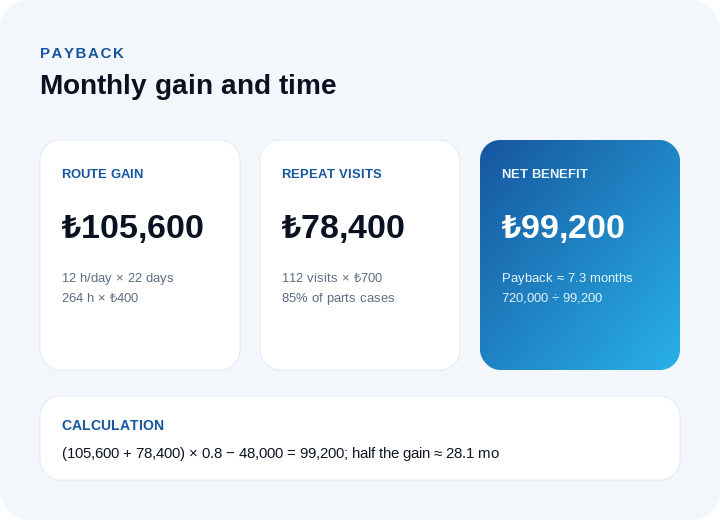
The calculation rests on two gain lines and a running cost. Say technician cost is ₺400 an hour (loaded, representative) and investment is ₺720,000 (80 person-days × ₺9,000).
- Route gain: 12 technicians × 60 minutes = 720 minutes = 12 hours a day; × 22 days = 264 hours; × ₺400 = ₺105,600 a month.
- Repeat visit gain: A repeat visit is 90 minutes (1.5 hours × ₺400 = ₺600) plus vehicle and fuel ₺100 = ₺700. The first six items prevent 85% of the 132 parts-related visits: 132 × 0.85 = 112.2 ≈ 112 visits × ₺700 = ₺78,400 a month. First-time fix rises to (1,056 + 112) ÷ 1,320 = 88.5%.
- Overlap allowance: The route gain also shortens repeat-visit travel, so the two lines partly count the same time. Conservatively 20% of the total is deducted: (105,600 + 78,400) × 0.8 = ₺147,200.
- Running cost: Software operation ₺44,400 + van stock carrying ₺3,600 = ₺48,000 a month.
Monthly net benefit is 147,200 − 48,000 = ₺99,200. Payback = 720,000 ÷ 99,200 ≈ 7.3 months. If only half the gains materialize: 147,200 × 0.5 − 48,000 = ₺25,600, so 720,000 ÷ 25,600 ≈ 28.1 months.
How Is Field Service Management Software Rolled Out?
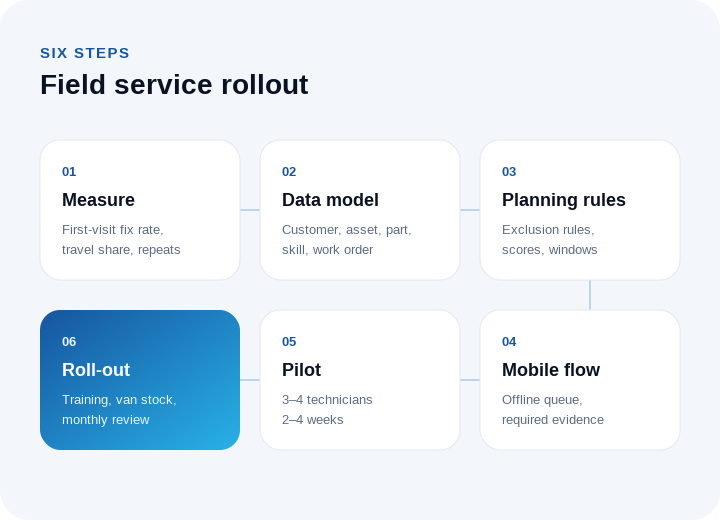
Six steps keep risk small; each step should end with a written output.
- Process and metrics: Draw the current flow; measure first-time fix, travel share and causes of repeat visits for a month. Our process mapping guide helps here.
- Data model: Define customers, addresses, assets, skills, parts and work order types.
- Planning rules: Write the exclusion rules, score weights and appointment windows.
- Mobile app and offline flow: Design required fields, evidence rules and the sync queue.
- Pilot: Work with three or four technicians for two to four weeks; compare indicators with the baseline.
- Roll-out and monitoring: Set up training, van stock routine and a monthly metrics review.
What Mistakes Are Common in Field Service Projects?
- Leaving offline work to the end: An app that fails without signal is abandoned within a week.
- Designing only for the dispatcher: If the technician's screen is slow, records are entered incompletely.
- Stocking vans without a calculation: It produces either idle capital or a second visit.
We recommend reading: Our software development process: from analysis to launch
We recommend reading: What Is Maintenance Management Software (CMMS)? Preventive Maintenance, Work Orders, Spare Parts and MTBF Guide
We recommend reading: What Is a Field Sales Mobile Order App? Visit Planning, Offline Mode, Credit Limits and Payback Guide
We recommend reading: What Is Appointment Booking Software? Calendar Model, Double-Booking Prevention, No-Show Rate and Payback Guide
We recommend reading: What Is Fleet Management Software? Vehicle Records, Fuel Deviation, Cost per Km and Replacement Guide
We recommend reading: What Is Warranty and After-Sales Service Management? Serial Tracking, Coverage Checks, Supplier Claims and Cost Guide
We recommend reading: How to Manage Spare Parts Inventory: Intermittent Demand, Critical Parts and Stock Levels Guide
Custom Software for Field and Dispatch Processes with İnovabil
İnovabil's focus is building company-specific software from scratch; we do not claim a ready-made field service product. Our recorded work relevant to teams operating in the field: logistics and shipment planning with wholesale order management for Karyak, shipment planning for Bofigo, warehouse management and a complaint and support management system for Sleepy, and CRM, purchasing and mobile for Avcılar İnşaat.
We can work out your field team's work order, planning and evidence flow together in the requirements stage and turn it into a written scope. Send a short summary of your team size, job types and current tools, and we will compare a ready-made solution with custom software, cost included.
Frequently Asked Questions
What is field service management software and what is it for?
It is the system that plans installation, maintenance and repair work done at the customer's site, from request to invoice. It brings the work order, technician dispatch, route, spare parts, mobile app, customer sign-off and invoicing into one record.
How does field service software differ from help desk software?
A help desk manages requests solved remotely from a desk. Field service software manages jobs that need a technician to visit the customer: skills, routes, parts and on-site evidence. Many businesses use both.
How can first-time fix rate be increased?
First separate the causes of repeat visits. In the example the biggest share is missing parts; putting the six most-used parts in the van lifts first-time fix from 80.0% to 88.5%. Skill-based dispatch and asset history also raise the rate.
Does a field service app work without internet?
It should. The app downloads the day's jobs to the phone, writes records to a local queue while offline and syncs when the connection returns. Photos are compressed; conflicts are merged field by field or sent to the dispatcher.
How many months does field service software take to pay back?
It depends on the business. With ₺720,000 investment and ₺99,200 monthly net benefit the example gives about 7.3 months; if only half the gains materialize, about 28.1 months. Recalculate with your own job counts, travel time and hourly cost.