

A customer says the device they have used for three months has stopped working. The sales record is in one spreadsheet, the invoice sits in accounting, and the service history is in a technician's notebook. Nobody can say at a glance whether the warranty is still valid; the device is repaired, the parts cost is charged to no one, and months later someone notices the same fault in other customers' units. Warranty and after-sales service management software links every product sold to its sales record by serial number, checks warranty coverage, turns a service request into a repair, replacement or return, and shows the cost by product, batch and supplier.
In this guide we explain how a warranty record is built, how coverage is checked, the service flow, how parts costs are claimed back from suppliers, warranty cost and the idea of a provision, how a serial-based failure cluster is caught, the revenue from paid service and extended warranty, the payback calculation and a six-step setup. Periods, rates and amounts are illustrative; they are not any company's or industry's data. For statutory warranty periods and consumer rights, consult your legal advisor.
What Is Warranty and After-Sales Service Management Software?
It is software that runs all the service work that arrives during and after the warranty period of a sold product in one chain of records. The links in the chain are: product and serial number, sales record, warranty start and end, service request, diagnosis, repair or replacement, parts used, supplier claim and customer feedback.
In businesses that sell machines, electronics and furniture, this work usually scatters across three places: sales knows the warranty date, service knows the fault, accounting knows the cost, but the three never meet in one record. The value of the software is that it joins them. We covered how stock and serial data are kept in our inventory tracking guide; the warranty record is built on that data.
We recommend reading: Our ERP software service
How Does It Differ from Returns, Help Desk and Field Service?
Four processes run side by side but answer different questions. Warranty management answers "is there an entitlement for this product, and to whom is the cost charged?"
| Process | Core question | Relation to warranty management |
|---|---|---|
| Warranty and after-sales service | Is the product covered, who bears the cost? | Core process |
| Returns management (RMA) | Will the product be taken back and refunded or replaced? | Can be an outcome of a warranty claim |
| Help desk (request management) | Who gets the incoming request, and how fast is it answered? | The front door of the claim |
| Field service | When does a technician go to the customer's site? | Applies when the repair is done on site |
Returns are detailed in our returns management guide, the request queue and SLA in our help desk article, and technician dispatch and routes in our field service article; we do not repeat them here. Maintenance and SLA for the software itself is a different subject, covered in our maintenance agreement article.
How Is a Warranty Record Linked to a Product and Serial Number?
Every unit sold gets a serial number, and the serial number is tied to the sales record, the customer, the batch and the warranty period. Without that link, warranty checking relies on the customer's word and a paper invoice.
The warranty period is a company policy and can vary by product group; the example below uses 24 months as an illustration. Set real periods and statutory minimums with your legal advisor.
- Serial number: SN-48213, batch P2.
- Sale (start) date: 12 January 2026; if your policy starts the warranty at delivery or installation, use that date.
- End: 12 January 2026 + 24 months = 12 January 2028; 730 days in total.
- Claim on 5 November 2027: remaining time 25 + 31 + 12 = 68 days; covered.
- Claim on 20 February 2028: expired; paid service.
Letting the system do the date arithmetic instead of a person prevents two errors: giving free service to an expired product and rejecting a product that is still covered.
How Is Warranty Coverage Checked?
An unexpired period is not enough on its own; whether the fault falls within the warranty also matters. Coverage rules are written in advance for each product group and run as a checklist when a claim is opened.
| Check | Covered example | Not covered example |
|---|---|---|
| Period | Claim opened before the end date | Expired product |
| Fault source | Manufacturing or material defect | Drop, liquid contact, misuse |
| Usage condition | Installation and maintenance per the manual | Unauthorised intervention, tamper marks |
| Document | Serial number matches a sales record | Serial number unreadable or no record |
| Consumable parts | Listed fault types | Parts that wear out naturally (per policy) |
A request outside coverage is not simply rejected; it becomes paid service, so the customer is not left without a solution and the business does not give away free labour and parts. The decision is recorded with photos and a diagnosis note, so there is evidence if the customer objects.
How Does a Service Request Become a Repair, Replacement or Return?
When a request is opened, the period and coverage are checked, the product is diagnosed and one of three outcomes is chosen: repair, replacement or return. The choice follows rules tied to the nature of the fault, parts availability and policy.
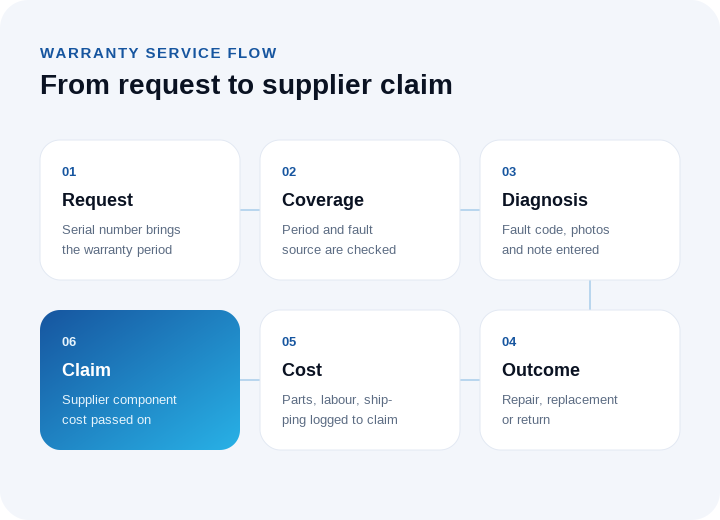
- Request: Opened with the serial number; the product and warranty period come in automatically.
- Coverage check: Period and fault source are checked; if outside coverage it goes to paid service.
- Diagnosis: Fault code, photos and a note are entered; the fault code is the raw material of later analysis.
- Outcome: Repair, replacement or return is chosen; the refund side moves to the returns process.
- Parts and cost: Parts used are deducted from stock and written to the claim with labour and shipping.
- Supplier claim: If the fault comes from a supplier's component, the parts cost is passed to the supplier.
A replacement product also gets a new serial number and a remaining warranty period; if this rule is not written down in advance, a warranty dispute follows every replacement.
How Are In-Warranty Parts Costs Managed and Claimed from Suppliers?
The customer does not pay for a repair under warranty, but the cost does not vanish. If the fault comes from a manufacturer's or supplier's component, the parts cost can be invoiced to them or offset. The terms are in the supply contract; consult your legal advisor on contract details.
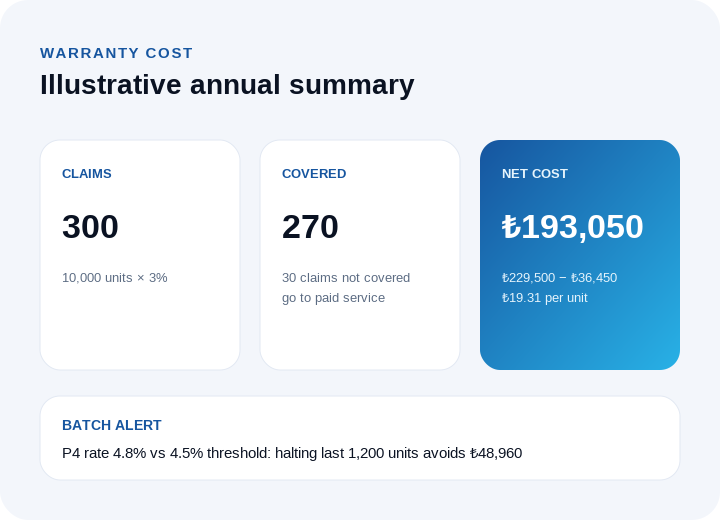
In the illustrative example, 10,000 products are sold in a year, the claim rate is 3% and the average repair costs ₺850 (parts ₺450, labour ₺250, shipping ₺150).
- Claims received: 10,000 × 3% = 300.
- Not covered: 10% = 30; covered 300 − 30 = 270.
- Gross warranty cost: 270 × ₺850 = ₺229,500.
- Caused by a supplier component: 270 × 40% = 108 claims; parts value to claim 108 × ₺450 = ₺48,600.
- Acceptance rate 75%: recovery ₺48,600 × 0.75 = ₺36,450.
- Net warranty cost: ₺229,500 − ₺36,450 = ₺193,050; ₺19.31 per product.
| Item | Calculation | Amount |
|---|---|---|
| Covered repair cost | 270 × ₺850 | ₺229,500 |
| Parts claimed from suppliers | 108 × ₺450 | ₺48,600 |
| Accepted recovery | ₺48,600 × 75% | ₺36,450 |
| Net warranty cost | ₺229,500 − ₺36,450 | ₺193,050 |
If the unit price is ₺5,000, revenue is ₺50,000,000 and net warranty cost is ₺193,050 ÷ ₺50,000,000 ≈ 0.39% of revenue. Without software, passing costs to suppliers is usually limited to what people remember; if recovery stays at 40% in the same example, 108 × ₺450 × 0.40 = ₺19,440 comes back and the ₺17,010 difference is lost.
How Are Warranty Cost and Provision Calculated?
A provision is a reserve set aside for warranty cost that has not yet arrived but is expected because of sales. Its management logic is simple: see, in the period of sale, the cost that the products sold will cause later.
Illustrative calculation: 4,000 products will be sold next period. Expected cost = 4,000 × 3% × 90% (covered share) × ₺850 = ₺91,800. The software supplies the historical claim rate and average cost by product group; how and in what amount this estimate is booked depends on tax and accounting rules, so consult your financial advisor (certified accountant).
How Does the Failure Rate and Serial-Based Early Warning Work?
An overall rate can look healthy while a problem builds in a single batch. That is why the rate is tracked by batch, serial range, supplier lot and fault code.
| Batch | Sold | Claims | Failure rate |
|---|---|---|---|
| P1 | 3,000 | 75 | 2.5% |
| P2 | 3,000 | 81 | 2.7% |
| P3 | 2,000 | 48 | 2.4% |
| P4 | 2,000 | 96 | 4.8% |
| Total | 10,000 | 300 | 3.0% |
The alert threshold is set at 1.5 times the baseline rate: 3% × 1.5 = 4.5%. P4's 4.8% exceeds it; the other three batches combined run at 204 ÷ 8,000 = 2.55%, so P4 is about 1.9 times that (4.8 ÷ 2.55). Of P4's 96 claims, 70 point to the same component code: 70 ÷ 96 ≈ 72.9%. When this table is kept with fault code and supplier lot, the root cause is found in the first weeks.
The value of early detection is concrete. If the alert arrives while the last 1,200 units of P4 are still unshipped, shipping is halted: 1,200 × 4.8% = 57.6 claims × ₺850 = ₺48,960 avoided. On the quality side this finding is tied to a corrective and preventive action; that process is covered in our quality control and nonconformance article.
Which Measures Are Tracked in Warranty and Service?
Five measures are enough, and all come from the claim record. Sample values are illustrative.
- Claim rate: 300 ÷ 10,000 = 3.0%; tracked by product and batch.
- First-repair resolution: If 243 of 270 covered claims close with one repair, 243 ÷ 270 = 90%; the other 27 are repeat claims.
- Service time: Average 9 days from intake to delivery; if 216 claims close within 7 days, target compliance is 216 ÷ 270 = 80%.
- Customer satisfaction: If 144 of 180 responses are satisfied, 144 ÷ 180 = 80%.
- Net warranty cost ratio: ₺193,050 ÷ ₺50,000,000 ≈ 0.39%.
Before turning a single measure into a target, look at its side effect: if half-repairs are done to shorten service time, first-repair resolution falls. Read the measures together.
How Do Paid Service and Extended Warranty Become Revenue?
The warranty process has two revenue doors: paid service for claims outside coverage, and an extended warranty or service package offered before the warranty ends.
In the example, the 30 uncovered claims turn into paid service at an average of ₺700: 30 × ₺700 = ₺21,000. If an extended warranty is sold to 800 customers at ₺400, revenue is 800 × ₺400 = ₺320,000; if 25% of them are expected to claim, 200 × ₺850 = ₺170,000 of cost arises and the contribution is ₺150,000 (46.9%; 150,000 ÷ 320,000). If the software sends an automatic offer 30 days before the warranty ends and sales rise by 200 units, the extra revenue is 200 × ₺400 = ₺80,000 and the contribution is ₺80,000 × 46.875% ≈ ₺37,500. Extended warranty pricing and sales should be reviewed with your legal advisor against consumer rules and contract terms.
How Is the Payback of Warranty Management Software Calculated?
The benefit comes from four items, all derived from the example above.
| Benefit item | Calculation | Annual amount |
|---|---|---|
| Higher supplier recovery | ₺36,450 − ₺19,440 | ₺17,010 |
| Paid service for uncovered claims | 30 × ₺700 | ₺21,000 |
| Cost avoided through batch alert | 1,200 × 4.8% × ₺850 | ₺48,960 |
| Extra extended-warranty contribution | ₺80,000 × 46.875% (≈ 46.9%) | ₺37,500 |
| Total benefit | ₺124,470 |
If the annual running cost is ₺30,000, the net annual benefit is ₺94,470, or ₺7,872.50 a month. If the investment is 20 person-days × ₺9,000 = ₺180,000, payback is 180,000 ÷ 7,872.5 ≈ 22.9 months. If a one-off event like the batch alert does not occur in a year, the benefit is ₺75,510, net ₺45,510, ₺3,792.50 a month, and payback stretches to ≈ 47.5 months. So redo the calculation with your own claim rate and a realistic event frequency.
How Is Warranty and Service Management Software Set Up?
- Clarify product and serial structure: Decide which products carry serial numbers and where batch information comes from.
- Write the warranty and coverage policy: Period, start rule, covered and uncovered examples; your legal advisor approves the legal text.
- Model the service flow: Define request, coverage check, diagnosis, outcome and cost steps together with fault codes.
- Connect stock, sales and accounting: Serial number from sales, parts from stock, cost to accounting; draw the integration points up front.
- Add the supplier claim: Collect claims by supplier with component and lot information.
- Measure and review monthly: Track claim rate, batch alerts and first-repair resolution every month.
What Mistakes Are Common in Warranty Management?
- Not linking the serial number to the sale: The warranty date stays disputed and the supplier claim has no basis.
- Leaving the fault code as free text: No analysis is possible and clusters stay invisible.
- Rejecting uncovered claims: Customers are lost; routing to paid service is both a solution and revenue.
- Not writing parts cost to the claim: The real warranty cost stays unknown and cannot be passed to the supplier.
- Settling for the overall rate: The problem batch hides in the average.
- Leaving the replacement's warranty undefined: "Remaining time or a fresh period?" comes up later.
We recommend reading: What is supply chain management? Cash cycle and risk guide
We recommend reading: How to Set Up Lot and Serial Number Traceability: Lot Records, FEFO, Quarantine and Recall Drills
We recommend reading: How to Manage Spare Parts Inventory: Intermittent Demand, Critical Parts and Stock Levels Guide
Custom Software and Service Processes with İnovabil
At İnovabil our focus is building bespoke software from scratch: custom software, ERP, CRM, e-commerce, web, mobile and integration. We recommend settling in the requirements analysis, in writing, how your warranty and service flow will be built around your products, product groups and your existing stock, sales and accounting systems.
We built a warehouse management system and a complaint and support management system for Sleepy; logistics and shipment planning with wholesale order management for Karyak; CRM, purchasing and mobile for Avcılar İnşaat; and a purchasing system for İZBAN. That work forms our experience in building request and record chains, but we do not claim to have a ready-made warranty module. Send us a short summary of your process and product structure and we will scope it together.
We recommend reading: Our software development process: from analysis to launch, step by step
Frequently Asked Questions
What is warranty and after-sales service management software?
Software that links a sold product to its sales record by serial number, checks the warranty period and coverage, turns a service request into a repair, replacement or return, and shows the cost by product, batch and supplier.
How does warranty management differ from returns management?
Returns management handles taking the product back and giving a refund or replacement. Warranty management decides whether the product is covered, what the repair costs and whether that cost is passed to a supplier; a return is one possible outcome of the warranty process.
How is the warranty period calculated in the software?
The start date (sale, delivery or installation, depending on policy) is added to the period. In the example, 12 January 2026 + 24 months = 12 January 2028, and a claim inside that range counts as covered. Periods are illustrative; consult your legal advisor for real ones.
How is warranty cost claimed back from a supplier?
Supplier-caused claims are collected by fault code, component and lot, and the parts cost is passed to the supplier under the contract terms. In the example, ₺48,600 is claimed on 108 claims and ₺36,450 is recovered at 75% acceptance.
What is a warranty provision?
A reserve for the warranty cost expected in the future from products sold. In the example, 4,000 × 3% × 90% × ₺850 = ₺91,800 of expected cost. Consult your financial advisor (certified accountant) for the accounting and tax treatment.