

A customer reports a problem with part of what they received. The first question is always the same: which batch did this come from, which raw material went into that batch, and who else received it? If the answer takes hours of digging through spreadsheets, the problem is traceability. Lot (batch) and serial number traceability is the ability to reconstruct a product's history and distribution from a single chain of records, in minutes.
This guide covers the difference between lots and serial numbers, the lot record, forward and backward tracing, lot splitting and merging, FEFO versus FIFO, expiry date alerts, quarantine, lot-level cost, label scanning, the recall drill and the payback calculation. All figures are illustrative; they are not data from a real company or sector.
What Is Lot and Serial Number Traceability?
Traceability means following a product's path from production to delivery in two directions: backward (which raw materials and which supplier did this product come from) and forward (which products did this material go into, and who received them). Identifiers make it possible: a lot number identifies a group produced or received under the same conditions, and a serial number identifies a single unit.
Quantity accuracy is the subject of our inventory tracking guide, and recall management belongs to our quality management article; this article builds the lot record both of them rely on.
We recommend reading: Our ERP software service
Lot or Serial Number: Which One Fits Which Product?
Lots suit low-value items made in large numbers; serial numbers suit individually valuable items whose own history matters. Some products carry both.
| Topic | Lot (batch) | Serial number |
|---|---|---|
| What it identifies | A group of units | One unit |
| Unique? | Shared within the group | Unique per unit |
| Typical product | Packaged, bulk, chemical, consumable goods | Machines, devices, valuable components |
| Carries | Production date, expiry, supplier lot, quality status | Production and component history, service record |
| Record load | Low; one record per group | High; one record per unit |
Rule of thumb: if the question after an incident is "which group", a lot is enough; a serial number pays for itself only when one unit's history changes the decision. Linking a serial number to a sale is covered in our warranty article.
Which Fields Does a Lot Record Hold?
A lot record should be small but complete.
| Field | Example | Why it is needed |
|---|---|---|
| Lot number | HL-0731 | A unique link between records |
| Item code | Component A | Which item the lot belongs to |
| Production or receipt date | 03.11.2026 | Date-range queries |
| Expiry date | 01.05.2027 | Issue order, alerts |
| Supplier and supplier lot | T-12 / 88-417 | Backward tracing, supplier notification |
| Status | Quarantine, released, blocked | Issue permission check |
| Quantity and location | 4,000 kg / Warehouse 2 | Balance and finding it |
The status field is the most critical: a quarantined lot is visible in stock but closed to issue, a blocked lot has been stopped on suspicion of a problem, and a released lot flows normally.
How Do Forward and Backward Tracing Work?
Every stock movement leaves a row linking a source lot to a target lot. Backward tracing reads those rows in reverse, forward tracing reads them in order. Example: 4,200 kg of raw lot HL-0731 was received; 4,000 kg was used in production and spread across three finished lots. One unit uses 0.5 kg of the component, so the lots look like this.
| Finished lot | HL-0731 used | Units made | Shipped | Left in stock | Customers |
|---|---|---|---|---|---|
| ML-1101 | 1,500 kg | 3,000 | 2,600 | 400 | M1, M2, M3 |
| ML-1102 | 1,600 kg | 3,200 | 2,900 | 300 | M2, M4, M5 |
| ML-1105 | 900 kg | 1,800 | 1,300 | 500 | M1, M6 |
| Total | 4,000 kg | 8,000 | 6,800 | 1,200 | 6 distinct customers |
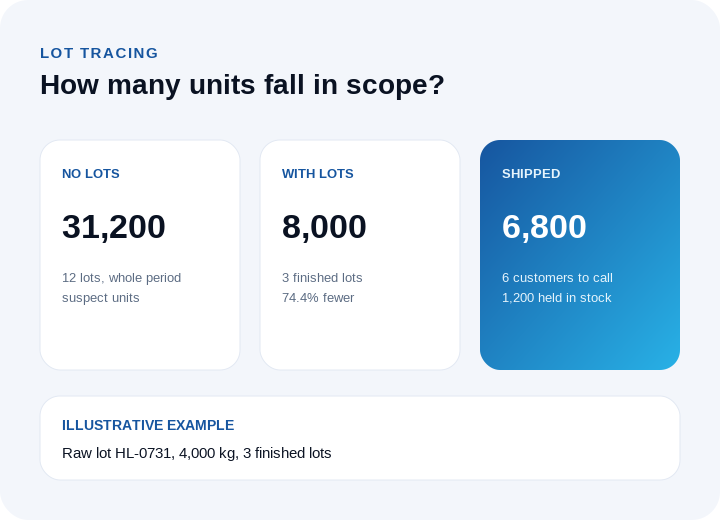
If a problem is reported on the raw lot, forward tracing produces this table: three finished lots, 8,000 units, of which 6,800 shipped and 1,200 in stock; six customers to call. The 1,200 units in stock are blocked. If a problem appears on a finished lot, backward tracing runs: which raw lots ML-1102 used, who supplied them, and where else those lots went.
The value of narrowing is clear. Without lot records, every product made while that material was in use would be suspect. In the example that is 12 lots at an average of 2,600 units, so 12 × 2,600 = 31,200 units. With lots the scope drops to 8,000 units: 8,000 ÷ 31,200 ≈ 25.6%, so suspect units fall by 74.4%.
On the shop floor, the work order to lot link comes from real-time shop floor records (see manufacturing execution systems); requirement calculation is in production planning.
How Are Lots Split and Merged?
Lots can be split and merged, but each operation must be recorded with a parent-child link; otherwise the chain breaks.
- Splitting: if 800 of a 2,000-unit lot go to another warehouse, sub-lots (ML-1101/A, ML-1101/B) are created; both inherit the parent's expiry date and supplier data.
- Merging: only for the same item, the same status and compatible expiry dates. The merged lot gets a new number, records both source lots as parents and takes the earliest expiry: a lot with 120 days left merged with one with 40 days left counts entirely as 40 days.
- No mixed status: quarantined and released lots are never merged.
FEFO or FIFO: How Does Expiry Affect Waste?
For products with an expiry date, issue order should follow expiry, not receipt. FIFO (first in, first out) looks at receipt; FEFO (first expired, first out) looks at expiry. When they give different orders, the difference appears as waste. An illustrative example follows.
- Three lots of 1,000 units each, unit cost ₺60. Receipt order: L2 (70 days left), L3 (120 days), L1 (40 days; arrived late but short-lived).
- 100 units ship per day. The customer contract requires at least 30 days of remaining life at shipment.
| Rule | Issue order | Sold | Unsellable (waste) | Cost |
|---|---|---|---|---|
| FIFO | L2, L3, L1 | 2,000 | 1,000 (L1) | ₺60,000 |
| FEFO | L1, L2, L3 | 3,000 | 0 | ₺0 |
Under FIFO, when L1's turn comes (day 20) it has 20 days left, below the contract limit, so it cannot be sold. Under FEFO, L1 ships in the first 10 days (40 to 31 days left), then L2 and L3 follow; none breaches the limit. Same stock, same demand, one difference: 1,000 units × ₺60 = ₺60,000. In software this is a rule that sorts suggested issue lots by expiry.
Which lot the cost flows from is a separate accounting decision; we compare the methods in inventory valuation methods.
How Are Expiry Alerts and the Quarantine Flow Set Up?
Alert thresholds are based on the share of total shelf life and the minimum remaining life the customer requires. Illustrative example: shelf life 180 days, customers require at least 30 days at shipment.
| Remaining life | Share | Status | Action |
|---|---|---|---|
| More than 60 days | Above 33.3% | Normal | Issue by FEFO |
| 31-60 days | 17-33% | Amber | Tell sales, issue first |
| 30 days or less | 16.7% or less | Red | Close issue to contract customers; second channel or disposal decision |
Quarantine applies at receipt and whenever a quality review is needed. The flow: a lot is opened at goods receipt with status "quarantine"; quality sampling and inspection are done; a release or reject record is posted; only released lots are open to issue. A quarantined lot is visible in stock but unusable, and that difference is deliberate. Quarantine costs waiting: raw material worth 4,000 kg × ₺40 = ₺160,000 sitting for three days means production runs on other lots, so inspection time should be measured.
Passing the supplier lot number and expiry date straight into the record through a shipment notice reduces errors; see the supplier portal article.
How Are Lot-Level Stock and Cost Kept?
Stock balance is kept at lot level, not only at item level: the item balance is the sum of its lot balances. A lot balance is receipts minus issues and must never go negative. If lots entered at different costs, finished lots have different costs too. Illustrative example:
| Finished lot | Raw material used | Raw material cost | Units | Per unit |
|---|---|---|---|---|
| ML-1101 | 1,500 kg HL-0731 × ₺40 | ₺60,000 | 3,000 | ₺20.00 |
| ML-1102 | 1,000 kg × ₺40 + 600 kg HL-0745 × ₺46 | ₺40,000 + ₺27,600 = ₺67,600 | 3,200 | ₺21.125 |
The same product comes out at ₺20.00 in one lot and ₺21.125 in the other, a gap of (21.125 − 20) ÷ 20 ≈ 5.6%. Lot cost shows the real margin by which lot was sold; an average hides the difference.
Negative situations test the design. A movement without a lot must not enter the system: the lot number is a mandatory field. Issuing more than the lot balance is blocked. If the wrong lot was scanned, it is corrected with a reversing entry and a reason code rather than deletion, so the chain stays intact and the error stays visible. We cover lot-level count differences in inventory counting.
How Do Lot Labels and Barcode Scanning Reduce Errors?
Typing lot numbers by hand is the weakest link. In the illustrative example there are 2,000 lot-tracked movements a month. With manual entry at a 1.5% error rate, that is 30 faulty records; with label scanning at 0.2%, 4 remain. The difference is 26 errors. If finding and fixing each takes 45 minutes, that is 26 × 45 ÷ 60 = 19.5 hours, or ₺5,850 at ₺300 an hour. The real cost is a recall in which a wrongly recorded movement sends you to the wrong customer or skips the right one.
The label carries the lot number, item code and expiry date in human-readable and machine-readable form. Code structure, scanner choice and check digits are in our barcode system article, and location records are in warehouse management systems; the only addition here is that the scanned label also carries the lot.
How Is a Recall Drill Designed and Measured?
Traceability is tested by trying it beforehand, not during a real incident. The drill: pick a raw lot at random, assume it is faulty, and within a set time produce every affected customer and the quantities still in stock. Three measures are enough.
| Measure | Formula | First drill | After improvement |
|---|---|---|---|
| Time to find | Start until the full list | 330 min (5.5 h) | 20 min |
| Coverage accuracy | Units found ÷ units actually shipped | 6,264 ÷ 6,800 = 92.1% | 6,800 ÷ 6,800 = 100% |
| Mass balance | Used + samples + remaining + waste = received | Gap found | 4,000 + 20 + 150 + 30 = 4,200 |
In the first drill 536 units were not found because two sub-lots had never been linked to their parent. Time fell from 330 to 20 minutes: (330 − 20) ÷ 330 ≈ 93.9% shorter. Mass balance is the honesty check: every kilo received must be written somewhere.
Run the drill at least once a year, with one lot per product group. Sector-specific mandatory deadlines, notification duties and record requirements exist; ask your legal counsel and the relevant authority for those details and do not take any figure from this article.
How Is the Payback of Traceability Calculated?
The benefit comes from less expiry waste and less time spent fixing lot errors. Illustrative assumptions: monthly expiry waste falls from ₺38,000 to ₺14,000 (₺24,000), error-fixing savings are ₺5,850. Running cost is ₺6,000 a month, investment ₺360,000.
Monthly net = 24,000 + 5,850 − 6,000 = ₺23,850. Payback = 360,000 ÷ 23,850 ≈ 15.1 months. If the waste saving halves (₺12,000), monthly net is 12,000 + 5,850 − 6,000 = ₺11,850 and payback stretches to 360,000 ÷ 11,850 ≈ 30.4 months. Harm avoided in a recall is not included; that is a separate risk item.
How Is a Lot Traceability Project Run?
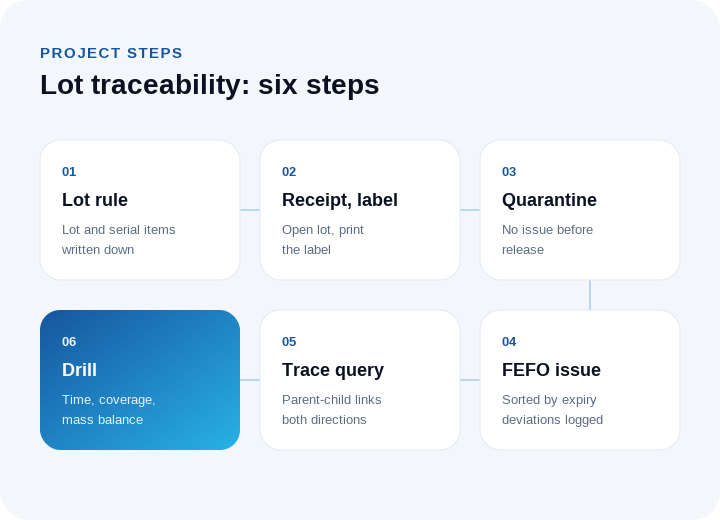
- Lot rule: which items are lot-tracked, which are serial-tracked, how lot numbers are generated; a written decision.
- Receipt and label: open the lot at goods receipt, print the label, enter the supplier lot.
- Quarantine and release: define the status field and the issue check.
- FEFO issue: sort suggested issues by expiry and log deviations.
- Trace query: build reports in both directions from parent-child records.
- Drill: measure time, coverage and mass balance, then close the gaps.
What Are Common Lot Tracking Mistakes?
- Leaving the lot number optional: an optional field is not filled, and the chain breaks.
- Not recording splits: without a parent link, forward tracing comes out incomplete.
- Marking quarantine without blocking issue: a status that is only a label does nothing.
- Skipping the drill: until time and accuracy are measured, traceability is an assumption.
We recommend reading: What is ERP? Modules, how it works and a selection guide
We recommend reading: How to Manage the Goods Receiving Process: Counting, Discrepancy Rules, Tolerance and ROI
Custom Software and Process Digitalisation with İnovabil
At İnovabil our focus is building software from scratch, specific to your company: custom software, ERP, CRM, e-commerce, web, mobile and integration. Requirements such as lot and serial number traceability change with your products, warehouse layout and customer contracts, so we recommend settling them in writing during requirements analysis: which items are lot-tracked, which fields are mandatory, what the issue rule will be.
We built the warehouse management system for Sleepy, logistics and shipment planning with wholesale order management for Karyak, CRM, purchasing and mobile for Avcılar İnşaat, and the purchasing system for İZBAN. Send us a short summary of your product groups and current record keeping, and we will draw up the scope together.
We recommend reading: Our software development process: step by step from analysis to launch
Frequently Asked Questions
What is lot and serial number traceability?
It is the ability to follow, in both directions, which raw material and lot a product came from and who received it, through a chain of lot or serial numbers. A lot identifies a group; a serial number identifies one unit.
What is the difference between a lot and a serial number?
A lot identifies a group produced or received under the same conditions; a serial number identifies a single unit. Lots are enough for packaged and bulk goods; serial numbers are used for individually valuable items whose history matters.
What is the difference between FEFO and FIFO?
FIFO issues by receipt order, FEFO by expiry date. For items with an expiry date, skipping FEFO can leave a late-arriving but short-lived lot unsellable; in the example the gap is 1,000 units, or ₺60,000.
What is the difference between backward and forward tracing?
Backward tracing finds which raw material and supplier lots a product came from. Forward tracing finds which products a raw or finished lot went into and which customers received them. Both read the same link records in opposite directions.
How long does a traceability system take to pay back?
In the example monthly net benefit is ₺23,850, investment ₺360,000 and payback about 15.1 months; if the waste saving halves, about 30.4 months. Recalculate with your own waste, error and labour figures.