

Finding the right person for your software team does not come down to one clever interview question; it comes from a consistent process end to end. Hiring software developers, including the technical interview, is a chain that runs from defining the role through the job ad, screening, technical assessment, references, the offer and the first 90 days on the job. If any link is loose, a strong candidate drops out along the way or the wrong one gets in.
This guide covers finding and assessing individual candidates: the role and competency matrix, screening, technical interview formats, a weighted scoring rubric, fair and consistent evaluation, references and the offer, onboarding and the cost of a bad hire. Team size, role mix and in-house cost are covered in our guide to building a software development team; we do not repeat those figures here. All example numbers are illustrative; they are not real salaries or market data.
Which Role and Which Level Are We Hiring For?
The first document to write before the ad is the answer to "who will do which work, at what level." "We are looking for a developer" is not a role, because an integration developer and a mobile interface developer need different skills.
A role profile has three parts: the work to be owned in the first six months (for example the order module of a dealer portal), the required competencies and the competencies that can be learned on the job. If you put the competencies in a matrix, the ad and the interview draw from the same source.
| Competency | Junior | Mid-level | Senior |
|---|---|---|---|
| Problem solving | Solves a described problem | Breaks down an ambiguous problem | Picks the right problem, weighs alternatives |
| Code quality | Readable, working code | Writes tests, reusable code | Sets the team's standard |
| Design | Implements a given design | Designs a module | Sets system boundaries and trade-offs |
| Communication | Asks clear questions | Justifies decisions | Reaches decisions with non-technical stakeholders |
| Learning | Learns with guidance | Learns independently | Teaches the team |
Decide the level by behaviors, not years of experience. Two people with the same number of years can be at very different levels. Before you commit to a permanent hire, it also helps to confirm whether the need is really a permanent seat or external capacity, using the comparison in our software outsourcing guide.
How Do You Write the Ad and Screen Applications?
A good ad describes the work; it does not pad a list. Instead of a long technology list, write what will be built in the first six months, how the team works and the steps of the assessment process. Explaining the process up front lets candidates know how much time they will spend and signals that you are serious.
Screening means reading each application against a short, fixed form. In the example the ad receives 120 applications and each takes a 10-minute read: 120 × 10 min = 1,200 min = 20 hours. In the end 40 candidates pass (33.3%). Screening uses only role-related criteria: relevant work experience, a written or code sample, an answer on motivation. Name, age, gender, marital status or a photo play no part in the decision; for the legal details, consult your legal counsel and HR specialist.
Storing and deleting candidate data (resumes, interview notes, reference details) and informing candidates fall under KVKK (Turkey's personal data protection law); set the periods and obligations with your legal counsel.
What Are the Technical Interview Formats?
There are four common formats, and each measures something different. You do not need to run all of them on every candidate; pick two or three depending on what the role demands.
| Format | What it measures | Time (example) | Risk to watch |
|---|---|---|---|
| Take-home assignment | Code quality, tests and explanation under realistic conditions | 2-3 hours for the candidate, 45 min to review | A very long assignment drives candidates away; help may have been used |
| Live coding | Way of thinking, asking questions, debugging | 60 min | Performance under pressure; may not reflect real work |
| Architecture discussion | Design, trade-offs, reasoning | 60 min | The interviewer assuming there is one right answer |
| Code review exercise | Spotting defects, giving feedback, prioritizing | 45 min | The exercise must be realistic and reasonably sized |
The code review exercise is one of the formats closest to daily work: give the candidate a short change and ask them to read it and find problems. We describe how this works in our code review guide. For the exercise you can use a real change from your own team, with sensitive details removed.
In the example process, 12 of the 40 candidates come to a technical interview. Two interviewers join each one: 12 × 90 min × 2 people = 2,160 min = 36 hours. Reviewing the assignments takes 12 × 45 min = 540 min = 9 hours. Four candidates reach the final stage, 75 minutes each with two people: 4 × 75 × 2 = 600 min = 10 hours.
How Do You Build a Scoring Rubric?
A rubric writes down what each criterion measures, what each score from 1 to 5 means and how much each criterion weighs. That removes the subjectivity from "a good candidate." Take the criteria for the role from the competency matrix and make the weights add up to 100%.
- Problem solving: 30%
- Code quality: 25%
- Design: 20%
- Communication: 15%
- Learning: 10%
Write an example behavior for each score. For code quality, 1 might be "the code does not run or cannot be read"; 3 "it runs and reads fine, but has no tests"; 5 "tested, no more complexity than needed, decisions explained." The calculation is total = Σ (weight × score). Use the average of two interviewers as the criterion score.
| Criterion | Weight | Candidate A score | Candidate B score | A contribution | B contribution |
|---|---|---|---|---|---|
| Problem solving | 30% | 4 | 5 | 1.20 | 1.50 |
| Code quality | 25% | 3 | 4 | 0.75 | 1.00 |
| Design | 20% | 4 | 3 | 0.80 | 0.60 |
| Communication | 15% | 5 | 3 | 0.75 | 0.45 |
| Learning | 10% | 4 | 3 | 0.40 | 0.30 |
| Total (out of 5) | 100% | 3.90 (78.0%) | 3.85 (77.0%) |
A simple average gives A 20 ÷ 5 = 4.0 and B 18 ÷ 5 = 3.6, so A looks far ahead; in the weighted calculation the gap shrinks to 0.05. That is why weights matter: you decide which competency the role needs more. The gap between these two candidates is smaller than a single interviewer's one-point swing on one criterion, so the decision should rest on the role's need more than on the rubric. If the team is overloaded with code review, B's code and problem-solving strength matters; if you need someone to guide newcomers, A's communication stands out.
Add two rules to the rubric: at least 3 points on every criterion and at least 3.5 in total. The floor stops a strong score on one criterion from covering a basic gap.
How Do You Keep Evaluation Fair and Consistent?
Consistency rests on three legs: the same questions, independent scoring and calibration.
- The same questions: For the same role, every candidate gets the same question set and the same assignment, regardless of order. The team writes and versions the question bank together.
- Individual scores first: Interviewers write their own scores right after the interview, without seeing each other's. Discussion comes afterward, so that whoever speaks first does not steer the others.
- Measuring agreement: If two interviewers differ by more than 1 point on a criterion, get a third opinion or discuss the difference and its reasons. Example: on design, one interviewer gave 4 and the other 2. The gap is 2; on discussion it turns out the second interviewer asked a different question.
In the first quarter, 12 interviews × 5 criteria = 60 score pairs are measured, and 9 pairs differ by more than 1: 9 ÷ 60 = 15% disagreement, that is, 51 pairs agree (85%). If this rate does not fall, the problem is not the candidate but the rubric or interviewer training; write the score descriptions more concretely. Keep personal characteristics unrelated to the job, and unmeasurable impressions such as "culture fit," out of the evaluation; for the legal framework, ask your legal counsel and HR specialist.
How Do You Run Reference Checks and the Offer?
Reference checks are done with the candidate's permission and with short, fixed questions: What work did you do together? How did they act in a hard situation? Would you work with them again? Record the answers in writing, as you did with the rubric. Take your legal counsel's view on sharing and storing candidate data.
At the offer stage, the example funnel produces 2 offers and 1 is accepted: 1 ÷ 2 = 50%. To raise the acceptance rate, send the offer quickly and explain the first six months of work and the 90-day plan. Pay, benefits and contract terms are set with the HR specialist and legal counsel; no figures are given in this article.
How Long Does Hiring Take and How Much Effort Does It Need?
The process is a funnel: each stage filters out part of the candidates. In the example funnel, one hire needs 120 applications; overall conversion is 1 ÷ 120 = 0.83%.
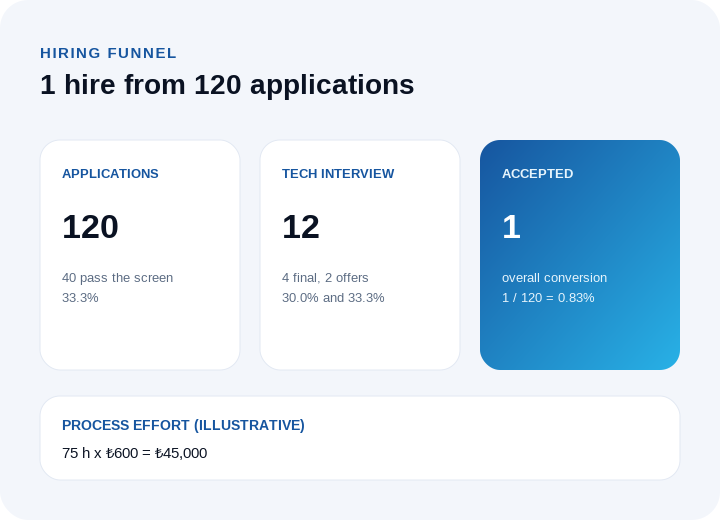
| Stage | Candidates | Conversion | Effort | Cost (₺600/h) |
|---|---|---|---|---|
| Application and screening | 120 → 40 | 33.3% | 120 × 10 min = 20 h | ₺12,000 |
| Assignment review and technical interview | 40 → 12 | 30.0% | 9 h + 36 h = 45 h | ₺27,000 |
| Final | 12 → 4 | 33.3% | 4 × 75 min × 2 = 10 h | ₺6,000 |
| Offer | 4 → 2 | 50.0% | — | — |
| Acceptance | 2 → 1 | 50.0% | — | — |
| Total | 120 → 1 | 0.83% | 75 h | ₺45,000 |
Check: 20 + 45 + 10 = 75 hours; 75 × ₺600 = ₺45,000. The ₺600 interviewer hour is an illustrative internal cost. This effort comes out of the interviewers' real work; delivery capacity drops while you hire. To plan for it, see our resource and capacity planning guide.
On timing, the example process takes 45 days and the goal is 30. The gain comes from cutting waiting:
| Step | Today (days) | Target (days) | How? |
|---|---|---|---|
| Ad and collecting applications | 14 | 10 | Start screening before the queue closes |
| Screening | 5 | 2 | Fixed form, first 48 hours |
| Technical interviews | 12 | 8 | Interview blocks reserved in calendars in advance |
| Final and decision | 6 | 4 | Decision meeting the day after the interview |
| References | 3 | 2 | Run in parallel with the offer |
| Offer and reply | 5 | 4 | Send the offer with the plan explained in the first meeting |
| Total | 45 | 30 | −15 days (−33.3%) |
A waiting candidate may accept another offer; a fast but structured process does not mean trading quality for speed.
How Do You Plan the Trial Period and the First 90 Days (Onboarding)?
Onboarding is the continuation of the interview: in the first weeks you confirm in real work what you saw in the rubric. The legal framework and details of any probation period are set with legal counsel and the HR specialist; what we recommend here is managing the first 90 days with written goals.
| Period | Goal | Measure |
|---|---|---|
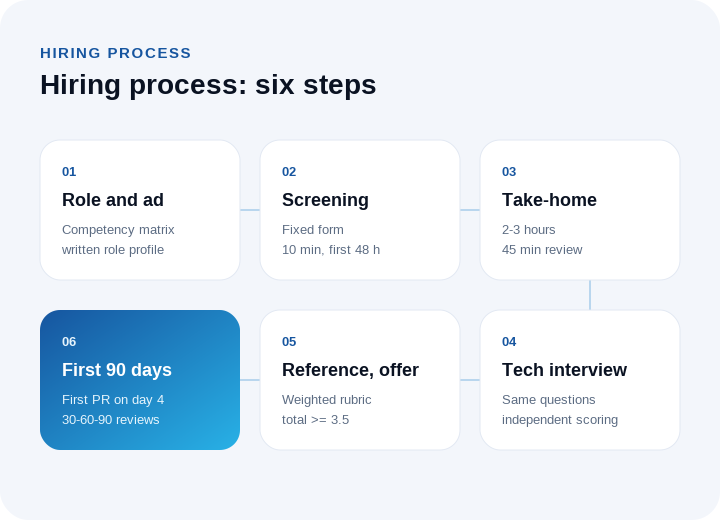
| Days 0-30 | Environment, codebase tour, a paired buddy, a first small change | First PR on working day 4; feedback talk on day 30 |
| Days 31-60 | An independent small feature, joining code reviews, shadowing the support rota | The feature ships; quality of review comments |
| Days 61-90 | Owning a feature end to end, writing their own growth goal | Day-90 talk: expectations and comparison with the rubric scores |
The time to the first PR is the clearest measure of onboarding quality. In the example it is 12 working days: access and accounts 2, environment setup 3, understanding the codebase 4, deciding the first task 3. With prepared onboarding it drops to 4: accounts ready on day one (0), scripted setup (1), a code tour and docs (2), a ready first task (1). The difference is 12 − 4 = 8 days, a 66.7% reduction. This is why current setup and architecture documents matter; see the handover example in our software documentation guide.
What Does a Bad Hire Cost, and Does a Structured Process Pay Back?
When the wrong person is hired, the loss goes beyond interview hours: months of low output, the mentoring effort the team spends, and running the process again. An illustrative calculation: 3 months × ₺120,000 (monthly total cost, illustrative) = ₺360,000, plus ₺45,000 to re-run the hiring process = ₺405,000. This is not a real salary or industry figure; recalculate with your own numbers.
The setup cost of a structured process: 80 hours × ₺600 = ₺48,000 for the rubric, question bank, assignment and interviewer training; 40 hours × ₺600 = ₺24,000 for the onboarding pack. Total investment: ₺72,000. Monthly running cost: a calibration meeting and question-bank upkeep, 5 h × ₺600 = ₺3,000.
Assumption (illustrative): 4 hires a year, and the bad-hire rate falls from 25% to 10%. The yearly reduction in expected loss is 4 × (0.25 − 0.10) × ₺405,000 = 4 × 0.15 × ₺405,000 = ₺243,000. Monthly gross gain is ₺243,000 ÷ 12 = ₺20,250; after the running cost, monthly net is ₺17,250. Payback: ₺72,000 ÷ ₺17,250 ≈ 4.2 months.
Cautious scenario: the reduction is halved (a 0.075 difference, so ₺121,500 a year; monthly ₺10,125 − ₺3,000 = ₺7,125). Payback is ₺72,000 ÷ ₺7,125 ≈ 10.1 months. If you make only 1 hire a year: 0.15 × ₺405,000 = ₺60,750 a year, monthly ₺5,062.5 − ₺3,000 = ₺2,062.5; payback ≈ 34.9 months. In other words, a business that hires rarely should keep the process light and scale the effort down.
What Mistakes Are Common in Hiring Developers?
- Opening an ad without writing the role: With no matrix, nobody can align the interview questions.
- Asking each interviewer different questions: Candidates become impossible to compare.
- Writing scores after the discussion: Whoever speaks first dominates the decision.
- Giving an overlong assignment: Good candidates give up; keep it within 2-3 hours.
- Using an algorithm puzzle as the only measure: A measure that does not reflect daily work gives a wrong signal.
- Running the process slowly: A waiting candidate picks another offer.
- Not planning onboarding: Someone well hired can get lost in the first weeks.
We discuss how technical debt slows a newcomer in our technical debt guide, and how the test process affects onboarding in our software testing guide.
We recommend reading: How to build a software development team: staffing, cost and capacity guide
We recommend reading: What is custom software?
Custom Software and Team Work with İnovabil
At İnovabil, our focus is building company-specific software from scratch: custom software, ERP, CRM, e-commerce, web, mobile and integration. We do not offer recruitment or consulting services and we make no commitment on team size. Before you build your own team, we suggest settling through requirements analysis which work will run in-house and which outside.
We built CRM, purchasing and mobile for Avcılar İnşaat; a purchasing system for İZBAN; logistics and shipment planning plus wholesale order management for Karyak; and warehouse management plus a complaint and support management system for Sleepy. Send a short summary of your project scope; let us evaluate our analysis and development process together.
We recommend reading: Our software development process: from analysis to launch, step by step
Frequently Asked Questions
How do you hire software developers?
Define the role and level with a written competency matrix, screen with a fixed form, pick two or three technical interview formats according to the role, score with a weighted rubric, check references and plan the first 90 days with written goals.
Which format should a technical interview use?
There is no single right format. A take-home measures code quality, live coding measures way of thinking, an architecture discussion measures design, and a code review exercise measures defect spotting. Pick two or three for the role and give every candidate the same set.
How do you prepare a scoring rubric?
Take 4-6 criteria from the competency matrix, make the weights total 100%, write an example behavior for each score and collect interviewers' scores independently. Total = Σ (weight × score); add a floor such as at least 3 points on each criterion.
How long should the hiring process take?
In the example it takes 45 days and can be cut to 30. The gain comes from reducing waiting: rolling screening, interview blocks reserved in advance, a decision meeting the next day and reference checks in parallel with the offer.
How much does a bad hire cost?
In the example, 3 months of low output (₺360,000) plus re-running the hiring process (₺45,000) comes to ₺405,000. The figures are illustrative; calculate with your own monthly cost and process hours.