

A sales-order system that has grown for years in one developer's hands, the software of a company you are thinking of buying, the source code you are about to receive from a departing vendor: all three raise the same question. "What condition is this software really in, and what will it cost us?" A software technical due diligence, in practice a code and architecture audit, answers that question through someone who did not write the system and does not profit from the outcome, working from evidence and a scorecard agreed in advance.
In this guide we cover when an audit is needed, the six-area weighted scorecard, the bus factor, what the repository history tells you, how to collect proof about tests, releases and backups, a two-week audit plan, how to cost the findings, and how to make the "fix it or rewrite it?" call. All figures are representative examples; they are not data from a real project or an industry average.
What Is a Software Technical Due Diligence?
A software technical due diligence, or code and architecture audit, is an independent measurement of a system's architecture, code quality, tests, security, release routine and the people who keep it alive, delivered in writing to the person who has to decide. "Due diligence" is the name of the careful review done before an acquisition or an investment.
The audit does not fix the problems one by one; it shows how large they are and what fixing them will cost. Code review looks at a single change, static analysis at machine-checkable rules, and a technical debt exercise at measuring the debt. The audit sits one layer above all of them and ends in a management decision.
We recommend reading: Our custom software service
When Is a Software Audit Needed?
An audit makes sense right before a decision that is expensive to reverse. If you are in at least one of the situations below, it is worth considering.
| Situation | Core question | Focus area |
|---|---|---|
| Buying the software or the company | Is there hidden repair debt in the price? | Architecture, security, licensing and ownership |
| Changing software vendors | Can the new team keep it running? | Documentation, tests, release routine |
| Single-developer dependency | What happens if that person leaves? | Bus factor, knowledge dependency |
| Before an investment or growth push | Will it carry twice the load? | Architecture, performance, operations |
| Retiring or rewriting a legacy system | Is it cheaper to improve or to rebuild? | Code quality, tests, fix cost |
Not every system needs one. For a small, short-lived, non-critical tool, a two-week audit is out of proportion; there it can be enough to confirm that the source code and the access rights have really been handed over.
Which Six Areas Does the Audit Cover and How Is It Scored?
The six areas cover both the technical and the human side of a system, and each is scored from 0 to 5: 0 absent, 1 weak, 2 insufficient, 3 acceptable, 4 good, 5 exemplary. Weights can be adjusted to the role of the software; the split below is a representative starting point and adds up to 100.
| Area | Weight | Example score (0–5) | Contribution = weight × score ÷ 100 |
|---|---|---|---|
| Architecture | 20% | 3.0 | 0.600 |
| Code quality | 20% | 2.5 | 0.500 |
| Testing | 15% | 1.5 | 0.225 |
| Security | 20% | 2.0 | 0.400 |
| Operations and release | 15% | 3.5 | 0.525 |
| Team and knowledge dependency | 10% | 1.0 | 0.100 |
| Weighted total | 100% | — | 2.350 |
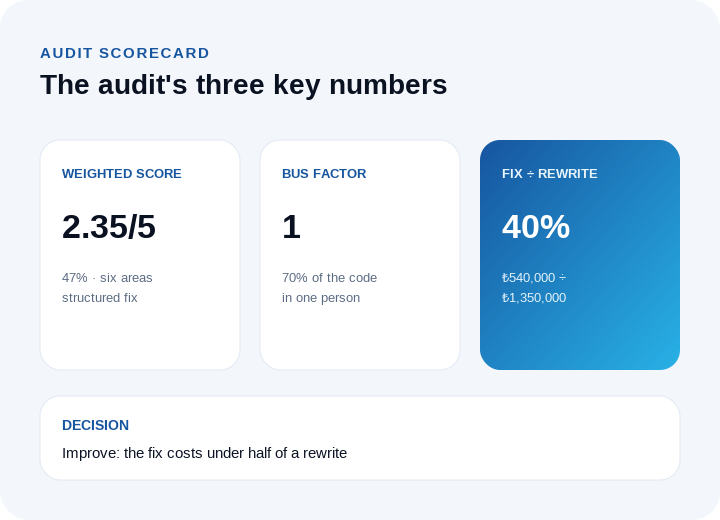
The weighted score is 2.35 ÷ 5 = 47%. The simple average of the same scores, (3.0 + 2.5 + 1.5 + 2.0 + 3.5 + 1.0) ÷ 6, is 2.25. A reading scale might look like this: 4.0 and above is healthy; 3.0–3.99 can be taken over with minor improvements; 2.0–2.99 calls for a structured improvement programme; below 2.0 is a rewrite candidate. The example's 2.35 sits in the third band.
Two extra rules are needed. An area at 1.0 or lower is flagged on its own even when the average looks fine; in the example, team and knowledge dependency is 1.0. And blocking findings, such as having no access to the source code or a licence problem, stop the decision regardless of the score.
How Are the Bus Factor and Code Ownership Measured?
The bus factor is the number of people who would have to leave before the project becomes unsustainable. The calculation is simple: rank the authors by their share of surviving lines, largest first, and find the smallest number of people whose cumulative share exceeds 50%.
| Contributor | Share of surviving lines | Cumulative share |
|---|---|---|
| A | 70% | 70% |
| B | 15% | 85% |
| C | 10% | 95% |
| D | 5% | 100% |
Because A alone passes the 50% line, the bus factor is 1. Look at module level too: if only A changed 9 of the 12 modules in the last 12 months, the dependency ratio is 9 ÷ 12 = 75%. "Surviving lines" matters; code that was deleted or rewritten over the years does not reflect ownership.
Ownership is not only "who wrote it". Whose name the source code, the domain, the cloud account and the third-party licences are registered under is also audited. For licences, see our software licence guide; for contract and copyright details, consult a legal advisor.
What Can Be Read From the Repository History?
Version history answers questions nobody asks out loud. A version control system already stores this data; an audit pulls out a handful of numbers.
- Change concentration: If there were 2,400 file-change records in the last 12 months and the 10 most-changed files account for 960 of them, then 960 ÷ 2,400 = 40% sits in 10 files. Ten of 600 files is only 1.7%; improvement priority starts there.
- Hotspot score: Change count × complexity. A file that changes often and is complex is far riskier than one that changes often but is simple.
- Dependency age: If 38 of 120 dependencies are more than two major versions behind, the ratio is 38 ÷ 120 = 31.7%. Known flaws and inventory are covered in our software bill of materials guide.
- Documentation freshness: If 6 of 20 documents match the current release, freshness is 6 ÷ 20 = 30%. Without written knowledge, knowledge lives in people, which directly affects the bus factor. We describe which documents you need in our software documentation guide.
These numbers do not deliver a verdict; they decide which questions get asked in the interviews. If a file inside the 40% concentration is "core price calculation", the finding is serious; if it is a "settings file", it is mild.
How Do You Ask for Proof About Tests, Releases and Backups?
An audit collects evidence, not claims. The sentence "we have backups" earns no points without a record showing the backup was restored.
| Claim | Evidence requested | Example finding (representative) |
|---|---|---|
| "We have tests." | List of critical flows and an automated test for each | 9 of 24 critical flows have automated tests: 37.5% |
| "Releases are safe." | Duration, outcome and rollback record of recent releases | 8 releases a year, 2 failed: 25%; manual, 14 steps, 6 hours |
| "We can roll back." | Record of a rollback rehearsal | Rollback took 180 minutes |
| "We take backups." | Restore test in a clean environment | Target 4 hours, measured 7 hours: 75% over |
| "Secrets are safe." | Output of a repository and environment scan | 3 live access keys in the repository |
Measure test coverage by critical flows, not by line percentage; see our test automation guide for prioritisation. For restores, compare the target (RTO) with the measured time: 7 ÷ 4 = 1.75 times, a 75% overrun; the concepts are in our data backup guide. An audit does not replace an expert penetration test; it tells you whether you need one.
How Does a Two-Week Audit Run and What Does It Cost?
For a mid-sized system, 10 working days and 2 people is a realistic start: 2 × 10 = 20 person-days. At a representative ₺12,000 per day, the cost is 20 × ₺12,000 = ₺240,000. The person-days can be split as follows.
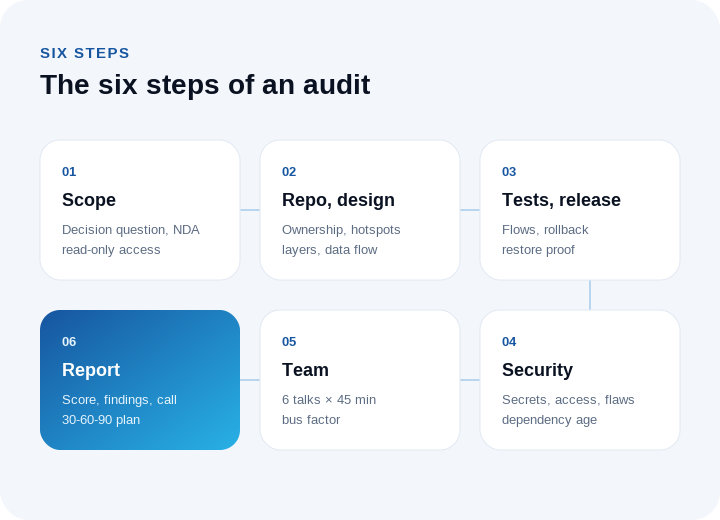
- Scope and access (2 person-days): Write down the decision question, sign the confidentiality agreement, open read-only access.
- Repository and design (6 person-days): Ownership, change concentration, layers, data flow.
- Tests and release (4 person-days): Critical-flow coverage, release and rollback records.
- Security (4 person-days): Secrets, access model, dependency flaws, restore proof.
- Team and knowledge (2 person-days): Six 45-minute interviews: 6 × 45 = 270 minutes, 4.5 hours.
- Synthesis and report (2 person-days): Scorecard, findings, cost and decision recommendation.
The total is 2 + 6 + 4 + 4 + 2 + 2 = 20 person-days. The payoff of an audit is avoiding a wrong decision. If the gap between improving and rewriting is ₺810,000 (see the example below), the audit pays for itself once the chance of a wrong decision exceeds ₺240,000 ÷ ₺810,000 = 29.6%; if you think your unaudited decision is more likely than that to be wrong, the investment is justified.
How Are Findings Classified and Fix Costs Estimated?
Every finding is written with a severity, evidence and a fix effort. Severity has four levels: critical (sometimes halts the takeover), high, medium and low. The list below is the result of a representative audit.
| Severity | Finding | Fix effort (person-days) |
|---|---|---|
| Critical | Backup restore never tested | 2 |
| Critical | Live secrets in the repository | 3 |
| High | Knowledge sits with one person; documentation and handover | 12 |
| High | Half of the critical flows untested (9 flows to add) | 14 |
| High | Manual release; no automated pipeline | 8 |
| Medium | Updating 38 outdated dependencies | 6 |
| Medium | Simplifying the most-changed files | 12 |
| Low | Refreshing documentation | 3 |
| Total | 60 |
The total is 2 + 3 + 12 + 14 + 8 + 6 + 12 + 3 = 60 person-days. At a representative ₺9,000 per development day, 60 × ₺9,000 = ₺540,000. Efforts are estimates and should be presented as ranges; for the logic, see our software development cost guide.
Improve or Rewrite: How Is the Decision Made?
The decision starts with a ratio: fix cost ÷ rewrite cost. In the same example, say a rewrite is 150 person-days: 150 × ₺9,000 = ₺1,350,000. The ratio is ₺540,000 ÷ ₺1,350,000 = 40.0%.
| Option | Effort | Cost (representative) | Main risk |
|---|---|---|---|
| Improve | 60 person-days | ₺540,000 | The old architecture's limits remain |
| Rewrite | 150 person-days | ₺1,350,000 | Feature parity, lost legacy rules |
| Rewrite (with parity allowance) | 150 × 1.25 = 187.5 person-days | ₺1,687,500 | Old system runs in parallel |
The feature parity risk: a system that has run for years holds unwritten rules, and if the new one misses them, rework follows. The 25% allowance is representative; with it the ratio falls to 540,000 ÷ 1,687,500 = 32.0%.
A representative decision rule: if the fix costs no more than 50% of a rewrite and there is no blocking finding, improve. In the example, 40% and 32% are below the threshold, so improving is recommended. A rewrite comes into play when platform support ends, the architecture cannot carry the load or the security model, or the source code cannot be accessed. If you do abandon the old system, our legacy system decommissioning guide covers the next step.
What Should an Audit Report Contain?
A good report assumes the decision-maker may not be technical. Five sections are enough.
- Executive summary: One page; the score, the bus factor, the three most important findings and the recommendation.
- Scorecard: The score, weight and evidenced rationale for each of the six areas.
- Findings: Severity, evidence, impact and a fix-effort range.
- Decision options: Cost and risk of improving, rewriting and taking over.
- Assumptions and limits: What was examined and what was not.
Adding a 30-60-90-day plan raises the odds that the report gets acted on: critical findings in the first 30 days, high ones in the next 60, a re-score on day 90.
How Are Contracts, Confidentiality and Independence Handled?
Because the auditor sees source code and commercial information, the framework must be in writing. The confidentiality agreement (NDA), the terms of source code access (read-only, time-limited, logged), who the findings may be shared with and the deletion of the code after the audit are settled with a legal advisor. In environments holding personal data, masked data is preferred over real data.
Independence matters as much as technical skill. If the audit is done by the team that wrote the system or by the firm that would sell the rewrite, a conflict of interest arises, and even correct findings will not carry the decision-maker's trust. For contract and handover terms, see our guides on how to get custom software developed and software outsourcing.
What Are the Common Mistakes in Software Audits?
- Not defining the decision question: A "general overview" produces a report, not a decision.
- Treating claims as evidence: A backup, test or release claim that is not verified by a record inflates the score.
- Reviewing only the code: If the bus factor and operations are skipped, the biggest risk slips through.
- A non-independent auditor: A party with a stake reads the findings in its own favour.
- Assuming a rewrite is the default: Without a parity allowance, a rewrite looks cheap.
- Leaving findings without an owner: A finding with no named owner and date does not get fixed.
An audit should not be shelved; re-score it 90 days after the takeover. For handover checks, see our project closure guide, and for the team you will build, our guide to building a software team.
We recommend reading: What is technical debt?
Custom Software and System Handover with İnovabil
At İnovabil our focus is building custom software from scratch for your company: custom software, ERP, CRM, e-commerce, web, mobile and integration. We do not offer a separate code audit or technical due diligence service; the framework in this article is meant to help companies that are taking over a system or changing vendors make their own decision more soundly. We recommend having the audit done by someone independent of the team that will do the development.
Analysis, design, development, testing, release, maintenance and support are recorded steps in our process. We built CRM, purchasing and mobile for Avcılar İnşaat; a purchasing system for İZBAN; a prepaid cargo system for Kredili Kargo; logistics and shipment planning for Karyak; and warehouse management plus a complaint and support management system for Sleepy. If you are about to take over an existing system, we suggest covering its condition in writing under these headings during requirements analysis.
We recommend reading: Our software development process: from analysis to release, step by step
Frequently Asked Questions
What is a technical due diligence and how does it differ from a software audit?
They are two names for the same work. Due diligence is the term in an acquisition or investment context; a code and architecture audit applies the same review to takeovers, vendor changes and single-developer dependency. The output is a scorecard, findings and a decision.
How long does a software code and architecture audit take and what does it cost?
For a mid-sized system, the example uses 10 working days and 2 people, that is 20 person-days. At a representative ₺12,000 per day it comes to ₺240,000. Real duration depends on the system's size and the depth you ask for.
How is the bus factor calculated and what is a good value?
Rank authors by their share of surviving lines and find the smallest number of people whose cumulative share passes 50%. If one person wrote 70%, the factor is 1. A practical target is at least two people who know each critical module.
When should you improve and when should you rewrite?
If the fix costs under roughly half of a rewrite and there is no blocking finding, you generally improve. If platform support has ended, the architecture cannot carry the load or the security needs, or the source code is out of reach, a rewrite comes into play. The threshold is representative.
Who should do the audit, and can the developing firm do it?
No. Ideally someone independent does it: someone who did not write the system and has no stake in a rewrite. The developing team should supply information but not do the scoring. Put confidentiality and access terms in writing; for legal details consult a legal advisor.