

Your company's software work is no longer a single project: the order system changes every week, dealers keep bringing new requests, and someone has to look at integrations whenever they break. At that point, the question of how to build a software development team demands far more than "let's hire a developer." Which roles, how many people, in what order, at what cost, and how much work can the team really deliver?
In this guide we walk through the role set, staffing by team size, hiring order, the loaded cost of a 4-person core team, the real capacity after leave and meeting time, and the break-even point against an external team, all with worked examples. Every figure is illustrative; none is an actual salary, market rate or industry average.
When Does It Make Sense to Build Your Own Software Team?
When the work is continuous all year, software is part of your competitive edge, and knowledge should stay inside the company. Building a team for a one-off project is usually unnecessary.
The three options answer the same need from different directions. We covered the outsourcing model in our what is software outsourcing guide and the process of commissioning a project from a firm in how to get custom software developed; here we give only the decision table.
| Situation | In-house team | External team | Hybrid |
|---|---|---|---|
| Workload | Steady all year | Fluctuating or a single project | Steady core, fluctuating peaks |
| Accumulated knowledge | Stays inside | Needs a handover plan | Core knowledge stays inside |
| Speed to start | Takes months (hiring) | Fast | Start with an external team, grow in-house |
| Cost structure | Fixed expense | Pay for what you use | Mix of fixed and variable |
| Management load | High (hiring, team management) | Medium (briefing, follow-up) | Medium to high |
Which Roles Does a Software Team Need?
Six roles cover the work: product owner, tech lead, developer, test engineer, designer and infrastructure (DevOps) owner. In a small team one person can carry several roles, but every role needs a named owner.
| Role | What they do | When needed | How to cover it at the start |
|---|---|---|---|
| Product owner | Prioritizes needs, makes acceptance decisions | From day one | A manager from the business unit, with regular weekly time |
| Tech lead | Architecture, code standards, technical interviews, risk | First hire | A senior developer |
| Developer | Feature and bug-fix work | From day one | Core team |
| Test engineer | Test scenarios, regression, quality gate | When releases become frequent | Core team or developer pairs |
| Designer | User flows, screen design | When user-facing screens multiply | External or part-time |
| Infrastructure (DevOps) | Release pipeline, monitoring, backups | When the system grows and downtime gets costly | Tech lead or external support |
The product owner is the most commonly skipped role. If developers do not know who tells them "what to build," the team works fast but builds the wrong thing. We described how to put requirements into writing in our requirements analysis guide; the product owner's job is to keep that output alive.
We recommend reading: What is the software development life cycle (SDLC)?
How Should You Staff a Team by Size?
Staffing expands role by role as the workload grows; building a full team up front is both expensive and hard to manage.
| Team size | Core staff | External or shared |
|---|---|---|
| 2–3 people | Tech lead, 1–2 developers | Product owner (business side), testing, design, infrastructure |
| 4–6 people | Tech lead, 2–3 developers, test engineer | Design and infrastructure (part-time or external) |
| 7–10 people | Tech lead, 4–5 developers, 1–2 testers, designer, infrastructure owner | Specialist peak work |
As the team grows, communication load grows too: a team of 4 has 6 pairwise communication lines and a team of 8 has 28 (n × (n − 1) ÷ 2). Doubling the team does not double the output, so it is healthier to start with a 4-person core and grow by measuring.
In What Order Should You Build a Software Team?
The first hire should be the tech lead, because that person shapes later interviews, the architecture and the code standard. Developers come next, then testing.
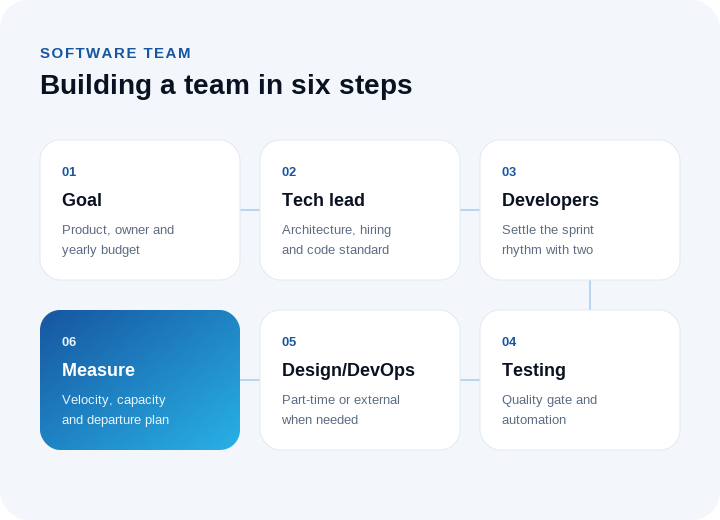
- Goal: Write down which product or system the team will carry, who the product owner is and the yearly budget.
- Tech lead: Hire a senior developer first; let that person run the technical interviews and architecture decisions.
- Developers: Make the second and third hires developers; settle the working rhythm with short sprints.
- Testing: Add the test engineer once releases become frequent; regression and automation become that person's responsibility.
- Design and infrastructure: Start with part-time or external help when the need arises.
- Measurement: Review velocity, capacity and the departure plan every quarter.
An illustrative hiring calendar and first-year cost follow. Monthly salaries are gross and the loaded-cost factor is 1.4 (representing employer charges, benefits, equipment, licenses and training; for the real factor, consult your financial advisor (certified accountant) or HR). The hiring expense (job ads, candidate search, interview time) is assumed to be one month of gross salary per person.
| Role | Gross monthly | Loaded monthly (× 1.4) | Start month | Months worked in year 1 | Year-1 cost |
|---|---|---|---|---|---|
| Tech lead | ₺150,000 | ₺210,000 | 1 | 12 | ₺2,520,000 |
| Developer 1 | ₺100,000 | ₺140,000 | 2 | 11 | ₺1,540,000 |
| Developer 2 | ₺100,000 | ₺140,000 | 3 | 10 | ₺1,400,000 |
| Test engineer | ₺80,000 | ₺112,000 | 5 | 8 | ₺896,000 |
| Total | ₺430,000 | ₺602,000 | ₺6,356,000 |
Hiring expense is 150,000 + 100,000 + 100,000 + 80,000 = ₺430,000; the year-1 total is ₺6,356,000 + ₺430,000 = ₺6,786,000. Once the team runs at full strength all year, the annual cost rises to the ₺7,224,000 calculated in the next section; year one looks cheaper, but the output is lower too.
How Do You Calculate the Cost of a Software Team?
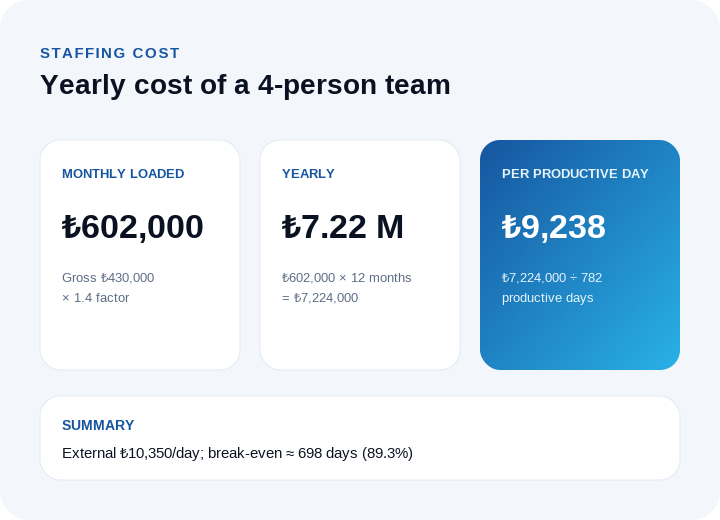
Cost means loaded cost, not gross salary, and you reach the unit cost by dividing the annual cost by productive person-days. For a 4-person core team the calculation is as follows.
- Monthly gross total: 150,000 + 100,000 + 100,000 + 80,000 = ₺430,000.
- Monthly loaded cost: ₺430,000 × 1.4 = ₺602,000.
- Annual cost: ₺602,000 × 12 = ₺7,224,000.
List what falls outside this number as well: the product owner's time in the business unit, management time, external help for design and infrastructure, software licenses and office space. They are not in the illustrative calculation; in a real budget each should be its own line. For the working infrastructure of a team, such as version control, code review and the release pipeline, see our version control guide and code review guide.
How Do You Calculate a Software Team's Real Capacity?
Capacity is not the number of days on the calendar but the productive person-days left after leave, meetings and administration. The assumptions below are illustrative.
| Step | Calculation | Result |
|---|---|---|
| Working days per year (per person) | 52 weeks × 5 days | 260 days |
| Leave, holidays and sickness | 260 − 30 | 230 days |
| Meetings and administration (15%) | 230 × 0.85 | 195.5 days |
| 4-person team (yearly) | 195.5 × 4 | 782 person-days |
| Two-week sprint | 40 × (230 ÷ 260) × 0.85 | ≈ 30.1 person-days |
| Capacity for new features (20% maintenance and bug share) | 782 × 0.8 | 625.6 person-days |
In the sprint calculation the nominal capacity is 4 people × 10 days = 40 person-days; multiplied by the leave ratio 230 ÷ 260 ≈ 0.885 and the meeting factor 0.85, it leaves 30.1 person-days. With 26 sprints a year, 26 × 30.08 ≈ 782, so the two calculations confirm each other.
Let us make the 625.6 person-days available for new features concrete with a yardstick: the dealer portal in our cost guide is a 73 person-day job. 625.6 ÷ 73 ≈ 8.6; in other words, a 4-person team delivers roughly 8.6 dealer-portal-sized jobs a year after the maintenance share is set aside. If you do not have a backlog that large, the team sits idle, which is why the break-even calculation in the next section depends on the utilization rate. Our technical debt guide also helps with prioritization and the maintenance share.
When Is an In-House Team Cheaper Than an External One?
When the workload fills roughly 89% of the team's capacity. Below that, an external team is cheaper.
For the comparison, take the external team's daily rate as ₺9,000 (the daily team rate in our cost guide). Managing an external team, defining the work and transferring knowledge also take your time; let us add an illustrative 15% management share: ₺9,000 × 1.15 = ₺10,350 effective cost per day.
- In-house cost per productive day: ₺7,224,000 ÷ 782 = ₺9,238 (approximately).
- Break-even days: ₺7,224,000 ÷ ₺10,350 ≈ 698 days.
- Break-even utilization: 698 ÷ 782 ≈ 89.3%.
| Utilization | Work in days | External cost (× ₺10,350) | In-house cost | Difference |
|---|---|---|---|---|
| 60% | 469.2 days | ₺4,856,220 | ₺7,224,000 | In-house ₺2,367,780 more expensive |
| 89.3% | 698 days | ≈ ₺7,224,000 | ₺7,224,000 | Break-even |
| 100% | 782 days | ₺8,093,700 | ₺7,224,000 | In-house ₺869,700 cheaper (≈ 10.7%) |
The direction is clear: at full utilization the in-house team saves about ₺869,700 a year, but at 60% utilization it loses ₺2,367,780. If you take the management share as 0%, break-even becomes 7,224,000 ÷ 9,000 ≈ 802.7 days, which exceeds capacity, so the in-house team is never cheaper. The break-even therefore depends on how much management load you put on the external team and how full your backlog is; recalculate it with your own figures. This calculation leaves out non-monetary factors such as knowledge staying inside, output quality and hiring delay; those can pull the decision toward either option.
What Should the Working Rhythm Look Like After the Team Is Built?
Building the team is only half of the job; without a working rhythm, velocity drops in the first months. Four basic habits are enough to start.
- Short cycles: Two-week sprints and a working release; a simple version of the agile rhythm described in our SDLC guide.
- Code review and version control: Every change is read by someone else; knowledge does not stay with one person.
- Automated release pipeline: Test and release automation reduces manual work; details are in our CI/CD guide.
- Quality gate: See our software testing guide for the pre-release testing routine.
Account for departures as well. If a developer leaves, finding a replacement can take 3 months and onboarding another 2 months at 50% productivity: 3 + 2 × 0.5 = 4 months of equivalent loss. With monthly productive capacity of 195.5 ÷ 12 ≈ 16.3 person-days per person, the loss is 4 × 16.3 ≈ 65.2 person-days, roughly 89% of the 73 person-day dealer portal. Knowledge sharing, documentation and code review shrink this risk; the tech lead should not be the only store of knowledge.
What Are the Common Mistakes When Building a Software Team?
- Not appointing a product owner: When no one decides priorities, the team does the wrong thing well.
- Making the first hire a developer: Without a senior person to run the architecture and later interviews, the team is built on a weak foundation.
- Building the full team up front: Before the workload is clear, a 10-person team leaves capacity idle.
- Budgeting with gross salary: If loaded cost is skipped, the budget is short from the start.
- Calculating capacity from calendar days: If leave and meeting share are skipped, commitments will not hold.
- Putting non-continuous roles on the payroll: A full-time hire for part-time work such as design or infrastructure lowers utilization.
- Cutting ties with external teams completely: When work peaks, keeping external support flexible is cheaper than inflating the in-house team.
We recommend reading: What is an MVP? What to build first and how to measure it
We recommend reading: How to Write Software Documentation: Document Types, ADRs, Runbooks and Handover
We recommend reading: How to Do Resource and Capacity Planning for Project Teams: Net Capacity, Heat Map and Overload Guide
We recommend reading: How to Hire Software Developers: Technical Interviews, Scoring Rubric and the First 90 Days
Custom Software with İnovabil, Before or While You Build a Team
At İnovabil our focus is building bespoke software from scratch: custom software, ERP, CRM, e-commerce, web, mobile and integrations. If your decision to build a team is not final yet, or the work must not stop while the team is being set up, we suggest developing the first release together and settling in writing, at the requirements stage, that the source code and the knowledge stay with you; whether your in-house team will take the project over later is part of that conversation. We do not give commitments on team size or duration upfront.
We have developed CRM, purchasing and mobile for Avcılar İnşaat; a purchasing system for İZBAN; logistics and shipment planning with wholesale order management for Karyak; and warehouse management plus a complaint and support management system for Sleepy. Send us a short summary of your workload and your current team; let us put together a written assessment.
We recommend reading: Our software development process: step by step from analysis to launch
Frequently Asked Questions
How do you build a software development team, and what is the first step?
First write down the product the team will carry, the product owner and the yearly budget; then make a senior tech lead the first hire. The following developers and the test engineer come through that person's interviews.
How big a team is enough for a small company?
In most cases a core team of 2–4 people is enough to start: a tech lead, one or two developers and, if needed, a test engineer. Covering design and infrastructure with external help or part-time staff when the need arises is cheaper.
How much does a four-person software team cost?
In the illustrative example, monthly gross is ₺430,000, loaded cost is ₺602,000 and annual cost is ₺7,224,000, which works out to about ₺9,238 per productive person-day. Real figures depend on your salaries, your loaded-cost factor and the structure of the team.
Is an in-house or an external team cheaper?
If the workload is steady all year and fills roughly 89% of team capacity, the in-house team is cheaper; in the illustrative example it saves about ₺869,700 a year at full utilization. If utilization drops to 60%, the in-house team costs about ₺2,367,780 more. Recalculate with your own management share.
How do you calculate team capacity?
Subtract leave and holidays from the yearly working days, then subtract the share of meetings and administration. In the example 260 − 30 = 230 days, × 0.85 = 195.5 productive days, which is 782 person-days for four people. Setting aside a maintenance and bug share lowers the capacity for new features.