

Before committing hundreds of thousands of lira to a software build, answering "will this actually work?" with a small experiment is the cheapest insurance a project can buy. A software proof of concept (PoC) does exactly that: it tests the riskiest technical or business assumption within a few weeks, reads the result against written criteria, and lets you decide on the large investment with evidence instead of optimism.
In this guide we cover what a software proof of concept is, how it differs from a pilot and an MVP, which risks to test first, why success criteria are written before the experiment, how to scope and cost a four-week PoC, when a PoC pays for itself (and when it does not), how to design a pilot, and how to run the decision meeting. All figures are illustrative; they are not a real project price or an industry average.
What Is a Software Proof of Concept?
A PoC is a short, deliberately narrow experiment that shows a software idea or technical approach is feasible. It answers "can this be done?", not "will users like it?" or "does it work at scale?".
A good PoC has three traits: it tests one risk, it reads the result as a number, and its output is disposable. Polished screens, broad features and scaling are not its job. Shrinking risk before a large scope is delivered is a natural part of commissioning custom software.
We recommend reading: Our custom software service
What Is the Difference Between a PoC, a Pilot and an MVP?
They answer different questions. A PoC asks "can it be built?", a pilot asks "does it deliver value in real work with a limited group?", and an MVP asks "does the first product version convince users?". Substituting one for another means searching for the answer to the wrong question.
| Topic | PoC (proof of concept) | Pilot | MVP |
|---|---|---|---|
| Question answered | Can the technical or business risk be overcome? | Does it create value in limited live use? | Does the first product version hold up in the market? |
| Duration | A few weeks | Weeks to a few months | Weeks to months |
| Users | The team and a few observers | A limited but real user group | The first slice of the target audience |
| Data | Sample or masked | Real, controlled | Real |
| Code lifetime | Disposable | Close to production quality | Grows, built upon |
| Output | Yes / no / adjust decision | Measured business impact | Measured product learning |
We covered the hypothesis-first scoping method of the MVP in What Is an MVP?; a PoC often comes even before the MVP and closes the question "can this product be built at all?".
When Do You Need a PoC, and When Don't You?
You need a PoC when an assumption is unknown and would be expensive if wrong. It is not mandatory for every software project.
- Needed: an integration never built before, a performance target never measured, a data source of unknown quality, a way of working never tried in the field.
- Not needed: a standard screen flow, a known integration, a building block done many times in similar projects.
- Not enough: user demand or product-market fit; those belong to the MVP and the pilot.
Economics sets the threshold, and you will see it in numbers in the "Does a PoC Pay for Itself?" section below.
Which Risks Should a PoC Test First?
Do not list features, list assumptions, and rank them by "if wrong, the project collapses". Take the top three. Each risk becomes a hypothesis with a number in it.
| Hypothesis | Why is it risky? | Criterion (written before the experiment) |
|---|---|---|
| H1: The legacy integration is fast enough | The legacy system's response time is unknown | p95 latency ≤ 2 s over 200 calls |
| H2: Product and account codes match automatically | Data is inconsistent; manual matching would be costly | Correct matching ≥ 95% on a 400-record sample |
| H3: Field users complete the flow on their own | User habits and device conditions are unknown | 3 of 3 field users finish the main flow unassisted |
p95 says 95% of requests finished faster than this value; it shows the slow tail, not the average. We worked through the same logic in our performance testing guide. Where requirements are not yet clear, run requirements analysis first; a PoC targets the uncertainty that analysis uncovers.
Why Are Success Criteria Written Before the Experiment?
Because a criterion written after seeing the result gets bent to fit the result. This is moving the goalposts: looking at a number lower than expected and saying "actually 90% would be fine too" makes the experiment meaningless.
Example: the criterion for H2 was 95%. Of 400 records, 380 matched correctly: 380 ÷ 400 = 95.0%. It meets the criterion exactly, but there is a second trap: the sample is small. The standard error is √(0.95 × 0.05 ÷ 400) = √0.0001188 ≈ 0.0109, about 1.1 points, and the 95% confidence interval is roughly ±2.1 points (1.96 × 1.09). The true rate could lie between 92.9% and 97.1%. So the result is "passed" but not certain, which is why the sample size is written next to the criterion.
What if the number had been 372 ÷ 400 = 93.0%? The rule written in advance decides: either "adjust" (improve the matching rules and retest) or "no-go". "Let's proceed anyway" deletes the criterion.
- For each hypothesis, write a pass number and a red line (below it the answer is directly no-go).
- Write the sample size and the measurement method next to the criterion.
- Lock the criteria with the decision makers' sign-off (an email approval is enough) before work begins.
We recommend reading: How to Run an A/B Test: Hypothesis, Sample Size, Significance and Pitfalls
How Do You Set the Scope and Duration of a PoC?
The scope is the smallest set that can test the hypotheses; the duration says that set should fit in 3 to 6 weeks. If the duration keeps stretching, the experiment has stopped being a PoC and is turning into a small project.
Example four-week plan (illustrative): daily team rate ₺9,000 (₺6,000 × 1.20 ÷ 0.80); total 2 + 4 + 3 + 3 = 12 person-days, 12 × ₺9,000 = ₺108,000.
| Week | Work | Person-days | Output |
|---|---|---|---|
| 1 | Lock criteria, prepare environment and sample data | 2 | Signed criteria document |
| 2 | H1: integration trial and latency measurement | 4 | 200-call measurement |
| 3 | H2: matching trial, 400 records | 3 | Accuracy table |
| 4 | H3: field observation, decision meeting | 3 | Decision document |
| Total | 12 | ₺108,000 |
Why should the code be disposable?
PoC code takes shortcuts for speed: hard-coded values, thin error handling, narrow tests. Moving it into production buries those shortcuts in the foundation of the next project. What remains is findings, not code: measurement tables, matching rules, learned limits. The only exception is a module that was written deliberately and tested, adopted after pricing the rewrite; make that decision explicitly in the result meeting. For the price of accumulated shortcuts see our technical debt article.
How are data and environment prepared?
A PoC should use realistic data but protect real customer data: mask identity fields, work in a separate environment, limit access to the PoC team. For the scope and obligations around personal data, consult your legal counsel; this article is not legal advice.
Does a PoC Pay for Itself? Economics and Break-Even
The economics of a PoC fit in one sentence: expected loss × share of that loss the PoC prevents − PoC cost. If positive, the experiment is worth it.
Example: the main project costs ₺657,000 (a dealer portal, 73 person-days × ₺9,000). Assume the chance that the approach turns out wrong is 25%, and that if it does, the entire budget is wasted (a simplification; in reality part of it can be salvaged).
- Expected loss = ₺657,000 × 25% = ₺164,250
- If the PoC prevents 80% of that loss, benefit = ₺164,250 × 0.80 = ₺131,400
- Net = ₺131,400 − ₺108,000 = +₺23,400
- Break-even prevention rate = ₺108,000 ÷ ₺164,250 = 65.8%; the PoC must prevent at least this much of the loss.
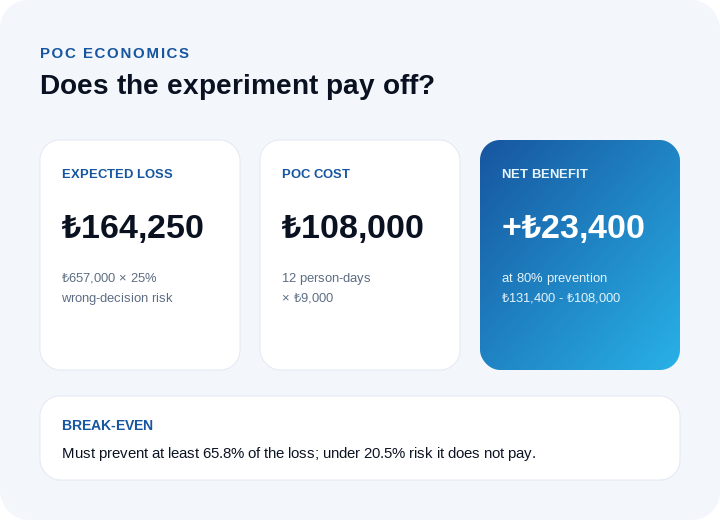
The real lesson is in the sensitivity. Change the probability of a wrong decision for the same project (the PoC prevents 80%): benefit = ₺657,000 × p × 0.80, net = benefit − ₺108,000.
| Probability of wrong decision | Expected loss | PoC benefit (80%) | Net |
|---|---|---|---|
| 10% | ₺65,700 | ₺52,560 | −₺55,440 |
| 15% | ₺98,550 | ₺78,840 | −₺29,160 |
| 20% | ₺131,400 | ₺105,120 | −₺2,880 |
| 25% | ₺164,250 | ₺131,400 | +₺23,400 |
| 40% | ₺262,800 | ₺210,240 | +₺102,240 |
Break-even probability = ₺108,000 ÷ (₺657,000 × 0.80) = ₺108,000 ÷ ₺525,600 ≈ 20.5%. If the chance of being wrong is below roughly one in five, the PoC does not pay for itself; at 10% it books a net loss of ₺55,440. The effectiveness of the PoC matters just as much (probability fixed at 25%):
| Share of loss the PoC prevents | Benefit | Net |
|---|---|---|
| 50% | ₺82,125 | −₺25,875 |
| 65.8% | ≈ ₺108,000 | ≈ 0 (break-even) |
| 80% | ₺131,400 | +₺23,400 |
| 90% | ₺147,825 | +₺39,825 |
This calculation rests on an honest estimate of the risk probability; if you pick the wrong riskiest hypothesis, the share the PoC prevents falls. For the expected-loss logic applied across a whole project see our risk management article, and for the discounted framing of an investment decision see the business case guide.
How Do You Design a Pilot?
After the PoC says "feasible", the pilot runs the solution in real work, with a limited group, under control. The pilot's answer concerns business impact, not technology.
- Choose the users: two teams, 25 users in total (13 + 12); get the team leads' participation in writing.
- Define a control group: 25 users doing the same work the old way; without a comparison you cannot claim improvement.
- Fix the duration: 6 weeks; the first week for adjustment, the remaining five for measurement.
- Write the exit criteria: before starting, just as in the PoC.
- Set up a support line: pilot users must be able to report problems; measure the response time too.
Example exit criteria and result (illustrative):
| Criterion | Threshold | Actual | Status |
|---|---|---|---|
| Weekly active users | ≥ 80% | 21 ÷ 25 = 84.0% | Passed |
| Order entry time (vs control) | ≥ 20% shorter | 8.0 → 6.0 min = −25.0% | Passed |
| P1 (critical) defects | 0 | 1 | Missed |
A pilot has a price too. 6 weeks × 3 person-days a week (support, fixes, measurement) = 18 person-days = ₺162,000. PoC and pilot together come to ₺108,000 + ₺162,000 = ₺270,000, which is ₺270,000 ÷ ₺657,000 ≈ 41.1% of the project. So doing both is not automatic: if the PoC closed the technical risk and the remaining risk is only user acceptance, going straight to a small MVP is often cheaper. The PoC alone is just ₺108,000 ÷ ₺657,000 ≈ 16.4%.
We recommend reading: How to Do User Acceptance Testing (UAT): Scenarios, Defect Severity, Acceptance Decision and Sign-Off
The Decision Meeting: Go, No-Go or Adjust?
The decision meeting applies the numbers to a rule written in advance; it is not a place to open new debates. Each criterion is scored 1 to 5, weighted, summed and read against thresholds.
| Criterion | Weight | Score (1–5) | Contribution |
|---|---|---|---|
| Technical feasibility (H1, H2) | 40% | 4 | 1.60 |
| User acceptance (H3, pilot) | 30% | 3 | 0.90 |
| Effort versus estimate | 20% | 4 | 0.80 |
| Risks closed | 10% | 3 | 0.30 |
| Total | 100% | 3.60 |
Decision rule (example): total ≥ 4.0 means go; 3.0 to 3.99 means adjust (fix the weak hypothesis and test it in a short extra round); < 3.0 means no-go. One more rule sits above this: if any "red line" was crossed, the answer is no-go regardless of score. In the example the total is 3.60, so the decision is "adjust": matching accuracy is borderline and the field flow has gaps. The large investment is postponed, yet nothing is thrown away.
The decision document contains the measurement tables, the reasoning, known limits and the next step (scope, team, timeline). If the decision is go, the findings carry into the bidding stage as input for the software RFP.
What Mistakes Are Common in PoCs and Pilots?
- Quietly shipping the PoC to production: disposable code goes live; it breaks at the first growth or security request.
- A demo with no criteria: "it looked nice" is not a result; without a number there is no decision.
- Putting on a show: demonstrating only the best case hides risk; try the worst data too.
- Too many hypotheses: more than five turns the PoC into a small project.
- Moving the goalposts: loosening the criterion when the result falls short.
- An uncontrolled pilot: without a comparison group, the cause of improvement is unclear.
- An experiment without a decision maker: the person who reads the result as go or no-go must be known from the start.
- Testing the wrong risk: test the one that collapses everything if wrong, not the easy one.
We recommend reading: How to Choose a CRM and How to Choose an ERP. In a selection process, short demos and pilot rounds can follow the criteria logic in this guide.
How Do You Run a PoC and Pilot in Six Steps?
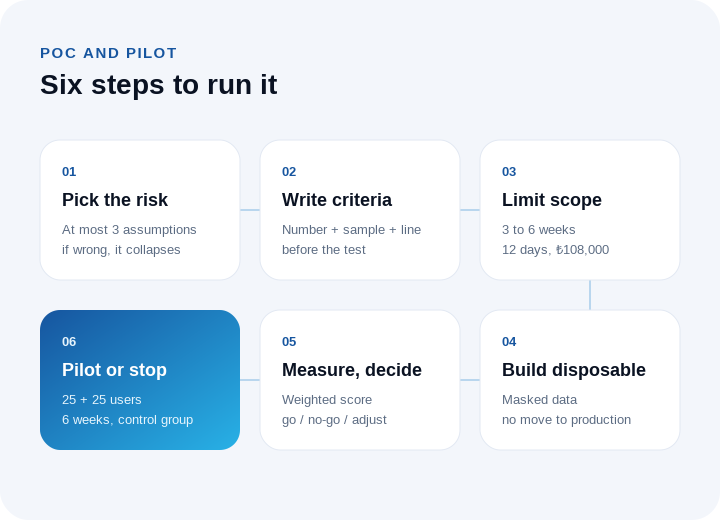
- Pick the risk: rank assumptions and take at most the three that would collapse the project if wrong.
- Write the criteria: a number, a sample size and a red line for each hypothesis; have the decision makers approve them.
- Limit the scope: 3 to 6 weeks, 12 person-days and ₺108,000 in the example; requests beyond the limit go to a separate list.
- Build it disposable: masked data, a separate environment, shortcuts allowed, no move to production.
- Measure and decide: write the numbers into the table as they are; go, no-go or adjust by weighted score and rule.
- Pilot or stop as needed: if the remaining risk is user acceptance, run 25 users, a control group and 6 weeks; otherwise go straight to a small first release.
PoC and Staged Custom Software with İnovabil
At İnovabil our focus is building bespoke software from scratch: custom software, ERP, CRM, e-commerce, web, mobile and integration. We do not offer a separate PoC service or a fixed-price commitment; however, instead of delivering a large scope in one go, we discuss shrinking the risk first as a suggestion during requirements analysis. The analysis, design, development, testing, release, maintenance and support steps on our process page, and our incremental development approach, fit this idea.
We built CRM, purchasing and mobile for Avcılar İnşaat; a purchasing system for İZBAN; logistics and shipment planning with wholesale order management for Karyak; and warehouse management plus a complaint and support management system for Sleepy. If you have an uncertain integration or a flow untested in the field, describe it briefly; together we can rank the risks and discuss, in a written assessment, whether an experiment is needed.
We recommend reading: Our software development process: step by step from analysis to release
Frequently Asked Questions
What is a software proof of concept, in short?
A PoC (proof of concept) is a disposable experiment that shows, quickly and within a narrow scope, that a software idea or technical approach is feasible. It is read against written criteria and feeds the decision on a large investment.
What is the difference between a PoC, a pilot and an MVP?
A PoC answers "can it be done?", a pilot answers "does it create value in limited real use?", and an MVP answers "does the first product version hold up?". PoC code is discarded, a pilot is controlled live use, and an MVP is the first product that grows.
How long does a PoC take and what does it cost?
It usually takes 3 to 6 weeks. In the example, 4 weeks, 12 person-days and ₺108,000 (₺9,000 a day). The figures are illustrative; real duration and cost depend on the number of risks and the state of the legacy systems.
Should you always run a PoC?
No. In the example, if the probability of a wrong decision is below about 20.5%, the PoC does not pay for itself; at 10% the net is −₺55,440. For known integrations and standard flows, moving ahead directly is the better choice.
What happens after a successful PoC?
The decision document says go, no-go or adjust by weighted score and the rule written in advance. If go, the findings carry into the RFP and the plan; if the remaining risk is user acceptance, a 6-week pilot or a small MVP follows. PoC code is not put into production by default.