

The team says "we do Scrum," yet sprint planning takes an hour, the daily meeting drifts to thirty minutes, half-finished work is shown as "nearly done" at the end of the sprint, and whatever the retrospective agreed on is forgotten by the next one. The problem is rarely Scrum itself. It is how Scrum is run. What is Scrum? The short answer is a framework; its real value appears only when roles, events and criteria are applied concretely.
This guide focuses on running Scrum in practice: backlog and definition of done, sprint capacity, the daily meeting, reading a burndown, review versus retrospective, and what the meetings cost. For where agile models sit in the development process and for forecasting a delivery date from velocity, see our software development life cycle (SDLC) guide; here we go beyond that summary into how each event is run. All figures are representative, not the average of any team or industry.
What Is Scrum?
Scrum is an agile framework for building complex products in small steps. The team divides work into sprints of one month or less, tries to finish the work it selects in each sprint, and shows the result to stakeholders to get feedback. According to the Scrum Guide, the framework consists of three roles, five events and three artifacts: the product backlog, the sprint backlog and the increment.
Scrum is not a project plan; it is a loop of trying and learning.
We recommend reading: How to Do Software Requirements Analysis
What Are Scrum's Roles and Five Events?
There are three roles and five events, and each answers a specific question. Mixing roles and events up is the most common way teams drift away from Scrum.
| Element | Who takes part / is accountable | Question it answers |
|---|---|---|
| Product Owner | One person | What do we build, and in which order? |
| Scrum Master | One person; serves the team | Is the process working, are impediments being removed? |
| Developers | The team | How do we build and finish this work? |
| Sprint | The whole Scrum team | Fixed length, one month at most; contains the other events |
| Sprint planning | The whole team | What can we do this sprint, why, and how? |
| Daily Scrum | Developers | Are we on track for the sprint goal? (15 minutes) |
| Sprint review | Team and stakeholders | What did we produce, and what should come next? |
| Retrospective | The Scrum team | How do we improve the way we work? |
The Product Owner and the Scrum Master should not be the same person.
How Do You Prepare the Product Backlog, and What Is a "Definition of Ready"?
The product backlog is the single list of work ordered by value. Top items are detailed; bottom items are rough. Refinement is the continuous activity that prepares this list for sprint planning; it is not a separate event.
For an item to enter a sprint, the team needs a written "definition of ready." An example: the user story is written in one sentence, the acceptance criteria can be tested, dependencies are known, the team understands it well enough to estimate, and it is small enough to finish in one sprint. The ready stock should cover at least two sprints; in the example the commitment is 300 hours per sprint, so the ready stock is 2 × 300 = 600 hours. For writing stories and acceptance criteria, see our requirements analysis guide; for ordering the list, our post on prioritizing with RICE helps.
How Do You Write a Definition of Done?
The definition of done is the shared set of criteria an item must meet to count as complete. Without it everyone understands "done" differently. An example checklist:
- The code is merged to the main branch and passed code review.
- Automated tests pass and new behavior has a test (software testing guide).
- The acceptance criteria were checked with the Product Owner.
- Deployed to the test environment, with security and access checks done.
- Necessary documentation is updated.
- No known critical defects.
The rule is simple: an item that fails even one criterion is not done, is not shown at the sprint review, and carries over to the next sprint as unfinished work. There is no partial credit.
How Does Sprint Planning Work, and How Do You Calculate Capacity?
Sprint planning answers three questions: why is this sprint valuable, what can we finish, and how will we do it? Its output is a sprint goal and a sprint backlog.
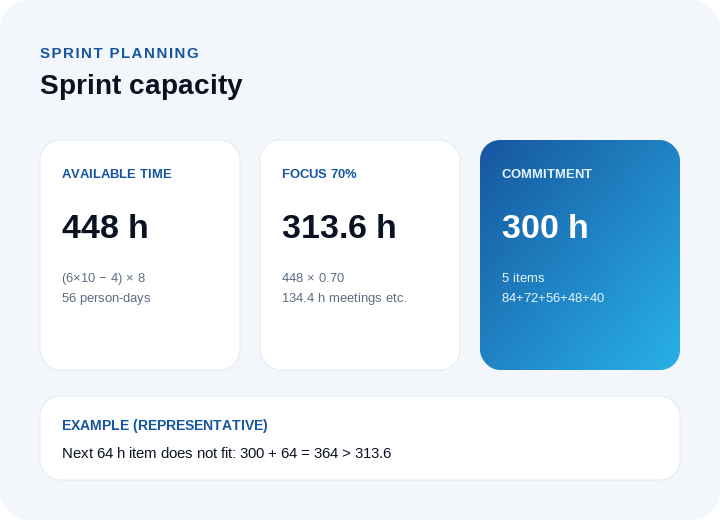
Example (representative): six developers, a two-week sprint, 10 working days of 8 hours; 4 person-days of leave in total during the sprint; a focus factor of 70% (the remaining 30% goes to meetings, interruptions, support and small tasks). The calculation:
- Available person-days = 6 × 10 − 4 = 56.
- Available hours = 56 × 8 = 448 hours.
- Focused capacity = 448 × 0.70 = 313.6 hours.
From the top of the backlog the team selected five items of 84, 72, 56, 48 and 40 hours; the total is 84 + 72 + 56 + 48 + 40 = 300 hours. The next 64-hour item does not fit, because 300 + 64 = 364 hours exceeds the 313.6-hour capacity. The commitment stays below capacity with a 13.6-hour buffer.
The focus factor is learned from your own history, not chosen as an assumption. Its effect on the result is large:
| Focus factor | Focused capacity | Gap against a 300-hour commitment |
|---|---|---|
| 60% | 448 × 0.60 = 268.8 hours | 31.2 hours over (11.6% too much) |
| 70% | 448 × 0.70 = 313.6 hours | 13.6 hours of buffer |
| 80% | 448 × 0.80 = 358.4 hours | 58.4 hours of slack |
The sprint goal says in one sentence why the sprint is being done and is not a list of items. Example: "A dealer can enter and approve a 40-line order from the reorder screen." To think about the plan together with the project's overall schedule, see our project plan guide; for capacity shared across several teams, see our post on resource and capacity planning.
How Do You Run the Daily Scrum?
The daily Scrum is a 15-minute event in which the Developers inspect progress toward the sprint goal and plan the day.
- Three questions: What did I contribute toward the goal yesterday, what will I do today, what is blocking me? The Guide leaves the format to the team; three questions are a common starting point.
- Walk the board: Go through items, not people, right to left (closest to done first).
- Impediment list: Keep impediments on the board with an owner and a date; solve them after the meeting.
- Time: Past 15 minutes it has become a problem-solving meeting; split it off.
If a manager joins to ask for status, the team starts reporting instead of planning. Managers can listen and ask afterward.
How Do You Read a Burndown Chart?
A burndown chart plots the remaining work day by day through the sprint and compares it with an ideal line. The ideal line divides 300 hours evenly across 10 days: 30 hours per day. If the actual line is above the ideal line, the team is behind.
| Day | Ideal remaining (hours) | Actual remaining (hours) | Gap |
|---|---|---|---|
| 1 | 270 | 292 | +22 |
| 2 | 240 | 270 | +30 |
| 3 | 210 | 262 | +52 |
| 4 | 180 | 250 | +70 |
| 5 | 150 | 214 | +64 |
| 6 | 120 | 205 | +85 |
| 7 | 90 | 170 | +80 |
| 8 | 60 | 128 | +68 |
| 9 | 30 | 60 | +30 |
| 10 | 0 | 24 | +24 |
After four days, 300 − 250 = 50 hours are finished, which is 16.7% of the work, while the ideal line says 40% (120 hours). The 68-hour drop in a single day on day 9 shows that work was finished in a rush near the end. The team opened many items at once and finished none. At the end of the sprint 24 hours remain: four items count as done (260 hours), and the fifth is not shown at the review because it is unfinished. By hours progress looks like 92%; by the definition of done, 4 of 5 items (80%) were delivered. An upward jump on a burndown means scope was added, a separate mistake (below).
What Is the Difference Between a Sprint Review and a Retrospective?
The sprint review inspects the product; the retrospective inspects the process. If they are mixed, both product feedback and process improvement stay half-done.
| Topic | Sprint review | Retrospective |
|---|---|---|
| Focus | The product increment | How the team works |
| Participants | Team and stakeholders | The Scrum team only |
| Input | Items that meet the definition of done | Sprint data and the team's observations |
| Output | An updated product backlog | Improvement actions with an owner and a date |
| Time (representative, two-week sprint) | 1.5 hours | 1.5 hours |
At the review only finished items are shown live; unfinished work is not demoed. Feedback becomes backlog items. For communicating with participants, see our post on stakeholder management.
How Do You Run a Retrospective and Follow Up on Actions?
A good retrospective narrows the conversation to three actions and gives each an owner and a date. The common format has three columns: went well, did not go well, try next. The team writes notes, groups similar ones, votes, and produces actions only for the chosen topics.
The observation from the sprint above is: "No item was finished in the first four days; three items were opened at the same time." Action: "At most two items open at once; owner: Scrum Master; from day one." Put actions on the sprint backlog and reserve time: if 12 hours are set aside for three actions, the commitment ceiling for the next sprint becomes 313.6 − 12 = 301.6 hours.
The action completion rate measures a retrospective's effect. If three actions were set in each of three retrospectives (9 in total) and 6 were completed, the rate is 6 ÷ 9 = 66.7%. If the uncompleted three are large, unowned or jointly owned, the problem is the action's shape: shrink it, give it one owner, set a date.
We recommend reading: What Is Technical Debt?
How Much Time and Money Do Scrum Meetings Cost?
Scrum events and backlog refinement take roughly 13% of a developer's time, and their cost can be calculated. Below are representative durations per developer in a two-week sprint and the total for a team of six (the hourly cost is derived from a daily team rate of ₺9,000: ₺9,000 ÷ 8 = ₺1,125).
| Activity | Time per person | Team total (6 people) |
|---|---|---|
| Sprint planning | 3 hours | 18 hours |
| Daily Scrum (10 × 15 min) | 2.5 hours | 15 hours |
| Sprint review | 1.5 hours | 9 hours |
| Retrospective | 1.5 hours | 9 hours |
| Backlog refinement | 2 hours | 12 hours |
| Total | 10.5 hours | 63 hours |
10.5 hours per person is 13.1% of the sprint's 80 hours. The team total is 63 hours at a cost of 63 × ₺1,125 = ₺70,875. It comes out of the 448 − 313.6 = 134.4 hours outside the focus factor: 63 ÷ 134.4 = 46.9%. If the daily Scrum runs 30 minutes instead of 15, each person gains another 2.5 hours; for the team that is 15 hours, or 15 × ₺1,125 = ₺16,875 per sprint, and ₺438,750 more per year at 26 sprints. The total of 78 hours takes 58.0% of the slack.
The return on meetings is a misunderstanding caught early. If a misunderstanding is noticed at the review, the fix takes 24 hours: 24 × ₺1,125 = ₺27,000. If the same mistake is noticed four sprints later, 96 hours of work (representative) has been built on top of it and the fix takes 120 hours, or ₺135,000. The difference is ₺108,000, which is 108,000 ÷ 70,875 ≈ 1.5 times one sprint's meeting cost. So a single event like this pays for about one and a half sprints of meetings.
What Mistakes Are Common in Scrum?
- Adding scope mid-sprint: Adding a 40-hour item to a 300-hour commitment makes 340 hours, which exceeds capacity by 26.4 hours (8.4%). If something is urgent, remove an item together with the Product Owner; if the sprint goal is truly invalid, the Product Owner may cancel the sprint.
- Mini-waterfall: If the first week of the sprint is design, the second is code and the last two days are testing, testing piles up at the end and the burndown ends steeply like the table above.
- Treating the Scrum Master as a manager: The Scrum Master does not hand out work or evaluate performance.
- No definition of done: Unfinished work is counted as "nearly done" and debt accumulates.
- Skipping the retrospective: It is the first meeting sacrificed, and the same problems repeat.
- Using velocity as a performance measure: Comparing teams pushes estimates up.
When Is Scrum Not Suitable?
Sprint planning becomes meaningless when requirements are fixed and the team just executes a specified job, or when most work is unexpected support and maintenance.
For a continuous flow such as support and maintenance, Kanban fits better: work items move across the board left to right and the number of open items (WIP) is limited. By Little's law, average waiting time is WIP ÷ daily completed items: with 12 open items and 4 completed per day the average wait is 12 ÷ 4 = 3 days; if WIP drops to 6 it becomes 6 ÷ 4 = 1.5 days. For on-call and review routines during incidents, see our post on incident management.
How Do You Run Scrum With a Remote Team?
The framework stays the same; what changes is the visibility of information and meeting discipline.
- One shared board: Decisions live on the board, not in chat.
- Daily Scrum: If time zones differ, use a written update plus two live sessions a week.
- Written notes before the retrospective: Quiet participants speak through notes.
- Shared screen and a recording for the review: Absent stakeholders watch the recording and reply in writing.
How Do You Start Scrum in Six Steps?
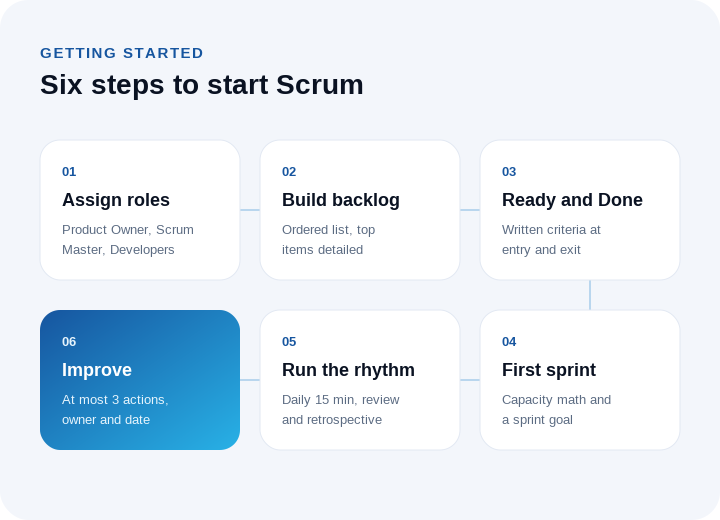
Start with one small team.
- Assign the roles: One Product Owner, one Scrum Master and the Developers.
- Build the product backlog: Order it by value and detail the top items.
- Write the definitions of ready and done: In writing, where everyone can see them.
- Plan the first sprint: Calculate capacity, write the sprint goal and keep the buffer.
- Run the rhythm: 15 minutes daily, a review and a retrospective at the end of the sprint.
- Improve with three actions: Put the actions in the sprint with owners and dates and track the completion rate.
After three sprints, update the focus factor with your own data; range forecasts from velocity are in our SDLC guide.
Scrum and the Software Development Process at İnovabil
At İnovabil our focus is bespoke software built from scratch for the company. Our way of working consists of analysis, design, development, testing, release, maintenance and support, and the output of each step is shared in writing; the details of the steps are on our process page. We do not offer a Scrum certification or a commitment to a particular team size; we set the working rhythm with you during analysis according to the project and the need.
We have built CRM, procurement and mobile for Avcılar İnşaat; a procurement system for İZBAN; logistics and shipment planning with wholesale order management for Karyak; and warehouse management plus a complaint and support management system for Sleepy. Write a short summary of your process and your delivery expectations, and let us settle the working rhythm and the scope of the first release together.
We recommend reading: Our custom software service
Frequently Asked Questions
What is Scrum, and how does it work in short?
Scrum is an agile framework that splits work into sprints of one month at most. It has three roles (Product Owner, Scrum Master, Developers) and five events (the sprint, planning, daily Scrum, review, retrospective). The work selected in each sprint is completed against the definition of done and shown to stakeholders.
How is capacity calculated in sprint planning?
Find the available person-days, convert them to hours and multiply by the focus factor. In the example, (6 × 10 − 4) × 8 = 448 hours and 448 × 0.70 = 313.6 hours. Keep the commitment below that figure, for example at 300 hours, to leave a buffer, and learn the focus factor from your own history.
Why should the daily Scrum be 15 minutes?
The aim is not to solve problems but to see progress toward the goal and the impediments. In the example, running 30 minutes instead of 15 costs a team of six 15 extra hours per sprint, or ₺16,875. Long discussions happen after the meeting with the people concerned.
What is the difference between a sprint review and a retrospective?
The review inspects the product: the team and stakeholders see finished work and give feedback. The retrospective inspects the process: only the team discusses how it worked and sets at most three actions. The outputs differ: one is an updated product backlog, the other is improvement actions with owners.
Is Scrum suitable for every project?
No. When requirements are fixed or most work is unpredictable support demand, the sprint commitment keeps breaking and Kanban fits a continuous flow better.