

Your accounting, sales, warehouse and website run separately, you type the same information into three places, and the off-the-shelf software you use does not support the most important step of your business. At this point most businesses ask the same question: "What if we had software built just for us?" Custom software is the answer to exactly that question: software designed and built from scratch around a business's own workflows, rules and users.
In this guide we explain what custom software is, whether terms such as bespoke software, tailor-made software and software built to order mean the same thing, how it works, its types, examples, advantages and disadvantages, which businesses it suits, what its cost depends on and who owns it. Example figures are illustrative.
What Is Custom Software?
Custom software is software designed and built from scratch around the needs of a single business and used only by that business. Every screen, every business rule and every data field is set by how that business actually works.
The same concept goes by several names: bespoke software, tailor-made software, software built to order, custom-built software and custom software development. What they share is that the software is not a ready-made package everyone uses but is built for the needs of one business. Companies that build it are called custom software companies.
We recommend reading: Our custom software development service
What Is the Basic Difference Between Custom and Off-the-Shelf Software?
Off-the-shelf software is built for the shared needs of many businesses and adapted through settings; custom software is built only for your needs. Off-the-shelf software starts fast and is usually cheaper at the start; custom software fits your business rules and your other systems exactly.
For a standard job, off-the-shelf software is often the right choice. Custom software comes to the fore if your edge lies in the way you work, if you need to join several systems in one flow, or if a package holds you back. You can find a detailed comparison of the two routes in our off-the-shelf or custom software guide.
How Does Custom Software Work? What Layers Does It Have?
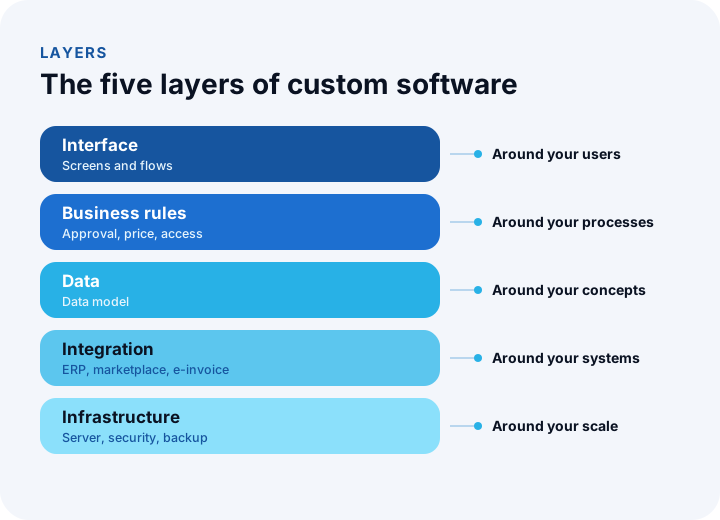
Custom software consists of five layers, and each layer is shaped around your business. In off-the-shelf software these layers are usually fixed; in custom software they are designed.
| Layer | What it does | What changes in custom software |
|---|---|---|
| Interface | Screens and flows the user sees | Screens are designed around how your users work |
| Business rules | Approval, price, access and calculation logic | Rules are written around your processes |
| Data | The structure in which records are kept | The data model is built with your business's own concepts |
| Integration | Data exchange with other systems | The connections you need with ERP, marketplaces, e-invoice and banks are built |
| Infrastructure | Server, security, backup and monitoring | Set to your scale and security needs |
What Types of Custom Software Are There?
Custom software is not a single kind of product; it has a few main types that solve different jobs. Most projects combine one or several of them.
| Type | What it is for | Example use |
|---|---|---|
| Internal business application | Manages request, approval, purchasing and task flows | Following a purchase request from approval to order |
| Admin panel | Lets you monitor operations from one screen and produces reports | Watching orders, stock and sales on a dashboard |
| Customer and dealer portal | Lets customers and partners do their own transactions | A dealer placing an order at their own price |
| Mobile application | Gives field teams or customers mobile access | A field sales team entering orders and collections |
| Integration software | Connects existing systems to each other | A marketplace order flowing to ERP and invoice automatically |
| Custom ERP, CRM and accounting | Runs the company's core processes around your business | Managing recipes, production and costing together |
| Custom e-commerce software | Builds sales models beyond a standard shop | Credit-term sales with dealer-specific prices and account limits |
We recommend reading: What is CRM? Sales funnel, modules and the steps of a successful project
What Are Examples of Custom Software?
Custom software is the system that best describes a business's work, so its examples vary from sector to sector. A few of the projects we have built at İnovabil are:
- Avcılar İnşaat: CRM and purchasing systems, with the mobile applications that work with them.
- İZBAN: A system that manages purchasing processes.
- Kredili Kargo: A prepaid shipping system for Sürat Kargo.
- Karyak: Custom software that brings logistics and shipment planning and wholesale order intake and management into one system.
- Sleepy: A warehouse management system (WMS) and a customer complaint and support management system.
- Bofigo: A shipment planning system.
What these examples share is that none of them could be solved by tweaking the settings of a ready-made package, or where it could, an important step of the work was left out. You can find all our references on our projects page.
What Are the Advantages and Disadvantages of Custom Software?
The biggest advantage of custom software is its exact fit to your business; its biggest disadvantage is the upfront investment and the preparation it needs. Both should be weighed honestly when deciding.
| Advantage | Disadvantage |
|---|---|
| Fits your business processes exactly; your process is not bent to the package | The upfront investment is usually higher than off-the-shelf software |
| Integrates as deeply as you want with your other systems | Needs analysis and development time; it cannot be used on day one |
| You do not wait for a vendor's roadmap when a new need appears | Needs a clear scope and team involvement |
| License cost does not grow with the number of users | Upkeep and infrastructure cost sit in your own budget |
| Only the features you need exist; there are no unnecessary screens | The wrong company or weak analysis puts the project at risk |
| You keep the process that is your competitive edge to yourself | If knowledge stays with a few people, dependence on individuals can arise |
Which Businesses Is Custom Software Right For?
If you answer "yes" to four or more of the six questions below, you should seriously consider custom software:
- Does the off-the-shelf software you use fail to support an important step of your business?
- Do you type the same data into several systems by hand?
- Does your competitive edge come from the way you work?
- Do you need to join several systems in one flow?
- Does license cost strain you as the number of users grows?
- Do you have critical processes running on spreadsheets and email?
We recommend reading: How to do software requirements analysis: a guide with templates
Custom Software, Subscription (SaaS) Software or a Low-Code Platform?
There are three more routes besides custom software, and each has a different place where it is strong and where it draws a limit. The choice depends on how unique your work is and how long you expect the software to last.
| Option | Strength | Limit |
|---|---|---|
| Subscription off-the-shelf software (SaaS) | Starts fast; upkeep belongs to the vendor | Your process is limited to the mold the product offers; cost grows with users |
| Low-code platform | Simple applications and forms are set up quickly | Struggles with complex business rules and deep integration; creates platform dependence |
| Custom software | Fits your business rules and systems exactly | Needs an investment in analysis and development |
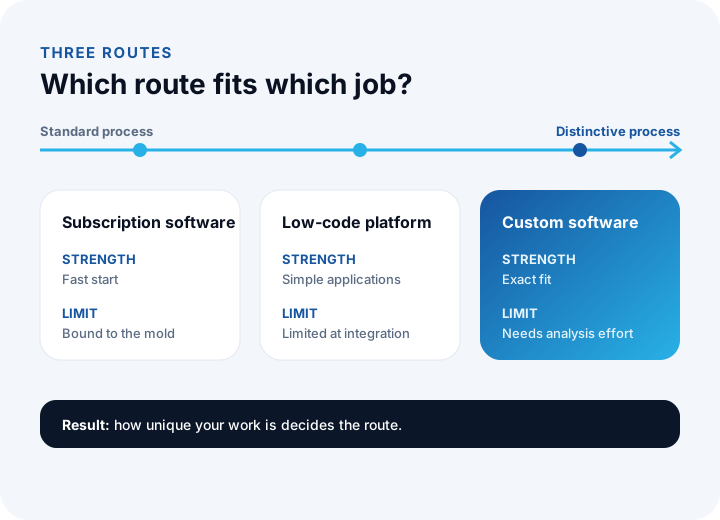
These routes do not exclude each other: an off-the-shelf solution for standard jobs and custom software for the processes that set you apart can be used together. We explained what subscription software is and how it works in our what is SaaS article.
What Mistakes Are Common in Custom Software Projects?
- Describing the solution instead of the problem: Saying "this job takes this long and we want to cut it" leads to a better solution than "build this screen."
- Wanting everything in the first release: Building the core first and growing it with experience lowers both risk and cost.
- Leaving users out of the process: If you go live before the people who will use the software have seen the screens, adoption is hard.
- Leaving upkeep out of the budget: People assume the software is finished the day it goes live; its real lifespan is set by upkeep.
What Does the Cost of Custom Software Depend On?
Custom software has no ready-made price list; cost depends on the scope. The main factors are the number of screens and modules, user roles, the number of integrations, the need for mobile and data migration from an old system.
The logic of the calculation is simple: total effort (person-days) is multiplied by the daily team rate, and then infrastructure and yearly upkeep are added. For example, for a project of 73 person-days at a daily rate of ₺9,000, the development fee is 73 × 9,000 = ₺657,000 (illustrative). Yearly infrastructure and upkeep come on top of that, and a three-year comparison with an off-the-shelf option should be made.
We recommend reading: How to estimate software development cost
Who Owns Custom Software?
That is set by the contract. Who keeps the source code, how the license is granted and how the data is handed to you must be written down up front; the assumption "I had it built, so it is mine" is not always true. Settle the details with your legal advisor.
Ownership of the data is yours in every case: your customer, order and stock data belongs to you and you should be able to export it at any time. Be sure to ask about this when choosing a company.
How Long Does Custom Software Last, and How Does It Stay Current?
Well-designed and regularly maintained custom software is used for years; software left unmaintained ages fast. What determines the lifespan of software is not the day it was written but the upkeep that follows.
Upkeep covers security updates, bug fixing, monitoring, backup and small improvements. In the example in our cost article, yearly upkeep was calculated as 15% of the development fee (₺98,550); the figure is illustrative but shows that upkeep should be a separate line in the budget. As the business changes, the software changes too: new modules are added, processes are updated and integrations are renewed.
How Do You Get Custom Software Developed?
In six steps: the need and goal are written down, a suitable company is chosen, quotes are compared on the same scope, a contract is signed, the software is built and accepted in parts, and support continues after release. We covered each step, the contract clauses and the payment plan in a separate guide.
We recommend reading: How to get custom software developed: choosing a company, quotes, contract and payment plan
We recommend reading: What Is Business Process Automation? Which Process to Automate First and How to Calculate Savings
We recommend reading: What Is a Software Maintenance and Support Agreement (SLA)? Scope, Response Times and Fees
We recommend reading: What Is Digital Transformation? A Maturity, Roadmap and Payback Guide for Small and Mid-Sized Businesses
We recommend reading: How to choose a CRM: criteria, scoring, cost and demo guide
We recommend reading: What is procurement software? Process, approval matrix, quote scoring and three-way matching guide
We recommend reading: What is help desk software? Ticket life cycle, priority matrix, SLA compliance and team sizing guide
We recommend reading: How to secure an API: authentication, authorization, tokens and rate limiting
We recommend reading: How to move from Excel to software: signs, cost and data migration
We recommend reading: What is shipment planning software? Routes, vehicle load and proof of delivery
We recommend reading: What is low-code? Limits, risks and cost of low-code development
Recommended reading: What is microservices architecture? Monolith difference, cost and decision guide
Recommended reading: What Is Role-Based Access Control (RBAC)?
Recommended reading: CRM vs ERP
Recommended reading: What Is an MVP?
Recommended reading: How to Choose a Database?
Custom Software Development with İnovabil
İnovabil is a custom software company based in Istanbul that builds software for businesses end to end: analysis, design, development, testing, release, and upkeep and support. We work on everything from request and approval flows to admin panels, customer and dealer portals, mobile applications, custom ERP, CRM and e-commerce systems and integrations.
Because we also build our own products that run live every day, such as Faprika, NetKasam and Shopiyz, we know how to keep software running for years, not only how to deliver it. Describe your need in a few sentences, and we will first send you the scope and our approach in writing.
We recommend reading: Our software development process: step by step from analysis to release
Frequently Asked Questions
What is custom software, in short?
Custom software is software designed and built from scratch around the needs, business rules and users of a single business. Instead of tweaking the settings of a package, the software is shaped around the way the business works.
Are custom, bespoke and tailor-made software the same thing?
Yes. Custom software, bespoke software, tailor-made software and software built to order all describe the same approach: the software is built for a single business and does not turn into a package that everyone shares.
What does a custom software company do?
A custom software company analyzes the business's needs, designs the screens and data structure, builds the software, tests it, releases it, and provides upkeep and support after release. A good company runs all of this with a transparent process and a written scope.
How long does it take to build custom software?
It depends on the scope. At the end of the analysis, a timeline split into work items is produced; because the software is built in parts, the first working release can be seen before the project ends.
When does custom software make more sense than off-the-shelf software?
Custom software can make more sense if your work is unique, if you need to join several systems in one flow, if off-the-shelf software does not support an important step of your business, or if license cost grows with your user count. For a standard business, off-the-shelf software is usually enough.