

You have a product idea, but building a software team will take months; or your current team cannot keep up and you need extra capacity for the next release. Software outsourcing means having an outside team do all or part of your software development instead of your own employees. It is not a single contract type; it is a shared name for engagement models, from fixed price to a dedicated team, each with a different risk and cost structure.
In this guide we explain what software outsourcing is, how it differs from insourcing, nearshore and offshore, the three engagement models, a three-year cost comparison between an in-house team and outsourcing, what should stay in-house, knowledge-transfer and dependency risks, KVKK (Turkey's personal data protection law) and confidentiality points, a vendor evaluation checklist and a six-step start. All figures are illustrative; they are not any company's price or a market average. For vendor selection and the contract side, see our guide to getting custom software developed; this article focuses only on the outsourcing engagement model.
What Is Software Outsourcing?
Software outsourcing is the contractual handover of stages such as planning, design, development, testing or maintenance to an external vendor. The vendor's team runs the work with its own staff; you set the goal, the priority and the acceptance criteria. The outsourced work can be an entire project or just a single part, such as testing or maintenance.
There is a distinction people often blur: custom software is the type of thing you build, while outsourcing is who builds it. Company-specific software can be written by an in-house team or an outside one. We described what custom software is and its layers in our what is custom software guide.
We recommend reading: Our custom software service
What Is the Difference Between Outsourcing, Insourcing, Nearshore and Offshore?
These terms answer two separate questions: who does the work and where the team sits. Insourcing means doing the work with an in-house team; outsourcing means an external team. Nearshore and offshore describe how far away, geographically and in time zone, the external team is.
| Term | Meaning | Strength | Watch out for |
|---|---|---|---|
| Insourcing | Work is done by your own employees | Knowledge stays in the company, full control | Hiring time and fixed cost |
| Outsourcing | Work is handed to an external team by contract | Fast start, flexible capacity | Knowledge transfer and dependency |
| Onshore | The external team is in the same country and work pattern | Easy communication, same language and law | Local pay levels |
| Nearshore | The external team works in a nearby time zone | Shared working hours, short travel | Cultural and contract-law differences |
| Offshore | The external team works in a distant time zone | Wide talent pool | Little shared time, heavy communication load |
When choosing a location, look at shared working hours, not at the lowest price; daily short communication becomes hard without overlapping time.
Which Engagement Models Are Used in Outsourcing?
There are three basic models. The only thing that decides which to choose is how clear the scope is and how long the work will last.
| Model | How you pay | Suitable when | Main risk |
|---|---|---|---|
| Fixed price | One fee for the scope, tied to milestones | Scope is written and clear, duration limited | Scope changes cost extra; vendor adds risk to the price |
| Time and materials | Person-days actually spent | Scope unclear, fast experiments, intermittent need | Budget control loosens; needs tight tracking |
| Dedicated team | A fixed monthly fee for a team set aside for you | Long-running product, continuous development | Fee continues if work slows; team turnover risk |
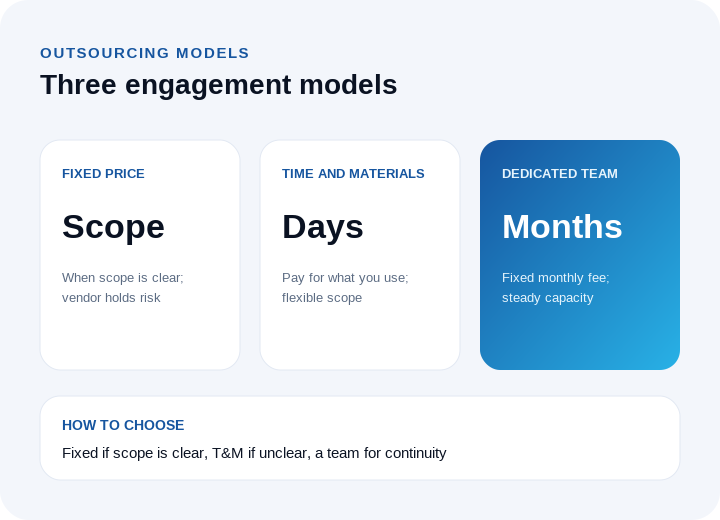
Scope is critical in fixed price: giving a fixed price to an unclear job either pushes the vendor to inflate the price against risk or pushes you into constant change-request negotiation. To write the scope down, see the sections in our software RFP guide. In time and materials, control is yours, but the price is a tight weekly follow-up. A dedicated team lets the people learn your product and deepen over the years.
In-House or Outsourced? How Do You Compare Three-Year Cost?
Outsourcing is not always cheaper, and not always more expensive. Compare the two on the same capacity and the same period, adding hidden items next to the visible fee. The assumptions below are illustrative and describe an equivalent capacity of 3 people in both options.
- In-house team: 3 people, a monthly loaded cost of ₺90,000 per person (salary and employer burden); recruitment at one month of loaded cost per hire; a management and coordination share of 10%; equipment and licences of ₺15,000 a month.
- Outsourced dedicated team: ₺240,000 a month for a team of 3 (₺80,000 per person); a 5% management share on your side; one month's fee for handover and knowledge transfer.
| Item (36 months) | In-house | Dedicated external team |
|---|---|---|
| Team cost: 3 × ₺90,000 × 36 and ₺240,000 × 36 | ₺9,720,000 | ₺8,640,000 |
| Recruitment: 3 × ₺90,000 | ₺270,000 | — |
| Management share (10% and 5%) | ₺972,000 | ₺432,000 |
| Equipment and licences: ₺15,000 × 36 | ₺540,000 | — |
| Handover and knowledge transfer (1 month) | — | ₺240,000 |
| Three-year total | ₺11,502,000 | ₺9,312,000 |
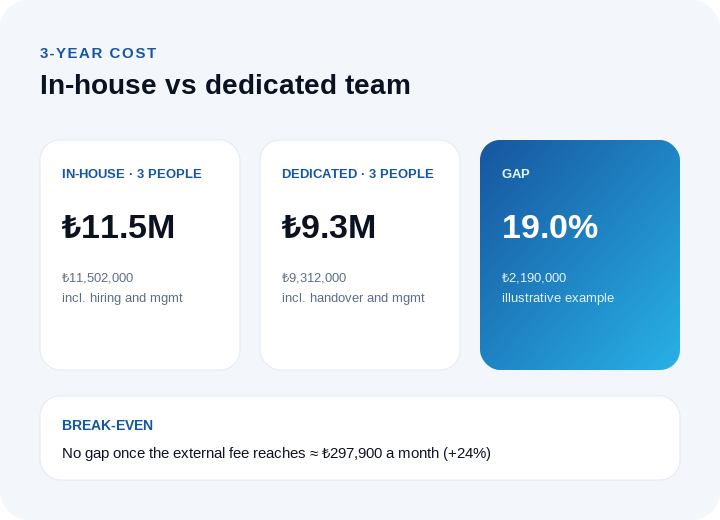
The gap is ₺11,502,000 − ₺9,312,000 = ₺2,190,000, about 19.0% of the in-house cost (2,190,000 ÷ 11,502,000). Monthly, the in-house team is ₺11,502,000 ÷ 36 = ₺319,500 and the external team ₺9,312,000 ÷ 36 = ₺258,667.
Break-even fee for the external team: Call the external monthly fee R; the total is 36 × R × 1.05 + ₺240,000. Setting this equal to the in-house ₺11,502,000 gives R = (₺11,502,000 − ₺240,000) ÷ 37.8 ≈ ₺297,900. In other words, if the external team rises about 24% above ₺240,000 a month (₺297,900 ÷ ₺240,000 ≈ 1.24), the advantage is gone.
Comparison with time and materials: At a rate of ₺5,000 per person-day plus a 5% management share, you pay ₺5,250 a day; to match the in-house ₺319,500 a month you would use ₺319,500 ÷ ₺5,250 ≈ 60.9 person-days a month. A team of three has 3 × 22 = 66 person-days of capacity a month, so as long as utilisation stays below 60.9 ÷ 66 ≈ 92.2%, time and materials is cheaper. The dedicated team's per-person-day equivalent is ₺240,000 ÷ 66 ≈ ₺3,636; the difference is the discount for a continuity commitment. These rates are illustrative values, independent of the daily rate in earlier articles.
This paper gap assumes the external team really works at full efficiency and at the same quality. An in-house team accumulates knowledge in the company, which has no monetary line in the table. To calculate the one-off effort cost of a project separately, use our software development cost guide.
What Should You Outsource and What Should You Keep In-House?
The rule is simple: coding capacity can be rented; product direction, business rules and data cannot. For everything you hand out, ask "what happens if the vendor leaves tomorrow?"
| Area | Usually | Why |
|---|---|---|
| Product ownership and priority | In-house | The business decides what gets built; the vendor implements |
| Architecture and technology choice | In-house approval, outside proposals | It sets long-term dependency |
| Data and access accounts | In-house | Your access to your data must not depend on the vendor |
| Source code repository | In your account | Ownership and easy handover |
| Interface and development | Can be run externally | Capacity and expertise can be rented |
| Testing and maintenance | External or mixed | The acceptance decision is still yours |
How Do You Manage Knowledge-Transfer and Dependency Risk?
The sneakiest risk of outsourcing is when only one or two people know the project; when they leave, the knowledge goes with them. The remedy is that knowledge lives in documents and the repository more than in people.
- Key-person risk: Write in the contract that at least two people on the team know every critical part and that changes will be notified to you in advance.
- Documentation: The architecture summary, setup steps, data model and business rules should be updated at every sprint end; make document delivery part of the acceptance criteria.
- Source code and accounts are yours: The code repository, cloud account, domain and third-party service accounts should be opened in your name, with access granted to the vendor and not the other way round.
- Regular code delivery: Verify that code enters your repository at every sprint end, not only at the end of the project.
How Do You Set Up Communication and a Shared Working Rhythm?
Success with an external team depends on rhythm more than on the contract. For the team to understand your product, short, regular contact is needed.
- One counterpart: One product owner on your side and one project manager on theirs; decisions go through a single channel.
- Sprint meetings: In two-week sprints, planning at the start and a review at the end; the order of priorities stays in your hands.
- Weekly demo: Seeing working software every week is how you catch a misunderstanding in the first week rather than the third.
For the general frame of process steps, see our software development life cycle guide, and for the time plan, our project plan guide.
How Do You Handle KVKK and Confidentiality When Outsourcing?
If the external team touches personal data, this is a data-processing relationship and needs a written frame. For legal details, always consult your legal advisor; the points below are only technical and contractual checkpoints.
- Confidentiality agreement: For the whole team, signed before the project and continuing after it.
- Data-processing frame: Which data the team will access, where it is stored and for how long; put these in writing.
- Sample data instead of real data: In development and test environments, use masked or generated data instead of real customer data.
- Least privilege: Give each person only the access their job needs; close accounts when the project ends and record it.
- Access logs: Who accessed what and when should be traceable.
Write your maintenance and support expectations using the clauses in our software maintenance agreement (SLA) guide.
How Do You Evaluate a Software Vendor? Eight Questions
Before the quote price, look at how the vendor runs the work. The questions below are the list you will seek answers to in interviews and reference checks.
- Has it completed a project of similar size and type, and can it give references you can talk to?
- Who will be assigned to us, and is the team that gives the quote the same team that does the work?
- How is handover done if a team member leaves, and do at least two people know every part?
- Will the code repository and cloud accounts be opened in our name?
- Are testing and documentation inside the process or at the end?
- What is the rhythm: sprints, weekly demo, single counterpart, shared working hours?
- How are scope changes priced and approved?
- Is it ready to put confidentiality and data processing in writing, and does it offer an exit and handover plan?
Get the answers in writing and put them side by side in the quotes.
How Do You End an Outsourcing Relationship? Handover and Exit Plan
An exit plan is an insurance written at the start of the relationship that you hope never to use. When signing the contract, write the exit too.
- Delivery list: Source code, documents, data model, environment details and account permissions.
- Handover period: A transition period that passes knowledge to the new team (example: one month) and its fee.
- Access closure: Closing the vendor's accounts and keeping the confidentiality obligation in force.
What Are Common Mistakes in Software Outsourcing?
- Looking only at price: The cheapest quote is the one that does not add scope and handover risk to the price.
- Handing over product ownership: Leaving priority to the vendor turns the product into something someone else steers.
- Leaving source code and accounts with the vendor: It becomes the most expensive bargaining chip when you part ways.
- Fixed price on an unclear scope: A fixed price before the scope is clear turns into constant change negotiation.
- Skipping the rhythm: Without a weekly demo, you meet surprises at the end of the project.
How Do You Start with Outsourcing? Six Steps
Starting small and growing by measurement limits risk. The six steps below keep your first outsourcing engagement manageable.
- Write the goal and scope: What will be done, what will not, and how success will be measured.
- Choose the model: Fixed price if the scope is clear, time and materials if it is unclear, a dedicated team if there is continuity.
- Evaluate vendors: Compare at least two quotes with the eight-question list and a reference call.
- Start with a small pilot: A limited job of 2–4 weeks to test the rhythm and the quality.
- Set up access and documents: The code repository, accounts, document routine and confidentiality frame should be ready before the pilot.
- Run the rhythm and review: With the weekly demo, sprint meetings and a quarterly review, change the model if needed.
We recommend reading: Software Project Risk Management: Risk Register, Scoring and Response Strategies
We recommend reading: How to Build a Software Development Team: Roles, Staffing, Cost and Capacity Guide
We recommend reading: How to Close a Software Project and Hand It Over: Criteria, Checklist, Access Handover and Lessons Learned
We recommend reading: How to Hire Software Developers: Technical Interviews, Scoring Rubric and the First 90 Days
We recommend reading: How to Do a Software Technical Due Diligence: Code and Architecture Audit, Scorecard and Decision Guide
An Outsourced Software Partner with İnovabil
At İnovabil our focus is building company-specific software from scratch; we help businesses meet their custom software, ERP, CRM, e-commerce, web, mobile and integration needs without building a software team. In that sense we can work as an outsourced software partner. We suggest settling the engagement model (project-based if the scope is clear, a longer collaboration if there is continuity) together and in writing at the end of requirements analysis; we do not commit up front to a team size or a duration.
We built CRM, purchasing and mobile for Avcılar İnşaat; a purchasing system for İZBAN; logistics and shipment planning with wholesale order management for Karyak; warehouse management and a complaint and support management system for Sleepy; and shipment planning for Bofigo. Our process consists of the steps analysis, design, development, testing, release, maintenance and support; handing over code and documents is part of that frame. Write your need briefly and let us look together at which model fits.
We recommend reading: Our software development process: step by step from analysis to release
Frequently Asked Questions
What is software outsourcing and how does it work in short?
It is having an external team do all or part of your software development under contract. The outside team runs the work; you set the goal, priority and acceptance criteria, and you keep product ownership, data and source code.
Is outsourcing or an in-house team cheaper?
It depends. In the illustrative example a three-person in-house team costs ₺11,502,000 over three years and an equivalent dedicated external team ₺9,312,000; if the external monthly fee rises about 24%, the advantage disappears. Recalculate with your own pay and hiring figures.
Fixed price, time and materials or a dedicated team?
Fixed price if the scope is written and clear; time and materials if the scope is unclear or the need is intermittent; a dedicated team for a long-running, continuously developed product. Many businesses start with time and materials in a pilot and change the model later.
Who should keep the source code and data in outsourcing?
You. The code repository, cloud accounts and data should be opened in your name, with access granted to the vendor. Have the contract state source code ownership and the handover obligation clearly; for legal detail, consult a legal advisor.
What should you watch for under KVKK when working with an external team?
A confidentiality agreement, a data-processing frame, least privilege and sample data instead of real data in test environments are the first technical steps. For the detail of your obligations, always consult your legal advisor.