

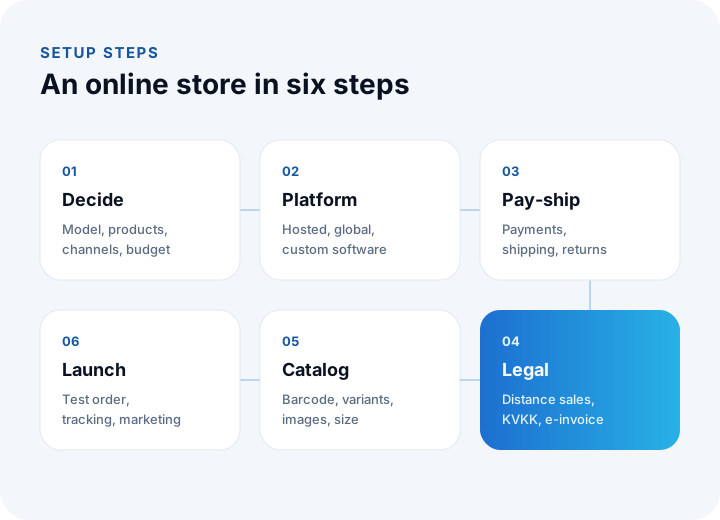
"We want to set up an online store" is usually the shared name of six separate decisions: what to sell, where to sell it, which platform to build on, how payment and shipping will run, who will prepare the legal texts, and where customers will come from once sales start. Building an e-commerce website is not just choosing a store theme; it is setting up a business in which product, platform, payment, shipping, invoicing and marketing are connected.
In this guide we explain how an e-commerce website is built in six steps, the decisions to make before you start, which platform suits whom, the legal and operational requirements specific to Turkey, how to prepare the product catalog, how to calculate cost and break-even orders, and the common mistakes. Example figures are illustrative; on legal matters, consult your legal advisor and financial advisor (certified accountant).
How Do You Build an E-commerce Website?
In six steps: decide the business model and products, choose the platform, set up payment and shipping, prepare the legal texts and the invoicing setup, enter the product catalog, and finally test and launch, then start marketing and measurement.
We recommend reading: E-commerce software: B2C, B2B and dealer portals
What Decisions Should You Make Before Building an Online Store?
Write down five decisions before looking at platforms. These decisions already determine which platform fits.
| Decision | Question to ask | How it affects the platform |
|---|---|---|
| Business model | Do you sell to consumers (B2C), to businesses and dealers (B2B), or to both? | B2B needs dealer-specific prices, account limits and credit-term sales |
| Product structure | How many products, how many variants, where is the stock? | A multi-variant, multi-warehouse setup needs a stronger platform |
| Sales channels | Only your own site, or marketplaces too? | With marketplaces, stock and price integration is a must |
| Existing systems | Do you use ERP, accounting or warehouse software? | If so, a link with e-commerce is needed |
| Goal and budget | What is your first-year order target and the budget you can set aside? | Budget affects the off-the-shelf versus custom question |
Which E-commerce Platform Should You Choose?
There are four routes, and the choice depends on your business model and growth plan. For a standard retail store a hosted platform is fast and affordable; if you need dealer sales, custom pricing and deep integration, custom development comes to the fore.
| Route | Strength | Limit |
|---|---|---|
| Hosted subscription platform | Sets up fast; upkeep belongs to the vendor | Design and business rules are as flexible as the package allows |
| Global platform such as Shopify | A mature ecosystem, a wide choice of themes and apps | Payment, invoicing and shipping connections specific to Turkey are set up separately |
| Self-hosted ready-made software | More control | Security, updates and speed are your responsibility |
| Custom e-commerce software | Fits your business model and systems exactly | Needs an investment in analysis and development |
If you are thinking of starting on a global platform, see our how to set up a Shopify store guide, which covers four topics specific to Turkey. We explained when custom software makes sense in our what is custom software article.
How Are Payment and Shipping Set Up?
Payment and shipping directly affect whether a customer completes the cart. For payment, a licensed payment provider is chosen; card, bank transfer and, if needed, cash on delivery are offered. When choosing a provider, compare commission and extra transaction fees, when the money is transferred to you and refund support; verify the rates from the provider's official price page.
For shipping, the shipment record, label, tracking and return flow must be tied to the order system. Desi calculation, multi-carrier rules and cash on delivery reconciliation are covered in our shipping integration guide.
What Are the Legal and Operational Requirements for an Online Store?
An online store operating in Turkey should not go live before its legal texts, invoicing setup and data protection obligations are ready. The list below shows the topics to ask about; the details depend on regulation and can change.
- Distance sales contract and pre-information: The texts that must be shown to the customer before an order are prepared with your legal advisor.
- Return and withdrawal terms: Written clearly on the site and set up as a process.
- KVKK (Turkey's personal data protection law) notice and cookie policy: The texts and consent mechanism for customer data and tracking cookies are set up.
- E-invoice or e-archive invoice: How the invoice will be issued from an order is decided with your financial advisor and connected to the system.
- Company and tax details: The trade name, tax details and contact address are visible on the site.
We recommend reading: What is e-invoice integration? A guide for orders, ERP and accounting
How Is the Product Catalog Prepared?
The catalog is the store's selling power, and the processes after the order depend on this data. Before entering products, prepare a template and fill in every product in the same format.
- Unique barcode and stock code: The key to marketplace and ERP connections.
- A clear product name and description: For search and AI answers, the first sentence should define the product.
- Images: Use images of the same ratio that load fast and have alt text.
- Variants and stock: Options such as size and color are kept as separate stock items.
- Dimensions and weight: Dimensions sit on the product card so that shipping desi and charges are calculated correctly.
What Does the Cost of an Online Store Consist Of?
Cost falls into two groups: setup and running. Looking only at the setup fee is misleading; monthly fixed costs, marketing and upkeep decide the total cost.
| Item | What it includes | Type |
|---|---|---|
| Platform | Subscription, hosting or custom software development | Setup and monthly |
| Design and theme | Brand fit, mobile view, custom pages | Setup |
| Product entry | Catalog preparation, images and descriptions | Setup |
| Integrations | Payment, shipping, e-invoice, ERP, marketplaces | Setup and monthly |
| Marketing | Ads, SEO, email | Monthly |
| Upkeep and support | Updates, security, bug fixing | Monthly or yearly |
How is the break-even number of orders found?
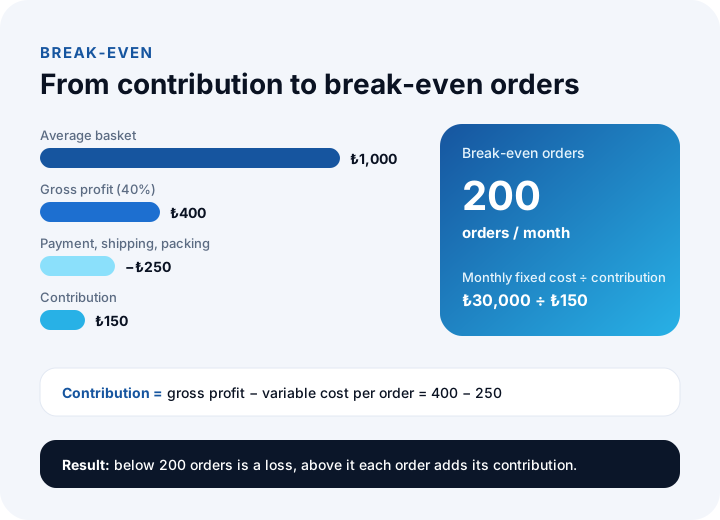
Example (illustrative): if the average basket is ₺1,000 and gross profit is 40%, gross profit per order is ₺400. If payment, shipping and packing cost ₺250 per order, the contribution is 400 − 250 = ₺150. If monthly fixed costs (platform subscription, upkeep and marketing) are ₺30,000, break-even is 30,000 ÷ 150 = 200 orders. Every month below that number is a loss, and every order above it earns its contribution as profit.
The visitors needed to reach the target order count come from the conversion rate: conversion rate = orders ÷ visitors. For 200 orders, a 2% conversion means 10,000 visitors (illustrative). What you can pay to bring in a visitor decides whether advertising is profitable; you can use our ROAS calculator for that (Turkish interface).
Why Do Speed and Mobile Fit Matter for an Online Store?
Most visitors come to a site from their phone and do not wait on a slow page; speed and mobile fit directly affect the conversion rate. The product page and the cart step should be usable one-handed on a phone, images should be served at small file sizes, and the payment step should carry no unnecessary fields.
After setup, try the loading time and mobile view of the product page on a real phone. Because search engines also assess speed and mobile usability, this work supports both sales and visibility.
How Is the Post-Order Process Designed?
When a customer places an order, the work has just begun: stock must fall, an invoice must be issued, a shipment record opened and the customer informed. If these steps are run by hand, errors and delays grow as the order count rises.
- Stock: Every order should lower stock instantly; it should also sync with marketplaces.
- Invoice: An e-invoice or e-archive invoice should be generated automatically from the order data.
- Shipping: The shipment record and label should open from the order and tracking should reach the customer.
- Returns: A return request should be managed together with the stock and invoice correction.
How Are Security and Backup Handled for an Online Store?
Because an online store holds customer data and a payment flow, security is a separate work item. Payment details should be processed by a licensed payment provider, not on your site; only authorized users should enter the admin panel, passwords should be strong and updates should be done regularly. Backing up order and customer data and testing a restore are also part of the plan.
We recommend reading: How to back up business data: RPO, RTO and the 3-2-1 rule
Should Marketplaces Run Alongside Your Own Online Store?
Marketplaces give quick reach, while your own site gives brand and customer data; most businesses run both. The condition for running both is managing stock and price from one center; otherwise overselling and price inconsistency appear.
We recommend reading: What is marketplace integration? A guide to managing products, stock and orders in one place
How Are Marketing and Measurement Set Up in the First 90 Days?
Set up measurement before launch, and treat the first 90 days as a learning period. In the first month, basic technical SEO, product page content and measurement tags; in the second, small-budget ad tests and email collection; in the third, invest in the channel the data points to.
For search visibility, our how to do SEO guide and, for being included in AI answers, our what is GEO article give actionable steps.
What Checks Are Made Before Launch?
A pre-launch checklist catches the most expensive mistakes before customers see them. Running a test order from start to finish is its most important item:
- Place a test order; check payment, stock decrease, invoice and the shipment record.
- Try the cart and payment step from a phone.
- Run the return and cancellation flow with a test order.
- The legal texts and the cookie consent are visible and working on the site.
- Measurement tags and conversion tracking are verified.
- Page titles, descriptions and the sitemap are checked.
- Backup and admin access are reviewed.
- Contact, support and order notification emails are tested.
What Mistakes Are Common When Building an Online Store?
- Looking only at the setup fee: If monthly costs and marketing are left out, break-even does not hold.
- Leaving legal texts until last: Going live with missing texts is both a legal and a reputational risk.
- Not testing shipping and payment: Try the real order flow end to end before launch.
- Neglecting catalog quality: A missing barcode, dimension or description later spreads into every system.
- Not setting up measurement: Budget is spent without knowing which channel brings sales.
Building an Online Store with İnovabil
At İnovabil we treat an online store not just as a storefront but as the design of the order, stock, payment, shipping, invoice and marketplace flow. For a standard retail store we develop our own e-commerce platform, Faprika; when a dealer portal, custom pricing and an ERP link are needed, we build custom e-commerce software. For Shopify-based projects we help through Shopiwell and our Shopify services page.
Describe your product, channels and existing systems in a few sentences, and we will first tell you in writing which route suits you and what the scope is.
We recommend reading: Our Shopify services
Frequently Asked Questions
How do you build an online store, and where do you start?
First the business model, products, sales channels and budget are decided. Then the platform is chosen, payment and shipping are set up, legal texts and the invoicing setup are prepared, the catalog is entered, the site is tested and launched, and marketing begins.
Should I choose a hosted platform or custom software?
For a standard retail store a hosted platform is fast and affordable. If you need dealer sales, custom pricing, product configuration or deep ERP integration, custom e-commerce software is the more direct choice.
Which legal texts does an online store need?
Texts such as the distance sales contract, pre-information, return and withdrawal terms, the KVKK notice and the cookie policy are needed. The details depend on regulation; settle them with your legal advisor and financial advisor.
How is the break-even number of orders calculated?
Monthly fixed cost is divided by the contribution per order. Contribution is found by subtracting variable costs such as payment, shipping and packing from the order's gross profit.
How long does it take to build an online store?
It depends on the platform and the scope. On a hosted platform, if the catalog and legal texts are ready, setup finishes quickly; custom software and integrated projects need time for analysis, development and testing.