

A manufacturer's or distributor's order day often looks the same: dealers phone in, send product photos over WhatsApp, email order lists. The sales rep keys every order into the ERP one by one, calls the warehouse to check stock, and looks up the dealer's discount and customer account balance on separate screens. B2B ecommerce means running this business-to-business sales process over the internet: through the dealer's own account, with prices and terms specific to them, at any hour of the day. In short, it turns wholesale that runs on phone calls and email into an orderly, measurable channel that largely runs by itself.
In this guide we explain what B2B ecommerce is, where it differs from B2C ecommerce, which features a dealer portal should have, why ERP and accounting integration is decisive, which businesses it suits, the difference between a ready-made platform and custom development, and the steps of a B2B project. At the end you will also find a checklist table to measure how ready your business is for B2B ecommerce.
What Is B2B Ecommerce?
B2B ecommerce (business to business) is a company selling its products and services online to its dealers, wholesalers, corporate customers or other businesses in the supply chain. The buyer is not a consumer but a business, so price, payment, order and delivery rules follow the rules of trade between businesses.
In practice, B2B ecommerce usually shows up as a dealer portal or a dealer order system. The dealer logs in with their own username; sees the price list, discounts, promotions and customer account assigned to them; places orders, tracks shipments, and follows invoices and payments. Instead of typing orders one by one, the sales team focuses on growing relationships with dealers, winning new dealers and collections.
B2B ecommerce is not only for large companies. A manufacturer with a few dozen dealers and a wholesaler distributing to hundreds of points share the same problems: orders taken by hand, wrong prices, delayed information and invisible stock. As the number of dealers grows, these problems multiply.
We recommend reading: Our ecommerce development service: B2C, B2B and dealer portal
What Is the Difference Between B2B and B2C Ecommerce?
In B2C ecommerce everyone sees the same price, pays upfront by card and usually buys a few items once; in B2B ecommerce, prices and terms are defined per buyer, payment is mostly by customer account and credit terms, and orders are large and regularly repeated. These basic differences change almost every screen of the system.
| Topic | B2C ecommerce | B2B ecommerce |
|---|---|---|
| Buyer | Individual consumer | Dealer, wholesaler, corporate customer |
| Access | Public store | Portal with approved-account login |
| Price | Same list price for everyone | Price and discount specific to dealer, group, region or quantity |
| Payment | Upfront by card | Customer account, credit terms, credit limit, bank transfer; card is possible too |
| Order | Few units, one-off | Large quantities, case or pack multiples, regular repeats |
| Purchase decision | One person, quick | Several people, approval flow, quote process |
| Documents | Invoice | Quote, proforma, order confirmation, waybill, invoice, statement |
| Product information | Image and description heavy | Product code, technical specs, units per case, stock and lead time heavy |
| Back-end systems | Payment and shipping integration | ERP, accounting, customer account, warehouse and shipping integration |
This table also explains why adding a "dealer login" on top of a B2C store platform is so often not enough. In B2B the problem is not listing products; it is calculating the right price for each dealer, checking the credit limit, passing the order correctly to the ERP and tracking the shipment.
Which Features Should a B2B Ecommerce Site Have?
A B2B ecommerce site should have dealer-specific prices and discounts, customer accounts and credit-term sales, fast and bulk ordering, live stock and lead time information, order and shipment tracking, document access and user permissions. These features make the dealer's job easier and lighten the load on the sales team.
Dealer-specific prices, discounts and promotions
Pricing is the heart of B2B. Price lists are defined by dealer, dealer group, region or channel; product group discounts, quantity tiers and seasonal promotions are layered on top. When a dealer logs in, they should see the net price with all these rules applied. Pricing rules are kept in one place, usually the ERP, and flow to the portal from there; otherwise two systems end up with different prices.
Customer account, credit-term sales and credit limit
Dealers mostly work on a customer account with credit terms rather than paying upfront. The portal should show the dealer's current balance, their due and overdue amounts and their available credit limit; when the limit is exceeded it should send the order to approval or offer card payment. Letting dealers see their own statements and payments also cuts the "what is my balance?" calls that reach the accounting team.
Fast and bulk ordering
Dealers often know their products by heart. Instead of browsing a storefront, they want to order quickly by typing a product code, uploading a list or repeating a previous order. Ordering in case and pack multiples, minimum order quantities, favorite lists and saved carts are standard expectations in B2B.
Stock, lead time and shipment tracking
Before ordering, the dealer needs to see whether the product is in stock and, if not, when it will arrive. After the order is placed, the approval, preparation, shipment and delivery stages should be traceable from the portal; the waybill and courier information should be linked to the order.
Documents and user permissions
Documents such as quotes, proformas, invoices, waybills and statements should be downloadable from the portal. A dealer company has several people working in it: the buyer prepares the order, the manager approves, the accountant sees only the statement. Users within a dealer and their permissions are a requirement for larger customers.
Why Does ERP and Accounting Integration Matter in B2B Ecommerce?
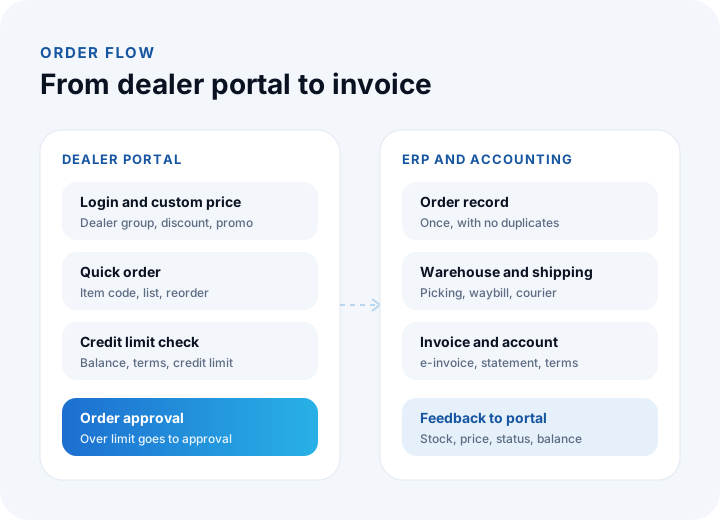
Because in B2B the true source of price, stock, account balance and invoice information is the ERP or accounting system. If the portal does not take this information from the ERP in real time or at short intervals, and does not pass orders to the ERP automatically, the sales team does the same work in two systems and errors become inevitable.
In a well-built integration, data flows in both directions:
- From ERP to portal: Product cards, price lists and discount rules, stock quantities and warehouses, dealer cards, account balances and risk limits, shipment and invoice information.
- From portal to ERP: Dealer orders, order notes and delivery addresses, payments taken by card, new dealer applications.
When designing the integration, the question "which system is the source of truth for which information?" should be answered up front. If prices are kept in the ERP, they cannot be changed in the portal; if an order is created in the portal, it is passed to the ERP once, with no duplicates. When these rules are clear, the portal and the ERP show the same reality.
Integration is the part of a B2B project with the most effort and risk. The service interfaces (API), data structure and documentation of the ERP in use directly affect the project's duration. That is why the integration analysis should be done before the design.
We recommend reading: What is API integration? A guide to connecting systems
Which Businesses Is B2B Ecommerce Suitable For?
B2B ecommerce suits businesses that sell regularly to dealers, wholesalers, retail points or corporate customers, apply customer-specific prices and payment terms, and today collect orders by phone, email or field reps.
- Manufacturers: Companies that sell through a dealer network and apply dealer-specific prices and promotions.
- Distributors and wholesalers: Companies that distribute many brands to hundreds of points and work with a wide catalog and multi-warehouse stock.
- Spare parts and technical product sellers: Sectors where product code, compatibility and technical specs matter and fast, accurate ordering is needed.
- Building materials, food, cosmetics, textile and packaging companies: Sectors with many regularly repeated orders placed in case and pack multiples.
- Corporate suppliers: Businesses that supply companies with office, cleaning, consumables or equipment at contract prices.
For businesses that sell to both consumers and dealers, the B2C store and the B2B portal can run together on the same product, stock and order infrastructure. That way product information is managed in one place, and each channel sells with its own prices and rules.
We recommend reading: Industry software: solutions by sector
What Are the Benefits of B2B Ecommerce for a Business?
B2B ecommerce reduces the order-taking workload, prevents problems caused by wrong prices and missing information, lets dealers order at any hour, makes collections and account tracking easier and makes sales data measurable. How big the benefits are depends on how much of your orders is processed by hand today.
- Sales team time: Reps spend time winning new dealers, building relationships with large customers and on collections instead of typing orders.
- Right price, right order: Price and discount rules are applied by the system; wrong prices, missing product codes and unreadable order lists disappear.
- Uninterrupted ordering: Dealers can order in the evening or at the weekend without waiting for office hours.
- Transparent account: Dealers see their own balance and due dates, so collection conversations go more smoothly.
- Measurable sales: You can see which dealer buys which product how often and which dealers have stopped ordering; campaigns are planned on data.
- Scalability: When the number of dealers grows, the order team does not have to grow at the same rate.
Ready-Made B2B Platform or Custom B2B Software?
If your pricing rules are simple, your ERP integration is standard and your processes fit common patterns, a ready-made B2B platform can be a fast start; if your price and discount structure is complex, you need a deep two-way integration with your ERP, or your ordering, approval and shipping processes are unique to you, custom-built B2B software is the better choice.
| Topic | Ready-made B2B platform | Custom B2B software |
|---|---|---|
| Getting started | Faster | Needs analysis and development time |
| Price and discount rules | Limited to the patterns the platform offers | Your company's rules applied exactly |
| ERP integration | Easy if a ready connector exists, limited if not | Designed in both directions for your ERP |
| Processes | You adapt to the platform's workflow | The software fits your company's workflow |
| Cost structure | Usually a recurring license or subscription | Project fee and maintenance; the software is yours |
| Best suited when | Simple rules, standard processes | Complex pricing, deep integration, unique processes |
When deciding, you need to think not only about today but also a few years ahead: once your number of dealers, products and sales channels grows, how far the system can stretch may matter more than how fast you started.
We recommend reading: Off-the-shelf or custom software? A decision guide
How Do You Build a B2B Ecommerce Site?
A B2B ecommerce site is built in these steps: analysis of the existing sales process and pricing rules, design of the ERP integration, design of the dealer experience, development and testing, a trial with pilot dealers, and rollout to the whole dealer network. The most often skipped step is the pilot and planning the dealers' move to the portal.
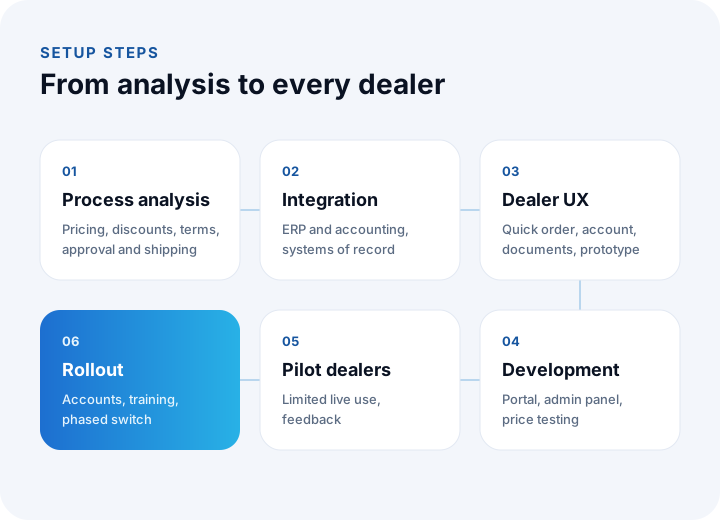
- Process and rule analysis: How orders are taken today, price lists, discount and promotion rules, payment and credit terms, and approval and shipping processes are written down.
- Integration design: What data flows to and from the ERP and accounting system, in which direction and how often is decided; the systems of record are made clear.
- Dealer experience design: Quick ordering, product search, cart, account screen and document access are designed around dealers' habits and tested on a prototype with a few dealers.
- Development and testing: The portal, admin panel and integrations are developed; price calculations are tested by comparing real dealer examples against the results in the ERP.
- Pilot dealers: The system first runs live with a limited number of dealers; fixes are made based on feedback.
- Rollout: Accounts are opened for all dealers, short training sessions and guides are prepared, and phone orders are gradually redirected to the portal.
Moving dealers to the portal is not a technical job; it is change management. Small incentives, such as a special promotion, fast approval or earlier shipment for dealers who use the portal, noticeably speed up the transition.
We recommend reading: Our project process: step by step from analysis to launch
What Are the Common Mistakes in B2B Ecommerce Projects?
The most common mistakes are building B2B as a copy of a B2C store, leaving ERP integration to the end, keeping price rules in two separate systems and not planning the dealers' move to the portal.
- Focusing on the storefront: Large images and long browsing paths slow the dealer down. The most valuable screens for a dealer are quick order and the account screen.
- Keeping prices in two places: Price lists managed separately in the portal soon conflict with the ERP and shake dealers' trust.
- Leaving integration for later: A portal without integration still has orders typed into the ERP by hand; the problem only moves.
- Skipping account and limit checks: A portal without limit control increases collection risk.
- Ignoring permissions within dealers: Accounts opened with a single user lead to password sharing and loss of control at larger dealers.
- Forcing the switch: Instead of suddenly shutting phone orders one day, a gradual move with a pilot, training and incentives is healthier.
Is Your Business Ready for B2B Ecommerce?
If you sell regularly to dealers, apply special prices and terms to them and process a significant share of orders by hand, you have enough ground to move to B2B ecommerce. The table below helps you determine your readiness and priorities.
| Question | If the answer is "yes" |
|---|---|
| Do most orders arrive by phone, email or messages? | Start with a quick order screen |
| Do you have dealer-specific price lists and discounts? | Write down the pricing rules first |
| Do dealers work on customer accounts and credit terms? | Account, limit and statement screens come first |
| Are product, stock and price data in an ERP or accounting system? | Start with an integration analysis |
| Do dealers often call asking "is it in stock, where is my order?" | Stock, lead time and shipment tracking |
| Do you sell to both consumers and dealers? | Plan B2C and B2B on the same infrastructure |
| Is your number of dealers growing? | Consider a scalable, custom structure |
We recommend reading: What Is CRM and What Is It Used For? A Complete Guide to Sales and Customer Management
We recommend reading: What Is Shipping Integration and How Is It Done? A Guide to Shipments, Labels and Tracking for E-commerce
We recommend reading: How to Build an E-commerce Website: Platform, Legal Requirements, Cost and Break-Even Guide
We recommend reading: How to choose a CRM: criteria, scoring, cost and demo guide
We recommend reading: How to secure an API: authentication, authorization, tokens and rate limiting
We recommend reading: What is shipment planning software? Routes, vehicle load and proof of delivery
Recommended reading: What is a customer portal? Self-service scope, security and payback guide
Recommended reading: What Is Role-Based Access Control (RBAC)?
B2B Ecommerce with İnovabil
At İnovabil we treat B2B ecommerce not as a store theme but as moving your sales process to digital. First we write down with you how your orders are taken today, your price and discount rules, and your account and credit terms; then we develop a dealer portal that offers your dealers custom prices, customer accounts, quick ordering, and stock and shipment tracking.
We connect the portal to your ERP and accounting system in both directions and set up payment and shipping integrations. If you need it, we combine your B2C store, marketplace channels and dealer portal on the same product, stock and order infrastructure. We stay by your side from the trial with pilot dealers to the move of the whole dealer network and the improvements after launch.
Tell us in a few sentences how many dealers you work with, how you take orders today and which ERP or accounting system you use; let us prepare a B2B roadmap for you.
Frequently Asked Questions
What is B2B ecommerce, in short?
B2B ecommerce is a company selling its products and services online to its dealers, wholesalers and corporate customers, with price, payment and order terms specific to each buyer. It usually works as a dealer portal accessed with an approved account.
Is a dealer portal the same as a B2B ecommerce site?
Largely yes. A dealer portal is the most common form of B2B ecommerce. Some portals focus only on taking orders, while others grow into a broader dealer management area that also includes customer accounts, documents, promotions, support requests and sales reports.
Is it mandatory to use an ERP for B2B ecommerce?
It is not mandatory but it is very important. If price, stock and account information are kept in an ERP or accounting system, the portal needs to connect to that system. For businesses that use no ERP at all, the portal's own admin panel can hold this information; it is recommended to design it so that it can be connected to an ERP later.
Can a B2C store and a B2B portal run on the same system?
Yes. A store open to consumers and a portal working with dealer-specific prices and rules can run together on the same product, stock and order infrastructure. Product information is managed from one place, and each channel applies its own prices and terms.
How do you get dealers used to the portal?
You start with a limited number of pilot dealers and improve the system with their feedback. Then accounts are opened for all dealers and short training sessions and guides are provided. Offering incentives such as fast approval, special promotions or priority shipping for orders placed through the portal speeds up the transition; phone orders are gradually redirected to the portal.