

As a business grows, the same question always lands on the table: should we run the company on off-the-shelf software from the market, or should we build custom software around our own processes? A wrong decision is expensive in both directions. A package that does not fit forces your team to work around the software for years; an unnecessary custom project burns time and budget.
In this guide we compare off-the-shelf vs custom software in a neutral way: what each one is, the cost items, when each is the right choice, the hybrid approach that combines the two, and the questions you should ask yourself before deciding.
What Is Off-the-Shelf Software?
Off-the-shelf software (packaged software) is software designed around the shared needs of many businesses, where the same product is sold or rented to everyone. Pre-accounting programs, general-purpose CRMs, ready-made e-commerce platforms and task management tools fall into this group.
The strength of off-the-shelf software is that it gathers the common needs of thousands of users in a single product. It is quick to set up, learning resources are plentiful and the initial cost is low. On the other hand, the product is shaped around the "average customer", not around you. The closer your business is to that average, the better off-the-shelf software fits.
What Is Custom Software?
Custom software is software designed and built from scratch around a business's own workflows, rules and users. Screens, approval steps, reports and connections to other systems are built according to how your business actually runs.
With custom software you adapt the software to the work; with off-the-shelf software you adapt the work to the software. The difference looks small but has big consequences in daily operations: unused screens, intermediate steps moved into Excel and data transferred by hand are often symptoms of this mismatch.
We recommend reading: Our custom software development service
What Are the Differences Between Off-the-Shelf and Custom Software?
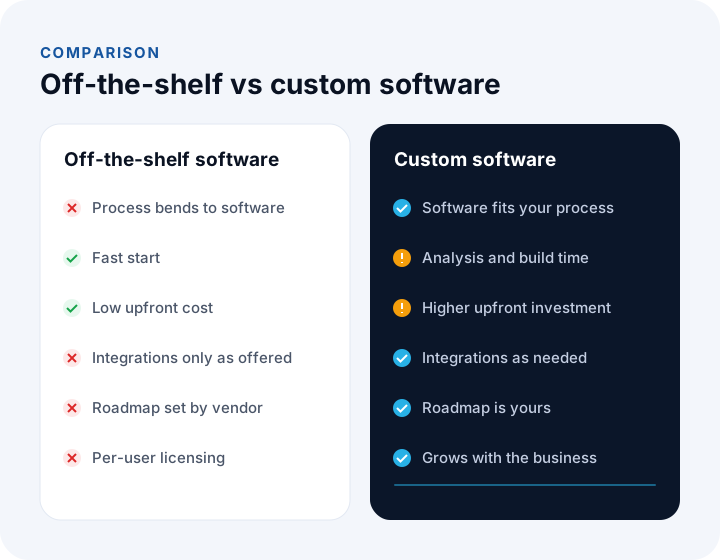
The core difference between the two options is whose needs the software is shaped around. The table below puts the two approaches side by side on the points that matter most when deciding.
| Topic | Off-the-shelf software | Custom software |
|---|---|---|
| Process fit | The business adapts to the flow the software offers | The software is built around the business's flow |
| Time to start | Short; setup and configuration are enough | Analysis, design and development time is needed |
| Upfront cost | Low; license or subscription | Higher; development investment |
| Long-term cost | Grows as users and modules increase | Largely limited to maintenance and new development |
| Integration | Only as much as the package offers | Built with the systems you need |
| New needs | Depends on the vendor's roadmap | Developed according to your priorities |
| Data and control | On the vendor's infrastructure and under its rules | Under your control, according to the contract |
When Is Off-the-Shelf Software the Right Choice?
If your work follows standard industry flows and software is not a competitive factor for you, off-the-shelf software is usually the right choice. Starting with a ready solution makes sense especially in these situations:
- Standard processes: Areas whose rules are set by regulation and work similarly in every business, such as pre-accounting, e-invoicing (e-Fatura) and payroll.
- Need for a fast start: Newly founded businesses that want to test the market first.
- Limited budget: Those who prefer a monthly or annual subscription to a development investment.
- Small teams: Businesses that work with few users and no complex approval flows.
When Is Custom Software Necessary?
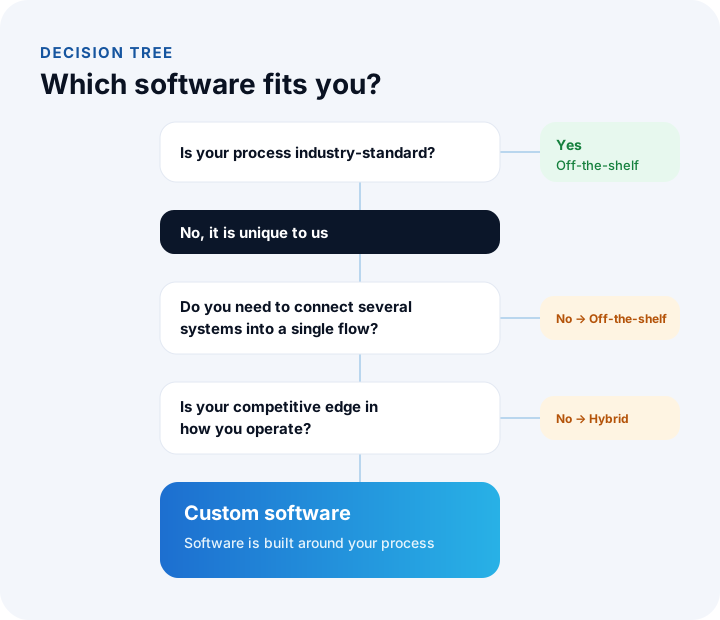
Custom software comes onto the agenda at the point where off-the-shelf software starts to limit you and your team does extra work to get around it. If two or more of the signs below apply to you, it is time to seriously consider custom software:
- Your processes are unique: Your pricing, approval, production or service flow does not fit standard industry patterns.
- Data is moved by hand: Orders are taken from one system and retyped into another, and reports are combined in Excel from different sources.
- Several systems must meet in one flow: Your sales, warehouse, accounting and website do not talk to each other.
- Per-user license cost is growing: License spend rises as the team grows, and you also pay for modules you do not use.
- You are waiting on the vendor for a new need: The feature you want is not on the package's roadmap or arrives too late.
- Software is part of your competitive advantage: The experience, portal or mobile app you offer your customers sets you apart from competitors.
What Makes Up the Cost of Custom Software?
The cost of custom software is not a single figure but a result of scope. The main items that determine the price are these:
- Scope: Number of screens, user roles, business rules and the complexity of reports.
- Platforms: Is web enough, or do you also need iOS and Android apps?
- Integrations: The number and difficulty of systems to connect, such as e-invoicing, accounting, ERP, marketplaces, shipping and banks.
- Data migration: The volume and cleanliness of the data to be moved from old systems.
- Maintenance and support: Updates after launch, bug fixing and new development.
When comparing cost, look not only at the initial investment but at the total cost over several years. With off-the-shelf software, license and subscription fees repeat every year and grow with the number of users; with custom software the initial investment is higher, but afterwards cost is largely limited to maintenance and new development.
We recommend reading: Our custom software development process: six steps from analysis to launch
How Do You Compare the Three-Year Cost of Off-the-Shelf and Custom Software?
The cost of off-the-shelf software grows with the number of users, while the cost of custom software depends largely on the development done up front and on yearly upkeep. That is why the comparison is made not on a single price but by number of users.
Example (illustrative figures, using the dealer portal assumptions in our cost article): the off-the-shelf license is ₺600 per user per month with a ₺150,000 adaptation fee; the three-year total of the custom solution is ₺1,132,650 (₺657,000 development, ₺180,000 infrastructure, ₺295,650 upkeep).
| Number of users | Off-the-shelf (3 years) | Custom (3 years) |
|---|---|---|
| 30 | 600 × 30 × 36 + 150,000 = ₺798,000 | ₺1,132,650 |
| 46 | 600 × 46 × 36 + 150,000 = ₺1,143,600 | ₺1,132,650 |
| 60 | 600 × 60 × 36 + 150,000 = ₺1,446,000 | ₺1,132,650 |
The break-even is at about 46 users: (1,132,650 − 150,000) ÷ (600 × 36) ≈ 45.5. Below that number of users the off-the-shelf option is cheaper, above it the custom option is more economical. This calculation shows only cost; factors such as process fit, integration and flexibility must be assessed separately.
Hybrid Approach: Can the Two Paths Be Combined?
Yes. For many businesses the most efficient solution is to use off-the-shelf and custom software together. In a hybrid approach standard work runs on off-the-shelf software, company-specific processes are custom built, and the two worlds are connected through integrations.
For example, a manufacturer can use a ready solution for pre-accounting and e-invoicing while running production planning, recipes and costing with a custom ERP module. Dealer orders can be taken through a custom B2B portal and passed automatically to both the ERP and accounting. The success of this approach depends on a solid integration between the systems.
We recommend reading: Integration and API development
8 Questions to Ask Before You Decide
When your team answers the questions below together, they largely clarify which path suits you:
| Question | If the answer is "yes" |
|---|---|
| Are our processes the same as other businesses in our industry? | Leans toward off-the-shelf |
| Does the team do extra work to get around the current software? | Leans toward custom |
| Do we enter the same data into more than one system by hand? | Custom software or integration |
| Is the software part of the experience we offer our customers? | Leans toward custom |
| Will our user count grow significantly in the coming years? | Calculate total cost |
| Must our need be solved within a few weeks? | Start with off-the-shelf |
| Is it critical for us where and how our data is kept? | Leans toward custom |
| Can we run standard work on ready software and unique work on custom software? | Hybrid approach |
Common Mistakes in Custom Software Projects
Even after you decide on custom software, the success of the project depends on avoiding a few common mistakes:
- Skipping the analysis: Starting to code before the process is clear means quickly turning the wrong process into software.
- Fitting everything into the first release: Going live with the core needs first and growing with later releases reduces both risk and cost.
- Not involving users: If the teams who will use the software are not part of design and testing, adoption becomes difficult.
- Not planning maintenance: Software is not finished when it goes live; the scope of updates and support should be discussed from the start.
- Leaving integrations to the end: If connections to other systems are not planned during analysis, surprises appear at the end of the project.
How Do You Move from Off-the-Shelf to Custom Software?
Businesses that hit the limits of an off-the-shelf product can move to a custom solution without dropping the current system. The move is planned so that work does not stop and data is not lost.
- Take an inventory of current use: Which modules, reports and integrations are really used, and which are not?
- Verify that the data can get out: Make sure all records (customer accounts, products, past transactions) can be exported from the current system.
- Rebuild only what is needed: Do not rebuild unused features; focus on the processes that created the need in the first place.
- Move in phases: Go live first in one unit or one module, run it alongside the old system and compare the figures.
- Get approval before closing the old system: Confirm that archive, legal retention and financial advisor (certified accountant) needs are met.
The most common mistake in a move is trying to copy every feature of the old system one-to-one. The aim is not to repeat everything the current software does, but to do better the work your process really requires.
We recommend reading: How to Get Custom Software Developed: Choosing a Company, Quotes, Contract and Payment Plan
We recommend reading: How to Choose an ERP: A Guide to Process Mapping, Module Priority, Payback and Rollout
We recommend reading: What Is Custom Software? Types, Examples, Advantages and Which Businesses It Suits
We recommend reading: What Is Business Process Automation? Which Process to Automate First and How to Calculate Savings
We recommend reading: How to choose a CRM: criteria, scoring, cost and demo guide
We recommend reading: How to move from Excel to software: signs, cost and data migration
We recommend reading: What is low-code? Limits, risks and cost of low-code development
Recommended reading: What is microservices architecture? Monolith difference, cost and decision guide
The Right Software Decision with İnovabil
At İnovabil we start every project not with "custom software right away" but with the question "what is the right solution for your business?" If you have a standard need, we say so openly and, where it fits, recommend our own ready products (Faprika, NetKasam, Shopiyz). Where custom software is needed, we build it end to end, from analysis to launch and beyond.
You can explore the software we build in e-commerce, CRM, ERP, accounting, work and project management, web and mobile, along with our working process, and ask for a roadmap made for you by describing your need in a few sentences.
Frequently Asked Questions
Is custom software necessary for every business?
No. For businesses whose processes are close to the industry standard and that do not see software as a competitive factor, off-the-shelf software is usually enough. Custom software stands out when processes are unique, when several systems must meet in one flow, or when software is part of the competitive advantage.
How long does it take to build custom software?
The time depends on the scope. At the end of the analysis phase a schedule broken down into work items is produced. With incremental development, you start seeing the first working release before the project ends.
Is custom software more expensive than off-the-shelf software?
The initial investment is usually higher. However, because license and subscription fees on off-the-shelf software repeat every year and grow with the number of users, the total cost over several years should be compared.
Will I lose my data when moving from off-the-shelf to custom software?
No. Data such as customers, products, orders and historical records is moved to the new system and verified through a data migration planned as part of the project.
Can off-the-shelf and custom software be used together?
Yes. In a hybrid approach, standard work runs on off-the-shelf software, company-specific processes run on custom software, and the systems are connected through integration.