

Software projects rarely stall because of code. They stall because nobody is sure who decides what, or who hears what and when. Sales wants a wider scope, finance wants to hold the budget, and the warehouse wants the way it works on the floor left alone. Stakeholder management and communication planning for software projects is the work that makes those demands visible, writes down who holds decision rights, and fixes in advance who gets which information, how often and through which channel.
In this guide we cover how to identify stakeholders, how to build an influence–interest matrix, how to write decision rights with RACI, the communication matrix, the meeting-load calculation, a weekly status report template, escalation, the decision log, and how conflicting requests turn into scope pressure. Every example figure is representative; the example project is the dealer portal we have used in our earlier articles.
What Is Stakeholder Management and Communication Planning in a Software Project?
Stakeholder management is identifying the people who are affected by the project or can affect it, grouping them by interest and influence, and planning the relationship you will have with each group; the communication plan is the document that writes down the content, frequency, channel and owner of that relationship.
This article covers only communication and stakeholders. For time and resource planning see our project plan guide, for the risk register see our software project risk guide, and for writing requirements see our requirements analysis guide.
How Do You Identify Stakeholders?
List everyone first, then filter. The missing stakeholder is the person who shows up at the end of the project saying "nobody asked us".
- Decision makers: Those who approve budget and scope (the managing director, department heads).
- Users: People who will use the system every day (warehouse, sales representatives, accounting, dealers).
- Technical owners: Those who run the existing systems, data and infrastructure.
- Reviewers: Finance, legal counsel and people who watch regulation. Leave legal detail to your legal counsel.
- External parties: Partners, suppliers and organizations such as a carrier that connect through data.
Ask one question while building the list: "Whose day will this project change, and whose decision is it waiting for?" Everyone who answers is a candidate.
How Do You Build an Influence–Interest Matrix?
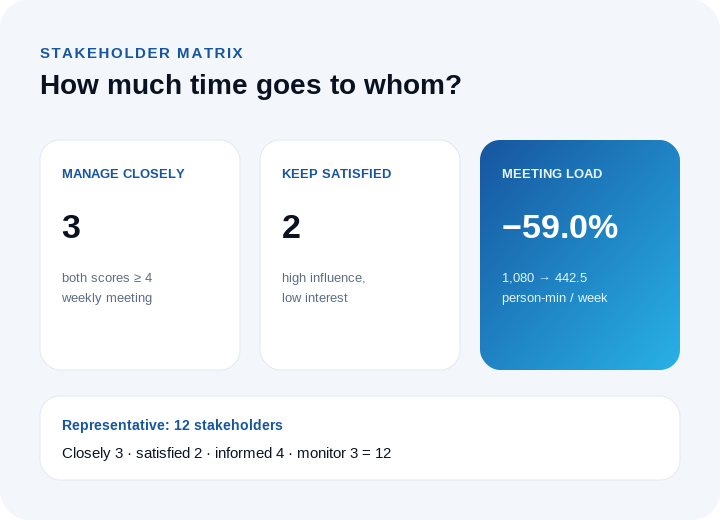
Give each stakeholder a score of 1–5 for influence (power to decide or block) and interest (how much the project affects them). If both are 4 or above, manage closely; if only influence is high, keep satisfied; if only interest is high, keep informed; if both are low, monitor. Below is a representative dealer portal example with 12 stakeholders.
| Stakeholder | Influence | Interest | Group |
|---|---|---|---|
| Sales manager | 5 | 5 | Manage closely |
| Finance manager | 4 | 4 | Manage closely |
| IT lead | 4 | 5 | Manage closely |
| Managing director | 5 | 3 | Keep satisfied |
| Legal counsel | 4 | 2 | Keep satisfied |
| Warehouse lead, pilot dealer representative, sales representatives, accounting team | 2–3 | 4–5 | Keep informed (4 people) |
| Regional managers, human resources, carrier partner | 1–3 | 2–3 | Monitor (3 people) |
That is 3 + 2 + 4 + 3 = 12 stakeholders. The matrix is not a one-off: as go-live approaches, the warehouse lead may move from "keep informed" to "manage closely". Keep the "manage closely" group to five people or fewer; a group that does not fit into the weekly meeting is not really being managed.
How Do You Write Decision Rights? How Is RACI Used?
Name a single approver for every type of decision. In RACI, R does the work, A is accountable and approves (one person per row), C is consulted and I is informed.
| Decision | Sponsor | Product owner | Finance | IT | Project mgr. |
|---|---|---|---|---|---|
| Priority order | I | A | C | C | R |
| Budget overrun | A | C | R | I | C |
| Technical architecture | I | I | I | A, R | C |
| Acceptance result | I | A | C | C | R |
| Go-live | A | C | I | R | R |
| Contract change | A | C | C | I | R |
The rule is one A per row; with two As, the decision waits between two people. Give the decision owner a time promise as well, for example "3 business days after the request arrives". A decision without a day count is only a wish. For the detail of acceptance decisions see our user acceptance testing guide.
How Do You Prepare a Communication Matrix?
A communication matrix writes the content, frequency, channel and owner for each stakeholder group in one table. The example below covers the four groups of the 12 stakeholders above.
| Group | Content | Frequency | Channel | Owner |
|---|---|---|---|---|
| Manage closely | Status, pending decisions, risks | Weekly | 30-minute meeting and written report | Project manager |
| Keep satisfied | Summary, budget, major decisions | Monthly | 60-minute steering committee | Project manager |
| Keep informed | Demo, upcoming changes, training | Every two weeks | 45-minute demo and a short note | Product owner |
| Monitor | Milestones | Monthly or event-based | One-paragraph email | Project manager |
Choose the channel by the weight of the content: decisions in a meeting, anything that must be on record in writing. Define a separate, well-known channel for urgent matters; otherwise everything arrives labelled "urgent".
How Do You Calculate the Meeting Load?
Meeting load = duration × number of attendees. Convert person-minutes to a weekly figure and compare the planned setup with the uncontrolled one.
| Meeting | Duration | Attendees | Person-min / week |
|---|---|---|---|
| Weekly status meeting | 30 min | 5 | 150 |
| Sprint demo (every 2 weeks) | 45 min | 9 | 202.5 |
| Steering committee (monthly) | 60 min | 6 | 90 |
| Planned total | 442.5 | ||
| Uncontrolled setup (a 60-minute weekly meeting for 14 people and 4 unplanned one-to-ones) | 1,080 |
The calculation: 5 × 30 = 150; 9 × 45 ÷ 2 = 202.5; 6 × 60 ÷ 4 = 90; the total is 442.5 person-minutes, or 7.4 hours. In the uncontrolled setup, 14 × 60 = 840 plus 4 × 30 × 2 = 240 gives 1,080 person-minutes, or 18 hours. The difference is 637.5 person-minutes (about 10.6 hours), a reduction of 59.0%.
At ₺300 an hour, the weekly saving is 10.625 × ₺300 = ₺3,187.50, or ₺44,625 over 14 weeks. The plan's own effort is 12 hours of setup plus 1.5 hours of reporting a week: 12 + 1.5 × 14 = 33 hours, or ₺9,900. The net gain is ₺34,725, and the plan pays for itself in about 3.1 weeks (9,900 ÷ 3,187.5). Even if the saving is halved, break-even is about 6.2 weeks. This assumes the hours saved go into other work, and it is representative.
How Do You Write the Weekly Status Report?
A good report is one page, comes in the same order every time and states the situation at first glance. The report prepares the meeting; it does not replace it.
| Section | Content |
|---|---|
| Status colors | Green / amber / red for overall, scope, schedule and budget |
| Completed | What finished this week, with numbers |
| Next week | What is planned and the dependencies |
| Risks | At most three, each with an owner |
| Pending decisions | Decision, owner, due date |
| Change requests | New, approved, rejected |
Write the color rule in advance. Example (representative): schedule deviation up to 5% is green, 5–15% amber, above 15% red. If 16.5 of the 18 planned person-days are complete in week four, the deviation is 1.5 ÷ 18 = 8.3%; the schedule is amber, and the report states the cause and a recovery plan. Do not soften the color: a report that shows red early lets management step in on time. For how to score risks, see our risk management article.
How Do You Set Up Escalation?
Escalation moves an unresolved issue to the next level after a set time; it exists to end the waiting, not to blame anyone.
| Level | Trigger | To whom | Response time |
|---|---|---|---|
| 1 | Decision not made within 3 business days | Decision owner | 2 business days |
| 2 | Level 1 unanswered | Sponsor | 2 business days |
| 3 | Sponsor unanswered, or budget and scope are affected | Extraordinary steering committee | 2 business days |
The longest wait is 3 + 2 + 2 + 2 = 9 business days. Two people blocked on a decision lose 2 × 8 × ₺300 = ₺4,800 of productivity a day; a 5-day delay costs ₺24,000 and 9 days cost ₺43,200. Writing the limit puts a ceiling on open-ended waiting. Escalation during a live incident is a separate subject; see our incident management article.
How Do You Keep a Decision Log?
A decision log is a single list of the decisions taken during the project. Three months later, the answer to "who asked for this, and why did we do it this way?" is found here.
- Fields: Number, date, decision, options considered, decision owner, rationale, who is affected, validity date.
- Example entry: K-07 · dealer discount free below the limit, finance approval above it · decision owner product owner · rationale: it meets both requests · affected: sales and finance.
- Rule: A verbal decision does not count until it is confirmed with a written summary.
- Review: Open decisions appear in the weekly report, and closed decisions are summarized monthly.
Scope decisions also connect to change management; for a system that is already live, we describe the process in our change management guide.
How Do Conflicting Requests Turn into Scope Pressure?
Conflict arises when stakeholders make requests without knowing each other's. Sales wants discounts to be free on the dealer pricing screen, while finance wants an approval step for every discount. Both are right; the solution is not to find who is right but to find the need under each request.
- Write the requests separately: Who wants what, and why.
- Ask for the need: Sales wants speed, finance wants margin protection.
- Generate options: Free below a limit, approval above it.
- Let the decision owner decide: The person with A in the RACI; the rationale goes into the log.
Turn scope pressure into a number. Say the base scope is 60 person-days; stakeholder conversations produced 9 new requests of about 3 person-days each. That is 27 person-days, or 45% extra scope. With a 10% change buffer, you have 6 person-days: only two requests fit. The remaining 7 requests, or 21 person-days (35%), go to a later release or to paid extra scope. Sharing this calculation up front prevents the question "why wasn't everything done?". The demand–capacity balance in our resource and capacity planning article helps with prioritization.
How Do You Measure the Success of the Communication Plan?
Four measures are enough; each one shows a behavior.
| Measure | Calculation (example) | Result | Target |
|---|---|---|---|
| Report on time | 13 ÷ 14 | 92.9% | ≥ 90% |
| Decisions within promise | 10 ÷ 12 decisions | 83.3% | ≥ 90% |
| Average decision time | 28 days ÷ 12 | 2.33 business days | ≤ 3 |
| Stakeholder pulse (out of 5) | 38 ÷ 9 responses | 4.22 | ≥ 4.0 |
In the example the average time is under the promise, but two of the 12 decisions (4 and 5 days) exceeded it; do not stop at the average, look at the ones that broke the promise. The pulse is a five-question survey after each demo. Hold a short conversation with anyone who scores 3 or below.
How Do You Set Up a Communication Plan in Six Steps?
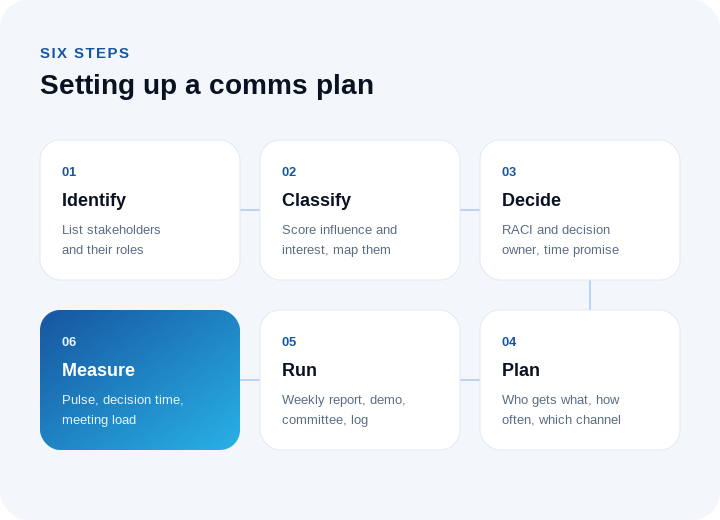
- Identify: List the stakeholders and their roles.
- Classify: Score influence and interest and place them on the matrix.
- Write decisions: Agree on the RACI and the decision time promise.
- Plan: Produce the communication matrix and the meeting load.
- Run: Operate the weekly report, demo, committee and decision log.
- Measure and adjust: Track the four measures; refresh the matrix and frequencies every three months.
The plan also ends with the project: for getting users used to the system, move on to our software adoption guide, and for handover and closing communication, to our project closure guide.
What Are Common Mistakes in Stakeholder Management?
- Inviting everyone to every meeting: Person-minutes multiply with attendee count, and decisions slow down.
- Not writing down the decision owner: Two people say "I decide", or nobody does.
- Ignoring the quiet stakeholder: Someone with high influence and low interest may want to decide at the very end.
- Delaying bad news: If red is reported early, intervention is cheap.
- Trusting verbal decisions: Without a written confirmation, the decision is reopened.
- Building the matrix once and leaving it: A stakeholder's influence and interest change with the project stage.
We recommend reading: How to create a project plan
We recommend reading: How to manage software project risks
Stakeholder and Communication Management in Custom Software Projects with İnovabil
At İnovabil our focus is custom software built from scratch for the individual company. In multi-department systems (CRM, purchasing and mobile for Avcılar İnşaat; a purchasing system for İZBAN; logistics and shipment planning for Karyak; warehouse management plus a complaint and support system for Sleepy), different departments naturally expect different things. That is why we recommend writing down the stakeholder list, the decision owners and the communication rhythm during the analysis stage.
The steps on our process page are analysis, design, development, testing, release, and maintenance and support; the communication plan stays the same across all of them. The rhythm and thresholds in this article are a suggestion, not a numeric commitment; we set them with you for your project.
We recommend reading: Our software development process: step by step from analysis to release
Frequently Asked Questions
What is stakeholder management in a software project?
It is the work of identifying the people affected by or able to affect the project, grouping them by influence and interest, and planning how often, through which channel and by whom each group will be communicated with.
What should a communication plan include?
The stakeholder group, the content to be communicated, the frequency, the channel and the owner. A weekly report template, a decision time promise and escalation levels are added to these.
Why is a RACI matrix needed?
It names one approver (A) and the person who does the work (R) for each decision. That way a decision does not wait because its owner is unclear.
How long should a weekly status report be?
One page. Status colors, completed work, next week, at most three risks, pending decisions and change requests are enough; detail is opened in the meeting.
How are conflicting stakeholder requests resolved?
Write the requests separately, ask for the need under each, generate an option that meets both, and have the person with decision rights decide. The decision is logged with its rationale, and anything that does not fit the scope is planned for a later release.