

A product sits in the Izmir warehouse with six weeks of cover while the same product runs out in Ankara in two days. Total stock is enough, but it is in the wrong place. For a business with several warehouses, branches or stores, the real question is not "how much stock do we have?" but "where is it, and when can it be sold?" Multi-warehouse inventory management means seeing the stock of every location in one system, recording transfers between locations, and holding the right quantity in each one.
This guide covers stock types, the transfer flow, in-transit stock and transfer variance, rebalancing between depots, choosing the fulfilment depot, depot-level turnover and cost, the payback calculation and a six-step setup. All example figures are illustrative; they are not data from a real company or sector.
What Is Multi-Warehouse Inventory Management?
Multi-warehouse inventory management gathers the main warehouse, regional depots, branches, stores and, where relevant, third-party warehouses into one stock ledger while tracking each location's stock separately. Every movement (receipt, issue, transfer, count adjustment) is posted to the depot where it happened; total stock is the sum of those locations.
The layout inside a single warehouse (bin addresses, picking, goods receipt) is a different subject, covered in our warehouse management system (WMS) guide. For the basics of the stock ledger itself, see our inventory tracking guide. This article adds the location dimension on top of that foundation.
We recommend reading: Our ERP development service
Which Stock Types Should Each Depot Separate?
The quantity on the shelf is not the quantity you can sell. Every depot should split stock into at least five types.
| Stock type | Meaning | Sellable? |
|---|---|---|
| On hand | Total units counted in the depot | Not all of it |
| Allocated | Tied to a confirmed order, not yet shipped | No |
| Quarantine / blocked | In quality inspection, damaged or under return review | No |
| In transit | Left one depot, not yet received by the other | Not yet |
| Available to sell | On hand − allocated − quarantine | Yes |
Take three illustrative depots. Main (Istanbul): on hand 300, allocated 30, quarantine 10; Ankara: 60, 12, 0; Izmir: 240, 20, 5. Available stock is 300 − 30 − 10 = 260 in Main, 60 − 12 = 48 in Ankara and 240 − 20 − 5 = 215 in Izmir. Total on hand is 600, allocated 62, quarantine 15, so total available is 600 − 77 = 523.
If the web shop shows 523 units and a campaign aimed at the Ankara region takes 100 orders, 52 units beyond Ankara's 48 available have to ship from another depot. With a freight difference of ₺24 per unit between Main and Ankara, the extra cost is 52 × ₺24 = ₺1,248 plus slower delivery. A total view is necessary but not enough: at decision time you need location-level available stock. For splitting stock across sales channels, see our marketplace integration guide.
How Do You Transfer Stock Between Warehouses?
A transfer is not simply "subtract here, add there"; there is a gap while the goods travel, and during that time they are sellable in no depot. The recorded flow has six steps.
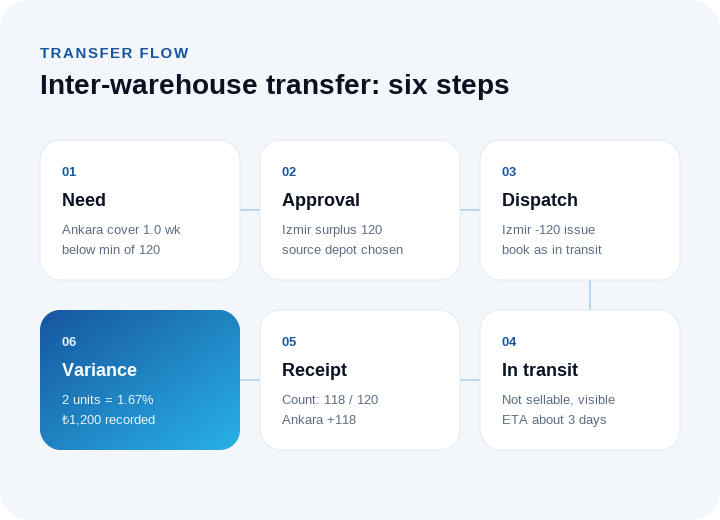
- Need: A depot's cover falls below its lower limit (the system alerts) or a planner requests stock.
- Approval: A source depot is chosen; the source is one with a surplus that does not breach its own lower limit.
- Dispatch: The issue is posted at the source and the quantity moves to "in transit". Available stock at the source drops at the same moment.
- In transit: The goods are visible in the system while moving, but nobody can use them for sales.
- Receipt: The receiving depot counts and enters the counted quantity; stock becomes sellable there at that moment.
- Variance: The difference between dispatched and received is recorded, investigated and closed.
In the example, 120 units go from Izmir to Ankara. At dispatch Izmir on hand drops from 240 to 120, Ankara stays at 60 and 120 shows as in transit; the system total stays at 300 + 60 + 120 + 120 = 600. How barcode scanning speeds up and cleans receipt is covered in our barcode system guide. For dispatch documents and waybill rules, ask your accountant.
How Do You Manage In-Transit Stock and Transfer Variance?
If in-transit stock is invisible, two errors follow: goods are treated as lost, or they are counted both at the source and at the destination and stock inflates. The rule is simple: in-transit stock is its own location, and the dispatching depot owns it until the receipt record is closed.
In the example Izmir dispatched 120 units and Ankara counted 118. The variance is 120 − 118 = 2 units, a rate of 2 ÷ 120 = 1.67% and a value of 2 × ₺600 = ₺1,200. Management needs three things: a mandatory count at receipt, a dispute window (for example 48 hours) and closing every variance with a cause (damage, short shipment, miscount).
To see the annual effect: 2 transfers a month × 12 months = 24 transfers of 120 units, so 2,880 units move a year. At a 1.67% variance the loss is 2,880 × 2 ÷ 120 = 48 units, and 48 × ₺600 = ₺28,800. With a target rate of 0.5% (illustrative) it would be 14.4 units, or ₺8,640, which is ₺20,160 a year less. If variances keep appearing on the same route or at the same depot, look for the cause there. For counting and variance review, see our inventory counting guide.
How Much Stock Should Each Warehouse Hold?
Two methods work together: a target based on demand share and a minimum-maximum band. The sample product costs ₺600 and sells for ₺1,000 (gross ₺400). Weekly demand is 100 units in Main, 60 in Ankara and 40 in Izmir; the total is 200, with shares of 50%, 30% and 20%.
The band: minimum = weekly demand × (transfer time 0.5 + review interval 1.0 + safety allowance 0.5 weeks) = 2 weeks of cover. Maximum = minimum + 2 weeks (transfer batch) = 4 weeks of cover.
| Depot | Weekly demand | Min (2 wk) | Max (4 wk) | Current | Cover | Status |
|---|---|---|---|---|---|---|
| Main | 100 | 200 | 400 | 300 | 3.0 wk | Within band |
| Ankara | 60 | 120 | 240 | 60 | 1.0 wk | Below minimum |
| Izmir | 40 | 80 | 160 | 240 | 6.0 wk | Above maximum |
The target is the middle of the band: 3 weeks of cover. Splitting the total 600 by demand share gives Main 300, Ankara 600 × 30% = 180 and Izmir 600 × 20% = 120 units. Ankara needs 180 − 60 = 120 units and Izmir's surplus is 240 − 120 = 120 units; one transfer solves it and Main is left alone.
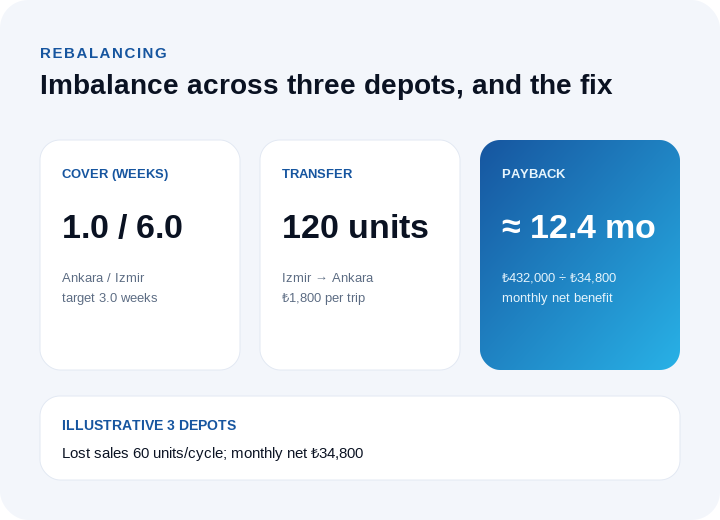
Before rebalancing, assume Ankara's next replenishment is 2 weeks away. Demand over that time is 60 × 2 = 120 units against 60 in stock, so 60 units of sales are lost, 60 × ₺400 = ₺24,000 of gross profit. After the transfer Ankara holds 180, covers the 120 of demand and the loss is zero. Do not freeze the target: seasons and campaigns change demand. Refresh weekly demand with the methods in our demand forecasting guide and the band updates itself.
Transfer or New Purchase Order?
You could also close Ankara's gap with a new supplier order, which leaves Izmir's surplus where it is. Here are the two routes side by side (lead time 4 weeks, monthly holding cost 2% of stock value; illustrative).
| Item | Izmir → Ankara transfer | New order of 120 units |
|---|---|---|
| Direct cost | 120 × ₺15 = ₺1,800 | Purchase price (stays as stock) |
| Extra stock investment | ₺0 | 120 × ₺600 = ₺72,000 |
| Extra monthly holding (2%) | ₺0 | ₺1,440 |
| Time | About 3 days | 4 weeks |
| Total stock / cover | 600 / 3.0 weeks | 720 / 3.6 weeks |
While a surplus exists, a transfer is both faster and cheaper in capital. A purchase order comes in only when total stock is genuinely short. The rule: rebalance between depots first, then close the remaining gap from supply. We cover the supply side in our supply chain management article.
Central versus regional depots. Pooling pays off for safety stock. Assume each depot has weekly demand deviation σ = 20 units, a lead time L = 4 weeks and z = 1.65 (a general confidence value); safety stock is z × σ × √L. Three separate depots need 3 × 1.65 × 20 × 2 = 198.0 units. If demand is pooled and the depots are independent, total σ = 20 × √3 ≈ 34.64 and safety stock is 1.65 × 34.64 × 2 ≈ 114.3 units. The difference is 83.7 units (42.3%), roughly ₺50,200 less stock. This rests on the independence assumption; if demand across regions is correlated, the gain shrinks. The price is longer delivery to the regions and higher freight, which is why regional stock is kept for products where price and speed matter most.
Which Depot Should Fulfil an Order?
Choosing the fulfilment depot for each order is a rule. A common ordering: among depots with enough stock and safe cover, pick the lowest freight cost. An example 3-unit order to Eskisehir (freight amounts illustrative; cover is on-hand stock ÷ weekly demand):
| Depot | Available | Cover | Freight | Result |
|---|---|---|---|---|
| Main | 260 | 3.0 wk | ₺55 | Candidate |
| Ankara | 48 | 1.0 wk | ₺36 | Excluded (cover < 2 wk) |
| Izmir | 215 | 6.0 wk | ₺52 | Selected |
Ankara is cheapest but its cover is 1.0 week, so it is protected and its remaining stock is kept for local customers. Between Main (₺55) and Izmir (₺52), Izmir wins: it is ₺3 cheaper and it burns down surplus stock. The rule is not fixed; during campaigns you raise the weight on delivery time. When a multi-line order cannot ship from one depot, you also need a split-shipment rule, a layer we cover in our order management system guide.
How Do You Track Turnover and Dead Stock by Depot?
Overall turnover hides the problem; measure it per depot. For 52 weeks a year, stock turnover = 52 ÷ cover (weeks); days of stock = cover × 7.
| Depot | Stock value | Cover | Turnover | Days of stock |
|---|---|---|---|---|
| Main | ₺180,000 | 3.0 wk | 17.3 | 21 |
| Ankara | ₺36,000 | 1.0 wk | 52.0 | 7 |
| Izmir | ₺144,000 | 6.0 wk | 8.7 | 42 |
| Total | ₺360,000 | 3.0 wk | 17.3 | 21 |
The total turnover of 17.3 looks fine, yet Izmir is at 8.7 and Ankara at 52.0. A check on annual cost of goods: Main 5,200 units × ₺600 = ₺3,120,000 ÷ ₺180,000 = 17.3; Ankara 3,120 × ₺600 = ₺1,872,000 ÷ ₺36,000 = 52.0. A dead-stock candidate is the quantity whose cover exceeds the upper limit (4 weeks): in Izmir, 240 − 160 = 80 units × ₺600 = ₺48,000. Limits can differ by ABC class; for classification, see our ABC analysis guide.
What Does a Depot Cost, and When Is a New One Justified?
Every new depot brings a fixed cost beyond stock: rent, staff, insurance, systems. Freight savings have to cover it. For a small regional space with a fixed cost of ₺15,000 a month and a freight saving of ₺24 per unit to the region (₺62 from the centre, ₺38 from the region; illustrative), the break-even order volume is ₺15,000 ÷ ₺24 = 625 units a month.
Ankara's monthly demand is 60 × 52 ÷ 12 = 260 units; freight savings alone come to 260 × ₺24 = ₺6,240, which covers 260 ÷ 625 = 41.6% of break-even. So justifying a regional depot on freight alone does not work; you need further reasons such as the effect of delivery time on sales, existing premises or shared use. Adding depots without this calculation only enlarges the rebalancing effort and the fixed cost.
What Is the Payback of a Multi-Warehouse Stock System?
The monthly gain comes from recovering lost sales; the cost is transfers and running the system. In the example 60 units of sales were lost in each replenishment period (2 weeks); assume 2 periods a month.
| Item | Monthly amount |
|---|---|
| Recovered gross profit: 2 × 60 × ₺400 | +₺48,000 |
| Transfer cost: 2 × ₺1,800 | −₺3,600 |
| Transfer variance loss: ₺28,800 ÷ 12 | −₺2,400 |
| System running and maintenance | −₺7,200 |
| Monthly net benefit | ₺34,800 |
With an investment of 48 person-days × ₺9,000 = ₺432,000, payback is ₺432,000 ÷ ₺34,800 ≈ 12.4 months. If the gain halves (₺24,000 − ₺13,200 = ₺10,800), it stretches to ₺432,000 ÷ ₺10,800 = 40 months. So measure your own lost sales and variance first.
How Do You Set Up a Multi-Warehouse Stock System?
- Define depots and types: Record every location, its owner and its stock types (available, allocated, quarantine, in transit).
- Measure: Pull cover, turnover, lost sales and transfer variance per depot as they stand today.
- Set targets and bands: Assign a cover target to each depot from demand share and min-max.
- Build the transfer flow: Suggestion, approval, dispatch, in transit, receipt, variance, each with a user and a timestamp.
- Write the fulfilment rule: Automate depot selection by stock, cover and freight cost.
- Monitor and adjust: Update the band through weekly cover, turnover, dead stock and variance reports.
What Mistakes Are Common in Multi-Warehouse Inventory?
- Not counting in-transit stock: Goods get reordered or written off as lost.
- Showing total stock: A channel sells stock that is not in the region.
- One-size target: Giving every depot the same cover ignores demand differences.
- No count at receipt: Variances cannot be found or assigned.
- Rebalancing by hand and rarely: Once the deviation grows, transfers turn urgent and costly.
- Justifying a depot on freight alone: The break-even calculation never gets done.
We recommend reading: What is shipping integration? A guide to dimensional weight, carrier choice and tracking
We recommend reading: How to Manage Consignment Inventory: Consumption Notices, Reconciliation and Tied-Up Capital Guide
We recommend reading: How to Manage Supplier Risk: Segmentation, Risk Scoring, Single-Source Dependency and Expected Loss Guide
We recommend reading: What Are Inventory Valuation Methods? FIFO, Weighted Average and Standard Cost Explained
We recommend reading: How to Calculate Available to Promise (ATP) and Delivery Dates: A Guide to CTP, Capacity and On-Time Promising
We recommend reading: How to Calculate Safety Stock and Reorder Point: Formula, z Value, EOQ and Worked Example
We recommend reading: How to Manage Dock Door Appointments: Slots, Queues, No-Shows and Payback Guide
We recommend reading: How to Manage Backorders: Line Status, Priority, Split Shipments and Fill Rate Guide
We recommend reading: How to Set Up Omnichannel Inventory: Click and Collect and Ship-from-Store for Stores and E-Commerce
Multi-Location Stock and ERP Solutions with İnovabil
At İnovabil our focus is building software from scratch, tailored to the company: custom software, ERP, CRM, e-commerce, web, mobile and integration. We make no claim of a ready-made multi-location stock product; in requirements analysis we write down your depot structure, transfer flow and fulfilment rules, then compare ready-made, adapted and custom options with their costs.
We have built warehouse management (WMS) for Sleepy, logistics and shipment planning plus wholesale order management for Karyak, shipment planning for Bofigo, CRM, purchasing and mobile for Avcılar İnşaat, and a purchasing system for İZBAN. Send us a short summary of your depot and branch structure; first we can measure your current cover and transfer data together.
We recommend reading: Our software development process: step by step from analysis to launch
Frequently Asked Questions
What is multi-warehouse inventory management?
It is tracking the stock of several warehouses, branches or stores in one system, location by location. Every movement is posted to the relevant depot, transfers run through a recorded flow and total stock is seen as the sum of locations.
How do you transfer stock between warehouses?
You identify the need, approve a source depot, post an issue at dispatch and move the quantity to in-transit stock, the receiving depot counts and receives it, and the difference between dispatched and received is closed. Each of the six steps is recorded with a user and a timestamp.
What is in-transit stock and why track it separately?
Goods that have left one depot and not yet entered another are in transit. Without separate tracking they are either written off as lost or counted twice, and they cannot be offered for sale. Until the receipt record closes, the dispatching depot owns them.
How much stock should each warehouse hold?
Give each depot a target cover from its demand share and set a minimum-maximum band. In the example the lower limit is 2 weeks of cover and the upper limit 4, and the 3-week middle is the target. As weekly demand is updated, the target is refreshed.
Should every order ship from the nearest depot?
No. Choose the lowest total cost among depots that have enough stock and safe cover. Touching the nearest depot when its stock is low raises the risk of lost sales for local customers; write the rule around cover and freight cost together.