

Your supplier drops goods in your warehouse but only invoices what you actually use. Or your product sits on a dealer's shelf and you are paid as it sells. In both cases the goods are in one place and the ownership is somewhere else. Consignment inventory management is the discipline of recording that split correctly, tying the consumption or sales notice to the invoice, and reconciling the stock at the end of each period. Without it, goods go missing, invoices go out late and nobody can say whose stock is where.
In this guide we cover the two directions of consignment, how it differs from a normal purchase and sale, how to track it with a stock owner field, the flow from notice to invoice, the cost of capital tied up with a dealer and the cash gain on supplier consignment, the reconciliation variance, aging stock and a six-step setup. The example figures are illustrative; for tax, ownership, contract, e-document and delivery-note procedure, consult your financial advisor (certified accountant) and a legal advisor.
What Is Consignment Inventory Management?
Consignment is an arrangement in which goods are placed in one party's warehouse or on its shelf, but payment is due only when the goods are used or sold. Inventory management here means keeping two facts correct for every unit at the same time: where it is and who owns it.
We covered the basics of stock tracking in our guide to tracking inventory; consignment adds an "owner" dimension on top of that foundation.
What Are the Two Directions of Consignment?
There are two directions, and their processes mirror each other: in one the stock is in your warehouse but belongs to someone else, in the other your stock is on someone else's shelf.
| Topic | Supplier consignment | Dealer (sale-on-behalf) consignment |
|---|---|---|
| Where is the stock? | In your warehouse | On the dealer's or store's shelf |
| Who owns it? | The supplier; it passes to you on use | You; it passes to the dealer on sale |
| Invoice trigger | Consumption notice | Sales notice |
| Who gives the notice? | You (production issue, usage) | The dealer (sales, count) |
| Main benefit | Payment is deferred, tied-up capital falls | Dealer is spared stock risk, sales may rise |
| Main risk | Price premium, stock-outs, count variance | Tied-up capital, loss, late notices |
Dealer targets, bonuses and credit limits are a separate subject; we covered them in our guide to dealer management systems. For the request-to-payment process on the supplier side, see our procurement software article.
How Does Consignment Differ From a Normal Purchase and Sale?
The difference is when ownership and the invoice change hands. In a normal purchase and sale the invoice is issued on delivery and ownership passes; in consignment the goods are delivered but ownership and the invoice wait for the notice.
| Topic | Normal purchase / sale | Consignment |
|---|---|---|
| Ownership | Passes on delivery | Passes on use or sale (per contract) |
| Invoice | Delivery or dispatch day | After the notice |
| Stock record | Buyer's own stock | At the location, owned by another party |
| Cash | Terms start at delivery | Terms start at the notice |
| Counting | Routine inventory | Joint reconciliation with the owner |
| Returns | Separate return process | Unsold stock is taken back |
Which party's balance sheet carries the stock value, in which account, how delivery notes and e-documents are handled and the tax consequences all depend on law and on the contract; settle these with your financial advisor (certified accountant).
How Is Consignment Stock Tracked in the System?
Consignment stock is tracked with a record that keeps location and owner separate on every line. A single "quantity" field is not enough; you need at least four pieces of information.
| Field | Example | Why it matters |
|---|---|---|
| Location | Consignment warehouse / Dealer 07 shelf | Physical place of the stock |
| Stock owner | Supplier A / Us | Who holds ownership |
| Status | On consignment / Consumed / Awaiting return | Invoice and count decisions |
| Arrival date | 12.10.2026 | Aging and return window |
The consignment warehouse is opened as a separate location from normal stock; stock owned by the supplier appears as "available" but stays out of valuation and out of payables. Moves between several locations follow the transfer logic in our multi-warehouse inventory guide; the difference is that a transfer never changes the owner. For reliable quantities and batches, scanning with a barcode system is a solid foundation.
How Does a Consumption or Sales Notice Determine the Invoice?
The invoice is born from the notice: when stock is consumed on your side or sold at the dealer, an event is recorded and the invoice is issued from that record. The process has six steps.
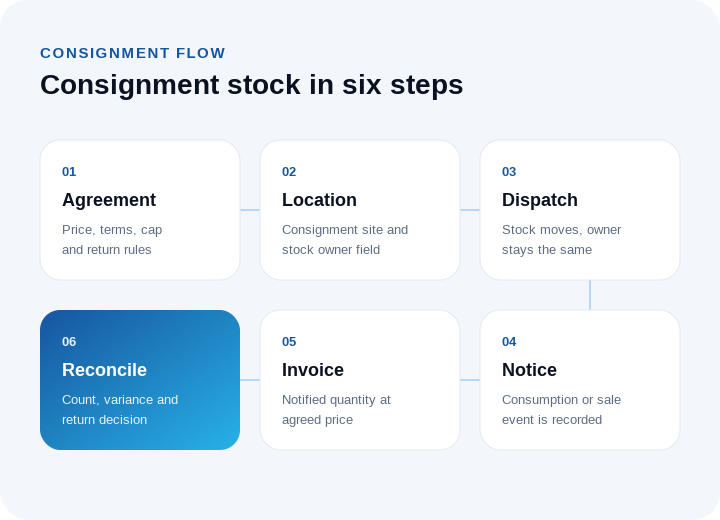
- Agreement: Put price, payment terms, maximum stock cap, notice frequency and return conditions in writing.
- Location: Open the consignment warehouse and the stock owner field in the system.
- Dispatch: Stock goes on consignment; the owner does not change, only the location.
- Notice: On your side the system records consumption from the production issue; the dealer reports its own sales record.
- Invoice: The invoice is prepared from the notified quantity and the contract price; amount and due date are linked in the system.
- Reconciliation: At period end the count, the system stock and the variance are reviewed.
Deriving the consumption event automatically from the production or sales movement, instead of typing it in, reduces errors. The later a notice arrives, the later the invoice and the collection; we calculate the money effect below. For how the invoice lands in the books, see our guide to tracking customer accounts.
How Do You Calculate Tied-Up Capital in Dealer Consignment?
With dealer consignment the stock sits at the dealer but is still yours, and once the sale is notified a receivable arises; both tie up your capital. The illustrative assumptions: 25 dealers; ₺200,000 of stock per dealer at cost (400 units × ₺500); monthly sales of ₺100,000 at cost (200 units); invoice price to the dealer 1.4 times cost; sales notice 15 days late on average; 30-day payment terms; a monthly cost of capital of 2.5%.
- Days of stock: ₺200,000 ÷ ₺100,000 × 30 = 60 days.
- Monthly invoice: ₺100,000 × 1.4 = ₺140,000; gross profit ₺40,000 per dealer, ₺1,000,000 a month across 25 dealers.
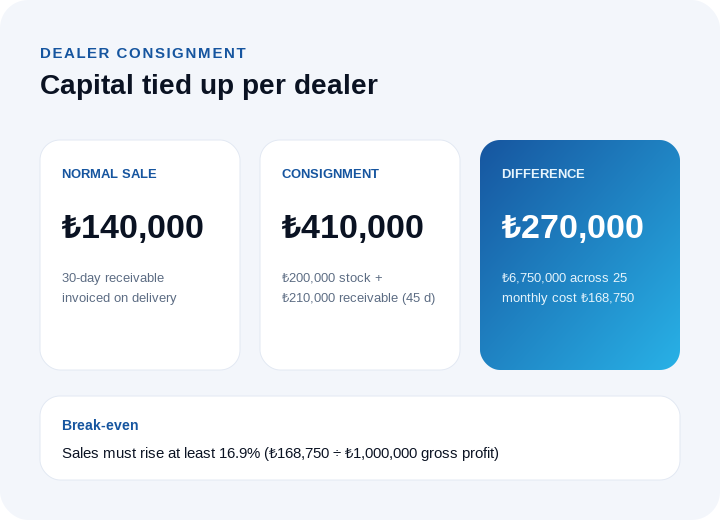
| Item (per dealer) | Normal sale | Consignment |
|---|---|---|
| Stock sitting at the dealer (yours) | ₺0 | ₺200,000 |
| Receivable: ₺140,000 × days ÷ 30 | ₺140,000 (30 days) | ₺210,000 (45 days) |
| Capital tied up | ₺140,000 | ₺410,000 |
The difference is ₺270,000 per dealer, ₺6,750,000 across 25 dealers. At a 2.5% monthly cost of capital, ₺6,750,000 × 0.025 = ₺168,750 a month, which is ₺168,750 ÷ ₺1,000,000 ≈ 16.9% of gross profit. For consignment to pay for itself, dealer sales must grow by at least ₺168,750 ÷ 0.40 = ₺421,875 (at cost): ₺16,875 per dealer, a 16.9% increase. If sales grow by less, consignment is nothing more than financing the dealer. Repeat this with your own rates; for limits and terms, the buffer logic in our cash flow guide helps.
What Does Supplier Consignment Gain in Cash?
With supplier consignment, the stock does not count on your balance sheet and payment is deferred until consumption, so tied-up capital falls. Illustrative example: monthly consumption ₺1,200,000, unit price ₺250 (4,800 units a month, 160 a day), average stock 20 days, 30-day terms, a monthly cost of capital of 2.5%.
- Average stock: 160 × 20 = 3,200 units; 3,200 × ₺250 = ₺800,000 (₺1,200,000 ÷ 30 × 20).
- In a normal purchase, payment is due 30 days after receipt; in consignment it is due 30 days after consumption. Since goods wait 20 days on average, payment moves out by 20 days: ₺800,000 of cash.
- Monthly gain: ₺800,000 × 0.025 = ₺20,000.
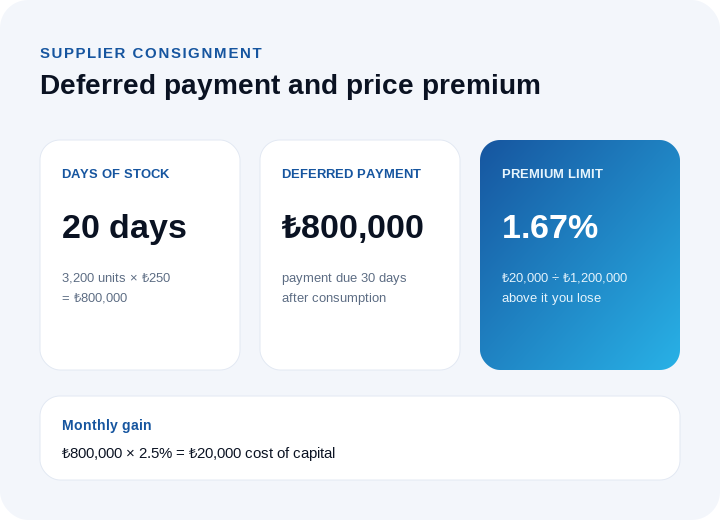
Suppliers usually pass this service on in the price. The price premium limit is ₺20,000 ÷ ₺1,200,000 ≈ 1.67%. If the supplier raises the price by more than 1.67%, consignment costs you money; a 2% premium, for example, is ₺24,000 a month (₺1,200,000 × 0.02), a net loss of ₺4,000. Put a cap and a floor in writing too: with a 5-day replenishment time, the floor is 160 × 5 + a safety allowance of 320 = 1,120 units, and the cap is 3,200 units. We covered the cash cycle across the chain in our supply chain management article.
How Do You Handle Period Counts and Reconciliation Variance?
In consignment, variance is verified from both sides: the owner's record is compared with the dealer's or warehouse's count. The difference between system quantity and count is classified by cause.
| Variance cause (per dealer, quarterly) | Units | Value (₺500) | What happens? |
|---|---|---|---|
| Sold but not notified | 7 | ₺3,500 | Invoiced (7 × ₺700 = ₺4,900) |
| Damaged | 3 | ₺1,500 | Contract damage rule applies |
| Lost | 2 | ₺1,000 | Investigated; liability per contract |
| Total variance | 12 | ₺6,000 | 400 units in system, 388 counted: 3.0% |
Across 25 dealers the variance is ₺150,000. The real loss part is damage plus loss, 5 units × ₺500 = ₺2,500 per dealer, ₺62,500 per period across 25 dealers; the remaining 7 units are a sale whose invoice is late. If the tolerance is set at ±1% (4 units out of 400), 12 units call for investigation. Supplier-side example: 3,200 in the system, 3,170 counted; a variance of 30 units = 0.94%, ₺7,500; it is within a ±1% (32 units) tolerance, but if the deviation runs in the same direction for three periods in a row, the cause is investigated. For the counting routine, the ABC and variance-review method in our inventory counting guide applies as is. Liability for damage and loss and compensation for variance are contract matters; consult your legal advisor.
What Happens to Unsold and Aging Consignment Stock?
Unsold consignment stock is tied-up capital and loses value over time, so the aging and return rules are written up front. An illustrative age profile of a 400-unit stock per dealer follows.
| Age | Units | Share | Value |
|---|---|---|---|
| 0–30 days | 200 | 50% | ₺100,000 |
| 31–60 days | 100 | 25% | ₺50,000 |
| 61–90 days | 52 | 13% | ₺26,000 |
| Older than 90 days | 48 | 12% | ₺24,000 |
Stock older than 90 days comes to ₺600,000 across 25 dealers, and at 2.5% a month that is ₺15,000 a month of capital cost. There are three options: take the stock back, move it to a faster-selling dealer, or convert it into a normal sale to the dealer. Return window, return freight and conditions for refurbished goods are written in the contract. Generating an aging alert automatically in the system means the decision does not wait for the count.
What Should You Watch for on Risk, Insurance and the Balance Sheet?
Because consignment stock sits in someone else's warehouse or hands, who bears the risk of damage, loss and theft must be stated clearly. Which party carries the insurance cover, how compensation works if goods are damaged on the dealer's shelf, and which party's balance sheet carries the stock value depend on the contract, the law and accounting practice. Settle these with your financial advisor (certified accountant) and legal advisor rather than with figures; on the software side, your job is to reflect the decision correctly in the record and keep every unit's owner and status visible.
When Does Moving From Spreadsheets to a System Pay Off?
Consignment tracking often starts in a spreadsheet and overflows as the number of dealers grows. Illustrative assumptions: 25 dealers; monthly reconciliation effort per dealer falls from 3 hours to 1; labor cost ₺300 an hour; real loss in counts (₺62,500 per period) falls 30% with the system; sales notice delay falls from 15 days to 5; the move takes 36 person-days; annual maintenance is 15%.
- Time: 25 dealers × 2 hours = 50 hours × ₺300 = ₺15,000 a month.
- Loss: ₺62,500 × 30% ÷ 3 = ₺6,250 a month.
- Notice: receivable days 45 → 35; per dealer ₺140,000 × 35 ÷ 30 = ₺163,333, a gain of ₺46,667; ₺1,166,667 across 25 dealers; × 2.5% = ₺29,167 a month.
- Gross monthly ₺50,417; running cost ₺4,050 (₺324,000 × 15% ÷ 12); net ≈ ₺46,367.
- Investment 36 × ₺9,000 = ₺324,000; payback ₺324,000 ÷ ₺46,367 ≈ 7.0 months.
If the notice gain is halved, net is ₺31,783 and payback is about 10.2 months; for the steps of the move, see our guide to moving from Excel to software. The figures are illustrative; plug in your own dealer count, delay and cost of capital.
How Do You Set Up Consignment Inventory Management in Six Steps?
- Define the scope: Which products and which dealers or suppliers suit consignment? Start with fast-moving items of known value.
- Run the numbers: For dealers, work out the tied-up amount and the sales growth required; for suppliers, the price premium limit.
- Write the contract: Price, terms, cap, notice frequency, tolerance, damage and returns (with your legal advisor).
- Build the system: Consignment location, stock owner and status fields; the flow that ties notice to invoice; an aging alert.
- Run a pilot: Work with two or three dealers or one supplier for a period; measure variance and delay.
- Scale up: Make period-end reconciliation routine and watch the indicators (variance percentage, notice delay, stock older than 90 days) monthly.
What Are Common Mistakes in Consignment Stock?
- Keeping location and owner in one field: The supplier's stock is valued like your own and creates a payable.
- Ignoring notice delay: Invoicing and collection slip and receivables swell.
- Skipping the count: The variance surfaces all at once years later.
- Missing the price premium: The consignment benefit melts away in the price.
- Setting no cap: The dealer's shelf or the consignment warehouse fills beyond need.
- Not watching aging stock: Unsold stock quietly eats capital.
We recommend reading: What is a supplier portal? Order confirmation, dispatch notice and payback guide
We recommend reading: How to Manage Supplier Risk: Segmentation, Risk Scoring, Single-Source Dependency and Expected Loss Guide
We recommend reading: What Is Vendor-Managed Inventory (VMI)? Min–Max Levels, Replenishment Proposals and Payback Guide
Stock, Order and Dealer Processes with İnovabil
At İnovabil our focus is building bespoke software from scratch; stock, warehouse, procurement and dealer processes are part of that. We built logistics and shipment planning with wholesale order management for Karyak, warehouse management (WMS) for Sleepy, a procurement system for İZBAN, and CRM, procurement and mobile solutions for Avcılar İnşaat. We do not claim a ready-made consignment product; we recommend writing down your consignment rules, your notice flow and your reconciliation needs in the requirements analysis and designing around your process.
We recommend reading: Our software development process: step by step from analysis to launch
Frequently Asked Questions
What is consignment inventory management?
It is tracking the location and the owner of every unit separately, in an arrangement where goods sit in one party's warehouse or on its shelf while ownership and the invoice wait until a consumption or sales notice.
When is the invoice issued in consignment?
After the consumption or sales notice, depending on the contract. The notice frequency sets the invoice and payment timing; consult your financial advisor (certified accountant) on e-document and delivery-note procedure.
Whose balance sheet shows consignment stock?
It depends on the contract and accounting practice; settle this with your financial advisor (certified accountant). Because the system keeps location and owner separate, the decision can be reflected correctly.
Does consignment always benefit the business?
No. In the example, dealer consignment earns nothing unless dealer sales grow at least 16.9%; in supplier consignment the gain turns into a loss if the price premium exceeds 1.67%. Calculate with your own figures.
How is consignment variance managed?
The period count is compared with system stock, the variance is classified by cause (unnotified sale, damage, loss) and anything above tolerance is investigated. Compensation and liability are contract matters.