

One large retail chain sends its orders as an email attachment, another asks you to log in to its portal, and a third pushes a file from its own system. Keying each of them in by hand costs time and creates errors. EDI (electronic data interchange) is the exchange of business documents between trading partners, such as orders, order responses, ship notices and invoices, in a pre-agreed standard format, from system to system and without manual re-entry.
In this guide we explain what EDI is, how it differs from an API, a portal and email, how the document flow works, how mapping and validation are set up, how acknowledgements and timeouts are handled, how duplicate documents are prevented on resend, how to choose between batch and real-time transfer, and what onboarding costs and pays back per trading partner. All example numbers are illustrative; they are not the figures of a real company or an industry average.
What Is EDI and What Is It Used For?
EDI is a structured exchange in which a document from one company's system reaches its partner's system without being retyped. The document has no human-readable layout; the name, order, length and meaning of every field are defined in advance, and the receiving system processes it directly.
It pays off in relationships with high volume and high repetition: retail chains, large buyers, logistics partners and distributors who order regularly. A job that looks simple with a handful of partners becomes a serious automation gain across dozens of partners. For the wider picture, see our API integration guide; EDI is the document-centred, contract-bound member of that family.
We recommend reading: Our integration service
How Does EDI Differ from an API, a Portal and Email?
All four carry documents, but they differ in who does the work and who catches the error. The table below gives a decision frame.
| Topic | Email and attachment | Portal | API | EDI |
|---|---|---|---|---|
| Document format | Free (PDF, spreadsheet) | Screen form | A schema you design | A standard format your partners apply |
| Who does the work? | A person keys it in | The sender logs in | Two systems talk | Two systems talk |
| Validation | None, eyeball check | Form rules | Rules you write | Standard rules and acknowledgements |
| Adding a partner | Quick, but always manual | Open an account | Documentation and testing | Mapping and mutual certification |
| Volume | Low | Low to medium | Medium to high | High and repetitive |
| Typical use | Few orders | Small partners | Flexible digital partnerships | Large buyer or chain requirement |
The choice is often made by the large buyer. We covered the portal approach for smaller partners in our supplier portal guide. For event-style real-time notification, a webhook is the better fit.
Which Documents Travel over EDI?
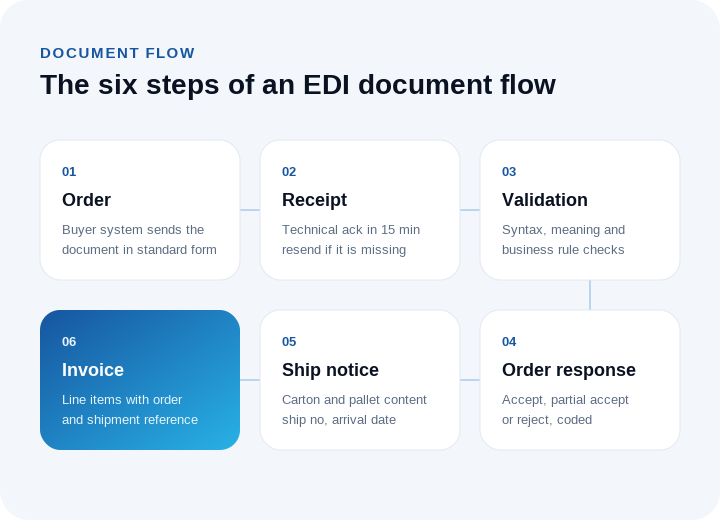
An order lifecycle has five core documents; the stock advice runs daily next to the flow.
| Document | Direction | What it carries | What happens at the other end |
|---|---|---|---|
| Purchase order | Buyer to seller | Item code, quantity, unit of measure, delivery date, ship-to address | An order record is opened and validated |
| Order response | Seller to buyer | Accept, partial accept, reject and confirmed date | The buyer updates its plan |
| Ship notice | Seller to buyer | Carton and pallet content, shipment number, expected arrival | Goods receipt is prepared in advance |
| Invoice | Seller to buyer | Lines, amount, tax, order and shipment reference | It enters the payment process |
| Stock advice | Seller to buyer | Available stock quantity | The buyer uses it when ordering |
For invoices that fall under statutory e-document rules, the official system is a separate layer; see our e-invoice integration guide and confirm the details with your accountant.
How Is an EDI Document Processed? Standard, Mapping and Validation
A document is processed in three stages: the incoming data is parsed, mapped to the fields of your own system, and validated against rules. Several standard families exist worldwide; which one you use is decided by your trading partner. Version and field details live in the implementation guide your partner publishes, and you map to that guide.
Mapping is the most labour-intensive part. Three topics stand out.
- Common fields: Document number, date, address and quantity exist in both systems, but with different names and formats.
- Item code cross-reference: The buyer sends its own item code, and it must be translated to yours. The table needs upkeep whenever a product is added.
- Unit of measure conversion: The buyer orders cartons while you hold stock in pieces. If the conversion is wrong, the gap grows silently.
Illustrative example: of a 2,400-item catalogue, 2,280 items match in the cross-reference; the match rate is 2,280 ÷ 2,400 = 95.0%. Say an average order has 6 lines. The probability that all lines match is 0.95⁶ ≈ 73.5%, so about 26.5% of orders get stuck on at least one line. If the match rate rises to 99.5%, 0.995⁶ ≈ 97.0% of orders match completely. A small gap per line turns into a large exception load per order.
A unit example: the buyer orders 25 cartons, 1 carton holds 12 pieces and the unit price is ₺85. With the correct conversion, 25 × 12 = 300 pieces and 300 × ₺85 = ₺25,500. Without conversion it is read as 25 pieces and an order worth ₺2,125 is opened, a twelvefold gap.
Validation runs on three levels:
- Syntax: Is the file corrupt, are the mandatory segments present?
- Meaning: Are mandatory fields filled, do dates and quantities make sense, does the item code exist in the cross-reference?
- Business rule: Is the buyer's credit limit sufficient, is the item active, can stock cover the quantity?
The first two levels are rejected automatically; the third usually needs a person's decision. For the order lifecycle, see our order management system guide.
How Are Acknowledgements, Errors and Timeouts Handled?
In EDI silence is uncertainty: you only know a document arrived from a confirmation message. That is why there are two separate acknowledgements.
| Acknowledgement | What it says | Illustrative time target | If it does not arrive |
|---|---|---|---|
| Technical receipt | The file arrived and is readable | 15 minutes | The document is resent |
| Business-level response | The document is accepted, partly accepted or rejected | 4 hours | A person follows up from the exception queue |
If no technical receipt arrives, resends back off with growing waits: a second send 15 minutes after the first, a third 30 minutes later, and human intervention 60 minutes after that. The total wait is 15 + 30 + 60 = 105 minutes (1 hour 45 minutes). When it expires, the document drops into the exception queue and the responsible person is notified. For queue mechanics, see our message queue guide.
For an illustrative 1,200 orders a month, the exception queue looks like this: 96 orders bounce on syntax or meaning validation, and 24 orders stall on a business rule (credit limit, inactive item). That is 96 + 24 = 120 orders, or 10%; the remaining 1,080 orders (90.0%) are processed without human touch. The reason for a rejection goes back to the partner as a coded reject message.
What Happens When the Same Document Arrives Twice?
Resending improves reliability but also creates a duplicate risk: the buyer thinks no reply came, sends the same order again, and you open two orders. The fix is to give each document a unique control number and apply duplicate protection.
- Key: Sender identity, document type and document control number together count as unique.
- Record: If a key has already been processed, the document is not processed again; the same response is sent again.
- Change: An order whose content changes is marked not as a new document but as an update with the same document number.
Illustrative measure: 2% of 1,200 orders are resent, which is 24 documents. In an unprotected system, 25% of them reach shipment: 24 × 25% = 6 duplicate shipments. If fixing each one costs ₺3,500, that is 6 × ₺3,500 = ₺21,000. With protection on, the 24 repeats are logged, not processed. This amount is not included in the payback calculation.
Should Documents Be Sent in Batches or in Real Time?
EDI documents can be sent at once or carried in scheduled batch files. The choice depends on the partner's system and the document type. Average waiting time is half the window interval.
| Transfer frequency | Files per day | Average wait | Worst-case wait |
|---|---|---|---|
| Every 4 hours | 6 | 2 hours | 4 hours |
| Every hour | 24 | 30 minutes | 1 hour |
| Every 15 minutes | 96 | 7.5 minutes | 15 minutes |
A stock advice can run as a daily batch; a ship notice should reach the buyer before the truck leaves. For scheduling batches and rerunning failed ones, see our batch processing guide.
How Long Does Onboarding a Trading Partner Take and What Does It Cost?
The cost has two parts: a shared layer built once (document model, validation, queue, monitoring, exception screen) and the mapping, testing and mutual sign-off done for each partner. Illustrative assumptions: the shared layer takes 30 person-days, each partner takes 8 person-days, and the daily rate is ₺9,000.
- Shared layer: 30 × ₺9,000 = ₺270,000.
- Per partner: 8 × ₺9,000 = ₺72,000.
- 10 partners: ₺270,000 + 10 × ₺72,000 = ₺990,000.
A typical calendar for one partner: week one for the guide and a mapping draft, week two for the cross-reference table and internal testing, week three for joint testing, week four for parallel running and go-live. That is about four calendar weeks, and 8 person-days is the real effort behind it.
The shared layer does not grow with the number of partners; later partners add only the mapping cost. That is why EDI looks expensive at the first partner and cheap at the later ones. For the general logic of bringing partners on board, see our onboarding guide.
What Does EDI Save Compared with Manual Entry?
Illustrative example: 1,200 orders a month come from 10 partners, so 120 orders per partner. With manual entry, each order takes 6 minutes, 3% of orders contain an error, and each error needs 2 hours of correction. An hour costs ₺300.
| Item | Manual entry | With EDI |
|---|---|---|
| Entry effort | 1,200 × 6 min = 7,200 min = 120 h = ₺36,000 | 120 exceptions × 6 min = 720 min = 12 h = ₺3,600 |
| Number of errors | 1,200 × 3% = 36 | 1,200 × 0.5% = 6 |
| Correction effort | 36 × 2 h = 72 h = ₺21,600 | 6 × 2 h = 12 h = ₺3,600 |
| Monthly total | ₺57,600 | ₺7,200 |
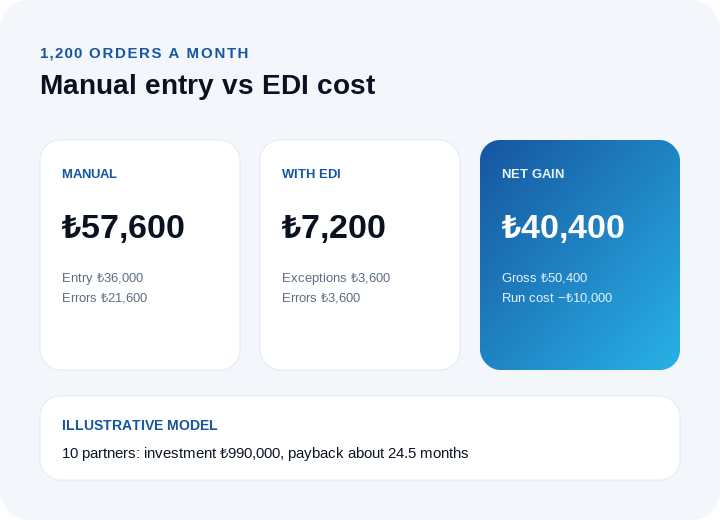
The monthly gross gain is ₺57,600 − ₺7,200 = ₺50,400. Say EDI service, maintenance and monitoring cost ₺10,000 a month; the net gain is ₺40,400. Payback: ₺990,000 ÷ ₺40,400 ≈ 24.5 months.
How Many Partners Does It Take for EDI to Pay Off?
Gross gain per partner: for 120 orders, ₺5,760 manually and ₺720 with EDI, a difference of ₺5,040. Since the running cost is shared, the break-even partner count is ₺10,000 ÷ ₺5,040 ≈ 1.98, so at least 2 partners are needed. Investment is ₺270,000 + ₺72,000 × n, and monthly net gain is ₺5,040 × n − ₺10,000.
| Number of partners | Investment | Monthly net gain | Payback |
|---|---|---|---|
| 5 | ₺630,000 | ₺15,200 | ≈ 41.4 months |
| 10 | ₺990,000 | ₺40,400 | ≈ 24.5 months |
| 20 | ₺1,710,000 | ₺90,800 | ≈ 18.8 months |
The conclusion is clear: EDI becomes economical as the partner count and order volume grow. If volume per partner halves (60 orders), the gain halves and payback stretches. Plug in your own numbers. The value of meeting a large buyer's requirement and keeping a sales channel open is not part of this calculation.
How Is an EDI Project Run?
Six steps give a model that works from the first partner to the later ones.
- Set the scope: Which partners, which document types, which volume? One partner and two document types are enough for the first phase.
- Get the implementation guide: The standard your partner uses and its field expectations should be in writing.
- Produce the mapping: Field mapping, item code cross-reference and unit of measure conversion.
- Build validation and the exception flow: Three validation levels, an exception queue and an owner.
- Test jointly: Both sides test with sample documents, including acknowledgement and reject scenarios.
- Run in parallel and monitor: Run alongside the manual flow for a few weeks; watch the first-pass rate, match rate and exception count.
The contract side covers the communication protocol, the legal validity of the document, retention and data protection duties; consult your legal adviser for those details. If the switch involves moving data, our data migration guide will help.
What Are the Common EDI Mistakes?
- Underestimating mapping: Most of the cost is in mapping; going live without validating the table with partners raises the exception load.
- Skipping acknowledgements: A document assumed delivered without confirmation can be lost.
- No duplicate protection: In an unprotected system, repeats reach shipment.
- Writing separate code per partner: Starting from scratch for each partner instead of a shared layer multiplies maintenance.
- Leaving the exception queue unowned: A waiting document is a late order.
We recommend reading: What is procurement software? A guide to the request-to-payment process
We recommend reading: What Is Vendor-Managed Inventory (VMI)? Min–Max Levels, Replenishment Proposals and Payback Guide
Integration and Document Flow with İnovabil
At İnovabil our focus is building custom software from scratch for your company: custom software, ERP, CRM, e-commerce, web, mobile and integration. For projects that need a partner document flow, we suggest writing down in the requirements stage which document leaves which system and enters which; the standard and mapping details are settled by your partner's guide.
We built CRM, purchasing and mobile for Avcılar İnşaat; a purchasing system for İZBAN; logistics and shipment planning with wholesale order management for Karyak; and warehouse management plus a complaint and support management system for Sleepy. Send us a short summary of your document flow and partners, and we will write the scope together.
We recommend reading: Our software development process: step by step from analysis to release
Frequently Asked Questions
What is EDI and how does it work in short?
It is the exchange of business documents such as orders, responses, ship notices and invoices between trading partners in a standard format, system to system. The sending system produces the document, the receiving system validates and processes it, and a two-stage acknowledgement closes the loop.
What is the difference between EDI and an API?
With an API, the providing side usually designs the schema and it is flexible; with EDI, the document format rests on a standard that trading partners apply and a pre-written agreement. They are also used together: EDI carries documents, while an API is preferred for instant queries and events.
Is separate software required for EDI?
No, but a shared layer is: parsing, mapping, validation, queue and monitoring. It can be built with an off-the-shelf solution or as custom software; partner count, volume and unique business rules decide.
How long does it take to connect one partner to EDI?
In the illustrative example about four calendar weeks and 8 person-days of effort. The duration depends on the time the partner can set aside and the quality of the mapping.
How many months does an EDI investment take to pay back?
In the illustrative example about 24.5 months with 10 partners and about 18.8 months with 20. If volume is low, it takes longer; calculate with your own numbers.