

Your store lists a phone charging set with 95 in stock. The same day, one customer buys only the case and another buys only the charger. By evening a second order for the set arrives and the warehouse has no cases left. Bundle inventory management is the stock, pricing and returns logic that prevents this when you sell several products as one item: should the bundle have its own stock or be calculated from its parts, how do separate sales affect it, and what happens when one part comes back?
This guide covers virtual versus assembled bundles, the bundle stock formula, double-selling risk in a shared pool, discount allocation across components, partial returns and shipments, channel stock, the kitting work order, bundle margin and payback. All figures are representative and exclude VAT; they are not the averages of a real business or sector.
What Is Bundle Inventory Management and Why Is It a Separate Topic?
A bundle looks like one line in the cart but is several items in the warehouse. The problem is that the sales record and the stock movement do not meet on the same item: a customer buys one bundle, and the warehouse must deduct three different components.
The topic is easily confused with its neighbours. A bill of materials (BOM) is the product tree of a manufactured item; a sales bundle recipe is far simpler. A product configurator lets a customer assemble options, whereas a bundle is a fixed, predefined combination. A promotion and coupon engine calculates cart discounts such as buy three, pay for two; this article covers the stock and cost side of a sales bundle. For product data see product information management, and for channel stock flow see marketplace integration.
Recommended reading: How to Track Inventory: A Practical Guide with Formulas
Should You Use a Virtual Bundle or an Assembled Bundle?
A virtual bundle has no stock of its own; it is calculated from component stock, and when an order arrives the components are picked and shipped together. An assembled bundle is put together and boxed in advance; it is a separate item with its own stock code and barcode. A hybrid model uses both.
| Topic | Virtual bundle | Assembled bundle | Hybrid |
|---|---|---|---|
| Bundle stock | Calculated from components | Separate stock item | Assembled units + calculated |
| Assembly | None; combined at picking | In advance, via a work order | Partial, before peak season |
| Double-selling risk | Low; single pool | High; two counts if components also sell alone | Medium; rule-based |
| Picking | Several lines | One line, one barcode | Mixed |
| Extra cost | Low | Assembly labour and special box | Medium |
| Fits when | Most ecommerce bundles | Gift sets, special box, serial records | Pre-campaign preparation |
Start virtual unless there is added value; we calculate the cost of assembly below.
How Do You Calculate Bundle Stock?
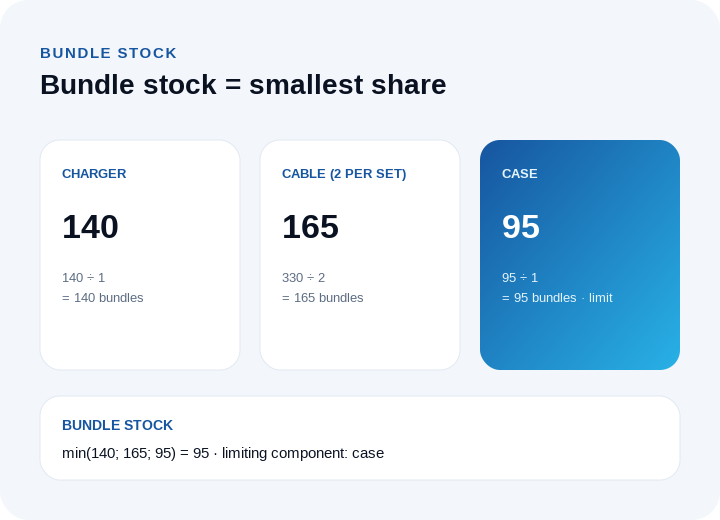
Bundle stock is the smallest of the numbers of bundles each component can supply: bundle stock = min(component stock ÷ quantity per bundle), each quotient rounded down. Example bundle: 1 charger, 2 cables and 1 case. Component stocks are 140, 330 and 95.
- Charger: 140 ÷ 1 = 140 bundles
- Cable: 330 ÷ 2 = 165 bundles
- Case: 95 ÷ 1 = 95 bundles
- Bundle stock = min(140; 165; 95) = 95; the limiting component is the case.
If cable stock were 331, 331 ÷ 2 = 165.5 would be written as 165, since half a bundle cannot be sold. The limiting component (here the case) also tells purchasing what to order first.
How Do You Prevent Double Selling When Components Also Sell Separately?
If you sell components both in bundles and alone, they must sit in one shared pool. Bundle stock is a view derived from that pool, not a second number kept separately. The table below follows the same pool step by step.
| Event | Charger | Cable | Case | Bundle stock |
|---|---|---|---|---|
| Start | 140 | 330 | 95 | min(140; 165; 95) = 95 |
| 40 bundles sold | 100 | 250 | 55 | min(100; 125; 55) = 55 |
| 20 cases sold alone | 100 | 250 | 35 | min(100; 125; 35) = 35 |
| 1 case return accepted | 100 | 250 | 36 | min(100; 125; 36) = 36 |
In the third row, cases sold alone cut bundle stock from 55 to 35. If a marketplace still shows 55, there is a risk of overselling 20 bundles. So bundle stock must be recalculated and pushed to channels after every component movement. Two orders taking the same last case at the same moment is the locking problem described in our article on concurrency control.
You can also reserve part of a component for a bundle campaign. If you reserve 30 cases for the bundle, cases available for single sale are 95 − 30 = 65. Release the reservation when the campaign ends.
How Do You Allocate the Bundle Discount Across Components?
If the bundle price is below the sum of its parts, the discount must be tracked somewhere; otherwise partial refunds and margin come out wrong. In the example, list prices are charger 600, cable 150 × 2 = 300 and case 250, total 1,150 (currency units). The bundle price is 980, a discount of 170. Allocation is by value share.
| Component | List | Share | Discount share | Net in bundle |
|---|---|---|---|---|
| Charger | 600.00 | 52.17% | 88.69 | 511.31 |
| Cable (2 units) | 300.00 | 26.09% | 44.35 | 255.65 |
| Case | 250.00 | 21.74% | 36.96 | 213.04 |
| Total | 1,150.00 | 100.00% | 170.00 | 980.00 |
Calculation: 170 × 600 ÷ 1,150 = 88.6957; 170 × 300 ÷ 1,150 = 44.3478; 170 × 250 ÷ 1,150 = 36.9565. Rounding each to the cent gives 88.70 + 44.35 + 36.96 = 170.01, one cent too many. Rounding down (88.69; 44.34; 36.95) and giving the remaining two cents to the largest remainders, the cable and the case, makes the total exactly 170.00. If the items in a bundle carry different VAT rates, how tax is allocated should be settled with your accountant.
The discount also has a limit. With component cost 620 and a margin floor of 25%, the bundle price can be no lower than 620 ÷ 0.75 = 826.67, which is at most 1,150 − 826.67 = 323.33, or 28.1%, below the list total.
What Happens When One Item Is Returned from a Bundle?
If a customer breaks up the bundle and returns only the case, two questions arise: how much to refund and how stock returns. There are three approaches to the amount.
| Approach | Refund for the case | Result |
|---|---|---|
| Proportional: net paid inside the bundle | 213.04 | Customer keeps the same discount rate on the rest (14.78%) |
| Discount withdrawn: rest at list price | 980 − 900 = 80.00 | Harsh for the customer; complaint and dispute risk |
| Refund at list price (wrong) | 250.00 | 36.96 over-refunded; margin erodes silently |
Most businesses choose the proportional method: 213.04 is refunded and the customer has paid 766.96 for the charger and cables, which equals a 14.78% discount on their list total of 900. The choice is commercial and should be written into the sales terms. How return periods and withdrawal rights apply to bundles is a question for your legal counsel. For the general flow, see our returns management article.
On the stock side, a returned case that passes inspection goes back to case stock (35 → 36 in the table above). Bundle stock rises only when the limiting component changes; if a charger is returned, bundle stock does not change because the case is the limit.
Should You Ship Partially When a Component Is Missing?
If a component is short on a bundle order, you can hold the whole order or ship what you have and send the rest later. The decision balances the extra shipping cost against orders lost while waiting.
| Situation | Default rule | Reason |
|---|---|---|
| All components in stock | One parcel | Lowest shipping, fewest errors |
| A component arrives within 1–2 days | Hold the order and tell the customer | No extra shipping paid |
| Missing component will take long | Offer the customer a choice | Wait, split or cancel |
Example threshold: a split shipment adds 70 shipping, and the unit margin of a virtual bundle is 360. If the cancellation probability while waiting is p, the expected loss is p × 360. Since 70 ÷ 360 = 19.4%, splitting is cheaper when the probability is above that, and waiting is cheaper when it is below. Use your own cancellation data.
How Do You Set the Stock Published to Marketplaces and Channels?
The number sent to channels is bundle stock minus a safety margin: published stock = bundle stock − safety margin. The margin equals expected sales during the sync interval. In the example, bundle stock is 35, component sales run at 6 per hour and sync happens every 15 minutes: 6 × 15 ÷ 60 = 1.5, rounded up to 2. Published stock is 35 − 2 = 33, split 15 / 10 / 8 across three channels (total 33).
The value of the split shows in a busy hour. Say demand is 18, 12 and 9 on three channels (total 39), real stock is 35, unit margin is 360 and an oversell cancellation costs 400.
| Approach | Accepted | Oversold | Net contribution |
|---|---|---|---|
| Every channel shows 35, no split | 39 | 4 | 35 × 360 − 4 × 400 = 11,000 |
| Fixed split 15 / 10 / 8 | 33 | 0 | 33 × 360 = 11,880 |
| Split plus reallocating unused share | up to 35 | 0 | 35 × 360 = 12,600 |
A fixed split removes overselling but turns away 6 requests and leaves 2 units idle. Moving unused share to another channel every 15 minutes is the best of the three. For channel sync and available stock logic, read our marketplace integration article; for several warehouses, see multi-warehouse inventory. Marketplaces have different bundle listing rules; verify them in the marketplace's official seller documentation.
How Do You Run a Kitting Work Order?
If you build assembled bundles, assembly is a work order: components are reserved, bundle stock is received and component stock is deducted. Example: for 60 bundles at 8 minutes each, the total is 8 × 60 = 480 minutes = 8 hours. At 300 per hour the job costs 2,400, or 40 per bundle.
Kitting does not change total capacity; it moves it. After building 60 bundles from the starting stock, loose components are 80 / 210 / 35, which still yield min(80; 105; 35) = 35 bundles; the total 60 + 35 = 95 is the same as before assembly. The difference is that the 60 bundles can no longer be sold as single items, so the work order needs a "disassembly" counterpart. If components are tracked by serial or lot, their link to the bundle is recorded too; see our barcode system article for code structure.
How Do You Calculate Bundle Cost and Margin?
Component costs: charger 360, cable 70 × 2 = 140, case 120; total 620. Selling items separately at 1,150 gives a margin of (1,150 − 620) ÷ 1,150 = 46.1%. Selling the virtual bundle at 980 gives (980 − 620) = 360, or 36.7%. The discount lowers the margin by about 9.4 points.
An assembled bundle adds assembly (40) and a special box (12): cost 620 + 52 = 672, margin 980 − 672 = 308, or 31.4%. Assembly does save some picking time: three lines × 40 seconds = 120 seconds in a virtual bundle versus one line of 40 seconds, a saving of 80 seconds × 300 ÷ 3,600 = 6.67. The net extra cost is 52 − 6.67 = 45.33, or 2,720 for 60 bundles. That is covered only by a special box or gift value.
| Scenario | Price | Cost | Unit margin | Margin |
|---|---|---|---|---|
| Items sold separately | 1,150 | 620 | 530 | 46.1% |
| Virtual bundle | 980 | 620 | 360 | 36.7% |
| Assembled bundle | 980 | 672 | 308 | 31.4% |
How Quickly Does Bundle Inventory Management Pay Back?
The main gain is fewer oversell cancellations. Suppose a store has 48 a month and cuts them to 12 with a shared pool and channel split: 36 fewer. If each cancellation costs 400 (customer contact, label and shipment cancellation, marketplace rating), the gain is 36 × 400 = 14,400 a month. After 2,400 of running cost, the net is 12,000. With a 120,000 setup investment, payback is 120,000 ÷ 12,000 = 10 months.
If the reduction is only half (18 cancellations), the gain is 18 × 400 = 7,200, net 7,200 − 2,400 = 4,800, and payback is 120,000 ÷ 4,800 = 25 months. If overselling is rare, a simple rule may be enough; measure your own cancellations first.
How Do You Set Up Bundle Inventory Management in Six Steps?
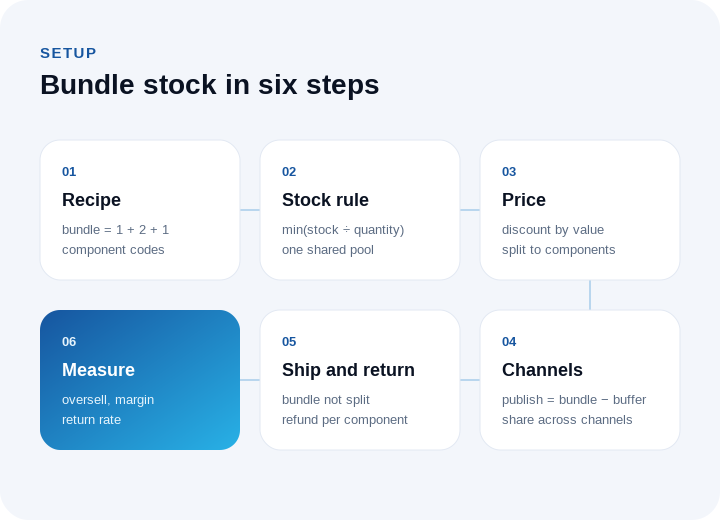
The order is: define the bundle recipe (component code, quantity, version); choose the stock rule (start virtual, one pool); allocate the discount by value share and write the margin floor; set up channel publishing (bundle stock − safety margin, channel split, reallocation); write the rules for missing components and partial refunds; and track oversell cancellations, bundle margin and return rate monthly.
On the system side, bundle stock must be recalculated after every movement and pushed to channels in near real time; for an event-based flow see our webhook article, and for the data flow between a web store and an ERP see ecommerce and ERP integration.
Recommended reading: How to Set Up Omnichannel Inventory: Click and Collect and Ship from Store
Recommended reading: What Is an Order Management System? Channels, Stock Allocation and Fulfilment
Ecommerce and Stock Software with İnovabil
At İnovabil our focus is building custom software from scratch for your company: ecommerce, ERP, CRM, web, mobile and integration. Bundle stock, price allocation and channel publishing depend on your product structure, existing ERP and sales channels; we do not claim a ready-made "bundle module". We suggest comparing off-the-shelf and custom options with costs during requirements analysis.
We built logistics, shipment planning and wholesale order management for Karyak; warehouse management (WMS) and a complaint and support management system for Sleepy; shipment planning for Bofigo; CRM, purchasing and mobile for Avcılar İnşaat; and a purchasing system for İZBAN. Share your product structure and channels and we will settle the rules together.
Recommended reading: Our software development process: from analysis to launch
Frequently Asked Questions
How is bundle stock calculated?
Divide each component's stock by its quantity in the bundle, round down, and take the smallest result. For a bundle with stock of 140, 330 (two cables) and 95, bundle stock is min(140; 165; 95) = 95.
Should I choose a virtual or an assembled bundle?
Unless there is added value such as a special box, gift value or serial records, a virtual bundle is cheaper and less error-prone. In the example, an assembled bundle adds 52 per bundle while saving only 6.67 in picking.
How do I prevent double selling if components also sell alone?
Keep components in one pool, calculate bundle stock from it and push it to channels after every movement. If needed, reserve part of a component for the bundle during a campaign.
How much is refunded if one item is returned from a bundle?
Most businesses refund the net amount paid inside the bundle; 213.04 for the case in the example. Refunding at list price over-refunds, and withdrawing the discount is harsh on the customer. Ask your legal counsel about withdrawal and return conditions.
How much stock should I publish to a marketplace for a bundle?
Subtract a safety margin from bundle stock: the sales expected during the sync interval. With several channels, split the remainder across them and reallocate unused share at intervals. Verify the marketplace's bundle listing rules in its official seller documentation.