

In many warehouses, half of the picking time is spent walking. A picker takes the order list and tours the racks, the best-selling item sits at the far end of the aisle, and two products that appear on the same order every day are stored at opposite ends of the building. Warehouse slotting and order picking optimization means deciding with data which item goes into which location and by which method each order is picked. It is the way to pick more lines with the same team, without another building, another hire or another machine.
This guide covers slotting strategies, the golden zone, picking methods, how travel distance is calculated in metres and minutes, the pick rate in lines per hour, picking accuracy and payback, all on one representative warehouse. Every dimension and amount is representative; none of them is a measurement of your own warehouse.
What Is Warehouse Slotting?
Slotting is the decision of assigning each item an address in the warehouse (aisle, rack, level, bin). A good slotting plan weighs pick frequency, item size and weight, items that are ordered together, and ergonomics at once. In a poor plan, items are put in whichever bin is empty on arrival, and over time the warehouse drifts into an arrangement nobody designed.
We explained what a warehouse management system does and why addressed racking is its foundation in our WMS guide; this article covers how to distribute items across those addresses.
We recommend reading: What is a warehouse management system (WMS)?
Which Slotting Strategies Are Used?
There are five basic strategies, and most warehouses combine two of them. The classification itself (A, B and C thresholds and how to compute them) is covered in detail in our ABC analysis guide; here we only look at how it turns into placement.
| Strategy | Rule | Strength | Weakness |
|---|---|---|---|
| Random (any empty bin) | Put it wherever there is space | Fills space well and is easy to start | Walking grows, and items are hard to find without a system |
| Fixed location | Every item has its own bin | Pickers memorise locations | Empty bins sit idle, so space is used poorly |
| Velocity-based (ABC) | Frequently picked items near the exit | The biggest cut in walking | Crowds the busiest aisle |
| Family (items ordered together) | Items on the same orders go side by side | Fewer stops per trip | Needs an affinity analysis |
| Volume and frequency (COI) | Smallest required volume per pick frequency goes first | Balances speed and space | Needs more data and calculation |
Which Data Should Velocity Slotting Use?
The measure is pick lines, not units sold. Walking depends on how many times a picker goes to a bin, not on how many units come out each time. An item that sells 12,000 units a year but ships them on 120 case lines gets far fewer visits than an item that sells 3,000 units on 2,400 lines. The second one should be placed first.
For each item, take the last three to six months of order lines and extract the pick line count, average quantity, unit size and weight, items it appears with, and seasonality. Without barcode-scanned movement records this data is unreliable.
The cube-per-order index (COI) combines volume with frequency: COI = bins required ÷ daily pick lines. A small COI means "small footprint, picked often", and such items go to the front. Four representative items:
| Item | Daily lines | Bins required | COI | Rank |
|---|---|---|---|---|
| Q | 120 | 2 | 2 ÷ 120 = 0.0167 | 1 |
| P | 200 | 4 | 4 ÷ 200 = 0.0200 | 2 |
| R | 60 | 6 | 6 ÷ 60 = 0.1000 | 3 |
| S | 20 | 4 | 4 ÷ 20 = 0.2000 | 4 |
P is picked most often, but Q takes only 2 bins for 120 lines a day, so it earns the most visits per bin and takes the front position.
What Is the Golden Zone and How Is It Set?
The golden zone is the height at which a picker reaches an item without bending or stretching, generally between waist and shoulder. The most frequently picked items go close to the exit horizontally and in this band vertically, so walking, bending and reaching all shrink.
- Heavy items go at waist height or below; heavy cases are not placed above the shoulder.
- Light, small and frequently picked items take the most comfortable spot in the golden zone.
- Rarely picked items go to the top and bottom levels and the rear aisles.
Lifting limits and heights depend on the relevant regulations and your occupational safety specialist.
What Are the Order Picking Methods?
Slotting answers "where"; the picking method answers "how many orders per trip". Four methods are common.
| Method | How it works | Suits | Watch out for |
|---|---|---|---|
| Single order | One picker collects one order from start to finish | Few orders, many lines per order | Walking multiplies as orders grow |
| Batch | Several orders are picked on one trip, then sorted | Many small orders | The sorting step carries error risk |
| Zone | Each picker works one zone and the tote passes to the next | Large warehouses with many items | Workload imbalance between zones |
| Wave | Orders are grouped by cut-off time and released on a schedule | Warehouses with fixed carrier departures | Idle gaps between waves, crowding inside them |
The methods are not exclusive: wave picking sets timing, while batch or zone picking sets the physical path. Many warehouses run batch picking inside waves. How the picked order connects to the vehicle and route is covered in our shipment planning software guide.
How Is Travel Distance Calculated?
Take a representative warehouse: a pick area 40 m deep from the exit door, and a picker walking at 1 m/s (with a cart, representative). For simplicity we assume that for every order line the picker walks from the entrance and back; real tours collect several lines, so absolute values are overstated, but the ratios are right.
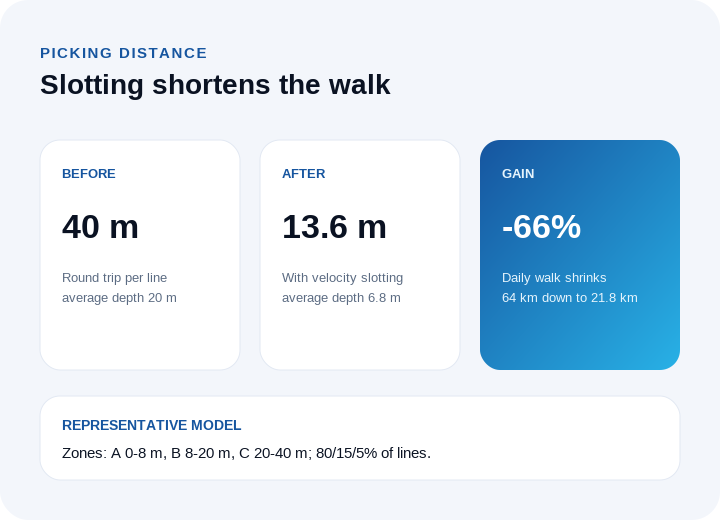
Before (random slotting): items are spread evenly over 40 m, so the average depth is 20 m and the round trip is 2 × 20 = 40 m. Walking per line is 40 s.
After (velocity slotting): we divide the area into three zones, and the share of lines is, representatively, 80 / 15 / 5.
| Zone | Depth range | Average depth | Line share | Contribution |
|---|---|---|---|---|
| A | 0–8 m | 4 m | 80% | 0.80 × 4 = 3.2 m |
| B | 8–20 m | 14 m | 15% | 0.15 × 14 = 2.1 m |
| C | 20–40 m | 30 m | 5% | 0.05 × 30 = 1.5 m |
| Average depth | 6.8 m | |||
The round trip is 2 × 6.8 = 13.6 m, or 13.6 s. Walking per line drops from 40 m to 13.6 m: (40 − 13.6) ÷ 40 = a 66% reduction. At 1,600 lines a day, walking falls from 1,600 × 40 = 64,000 m (64 km) to 1,600 × 13.6 = 21,760 m (21.8 km).
How Is the Pick Rate (Lines per Hour) Measured?
The pick rate is the number of lines picked per hour: lines per hour = 3,600 ÷ total seconds per line. Seconds per line has three parts: walking, searching and picking (including the barcode scan), and end-of-trip tasks. Representatively, search, pick and scan take 25 s and labelling and cart handling take 15 s, a fixed 40 s in total.
| Item | Before | After |
|---|---|---|
| Walking (1 m/s) | 40 s | 13.6 s |
| Fixed tasks | 40 s | 40 s |
| Seconds per line | 80 s | 53.6 s |
| Lines per hour | 3,600 ÷ 80 = 45.0 | 3,600 ÷ 53.6 = 67.2 |
| Share of walking | 50.0% | 25.4% |
| Daily picking labour (1,600 lines) | 35.6 h | 23.8 h |
The rate rises from 45.0 to 67.2: (67.2 ÷ 45.0) − 1 = a 49.3% increase. Daily labour is 1,600 × 80 = 128,000 s = 35.6 h before and 1,600 × 53.6 = 85,760 s = 23.8 h after; the difference is 42,240 s, or 11.7 hours a day. With 7 productive hours per shift, the people needed fall from 35.6 ÷ 7 = 5.1 (6 people) to 23.8 ÷ 7 = 3.4 (4 people).
How Much Faster Is Batch Picking Than Single-Order Picking?
We compare the methods on a separate representative example, independent of slotting (the two examples are not added together). The warehouse takes 400 orders a day with 4 lines each (1,600 lines in total). In a warehouse with velocity slotting, a single-order tour of 4 lines is measured at 48 m; a batch tour that collects 3 orders at once (12 lines) is 72 m. Fixed time per tour is 90 s, 25 s per line, and batch picking adds sorting at 30 s per order.
| Item | Single (1 order) | Batch (3 orders) |
|---|---|---|
| Walking (1 m/s) | 48 s | 72 s |
| Line tasks | 4 × 25 = 100 s | 12 × 25 = 300 s |
| Fixed time per tour | 90 s | 90 s |
| Sorting | — | 3 × 30 = 90 s |
| Total | 238 s | 552 s |
| Per order | 238 s | 552 ÷ 3 = 184 s |
Each order saves 238 − 184 = 54 s, or 22.7%. Across 400 orders, the day takes 400 × 238 = 95,200 s (26.4 h) with single picking and 400 × 184 = 73,600 s (20.4 h) with batch picking, exactly 6.0 hours less. The sorting step is the price of batch picking, so it is verified by barcode.
For zone picking, the key indicator is workload balance. If 1,600 daily lines split across three zones as 900 / 500 / 200, the ideal share is 533.3 lines; the busiest zone carries 900 ÷ 533.3 = 1.69 times the ideal and becomes the bottleneck. Staff are allocated in proportion to line share (about 3 / 2 / 1). The general logic of bottlenecks is covered in our capacity planning and bottleneck guide.
How Is the Picking Error Rate Calculated and Reduced?
The picking error rate is wrong lines divided by total lines: error rate = wrong lines ÷ lines picked. An error can be a wrong item, a wrong quantity or a missing line, and once it reaches the customer it causes reshipment, returns and reputation cost.
Representative example: 1,600 × 22 = 35,200 lines a month. Without barcode verification the rate is 0.8% (8 errors per 1,000 lines): 35,200 × 0.008 = 281.6 errors. Suppose scanning every picked item brings it to 0.2%: 35,200 × 0.002 = 70.4 errors. The reduction is 211.2 errors a month. At ₺350 per error (reshipment, return freight, labour), the monthly gain is 211.2 × ₺350 = ₺73,920.
- Mandatory scanning: the picker cannot move on without scanning the bin address and the item barcode.
- Separate look-alike items: place sizes or colours of the same model a few bins apart, not side by side, to reduce wrong picks.
Count differences are also tied to slotting; how to set up cycle counting is in our inventory counting guide, and the basics of stock accuracy are in our inventory tracking guide.
How Is the Payback of Slotting Optimization Calculated?
The gain comes from walking time; the costs are analysis, relocation and labels. Representative assumptions: picking labour at ₺300 an hour and 22 working days a month.
| Item | Calculation | Amount |
|---|---|---|
| Monthly labour gain | 11.73 h × 22 days × ₺300 | ₺77,440 |
| Monthly running cost (reviews) | 16 h × ₺300 | ₺4,800 |
| Monthly net gain | ₺77,440 − ₺4,800 | ₺72,640 |
| Investment: analysis and rules | — | ₺96,000 |
| Investment: relocation | 120 h × ₺300 | ₺36,000 |
| Investment: labels and addresses | — | ₺48,000 |
| Total investment | ₺180,000 |
Payback: 180,000 ÷ 72,640 ≈ 2.5 months. If the gain halves (₺38,720 gross, ₺33,920 net), payback is 180,000 ÷ 33,920 ≈ 5.3 months. The error saving (₺73,920) is not included, because barcode verification is a separate improvement.
How Is a Slotting Project Run?
Slotting is not a one-time job; the product mix and the season change. A six-step path works well.
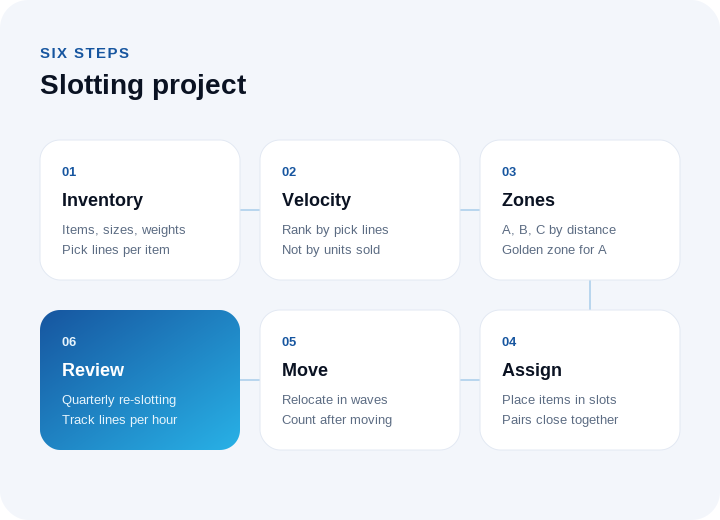
- Inventory: collect the item list, dimensions, weights and current addresses in one table.
- Velocity analysis: extract pick frequency per item from the last three to six months of lines and rank it.
- Zones: divide the warehouse into A, B and C zones by distance from the exit, plus the golden zone.
- Assign: place items in bins by the rules; items ordered together go close, heavy ones low.
- Move: relocate in waves outside peak picking hours, and count the addresses after each wave.
- Review: track lines per hour, walking distance and error rate; re-slot every quarter.
How to distribute stock when there is more than one warehouse is a separate topic, covered in our multi-warehouse inventory guide.
What Are Common Slotting Mistakes?
- Looking at units sold: the measure is line frequency; units mislead.
- Piling every A item into one aisle: walking shrinks, but pickers queue for each other in the same aisle; spread the density across zones.
- Not counting after the move: the system and the shelf stop matching, and the new layout turns into chaos.
- Forgetting ergonomics: a heavy case above the shoulder costs both safety and speed.
We recommend reading: What is a barcode system? Code types, labels and scanners
We recommend reading: How to Manage Dock Door Appointments: Slots, Queues, No-Shows and Payback Guide
Warehouse and Picking Processes with İnovabil
At İnovabil our focus is bespoke software built from scratch. On the warehouse and logistics side we built the warehouse management system (WMS) for Sleepy, logistics and shipment planning with wholesale order management for Karyak, shipment planning for Bofigo, and a prepaid cargo system for Kredili Kargo. Slotting and picking rules change from warehouse to warehouse, so we suggest settling them in the requirements analysis, with your own measurements and in writing; we do not promise a ready-made optimization module.
Send us a short summary of your current warehouse flow and product mix, and we will work out together which rules should move into the system.
We recommend reading: Our software development process: from analysis to launch
Frequently Asked Questions
What is warehouse slotting?
It is the decision of assigning each item an address in the warehouse. A good plan weighs pick frequency, size and weight, items ordered together and ergonomics to cut walking and errors.
What is the golden zone?
The height a picker reaches without bending or stretching, generally between waist and shoulder. The most frequently picked, light items are kept near the exit and at this height; heavy items go at waist height or below.
Is batch picking better than single-order picking?
With many small orders, batch picking is usually faster; in the example, time per order fell from 238 s to 184 s. But the sorting step carries error risk and should be verified by barcode. For few, many-line orders, single-order picking may be enough.
How much does slotting raise the pick rate?
It depends on the warehouse. In the representative example walking fell by 66% and the rate rose from 45.0 to 67.2 lines per hour (49.3%). Calculate your real gain with your own order lines, warehouse dimensions and fixed times.
How can the picking error rate be reduced?
Require scanning of the bin address and the item barcode, separate look-alike items by a few bins, keep address labels clear, and record the cause of each error so it feeds back into slotting decisions.