

The system says 40 units, but the shelf holds 37. Sales has promised the item as in stock, the warehouse cannot find it, and the customer is waiting. In most businesses this only comes to light at the year-end count, and by then the wrong record has been distorting decisions for months. The answer to how to do inventory counting is not one big counting day; it is a repeatable procedure that includes preparation, a method, discrepancy review and an approved correction entry.
This guide covers the year-end full count versus cycle counting, preparation before the count, count frequency by ABC class, blind and double counting, variance and stock accuracy calculations, tolerance thresholds, how to investigate the causes of discrepancies, and what each approach costs. All figures are illustrative.
What Is an Inventory Count and Why Do It?
An inventory count is the process of physically counting goods in the warehouse or on the shelf and comparing the result with the quantity recorded in the system. The aim is to see the gap between record and reality, find its cause and correct the record.
We covered the day-to-day stock record in our stock tracking guide; this article focuses on how that record is tested against physical reality.
We recommend reading: How to track inventory: formulas, metrics and a 30-day action plan
Year-End Full Count or Cycle Counting?
The two approaches reach the same goal at a different rhythm: a full count counts all stock at once, while cycle counting splits stock into parts and counts continuously throughout the year.
| Topic | Year-end full count | Cycle counting |
|---|---|---|
| Rhythm | One (or a few) large counts a year | Small planned counts every day |
| Warehouse operations | Usually closed or slowed | Keep running |
| Catching errors | Months later | Within days or weeks |
| Count team | Temporary, often inexperienced | Small, experienced and permanent |
| Best suited to | Few items, slow-moving stock, counts required by regulation | Many items, constant movement, high stock value |
The two approaches do not have to replace each other. Whether cycle counting can replace the year-end count is an accounting and regulatory question; decide it with your financial advisor (certified accountant).
How Do You Prepare Before an Inventory Count?
The success of a count is largely decided before the counting day; an unprepared count fills the discrepancy list with false differences.
- Write down the scope and cut-off time: Define which warehouse, shelves and items will be counted and when the count starts and ends. The cut-off time is the moment the system quantity is frozen.
- Stop or separate movements: Receiving and shipping are paused during the count; if that is not possible, movements are written on a separate list.
- Close the documents: Delivery notes and shipping documents that arrived before the cut-off are posted to the system. An unposted document is the most common cause of a false difference.
- Tidy the shelves: Gather each product in one location and mark damaged and returned goods separately.
- Prepare count sheets: Each line shows the product code, location and unit of measure; in a blind count the system quantity is not shown to the counter.
- Define the team and roles: The counter, the verifier and the approver should be different people; nobody should count and approve their own shelf alone.
How Do You Set Count Frequency by ABC Class?
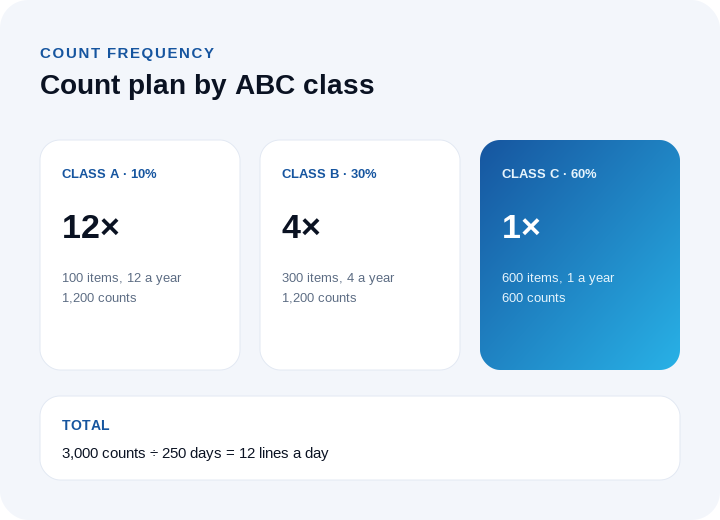
The core idea of cycle counting is not to count every item equally often: valuable, fast-moving items are counted often, cheap, slow-moving items rarely. Items are split into classes A, B and C by annual consumption value; class A is the small group of items that carries most of the value.
In the illustrative example there are 1,000 items: class A is 10% of items, class B 30% and class C 60%. Count frequency is set at 12 times a year for A, 4 for B and 1 for C.
| Class | Items | Annual frequency | Annual counts | Per working day (250 days) |
|---|---|---|---|---|
| A (10%) | 100 | 12 | 100 × 12 = 1,200 | 1,200 ÷ 250 = 4.8 |
| B (30%) | 300 | 4 | 300 × 4 = 1,200 | 1,200 ÷ 250 = 4.8 |
| C (60%) | 600 | 1 | 600 × 1 = 600 | 600 ÷ 250 = 2.4 |
| Total | 1,000 | — | 3,000 | 12 |
3,000 count lines a year divided by 250 working days is 12 lines a day. If one counter handles 30 lines an hour (illustrative), that is 12 ÷ 30 = 0.4 hours, or 24 minutes. Set class boundaries and frequencies from your own stock value and error history.
Counting Methods: Blind Count, Double Count and Second Counter
If the counter knows the system quantity, they tend to write a number closer to what they know than to what they see. The method you choose therefore determines how trustworthy a difference is.
| Method | How it works | Strength | Weakness |
|---|---|---|---|
| Open count | The counter sees the system quantity and confirms it | Fast | Hides errors; not recommended |
| Blind count | The counter sees only product and location and writes the quantity | No bias | Can produce false differences |
| Double count | Two people count the same line without knowing each other's result | Catches counting errors | Doubles the time |
| Second counter (difference-based) | Only lines that differ are recounted by an independent person | Fast and effective | A wrong count that matches the system goes unnoticed |
The most balanced setup in practice is a blind count on every line and an independent second counter on lines that differ. Barcode scanners speed up these steps and reduce typing errors; for the technology see our barcode system guide.
How Are Count Variance and Stock Accuracy Calculated?
Three measures are enough: quantity variance, value variance and stock accuracy. Quantity variance is the count minus the system; value variance is that multiplied by unit cost; stock accuracy is the ratio of correct records to counted records.
- Quantity variance = counted quantity − system quantity. A negative value means a shortage, a positive value a surplus.
- Value variance = quantity variance × unit cost.
- Stock accuracy = number of correct records ÷ number of counted records. Define "correct" (exact match or within tolerance) in advance.
An illustrative count period: 250 lines were counted, and the system value of the counted stock is ₺1,250,000. 230 lines matched the system and 20 differed. Of the 20, 14 were shortages (total −₺22,400) and 6 were surpluses (total +₺7,400).
| Measure | Calculation | Result |
|---|---|---|
| Stock accuracy (first count) | 230 ÷ 250 | 92% |
| Net value variance | −22,400 + 7,400 | −₺15,000 |
| Gross (absolute) value variance | 22,400 + 7,400 | ₺29,800 |
| Net variance rate | 15,000 ÷ 1,250,000 | 1.2% |
| Gross variance rate | 29,800 ÷ 1,250,000 | 2.4% |
Track net and gross variance together: positive and negative differences can offset each other and shrink the net figure.
How Do You Set a Tolerance Threshold and Who Approves?
Investigating every difference with the same seriousness wastes time; a tolerance threshold decides which differences close automatically and which enter review. The threshold is set on both quantity (percentage) and value (₺), and a difference is investigated if either is exceeded.
Illustrative threshold: ±2% or ±₺500 per item. Example: a product with a unit cost of ₺300, system 40, count 37. The quantity variance is −3, the percentage is 3 ÷ 40 = 7.5%, and the value variance is 3 × ₺300 = −₺900. Both thresholds are exceeded, so the difference enters review.
| Value variance (absolute) | Approver | Required document |
|---|---|---|
| Up to ₺500 | Count supervisor | Count sheet and a short note |
| ₺500 to ₺5,000 | Warehouse manager | Discrepancy review form |
| Above ₺5,000 | Finance manager | Review form and second count record |
Why Do Differences Occur and How Are They Investigated?
Investigation separates a record error from a timing difference from a real loss. A six-step flow makes this systematic.
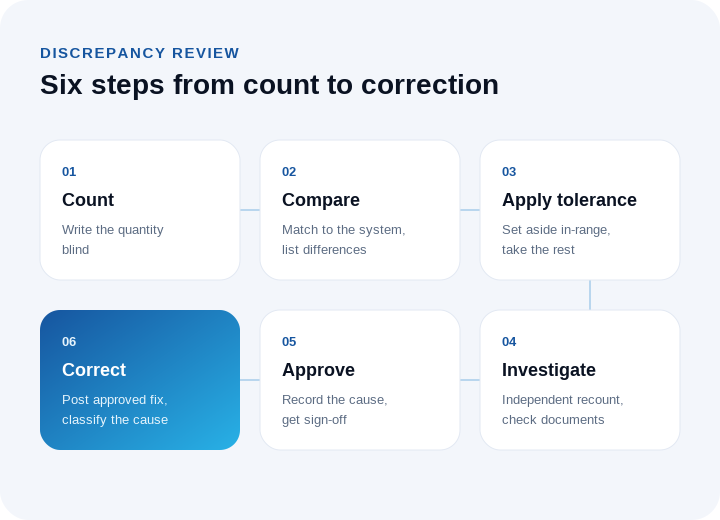
- Count: Write the quantity with a blind count.
- Compare: Match the count to the system quantity and list the differences.
- Apply tolerance: Set aside those within tolerance and take the rest into review.
- Investigate: Recount with an independent second counter and check documents and movements.
- Approve: Write the cause and get it approved according to approval authority.
- Correct the record: Post the correction movement if needed, classify the cause and close the item.
Here is the review result for the 20 differing lines in the illustrative example.
| Cause | Lines | Net value | What is done |
|---|---|---|---|
| Cut-off error (movement during the count) | 3 | −₺900 | Post the movement, tighten the cut-off rule |
| Posting delay (late-posted document) | 3 | −₺600 | Post the document, monitor processing time |
| Wrong shelf (found in another location) | 5 | ₺0 | Post a location transfer, review shelf discipline |
| Counting error (fixed on recount) | 4 | −₺1,000 | Record unchanged, counter training |
| Real loss (scrap, damage, missing) | 5 | −₺12,500 | Approved correction entry, root cause search |
| Total | 20 | −₺15,000 | — |
The totals reconcile: 3 + 3 + 5 + 4 + 5 = 20 lines; −900 − 600 + 0 − 1,000 − 12,500 = −₺15,000. Two measures come out of this table. The shrinkage rate = real loss ÷ system value of the counted stock = 12,500 ÷ 1,250,000 = 1.0%. The lasting record error after review is 10 lines (5 real losses and 5 wrong shelves), that is 10 ÷ 250 = 4%.
How Do You Post the Correction Entry After the Count?
A correction is made not to hide a difference but to reflect a documented, explained record in the system. In the example above only two kinds of entries are needed: an approved stock adjustment of −₺12,500 for the 5 real losses and a location transfer for the 5 wrong-shelf lines.
- Every correction movement is tied to the count number, the cause and the approver.
- The person who counted does not close their own difference alone.
- Items where the same cause repeats move to a higher count frequency.
The effect of the corrected quantity on cost and accounting should be assessed with your financial advisor; we explained how product cost is built up in our product cost guide.
How Do You Plan the Count Team and Duration?
Duration is calculated from the number of lines, the number of counters and counter speed. In the illustrative example one counter handles 30 lines an hour, the full count has 1,000 lines and the team has 6 people.
- Team speed: 6 × 30 = 180 lines per hour.
- One pass: 1,000 ÷ 180 ≈ 5.6 hours.
- Double count on all lines: 2 × 5.6 ≈ 11.1 hours.
- Blind count plus a second counter only on differing lines (for example 8%, i.e. 80 lines): 5.6 + 80 ÷ 180 ≈ 5.6 + 0.4 = 6.0 hours.
With preparation, review and posting added, setting aside two working days (16 hours) for a full count is reasonable.
How Do You Compare the Cost of a Full Count and Cycle Counting?
The comparison has two items: counting labor and the cost of the warehouse standing still. The following assumptions are illustrative: counter hour ₺300, a loss of ₺4,000 for each hour the warehouse is closed, counter speed 30 lines per hour.
- Year-end full count: The warehouse is closed 2 days × 8 hours = 16 hours: 16 × ₺4,000 = ₺64,000. Labor: 6 people × 16 hours = 96 person-hours × ₺300 = ₺28,800. Total ₺92,800.
- Cycle counting: 3,000 lines a year ÷ 30 = 100 person-hours. A second count for 10% of lines (300 lines): 300 ÷ 30 = 10 person-hours. Total 110 person-hours × ₺300 = ₺33,000. The warehouse keeps working, so there is no closure cost.
| Item | Year-end full count | Cycle counting |
|---|---|---|
| Person-hours | 96 | 110 |
| Counting labor | ₺28,800 | ₺33,000 |
| Warehouse closure | ₺64,000 | ₺0 |
| Annual total | ₺92,800 | ₺33,000 |
The difference is 92,800 − 33,000 = ₺59,800, so under these assumptions cycle counting is 64.4% cheaper (59,800 ÷ 92,800). Cycle counting labor is slightly higher; the gain comes from the warehouse not stopping. If regulation or audit also requires a year-end count, the two together come to 92,800 + 33,000 = ₺125,800. In a real decision, use your own counter speed and the real cost of a closure.
What Are the Accounting and Regulatory Aspects of Inventory Counting?
An inventory count is not only an operational task; stock value affects the balance sheet and cost. The year-end count obligation, the counting procedure, how records are drawn up and how a count difference is booked all depend on regulation and may change over time.
Clarify with your financial advisor which count is required, whether cycle counting replaces the year-end count and how difference entries are posted. For managing records with software, see our accounting software service.
How Do Barcodes and a Warehouse Management System Make Counting Easier?
A barcode scanner removes the need to type count lines and prevents scanning the wrong product; a warehouse management system produces location-based count sheets and assigns counts to locations and counters.
We covered the scope of a warehouse management system in our WMS guide and the stock allocation and shipping flow of an order in our order management system article. A wrong stock record also directly distorts the net requirement calculation in production planning.
What Are Common Mistakes in Inventory Counting?
- Counting before closing documents: An unposted delivery note is the most common source of false differences.
- Running an open count: Showing the counter the system quantity hides errors.
- Correcting without finding the cause: The difference closes, but the error comes back.
We recommend reading: How to Run an ERP Implementation: Process Design, Training, Pilot and Go-Live Guide
We recommend reading: How to Do Demand Forecasting: Moving Average, Exponential Smoothing, Seasonality and Error Metrics Guide
We recommend reading: How to Manage Subcontract Manufacturing: Material Shipments, Scrap, Reconciliation and Subcontractor Performance
We recommend reading: How to Manage Multi-Warehouse Inventory: Transfers, In-Transit Stock and Rebalancing Guide
We recommend reading: What Is Fixed Asset Management? Asset Cards, Custody, Counts, Depreciation and Book Value Guide
We recommend reading: How to Optimize Warehouse Slotting and Order Picking: Strategies, Pick Methods and Payback Guide
We recommend reading: What Are Inventory Valuation Methods? FIFO, Weighted Average and Standard Cost Explained
We recommend reading: How to Calculate Safety Stock and Reorder Point: Formula, z Value, EOQ and Worked Example
We recommend reading: How to Set Up Lot and Serial Number Traceability: Lot Records, FEFO, Quarantine and Recall Drills
We recommend reading: How to Set Up Omnichannel Inventory: Click and Collect and Ship-from-Store for Stores and E-Commerce
We recommend reading: How to Manage Spare Parts Inventory: Intermittent Demand, Critical Parts and Stock Levels Guide
We recommend reading: How to Manage Slow-Moving and Dead Stock: Aging, Classification, Clearance and Decision Guide
Stock and Warehouse Processes with İnovabil
At İnovabil our focus is building software from scratch, tailored to the company: custom software, ERP, CRM, e-commerce, web, mobile and integration. Our ERP solutions include modules such as stock management, purchasing, and sales and shipping; one of our stock and warehouse solutions is the warehouse management system (WMS) we built for Sleepy. For Karyak we built logistics and shipment planning together with wholesale order management.
We suggest clarifying needs such as count sheet generation, blind counting, tolerance and approval flow during requirements analysis and deliberately including them in the scope; at that stage we can compare in writing which work is covered by off-the-shelf tools and which by custom development. Our process steps are on our process page and our ERP approach is on the ERP development page; for selection criteria see how to choose an ERP.
Frequently Asked Questions
How do you do an inventory count?
First prepare the scope, cut-off time and documents; then write quantities with a blind count, compare with the system, recount above-tolerance differences with an independent second counter, investigate the cause and post an approved correction entry.
What is cycle counting and how does it differ from a full count?
Cycle counting splits stock into parts and counts them on a plan throughout the year; the warehouse keeps working and errors are caught within days. A full count counts all stock at once, often stops the warehouse and sees errors months later.
How do you set count frequency by ABC class?
Valuable, fast-moving class A items are counted often, middle class B less often, and cheap class C items once a year. In the example with 1,000 items, A is counted 12 times, B 4 times and C once: 1,200 + 1,200 + 600 = 3,000 counts, 12 lines a day.
How is stock accuracy calculated?
Divide the number of correct records by the number of counted records. In the example, 230 of 250 lines matched the system, so accuracy is 230 ÷ 250 = 92%. Define in advance whether "correct" means an exact match or within tolerance.
Is an inventory count legally required?
The year-end inventory obligation and procedure depend on regulation and may change over time. Ask your financial advisor which count is required and whether cycle counting can replace it.