

Shipping is the second bill an online order generates after the sale itself, and most businesses treat it as a general overhead spread across revenue and never look at its parts. Yet the answer to how to reduce shipping costs in e-commerce, in other words shipping cost optimization, does not sit in one negotiation. It sits in a handful of small decisions that interact: box size, tariff tier, parcel consolidation, the free-shipping threshold and invoice auditing.
In this guide we first show how to measure shipping spend, then how to cut it through desi and packaging, tariffs, carrier selection rules, the free-shipping threshold, returns, cash on delivery, damage and invoice reconciliation, all worked through one example of 3,000 orders a month. Every figure is representative; none is a real carrier tariff or market price. For the technical side of the integration itself, see our shipping integration guide.
How Do You Measure Shipping Cost?
Start with two indicators: shipping cost per order and shipping cost as a share of revenue. Both must include items that never appear on the carrier invoice, such as packaging and return labels, otherwise the cost looks lower than it is.
The example store ships 3,000 orders a month at an average basket of ₺900. Monthly revenue is 3,000 × ₺900 = ₺2,700,000.
| Item | Monthly amount | Per order | Share of revenue |
|---|---|---|---|
| Carrier invoice (outbound parcels) | ₺240,000 | ₺80.00 | 8.89% |
| Packaging (box, filler, tape) | ₺30,000 | ₺10.00 | 1.11% |
| Total | ₺270,000 | ₺90.00 | 10.00% |
| Return labels (180 returns × ₺70) | ₺12,600 | ₺4.20 | 0.47% |
We keep return labels on a separate row because the return rate, and who pays for the label, differs from business to business. Feed the calculation with order data and the parcel lines on the carrier invoice. To see carrier, desi and zone for all orders in one place, the single-queue approach in our order management system guide helps.
How Do You Optimize Desi and Packaging?
A carrier bills either the actual weight or the volumetric weight (desi), whichever is larger. Desi = width (cm) × length (cm) × height (cm) ÷ divisor. The divisor depends on the carrier and the service; the gap between the common 3000 and 5000 is large: a 40 × 30 × 25 cm box is 30,000 ÷ 3000 = 10 desi, but 30,000 ÷ 5000 = 6 desi. Read the divisor from your contract; to test dimensions, use our free desi calculator (Turkish interface).
You pay for the air in the box. The example product measures 28 × 20 × 10 cm and weighs 2 kg, and it ships in a 40 × 30 × 25 cm box today. This product group is 1,000 orders a month. Assume a representative tariff: parcel price = ₺46 + ₺6 × desi, with desi rounded up (rounding rules vary by carrier).
| Box (cm) | Volume | Desi (÷3000) | Billed | Parcel price |
|---|---|---|---|---|
| A: 40 × 30 × 25 | 30,000 | 10.00 | 10 desi | ₺106 |
| B: 34 × 26 × 15 | 13,260 | 4.42 | 5 desi | ₺76 |
| C: 30 × 22 × 14 | 9,240 | 3.08 | 4 desi | ₺70 |
| D: 30 × 22 × 13 | 8,580 | 2.86 | 3 desi | ₺64 |
Box B leaves enough cushioning around the product. Moving from A to B saves ₺106 − ₺76 = ₺30 per parcel; 1,000 orders × ₺30 = ₺30,000 a month. The one-off cost of new boxes and strapping, ₺24,000, pays back in the first month: 24,000 ÷ 30,000 = 0.8 months.
Watch the thresholds. Box C is 3.08 desi and rounds up to 4; trimming 1 cm of height to reach D saves another ₺6. But D leaves very little cushioning, which we revisit in the damage section. Keep the number of box sizes small too: a few standard sizes are cheaper than dozens of custom ones and cause fewer errors in the warehouse.
How Do You Negotiate Carrier Tariffs and Volume Tiers?
Tariff negotiation has two levers: the unit price and a tier tied to monthly parcel volume. A tier commits you, so you need to be able to forecast volume through the year. Representative tiers:
| Monthly parcels | Discount | Note |
|---|---|---|
| Under 1,000 | 0% | List tariff |
| 1,000 – 2,499 | 3% | First tier |
| 2,500 – 4,999 | 6% | The example store's tier |
| 5,000 and above | 9% | High volume |
In this example the business pays the undiscounted list tariff today, so the first invoice of ₺240,000 is a list amount and the tier is a separate gain from a new agreement. After the box change and parcel consolidation the invoice is ₺202,200 (calculated below) and the parcel count is 2,850; it stays above 2,500, so 6% applies: 202,200 × 0.06 = ₺12,132. If parcels fall to 2,400, the tier drops to 3% and the discount halves; in a seasonal business, read the commitment against the lowest month, not the average. Ask in writing for fuel surcharges, cash-on-delivery fees and redelivery fees as separate lines, and consult your legal advisor on contract details.
How Do You Set Carrier Selection Rules?
A written rule that routes each parcel to the best carrier by weight, zone and speed can be cheaper than relying on one carrier, but the price is split volume. Let the second carrier's representative tariff be ₺36 + ₺8 × desi (list price, no discount agreement).
| Desi | Carrier A: 46 + 6d | Carrier B: 36 + 8d | Cheaper |
|---|---|---|---|
| 2 | ₺58 | ₺52 | B |
| 4 | ₺70 | ₺68 | B |
| 5 | ₺76 | ₺76 | Equal |
| 6 | ₺82 | ₺84 | A |
| 10 | ₺106 | ₺116 | A |
The break-even desi: 46 + 6d = 36 + 8d, so d = 5. The rule is 4 desi and below to B, 6 desi and above to A. Does splitting actually save money? Take the ₺210,000 invoice after the box change (1,000 parcels at 5 desi, 1,250 parcels at 2 desi, 750 parcels at 6 desi) and compare two options.
- Option 1, one carrier: all 3,000 parcels with A at the 6% tier: 210,000 × 0.06 = 12,600 discount, invoice ₺197,400.
- Option 2, split: the 1,250 two-desi parcels go to B, each ₺6 cheaper: ₺7,500 saved, total ₺202,500. The 1,750 parcels left with A fall to the 3% tier: (76,000 + 61,500) × 0.03 = 4,125 discount; invoice 202,500 − 4,125 = ₺198,375.
With these assumptions, a single carrier is ₺975 cheaper. The result can flip with different tariffs; the rule is to calculate both in the same table. Routing by speed and zone for marketplace orders and for your own store requires making the carrier choice in one place.
How Do You Set the Free-Shipping Threshold?
A free-shipping threshold is not a cost item but a lever for growing the basket; whether it pays depends on how much baskets grow and how many customers walk away. The example store considers raising its threshold from ₺900 to ₺1,000; below the threshold the customer pays a flat ₺60. In the ₺900–1,000 band there are 400 orders a month at an average basket of ₺950, with a 40% gross margin and a parcel cost of ₺80.
| Behavior | Orders | Contribution per order | Total |
|---|---|---|---|
| Today (free shipping) | 400 | 950 × 40% − 80 = ₺300 | ₺120,000 |
| Adds items to reach threshold (₺70 more) | 120 | 1,020 × 40% − 80 = ₺328 | ₺39,360 |
| Pays the ₺60 fee | 200 | 380 − 80 + 60 = ₺360 | ₺72,000 |
| Abandons | 80 | ₺0 | ₺0 |
| Total after the change | 400 | ₺111,360 |
The change: 111,360 − 120,000 = −₺8,640. With these assumptions, raising the threshold does not pay. The break-even abandonment rate: with 30% adding items, average contribution is 0.30 × 328 + (0.70 − a) × 360; setting it equal to ₺300 gives a = 14%. If abandonment stays below 14%, the higher threshold pays. That is why we did not count the threshold change in total savings; measure it with a short, limited-traffic test. For consumer rights and fee disclosure, consult your legal advisor.
How Do You Cut Consolidation, Cash-on-Delivery and Damage Costs?
Three small items add up to a meaningful amount together.
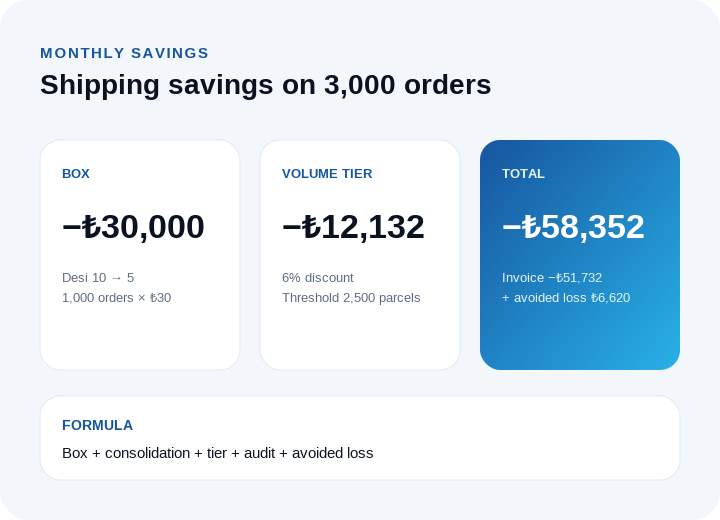
- Parcel consolidation: If the same customer orders again within 24 hours, add a short holding window (for example 2 hours) so the parcels can ship together. Say 150 second orders a month. Separate shipping: 2 × (46 + 6 × 3.5) = 2 × ₺67 = ₺134. One combined parcel of 6 desi (the shared box saves 1 desi): 46 + 36 = ₺82. Saving ₺52; 150 × 52 = ₺7,800. This lowers the invoice from ₺210,000 to ₺202,200 and the parcel count from 3,000 to 2,850.
- Cash on delivery: The carrier charges a collection fee, and a refused parcel costs both the outbound and the return leg. With 400 cash-on-delivery orders a month, a ₺12 collection fee and a 10% refusal rate: 400 × 12 = ₺4,800; 40 refused × (₺80 outbound + ₺70 return) = ₺6,000; total ₺10,800, or ₺27 per order. If a phone or message confirmation and an online-payment incentive cut refusals to 6%, 24 remain: 16 × 150 = ₺2,400.
- Damage and loss: Say 0.5% of parcels are damaged or lost: 15 incidents. Cost per incident = product cost (60% of ₺900 = ₺540) + reshipping ₺80 = ₺620; ₺9,300 a month. Protective filler brings the rate to 0.3% (9 incidents, ₺5,580): a difference of ₺3,720. Filler costs 800 fragile orders × ₺2 = ₺1,600; net ₺2,120. If a box that is too tight (like box D) pushes the damage rate up, the gain reverses.
For reconciling cash-on-delivery collections with the carrier and passing tracking data to the customer, see the flow in the shipping integration guide.
We recommend reading: What is shipping integration? A guide to desi, tracking and cash-on-delivery reconciliation
How Do You Reduce Return Shipping Costs?
Returns are the least visible and most debated part of shipping spend. With 180 returns a month (6%) and a ₺70 return label, ₺12,600 is spent. If better size and dimension information, accurate product photos and clear descriptions bring the return rate to 5%, 150 returns remain: 30 × 70 = ₺2,100. Who pays for the return is tied to withdrawal rights and consumer law; talk to your legal advisor before deciding. For the whole process, including sorting by reason and inspection at the warehouse, see our returns management guide.
How Do You Audit a Carrier Invoice?
If invoice lines do not match your shipment records, you overpay. Compare each parcel's desi and weight in your records with the invoice value, and filter out duplicate lines and redelivery fees.
Example: on 100 parcels the desi measured by the carrier is higher than the one you declared, averaging ₺15 extra (1,500); on 30 parcels there is a redelivery fee of ₺25 with no record behind it (750). The total dispute is ₺2,250; suppose the carrier accepts 80%: 2,250 × 0.8 = ₺1,800 recovered per month. To do this monthly, invoice lines must be stored against parcel numbers in your system; done by hand it usually gets skipped.
How Much Do You Save in Total per Month?
Let us apply the steps in order and add them up. Invoice order: box, consolidation, tier, reconciliation.
| Step | Calculation | Monthly saving |
|---|---|---|
| Smaller box | 1,000 × (106 − 76) | ₺30,000 |
| Parcel consolidation | 150 × 52 | ₺7,800 |
| 6% volume tier | (240,000 − 30,000 − 7,800) × 0.06 | ₺12,132 |
| Invoice reconciliation | 2,250 × 0.8 | ₺1,800 |
| Invoice total | 240,000 → 188,268 | ₺51,732 |
| Cash-on-delivery refusals | 16 × 150 | ₺2,400 |
| Return labels | 30 × 70 | ₺2,100 |
| Damage (net) | 3,720 − 1,600 | ₺2,120 |
| Free-shipping threshold | Not counted | ₺0 |
| Grand total | ₺58,352 |
The invoice falls from ₺240,000 to ₺188,268: 51,732 ÷ 240,000 = a 21.6% reduction. Shipping and packaging cost per order drops to (188,268 + 30,000) ÷ 3,000 = ₺72.76 from ₺90. As a share of revenue it falls from 10.00% to 218,268 ÷ 2,700,000 = 8.08%. The three items outside the invoice (₺6,620) are avoided losses and do not show up as an invoice reduction.
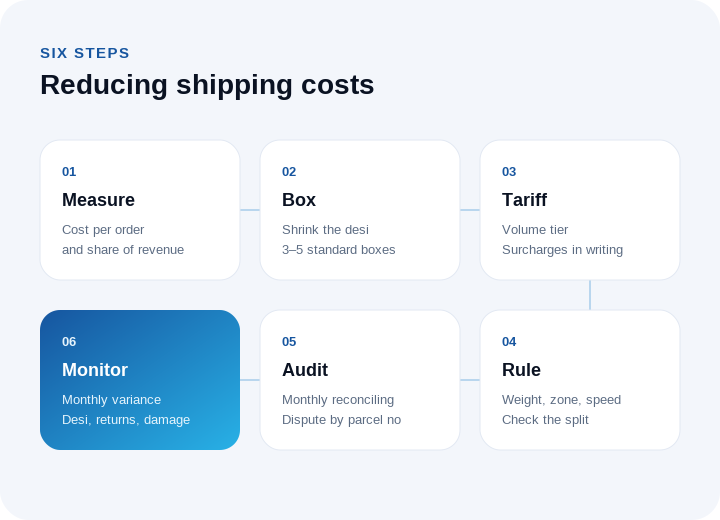
Six Steps to Reduce Shipping Costs
- Measure: Calculate cost per order and share of revenue; add packaging and return labels.
- Shrink the box: Pick 3–5 standard boxes by product group and aim just below the desi thresholds.
- Negotiate the tariff: Read the tier against your lowest monthly volume and get surcharges in writing.
- Write a selection rule: Set rules by weight, zone and speed; calculate whether splitting erodes the tier.
- Audit the invoice: Reconcile monthly and send disputes with parcel numbers.
- Monitor: A monthly variance report: desi difference, redelivery, return and damage rates, share of revenue.
For a quick estimate with your own tariff and dimensions, try the shipping cost calculator (Turkish interface). When you set up shipping options and the payment flow on your own storefront, our guide on how to build an e-commerce website helps; for delivery with your own vehicle fleet, see shipment planning software.
We recommend reading: What is an order management system? A guide to the cross-channel order life cycle
We recommend reading: What Is Dropshipping and How Do You Run It? Supplier Feeds, Unit Economics and Automation
We recommend reading: How to Set Up Address Data Quality and Address Validation: Standardization, Match Score and Payback Guide
We recommend reading: How to Analyze Product Profitability and Rationalize SKUs: Contribution Margin, Carrying Cost and Pruning Guide
We recommend reading: How to Set Up Omnichannel Inventory: Click and Collect and Ship-from-Store for Stores and E-Commerce
Shipping and Order Processes with İnovabil
At İnovabil our focus is building software from scratch for your company: custom software, e-commerce, ERP, CRM, web, mobile and integration. Measuring shipping cost in software, meaning keeping parcel, desi and invoice data in one place, is a requirement to pin down during the analysis stage; you cannot reduce a cost you do not measure.
We built the prepaid shipping system for Kredili Kargo, logistics and shipment planning with wholesale order management for Karyak, and warehouse management for Sleepy. Send us a short summary of your parcel volume and your current shipping process, and we will put the need in writing together.
We recommend reading: Our software development process: from analysis to launch, step by step
Frequently Asked Questions
How do you reduce shipping costs in e-commerce?
First measure cost per order and share of revenue; then cut desi with a smaller box, negotiate the volume tier, consolidate parcels and audit the invoice parcel by parcel. In the example, these steps cut the ₺240,000 monthly invoice by about 21.6%.
How is desi calculated and why does it matter?
Desi = width × length × height (cm) ÷ divisor; the divisor varies by carrier and 3000 is common. Because the charge follows the larger of actual weight and desi, a light but bulky box is expensive. A 40 × 30 × 25 cm box is 10 desi.
Does raising the free-shipping threshold reduce shipping cost?
There is no guarantee. A threshold can grow the basket but also increases abandonment. In the example, raising it from ₺900 to ₺1,000 lost ₺8,640 a month; the break-even abandonment rate was 14%. Measure it with a limited test first.
Is it cheaper to use two carriers?
Sometimes. A cheaper carrier saves on small parcels, but splitting volume can drop the discount tier. In the example one carrier came out ₺975 cheaper. Calculate both options in one table with your own tariffs.
How do you find overcharges on a carrier invoice?
Match each invoice line to your own records by parcel number, desi and weight; separate duplicate lines and redelivery fees with no record. In the example, ₺2,250 a month was disputed and ₺1,800 recovered at an 80% acceptance rate.