

For a business that prepares, invoices and ships orders, one line of text decides the last step. The customer typed "Gul Sk. No 12", left the neighborhood blank and picked the wrong district; the parcel leaves, the courier cannot find it and the shipment comes back. Address data quality and address validation are the discipline of structuring an address the moment it enters your system, standardizing it and matching it to a real delivery point. The goal is not prettier addresses; it is catching a failed delivery before the parcel is handed to the carrier.
This guide covers why an address must be split into fields, the typical errors, standardization rules, dependent selection lists, extracting fields from free text, validation levels, the match score, duplicate addresses, metrics and the payback calculation. The address structure described is Turkish (province, district, neighborhood, street, building, apartment), because that is where the hard cases are. All figures are illustrative, not measurements from a real business or industry.
What Is Address Data Quality and Why Split an Address into Fields?
Address data quality is the degree to which a stored address is complete, consistent, current and fit for delivery. The first step to making it measurable is splitting free text into fields, because a single line cannot be searched, compared or validated.
| Topic | Free-text address | Structured fields |
|---|---|---|
| Entry | One box, fast but unchecked | Province, district, neighborhood, street, building no, apartment |
| Validation | Not possible, or checked by hand | Checked field by field and across fields |
| Duplicate detection | Spelling differences hide matches | Grouped by a normalized key |
| Carrier form | Lines split manually | Fields pass straight through |
| Reporting | District or neighborhood breakdowns are hard | Delivery success by area is easy |
A Turkish address usually runs in this order: province, district, neighborhood, street or avenue, building number, door and apartment. The postal code is a helper field, not proof, because one code can cover several streets. The codes and lists published by the official address registry are the conceptual reference for this structure; decide which one to use together with your carrier and your contract.
We recommend reading: Our integration services
What Are the Typical Errors in Address Entry?
Most errors fall into a handful of patterns. Knowing the pattern tells you which rule to write.
| Error type | Example | Direction of the fix |
|---|---|---|
| Spelling | "Kadikoy" typed with wrong or missing special letters | Fuzzy matching, selection from a list |
| Abbreviation | Mah., Mh.; Cad., Cd.; Sk., Sok. | Expand to the full name with a dictionary |
| Turkish characters | dotless i typed as i, s-cedilla typed as s | Build the key by folding characters |
| Neighborhood change | A merged or renamed neighborhood | Old name to new name mapping table |
| Missing building and apartment | Street given, no number | Required field; if missing, send to confirmation |
| Wrong district | Neighborhood does not belong to the district | Cross-field consistency rule |
The source of these errors is often not the user but the form: a form that gives no hint, squeezes fields on mobile and accepts a missing field lowers address quality from the start. We covered friction in the payment flow in our e-commerce checkout guide; here the subject is the correctness of the address itself.
How Do You Standardize Addresses?
Standardization means storing the same address in one spelling. Four rules do most of the work.
- Locale-aware casing: In Turkish, lowercase "i" becomes uppercase "dotted I" and lowercase "dotless i" becomes plain "I". A generic uppercase function breaks names like Isparta and Izmir; do the conversion with the Turkish locale.
- Abbreviation dictionary: Expand "Mh." and "Mah." to the full word for neighborhood, "Cd." and "Cad." to avenue, "Sk." and "Sok." to street. Keep the dictionary in one place.
- Whitespace and punctuation: Strip extra spaces, dots and slashes; split a pattern like "No:12/5" into the building and apartment fields.
- Separate display from key: Show the customer and the label the clean spelling; store a separate character-folded key (dotless i to i, s-cedilla to s) for comparison.
Standardization must not overwrite the source: the original text the customer typed stays in its own field. If a rule turns out to be wrong, you can go back.
How Do You Set Up Dependent Selection Lists?
The cheapest validation is to let the user choose so that they cannot mistype. Choosing a province opens its districts, choosing a district opens its neighborhoods, and choosing a neighborhood brings up spelling suggestions for the street.
- Dependent lists: The district list shows only districts of the chosen province, so "neighborhood and district do not match" disappears structurally.
- Local code table: Keep the province, district and neighborhood lists in your own database; calling an outside source on every entry is slow and fragile.
- Update frequency: Neighborhoods merge and get renamed. In an illustrative table of 1,000 neighborhood records where 24 change per year, a table never updated leaves 48 records, or 4.8%, stale after two years. Put the update on a calendar (for example every three months) and keep a redirect for old names.
- Street can stay free: A list down to street and building level becomes huge; spelling suggestions and later matching suit it better.
If you load data in bulk from a file, the same rules must run during import; for the design of bulk loading see our CSV and Excel import guide.
How Do You Extract Fields from a Free-Text Address?
If the customer pasted the address into one box, or it arrived in one column from a legacy system, fields have to be extracted. There are two approaches: rule-based parsing (looking for abbreviations and markers such as "No", "Floor", "Apt.") and matching against a reference list (fitting parts of the text to the province, district and neighborhood table). In practice they work together: rules find the building and apartment, the list finds the upper levels.
Every extraction should carry a confidence score from 0 to 1. Here is an example flow for 2,000 new addresses in a month.
- Score 0.90 and above: 1,600 addresses (80%) are accepted automatically.
- Score 0.70 to 0.90: 260 addresses (13%) are shown to the customer as "Is this your address?".
- Score below 0.70: 140 addresses (7%) go to human review.
The total is 1,600 + 260 + 140 = 2,000. Of the 140 reviewed, 100 are corrected and 40 stay marked "could not be verified". The thresholds (0.90 and 0.70) are illustrative; on your own data, tune the balance between wrongly accepted and needlessly confirmed addresses with a labeled sample.
What Are the Levels of Address Validation?
"Validated" can mean three different things. Do not report on it unless the record says which one you mean.
| Level | What it checks | What it does not guarantee |
|---|---|---|
| 1. Valid format | Required fields filled, building number is numeric | That such a neighborhood or street exists |
| 2. Existing address | Province, district, neighborhood chain and street name agree with the reference | That the building and apartment really exist |
| 3. Deliverable | A carrier or an earlier successful delivery confirmed the address | That the recipient will be there that day |
Illustrative measures on the same 2,000 addresses: 1,940 (97%) pass level 1 and 1,860 (93%) pass level 2. Level 3 cannot be queried directly; it accumulates from delivery results: an address delivered successfully gets a "deliverable" flag and raises its confidence on later orders. We described how to write delivery results back in our shipping integration guide.
How Is the Match Score Calculated?
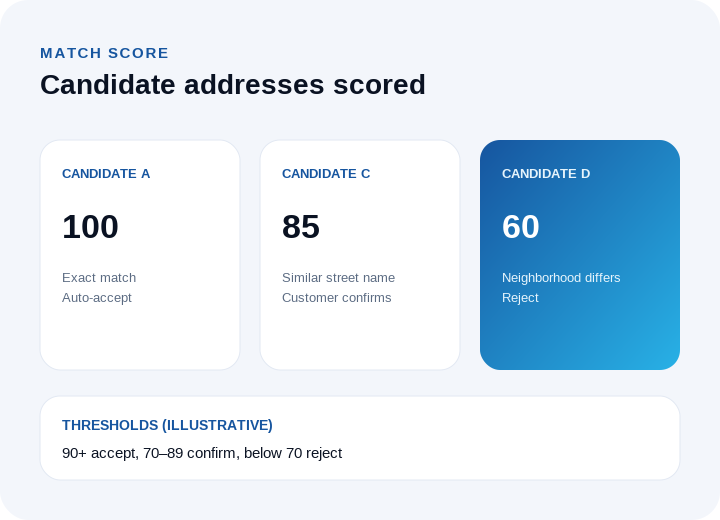
When comparing the entered address with candidates in the reference, use a weighted score instead of a plain "matched or not". In delivery, the neighborhood and the street matter most, so the example weights are neighborhood 40, street 30, building 20 and district 10 (100 in total). Each field scores 1 (exact), 0.5 (similar) or 0 (no match).
| Candidate | Neighborhood (40) | Street (30) | Building (20) | District (10) | Score |
|---|---|---|---|---|---|
| A | 1 = 40 | 1 = 30 | 1 = 20 | 1 = 10 | 100 |
| C | 1 = 40 | 0.5 = 15 | 1 = 20 | 1 = 10 | 85 |
| B | 1 = 40 | 1 = 30 | 0 = 0 | 1 = 10 | 80 |
| D | 0 = 0 | 1 = 30 | 1 = 20 | 1 = 10 | 60 |
The decision rule (illustrative): 90 and above is accepted automatically, 70 to 89 needs customer or human confirmation, below 70 is rejected. The best candidate must also lead the runner-up by at least 10 points. In the example A leads C by 15 points and passes automatically with 100. If only C and B were left, the gap would be 5; with 85 and 80 so close, the system does not guess and asks the customer. D stays at 60 because the neighborhood does not match: even if street and building agree, delivery to the wrong neighborhood is a well-known carrier error.
How Do You Detect Duplicate Addresses?
The same address can be written differently: "Gul Sk. No:12 D:5 Kadikoy" and "gul sokak 12/5 kadikoy". After standardization and character folding both produce the same key: gul sokak|12|5|kadikoy. Grouping by key reduces 500 address records in the example table to 410 unique addresses; 90 records, or 18%, are duplicates.
A duplicate address is not a problem, it is information: if five customer records point to the same address it may be an apartment building, or the same person recorded repeatedly. Matching at the customer-record level (name, email, phone) is a separate subject, covered in our master data management guide. Here the address is only a supporting field.
How Does Address Quality Affect Delivery Cost?
A bad address creates cost in three places: re-shipping, the return leg and customer support. Example: 10,000 shipments a month, 3% undeliverable because of the address, that is 300 shipments. The illustrative cost per failed shipment is 180 liras: 95 for re-shipping, 55 for the return and 30 for support. Monthly loss: 300 x 180 = 54,000 liras.
After validation the rate falls to 1.2%: 120 shipments, 120 x 180 = 21,600 liras. The difference is 32,400 liras. We described ways to lower shipping fees separately in our shipping cost guide; address quality belongs on that list and does not replace tariff negotiation.
Address failures also touch stock and returns: if a returned parcel re-enters stock without control, inventory drifts. The flow for returned shipments is covered in our returns management guide.
Coordinates, International Addresses and Address History
A map coordinate is an extra way to validate: you check that the text and the coordinate fall in the same neighborhood, and you can give the courier a pin. But coordinates and location data may count as personal data; consult your legal counsel on purpose and retention.
An international address has no district and neighborhood structure; province, postal code and line order change by country. If you sell abroad, keep the field schema flexible by country and apply the Turkish rules only to Turkish addresses.
Address history should also be recorded. When a customer moves, do not delete the old address; keep a valid-from and valid-to date. The address at order time is stored as a separate copy in the order record, so changing the customer address later does not break the delivery record of an old order.
An Address Is Personal Data: Access and Masking
An address combined with a name and phone number identifies a person. Let only the roles that need the address (shipment preparation, customer service) see it; in reports and test environments use province and district level or a masked value instead of the full address. For masking methods see our data masking guide, and for role design our role-based access control guide. For the details of data protection obligations, work with your legal counsel.
Which Metrics Track Address Quality?
Four measures are enough. The example values use the 2,000-address month above.
| Metric | Formula | Example |
|---|---|---|
| Validated address share | (automatic + confirmed + corrected) / total | (1,600 + 260 + 100) / 2,000 = 98% |
| Correction rate | (customer confirmations + human corrections) / total | (260 + 100) / 2,000 = 18% |
| Unverified share | marked "could not be verified" / total | 40 / 2,000 = 2% |
| Address-caused failure | address-related undeliverable / shipments | 300 / 10,000 = 3% to 120 / 10,000 = 1.2% |
Also track the free-text share: the proportion of entries that skipped field splitting is a leading indicator of quality. For turning measures into indicators, the leading versus lagging distinction in our KPI guide helps.
How Is an Address Validation Project Set Up and What Is the Payback?
A six-step path is enough.
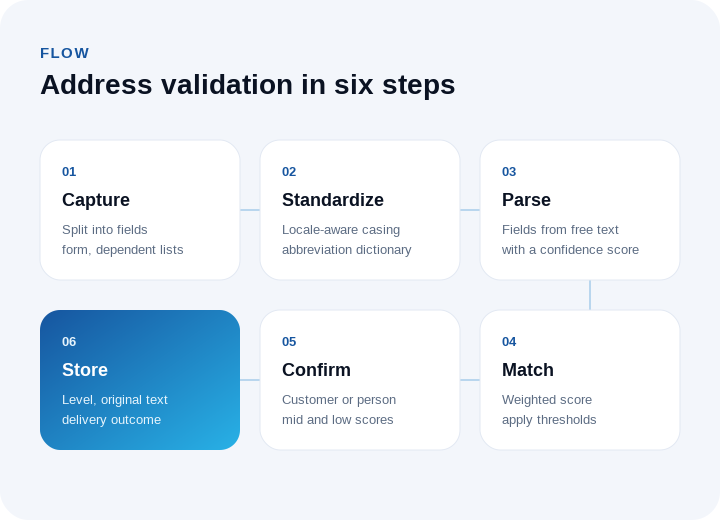
- Capture: Split the form into fields and use dependent lists for province, district and neighborhood.
- Standardize: Locale-aware casing, abbreviation dictionary, key generation.
- Parse: Split free text into fields and write a confidence score.
- Match: Compute the weighted score against the reference and apply the thresholds.
- Confirm: Route mid-score addresses to the customer and low-score ones to a person.
- Store and feed back: Keep the validation level, the original text and the delivery result; update the tables regularly.
Payback: monthly gain 32,400 liras. Monthly running cost for human review and table upkeep is 6,000 liras (in the example, 140 addresses x 3 min = 7 hours x 300 liras = 2,100 liras of review is included). Monthly net 32,400 - 6,000 = 26,400 liras. With a setup investment of 240,000 liras, payback is 240,000 / 26,400 = about 9.1 months. If the failure rate only falls from 3% to 2%, the gain is 100 x 180 = 18,000 liras, the net is 12,000 liras and payback takes 20 months. The value of the project depends on your real failure rate and shipment volume; measure your own number first.
We recommend reading: What is an order management system?
We recommend reading: What is API integration?
Integration and Shipping Processes with İnovabil
At İnovabil our focus is building software from scratch, specific to your company: custom software, ERP, CRM, e-commerce, web, mobile and integration. Address quality sits where order entry, shipping and warehouse processes meet; that is why we suggest writing down the address fields, the validation level and the data flow with the carrier during requirements analysis.
We built a prepaid cargo system for Kredili Kargo, logistics and shipment planning with wholesale order management for Karyak, shipment planning for Bofigo, and warehouse management for Sleepy. Describe your current order and delivery process in short; we will review the address flow with you and produce a written assessment.
We recommend reading: Our software development process: from analysis to release
Frequently Asked Questions
What is address validation?
It is splitting an entered address into fields, standardizing it and matching it against a reference to check that it corresponds to a real delivery point. The goal is to catch a bad address before the parcel is handed to the carrier.
Is a postal code enough to validate an address?
No. One postal code can cover several streets, and a code can be typed wrongly. The postal code is a helper field; you still need matching at neighborhood, street and building level.
Should I take addresses with selection lists or free text?
Use dependent selection lists for province, district and neighborhood, and add spelling suggestions to free entry for street and building. That prevents structural errors up front while keeping flexibility.
What should happen to a low-scoring address?
A mid-score address is shown to the customer as "Is this your address?", a low-score address goes to human review. If both are resolved before shipping, the cost of a failed shipment never arises.
Is address data personal data?
An address combined with a name and phone number can identify a person, so treat it as personal data. Tie access to roles, mask it in reports, and consult your legal counsel on the details of your obligations.