

You have no stock and no warehouse, yet products are selling on your site or marketplace. When an order arrives, a supplier packs the item and ships it, and you keep the difference. That is dropshipping in one sentence. Running it well means managing where the profit leaks, who holds the stock and how each order reaches the right supplier.
In this guide we cover how dropshipping differs from holding stock, the supplier stock and price feed, overselling risk, unit economics (contribution margin and break-even ad cost), order routing, multi-supplier carts, return responsibility, supplier scorecards and automation payback. All figures are representative and exclude VAT; they are not real prices, commission rates or industry averages.
What Is Dropshipping and How Does It Work?
Dropshipping is a retail model in which the seller does not keep the product in stock; after an order, the supplier ships the item to the customer. The customer buys from your store and pays you, and the product leaves the supplier's warehouse.
Your job is to publish products and prices, generate demand, route each order to the right supplier and run the customer relationship; storage, packing and dispatch sit with the supplier. For how to set up the store itself, see our guide to building an e-commerce website; here we cover only what is specific to this model.
We recommend reading: Our e-commerce development service
How Does Dropshipping Differ From Holding Your Own Stock?
The difference is who holds the stock and the cash. In classic retail you buy first and sell later; in dropshipping you sell first and buy later.
| Topic | Holding stock | Dropshipping |
|---|---|---|
| Stock owner | You | Supplier |
| Payment order | Purchase first, sale later | Sale first, supplier payment after |
| Capital needed | High; stock ties up cash | Low; only a short financing gap |
| Unit margin | Higher with volume discounts | Lower at supplier prices |
| Packing and dispatch | You | Supplier |
| Stock visibility | Your own system | As reported by the supplier |
| Dead-stock risk | You | Supplier |
| Delivery and quality control | You | Indirect; depends on the supplier |
A representative example shows when each model pays off. The selling price is ₺1,000. With your own stock, wholesale cost is ₺540, storage and packing ₺35 and your contracted shipping ₺55. In dropshipping, supply cost is ₺620 and shipping ₺70. In both, channel and payment commission is 12% (₺120) and the expected return cost is ₺12.
- Own-stock contribution: 1,000 − 540 − 120 − 55 − 35 − 12 = ₺238.
- Dropshipping contribution: 1,000 − 620 − 120 − 70 − 12 = ₺178. The gap is ₺60 per order.
- Capital tied up (400 orders a month): With 45 days of stock: 400 × ₺540 × 45 ÷ 30 = ₺324,000. In dropshipping the supplier is paid with the order and the channel pays out in 7 days: 400 × ₺620 × 7 ÷ 30 ≈ ₺57,867. Difference ≈ ₺266,133.
- Cost of capital: At an assumed 3% a month, about ₺19.96 per order (₺665.33 × 0.03).
Holding stock therefore nets 60 − 19.96 = ₺40.04 more per order. If the warehouse and team cost ₺12,000 a month, break-even is 12,000 ÷ 40.04 ≈ 300 orders a month: at 400 orders own stock is ahead by ₺4,016 (40.04 × 400 − 12,000), while at 200 orders dropshipping wins. Dead-stock risk is not included. Dropshipping is a good way to test demand; once volume settles, recalculate the model.
How Do You Set Up a Supplier Stock and Price Feed?
The supplier's stock and price data should reach your system automatically, regularly and with validation. A manually updated spreadsheet is the most common source of trouble in dropshipping.
- Feed type: A supplier interface (API), a file or event notifications. Events are near real time, files are periodic; the difference is covered in our webhook guide.
- Matching: The supplier's item and yours are linked by one key (barcode or internal code); unmatched rows never go live.
- Price rule: The selling price is calculated from the supply price, not typed by hand, and the new price is held within lower and upper limits.
A supplier price rise is the critical case. If supply cost goes from ₺620 to ₺650, contribution falls from ₺178 to ₺148 (−16.9%). To protect it, the new price must be (178 + 650 + 70 + 12) ÷ (1 − 0.12) = 910 ÷ 0.88 ≈ ₺1,034.09: a ₺30 cost rise needs a ₺34.09 price rise because of the commission share. To enrich supplier data rather than copy it, see product information management; for pricing logic, price optimization.
How Do You Prevent Overselling in Dropshipping?
The stock is not yours, and the supplier also sells the same item elsewhere. Consumption you cannot see can drain the stock faster than the figure you published, and the gap becomes cancelled orders.
A representative example: the supplier shows 40 units, your sales rate is 4 an hour and the supplier's other channels sell 8 an hour. Total consumption is 12 units an hour, so the stock runs out in about 40 ÷ 12 ≈ 3.3 hours. As the sync interval grows, overselling changes like this.
| Sync interval | Total consumption in the interval | Remaining (40 − consumption) | Oversold |
|---|---|---|---|
| 1 hour | 12 | 28 | 0 |
| 2 hours | 24 | 16 | 0 |
| 4 hours | 48 | −8 | 8 orders |
| 6 hours | 72 | −32 | 32 orders |
The protective rule: published stock = supplier stock − other-channel rate × interval − safety margin. The safety margin is your own rate × the interval: 40 − 8 × 1 − 4 = 28 units. The same logic gives a shut-off threshold: when supplier stock falls to total rate × interval = 12 × 1 = 12 units, close the item for sale (12 − 8 − 4 = 0).
If the supplier will not tell you the other-channel rate, infer it from the stock change: if stock fell from 52 to 40 in one hour and you sold 4, the other channels pull (52 − 40 − 4) ÷ 1 = 8 units an hour. Rates multiply on campaign days, so leave headroom. For the marketplace side, see marketplace integration.
How Are Unit Economics Calculated in Dropshipping?
You cannot plan ad spend without knowing what each order earns before advertising (the contribution margin). It is the selling price minus supply cost, commission, shipping and expected return cost.
- Selling price ₺1,000, supply ₺620, commission 12% = ₺120, supplier shipping (free to the customer) ₺70.
- Return rate 8%, net loss per return ₺150; expected cost 0.08 × 150 = ₺12.
- Contribution margin: 1,000 − 620 − 120 − 70 − 12 = ₺178 (17.8%).
- Break-even ad cost: at most ₺178 per order. Break-even ROAS: 1,000 ÷ 178 ≈ 5.62; any return below that loses money.
- Target of 5% net profit: ads at most 178 − 50 = ₺128; target ROAS 1,000 ÷ 128 ≈ 7.81.
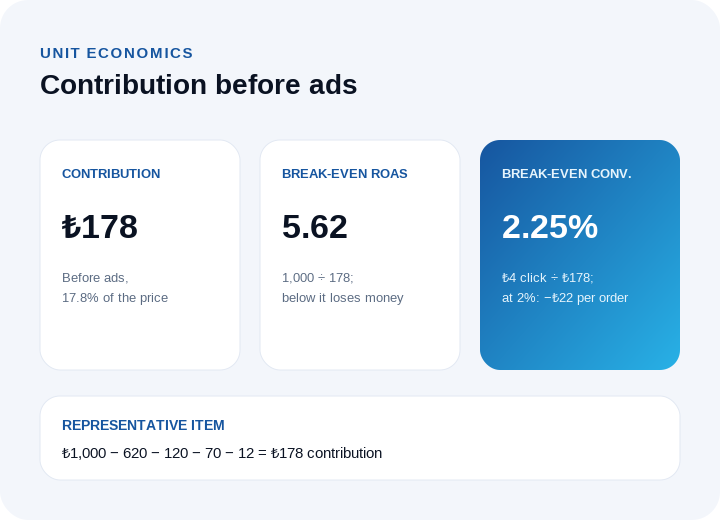
Ad cost depends on the conversion rate. If a click costs ₺4, ad cost per order is 4 ÷ conversion; break-even conversion is 4 ÷ 178 ≈ 2.25%. If all 400 monthly orders come from ads:
| Conversion | Ad cost per order | Net per order | Monthly, 400 orders |
|---|---|---|---|
| 1.5% | ₺266.67 | −₺88.67 | −₺35,467 |
| 2.0% | ₺200.00 | −₺22.00 | −₺8,800 |
| 3.0% | ₺133.33 | +₺44.67 | +₺17,867 |
| 4.0% | ₺100.00 | +₺78.00 | +₺31,200 |
A half-point move in conversion flips the result from profit to loss, so tie ad spend to a per-product break-even. For the shipping line, see how to reduce shipping costs.
How Is an Order Routed to the Supplier?
After payment is confirmed, the order is split into lines, sent automatically to the right supplier, and the supplier's confirmation is awaited. If no confirmation arrives, the order drops into an alert queue.
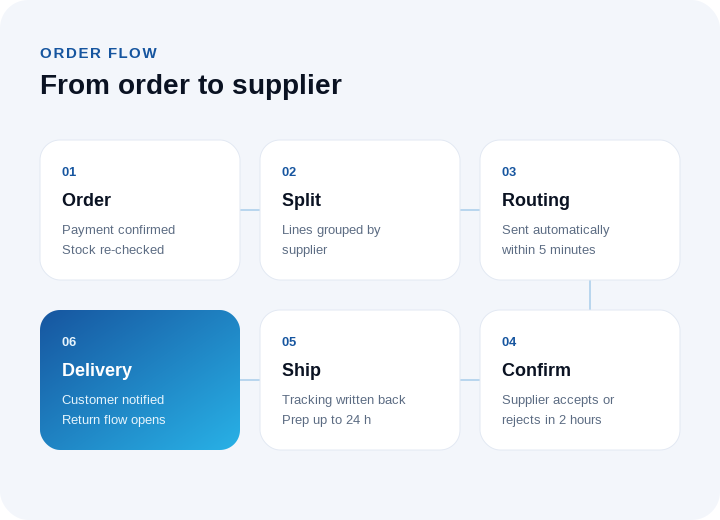
Take representative timings: manual routing waits 4 hours on average, automatic routing 5 minutes; supplier confirmation takes 2 hours and preparation and handover 24 hours.
- Manual: 4 + 2 + 24 = 30 hours.
- Automatic: 5 ÷ 60 + 2 + 24 ≈ 26.1 hours. A saving of about 3.9 hours, roughly 13%.
The lesson: automating routing shortens lead time only a little; the supplier's preparation time sets most of it. So when you promise delivery, look at the distribution of late orders, not only the supplier's average. Every step should show its status on the order, and the tracking number should be written back to the customer and the marketplace. Multichannel order logic is in our order management system guide, and writing tracking back in what is shipping integration.
How Do You Handle a Cart With Several Suppliers?
If a cart holds items from different suppliers, the order is split by supplier; each package has its own shipping, tracking number and delivery date. This affects both cost and customer experience.
A representative cart: two items from supplier A priced ₺1,000 and ₺400 (supply ₺620 + ₺250), and one ₺600 item from supplier B (supply ₺380). Total sales ₺2,000, supply ₺1,250, commission 12% = ₺240, shipping A ₺70 + B ₺60 = ₺130, expected returns ₺12 × 2 = ₺24 for two packages.
- Contribution: 2,000 − 1,250 − 240 − 130 − 24 = ₺356 (17.8%). In one package (shipping ₺70, same ₺24 returns) it would be ₺416 (20.8%); the split costs ₺60.
- Partial cancellation: If B is out of stock and the ₺600 line is cancelled, the remainder is sales ₺1,400, supply ₺870, commission ₺168, shipping ₺70, returns ₺12: contribution ₺280. B's line was worth ₺76.
- Delivery promise: Based on the slowest supplier; if A takes 3 days and B 5 days, promise 5.
Who Is Responsible for Returns in Dropshipping?
Toward the customer you are the seller; the split of responsibility with the supplier is set by contract. Consumer rights, return periods and liability are legal matters; consult your legal counsel. On the software side, written answers to these questions are needed.
| Scenario | Who decides the return? | Where does the item go? | Step needed in software |
|---|---|---|---|
| Customer changed their mind | Seller, under the contract and rules | Address stated in the contract | Return request, supplier notice, status tracking |
| Damaged item | Seller; opens a claim with the supplier | Supplier or seller | Photo and description, claim back to the supplier |
| Wrong item shipped | Seller; flags it as a supplier error | Supplier | Error reason record, reflected in the supplier score |
| Supplier ran out of stock | Seller (cancellation and refund) | None | Partial cancellation, refund, customer notice |
For the return process itself, approval rules and root-cause analysis, see our returns management guide.
How Do You Evaluate a Dropshipping Supplier?
Measure a supplier by total cost to you, not by unit price. Five indicators are enough: confirmation time, stock accuracy, on-time dispatch, supplier-caused cancellations and the rate of wrong or damaged shipments.
In the representative example each supplier handled 200 orders. Score = 50% × on-time dispatch + 30% × (100 − cancellation rate) + 20% × (100 − defect rate).
| Supplier | On-time dispatch | Cancelled | Defective | Score | Hidden cost per order |
|---|---|---|---|---|---|
| A | 188 ÷ 200 = 94.0% | 4 = 2.0% | 6 = 3.0% | 95.8 | ₺16 |
| B | 170 ÷ 200 = 85.0% | 14 = 7.0% | 10 = 5.0% | 89.4 | ₺34 |
| C | 196 ÷ 200 = 98.0% | 2 = 1.0% | 4 = 2.0% | 98.3 | ₺10 |
Hidden cost assumes ₺200 per cancellation (compensation and channel rating) and ₺400 per defective shipment. B: 14 × 200 + 10 × 400 = ₺6,800, or ₺34 per order; C: 2 × 200 + 4 × 400 = ₺2,000, or ₺10 per order. The gap is ₺24: unless B's product is at least ₺24 cheaper per order than C's, B is the more expensive supplier. The scores look close, but the cost gap is clear. For more, see supplier risk management and the supplier portal.
When Does Dropshipping Automation Pay Back?
The return grows linearly with order volume, while the running cost is fixed. A representative example: 400 orders a month.
- Labor: Manual routing takes 3 minutes per order: 400 × 3 = 1,200 min = 20 hours. With automation 5% are exceptions: 20 × 3 = 60 min = 1 hour. Saving 19 hours × ₺300 = ₺5,700.
- Misrouted orders: 2% to 0.5%: 2 instead of 8 orders, 6 orders × ₺350 = ₺2,100.
- Oversold cancellations: 1.5% to 0.5%: 2 instead of 6, 4 × ₺200 = ₺800.
Gross gain is 5,700 + 2,100 + 800 = ₺8,600 (₺21.5 per order). With ₺2,000 a month running cost the net is ₺6,600; with a ₺96,000 investment, payback is 96,000 ÷ 6,600 ≈ 14.5 months. If the gain halves, net is 4,300 − 2,000 = ₺2,300 and payback is about 41.7 months. At 100 orders a month the gross is ₺2,150, net ₺150 and payback takes 640 months. At low volume a simple flow makes more sense.
What Mistakes Are Common in Dropshipping?
- Advertising without knowing the contribution margin: if conversion is below break-even, every order loses money.
- Syncing stock too rarely: overselling turns into cancellations and lost customers.
- Not passing supplier price rises on: forgetting the commission share leaves the margin under-protected.
- Relying on one supplier and leaving return responsibility unwritten: a stock-out halts sales, and the cost stays with the seller.
We recommend reading: How to build an e-commerce website: platform, payment, shipping and break-even guide
We recommend reading: How to Manage Backorders: Line Status, Priority, Split Shipments and Fill Rate Guide
Custom E-Commerce and Integration Software With İnovabil
At İnovabil our focus is building software from scratch, specific to each company: custom software, e-commerce, ERP, CRM, web, mobile and integration. Pieces such as the supplier stock feed, order routing and write-back change with each company's suppliers and rules, so we put them in writing during requirements and design them as integrations that fit.
We built a prepaid shipping system for Kredili Kargo, logistics and shipment planning with wholesale order management for Karyak, and warehouse management for Sleepy; for Avcılar İnşaat we delivered CRM, purchasing and mobile. Send us a short summary of your supplier count, order volume and current setup, and we will scope the integration together.
We recommend reading: Our integration service
Frequently Asked Questions
What is dropshipping, in short?
It is a model where the seller sells without holding stock. The customer orders from and pays the seller; the seller routes the order to the supplier, who packs and ships it. The earnings are the gap between the selling price and supply and other costs.
How does dropshipping make a profit without stock?
Through the contribution margin: from the selling price you subtract supply, commission, shipping and expected returns. In the example the contribution is ₺178; if ad cost stays below that, a profit remains.
What is the biggest risk in dropshipping?
Dependence on the supplier and delayed stock data. The item you sold may be gone at the supplier, which means oversold orders, cancellations and unhappy customers. Frequent stock sync and a published-stock buffer reduce the risk.
Who is responsible for returns and warranty in dropshipping?
Toward the customer it is generally the seller; the split with the supplier depends on the contract. Consult legal counsel for the details. In software, record the return reason and the responsible party.
At how many orders is dropshipping automation worth it?
In the example, at 400 orders a month the investment pays back in about 14.5 months; at 100 orders it takes about 640. If volume is low, start with a simple flow and automate as orders grow.