

Updating a bill of materials when a part changes is easy. The hard part is seeing what that change does to the old parts in the warehouse, the open work orders, the purchase orders still on the way and the product cost. In a manufacturing business, BOM revision and engineering change management means every change to a bill of materials is recorded: who changed it, why, from which date and with what impact. Unmanaged changes come back as two different parts mixed up on the shop floor and products built to the wrong revision.
This guide covers the revision code and effectivity date, the flow from change request to change order, impact analysis, the where-used query, cut-in strategies, substitute parts, consistency between BOM, routing and cost, the audit trail, and a worked example that prices a wrong-revision build. All figures are illustrative; they are not benchmarks for any company or industry. For the basics of BOMs and MRP, see our production planning guide; we do not repeat them here.
What Is a BOM Revision?
A revision is a recorded, numbered version of the same bill of materials. Each revision has a code (A, B, C or 01, 02), an effectivity start and usually an end; for one product, only one revision should be active at any moment.
When to bump the revision code is a rule you must set. A common split: a change that affects form, fit or function opens a new revision; a typo fix or an added note does not.
| Field | Example | Why it matters |
|---|---|---|
| Revision code | M1 / Rev C | Separates which version was built |
| Effectivity start | Date or serial no. | Draws the line between old and new |
| Effectivity end | Start of the next revision | Prevents overlapping revisions |
| Change order no. | ECO-0142 | Links the version to its reason |
| Status | Draft, approved, active, inactive | Keeps draft BOMs out of production |
What Are ECR and ECO, and How Does the Change Flow Work?
An ECR (engineering change request) says "we want to change this"; an ECO (engineering change order) is an approved change that will be carried out. Separating the request from the order stops every idea from landing on the shop floor.
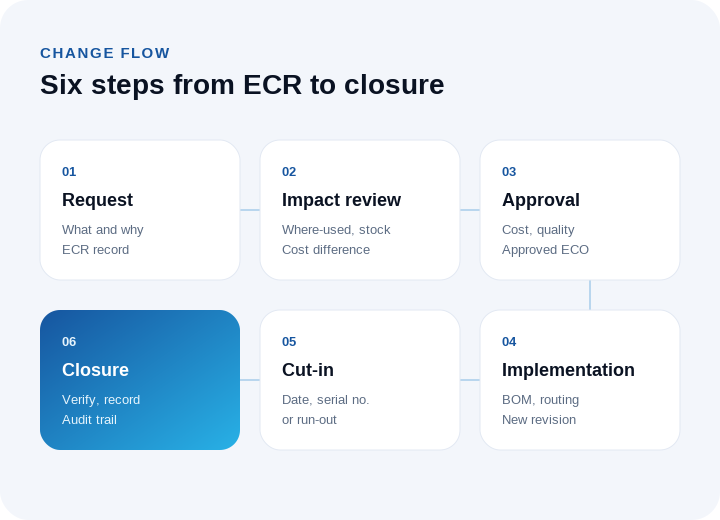
| Stage | Question asked | Output |
|---|---|---|
| Request (ECR) | What changes, and why? | Request record with reason |
| Impact analysis | What does it affect, and what does it cost? | Impact report and cost difference |
| Approval | Is it worth it, and who decides? | Approved ECO |
| Implementation | Are BOM, routing and documents updated? | New revision (draft) |
| Cut-in | When does it take effect? | Effectivity date or serial no. |
| Closure | Was it really carried out? | Verification and record |
At approval, who decides what depends on amount and risk: a change that affects cost goes to finance, and one with a safety or compliance effect goes to the quality owner. We cover approval chains, thresholds and delegation in our workflow approval guide. If you classify changes as urgent, normal and planned, even the urgent ones stay on the record; they simply follow a shorter approval path.
We recommend reading: Our ERP development service
How Do You Analyze the Impact of a Change?
Impact analysis answers "who is affected?" before you approve the change. You look at four areas: stock, open work orders, open purchases and customer orders.
| Area | What you check | Decision |
|---|---|---|
| Stock | On-hand quantity and value of the old part | Consume, return or scrap |
| Open work orders | Orders released on the old revision with material already issued | Finish on the old one or reissue |
| Open purchases | Orders for the old part already placed or in transit | Cancel, redirect or accept |
| Customer orders | Orders whose contract names the old revision | Get customer approval, notify |
| Service and spares | Spare parts for products in the field | Keep the old part for service |
Done by hand, finding where a part appears in the product tree is often the longest task; the query in the next section shortens it. For the on-hand value, the counting and valuation logic in our inventory tracking guide is enough.
How Do You Run a Where-Used Analysis in a Multi-Level BOM?
Where-used reads the product tree from the bottom up: which assemblies contain this part, and which finished products contain those assemblies? In a multi-level BOM the impact does not stop at the direct parent.
For example, a connector coded P-14 appears in three sub-assemblies, and those link to three finished products (illustrative):
| Level | Item | Usage | Total P-14 per finished product |
|---|---|---|---|
| Level 1 | Assembly M1 | 2 pcs | — |
| Level 1 | Assembly M2 | 1 pc | — |
| Level 1 | Assembly M3 | 4 pcs | — |
| Level 2 | Product F1 (1 × M1 + 1 × M2) | — | 2 + 1 = 3 pcs |
| Level 2 | Product F2 (2 × M1) | — | 2 × 2 = 4 pcs |
| Level 2 | Product F3 (1 × M3) | — | 1 × 4 = 4 pcs |
If the query showed only M1, the old part would stay in the M2 and M3 BOMs. A good query returns both the levels and the quantity multipliers (total pieces per finished product).
When Does a Change Take Effect? Cut-In Strategies
The right cut-in point depends on why the change is being made. There are four common routes.
| Strategy | How it works | When it fits |
|---|---|---|
| Date cut-in | Work orders opened after a date take the new revision | Planned improvement, supplier change |
| Lot / serial number cut-in | New revision from a given serial number onward | When traceability in the field is needed |
| Run-out | Old BOM until the old part is used up, then the new one | When there is no safety or compliance issue |
| Immediate | Use of the old part stops now | Safety, compliance or serious quality issue |
Open work orders need their own rule. A common practice: a work order locks the BOM revision that is current when it is released; a revision that takes effect later affects only new orders. Otherwise the BOM changes in the middle of the shop floor, and two different parts end up in the same order.
How Do You Calculate Old and New Part Stock and Scrap Cost?
Immediate switch or run-out? A calculation settles it. Illustrative example: connector P-14 costs ₺18, and the new P-22 costs ₺16, so the reason for the change is cost improvement, not safety.
- Daily consumption: M1 15 assemblies × 2 = 30, M2 12 × 1 = 12, M3 2 × 4 = 8; total 50 pcs/day.
- Old part: 800 in the warehouse, 300 on order that cannot be cancelled; total 1,100 pcs.
- Run-out time: 1,100 ÷ 50 = 22 days.
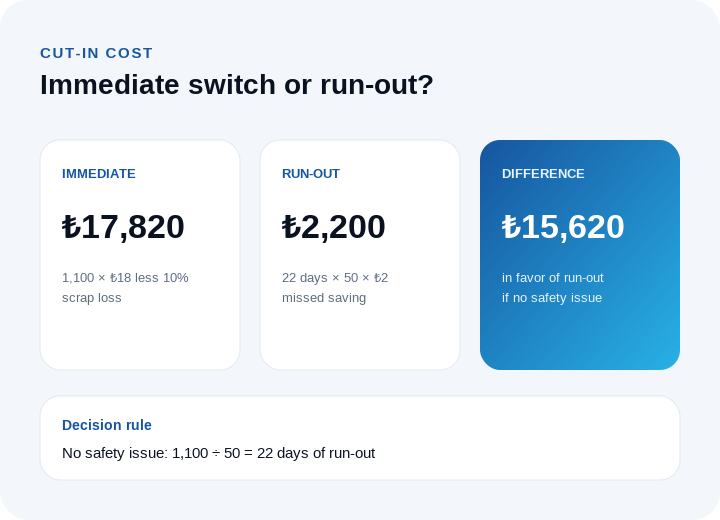
| Item | Immediate switch | Run-out (22 days) |
|---|---|---|
| Old part value: 1,100 × ₺18 | ₺19,800 | Consumed, no loss |
| Scrap recovery (10%) | −₺1,980 | — |
| Scrap loss | ₺17,820 | ₺0 |
| Delayed saving: 22 days × 50 × ₺2 | ₺0 | ₺2,200 |
| Total cost | ₺17,820 | ₺2,200 |
The difference is ₺17,820 − ₺2,200 = ₺15,620 in favor of run-out. If the part had a safety problem, the calculation would be moot and an immediate switch would be mandatory. In a run-out plan, give MRP the date too: if the new part is needed on day 22 and its lead time is 10 days, the new order must be placed by day 12 (22 − 10 = 12). Keeping the two parts on separate shelves with separate labels also reduces mix-ups.
What Is an Alternate or Substitute Part?
A substitute part is a defined alternative that may replace the primary part in a BOM. It differs from a revision in that it is not permanent: the primary part stays defined and the substitute is used only when needed.
- Two-way substitute: The two parts are interchangeable (same form, fit and function).
- One-way substitute: The new part can replace the old one, but not the other way round.
- Temporary alternate: Defined with a date range for the duration of a supply problem.
Substitute use must be on the record. If you cannot see which part was actually used in which work order, you cannot know what is inside a product in the field. When material is sent to an outside processor, the revision that went out is tracked too; we cover that in our subcontract manufacturing guide.
How Do BOM, Routing and Cost Stay Consistent?
When a part changes, more than the BOM changes: assembly time (routing) and standard cost can be affected too. In our example, fitting P-22 takes less time per connector: on M1, 2 pcs × 45 sec = 90 sec becomes 2 × 35 sec = 70 sec, a 20-second gain. At a labor rate of ₺360/hour = ₺0.10/sec, 20 sec = ₺2.00.
| Item | P qty | Material difference | Labor difference | Total |
|---|---|---|---|---|
| Assembly M1 | 2 | −₺4 | −₺2 | −₺6 |
| Assembly M2 | 1 | −₺2 | ₺0 | −₺2 |
| Assembly M3 | 4 | −₺8 | ₺0 | −₺8 |
| Product F1 (M1 + M2) | — | — | — | −₺8 (₺2,450 → ₺2,442, 0.33%) |
| Product F2 (2 × M1) | — | — | — | −₺12 (₺3,100 → ₺3,088, 0.39%) |
| Product F3 (M3) | — | — | — | −₺8 (₺1,900 → ₺1,892, 0.42%) |
When the standard cost changes, the old part in stock is revalued too: 800 pcs × (₺18 − ₺16) = ₺1,600 is booked as a price variance. If the routing is not updated, planning works with the old time; if the cost is not updated, the margin looks wrong. We walk through how cost is built in our product cost guide. To track which revision was actually built on the shop floor, see our manufacturing execution system (MES) guide.
Why Do Change History and the Audit Trail Matter?
An audit trail records every change: who, when, why and with which old and new values. When a product causes trouble in the field, being able to answer "which revision was this built to?" within minutes depends on it.
- Field-level record: Which line changed, and which quantity or part.
- Traceability: Going back from a serial or lot number to the work order, and from the work order to the revision.
- Rollback: The old revision is never deleted, only deactivated, so it can be reactivated if needed.
- Authority: Editing an active BOM directly is restricted; changes go only through an ECO.
For the traceability and record-retention details of industry standards and certifications, consult the relevant specialist or auditor; this article does not go into them. To link nonconformance and corrective action records to a BOM change, read our quality management software guide.
What Does a Wrong-Revision Build Cost, and When Does Change Management Pay Back?
The cost of building to the wrong revision depends on where the mistake is caught. Illustrative scenario: assembly M1 was built with the old part for three days (3 × 15 = 45 units). 35 units were caught in the warehouse and reworked: disassembly and rework 1.5 h × ₺300 = ₺450. 10 units had already shipped: ₺450 for rework plus ₺1,800 for recall (freight and service), which is ₺2,250.
Incident cost: 35 × ₺450 + 10 × ₺2,250 = ₺15,750 + ₺22,500 = ₺38,250.
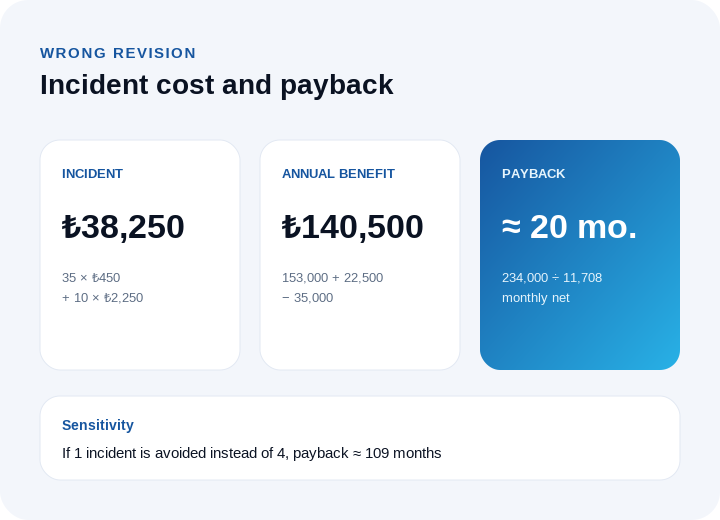
| Item | Calculation | Amount (annual) |
|---|---|---|
| Incidents avoided | (6 − 2) × ₺38,250 | ₺153,000 |
| Impact analysis time saved | 30 ECOs × (4 − 1.5) h = 75 h × ₺300 | ₺22,500 |
| System running cost | — | −₺35,000 |
| Net annual benefit | 153,000 + 22,500 − 35,000 | ₺140,500 |
Monthly net benefit is ₺140,500 ÷ 12 ≈ ₺11,708. If the setup investment is 26 person-days × ₺9,000 = ₺234,000, payback is 234,000 ÷ 11,708 ≈ 20 months. The result is sensitive to incident frequency: if only 1 incident is avoided instead of 4, net benefit falls to 38,250 + 22,500 − 35,000 = ₺25,750 and payback stretches to about 109 months. In other words, change management earns its keep where wrong-revision incidents actually happen; count your own history and recalculate. The labor saving (₺30/day) is deliberately left out of this calculation.
How Do You Set Up Change Management in Six Steps?
- BOM inventory: Write down which BOMs are active, the revision code and the effectivity rule; keep one active revision per product at a time.
- Classes and approval matrix: Define urgent, normal and planned classes and who approves what.
- Impact report: Combine the where-used query with stock, open work order, open purchase and order impact in one report.
- Effectivity and lock: Define date, serial number and run-out options in the system; lock the revision when a work order is released.
- Routing and cost match: Make the routing and standard cost update mandatory before an ECO can close.
- Pilot and audit trail: Try it with one product family for 4–6 weeks; test the question "which serial was built to which revision?"
What Mistakes Are Common in Change Management?
- Correcting the active BOM directly: History and reasons disappear; old work orders get misread.
- Skipping where-used: One assembly is updated while the others keep asking for the old part.
- Forgetting open work orders: A BOM changes mid-order, or the order carries on with the old part.
- Not updating routing and cost: Plans and margins stop reflecting reality.
- Not separating the old part physically: Shelf-level confusion causes errors that no software can prevent.
- Ignoring service parts: No spares remain for products still running the old version in the field.
We recommend reading: What Is Production Capacity Planning and Bottleneck Analysis? Effective Capacity, Load Ratio and Lead-Time Guide
We recommend reading: Bundle Inventory Management: How to Handle Kits, Virtual Bundles, Price Allocation and Partial Returns
BOM and Process Software with İnovabil
At İnovabil, our focus is building software from scratch, tailored to the company: custom software, ERP, CRM, e-commerce, web, mobile and integration. If you need something like BOM revision and change management, we suggest writing it down in requirements analysis together with change classes, approval steps, effectivity rules and the link to routing and cost; we do not claim to offer a separate product or a ready-made PLM solution.
We have built CRM, purchasing and mobile for Avcılar İnşaat; a purchasing system for İZBAN; logistics and shipment planning with wholesale order management for Karyak; and warehouse management plus a complaint and support management system for Sleepy. Send us a short note describing your processes and we will clarify the need together and produce a written scope.
We recommend reading: Our software development process: from analysis to launch, step by step
We recommend reading: What is ERP and what is it for?
Frequently Asked Questions
What is a BOM revision?
A recorded version of the same bill of materials, with a code and an effectivity date. Every change opens a new revision and the old one is not deleted, so you can trace which product was built to which BOM.
What is the difference between an ECR and an ECO?
An ECR is a change request on which nothing has been decided yet; an ECO is an approved change order that will be carried out. Separating the request from the order stops every idea from reaching production and leaves room for impact analysis.
When should you choose a run-out strategy?
When the change carries no safety or compliance issue and the old stock is used up in a short time. In the example, 1,100 pcs ÷ 50 = 22 days; run-out is cheaper because the missed saving is ₺2,200 against a scrap loss of ₺17,820.
Why does where-used analysis matter?
It shows every use of a part across assemblies and finished products, with levels. If it is skipped, the change is applied in only one place and the other BOMs keep asking for the old part.
How are open work orders affected by a change?
If a work order locks its BOM revision when released, the new revision applies only to orders opened later. For open orders a separate decision is made: finish on the old revision or reissue.