

Sheet metal, fabric or a raw part leaves for an outside workshop; it comes back cut, sewn or painted. In the days in between, the material is not in your warehouse, but it is still yours. The "how much is left?" phone call and a hand-kept spreadsheet balance stop being enough at that point. Subcontract manufacturing tracking means recording and monitoring the material you send to the subcontractor, the work ordered, the product that comes back, and the gap in between.
In this guide we explain how subcontract (outsourced) manufacturing works, how to track the stock held at the subcontractor, how to calculate consumption, scrap and yield against the recipe, how to cost the work, how to handle acceptance and quality problems, delays and subcontractor performance, where the break-even sits between subcontracting and in-house production, and how to set up tracking in six steps. The sample figures are illustrative; they are not real prices or industry averages.
What Is Subcontract Manufacturing and How Does It Work?
Subcontract manufacturing means having one stage of a product's production (cutting, sewing, painting, coating, heat treatment and so on) done by an outside company. You usually supply the material; the subcontractor provides only labour and machine time. That is why two separate records are needed: the purchase record for the service bought from the subcontractor, and the stock movement for the material sent to it.
The process runs in six steps: a work order is opened, material is shipped, the subcontractor does the job, an interim check is made, the product is received and accepted, and finally material and fee are reconciled. Buying software development from an outside team is a different subject, which we cover separately in our software outsourcing guide. For the in-house production plan, see our production planning guide; a subcontract work order is the branch of that plan that leaves the building.
We recommend reading: How to do production planning
Who Owns the Stock at the Subcontractor and How Is It Tracked?
As long as you keep ownership of the material, the stock at the subcontractor belongs in your inventory. So a shipment is not an "issue out" but a "transfer from your warehouse to the subcontractor's warehouse"; it does not reduce your stock total, only changes its location. Opening a separate virtual warehouse for each subcontractor makes this easy to follow.
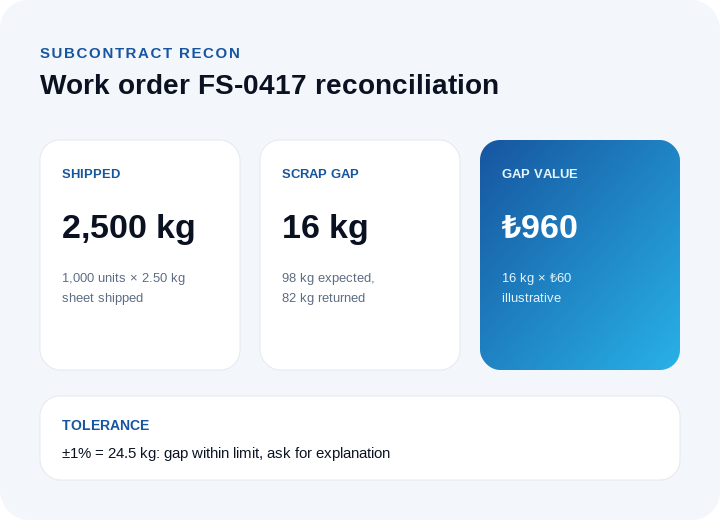
The reconciliation formula is: shipped = processed and returned + scrap returned + remaining at subcontractor + unexplained difference. The unexplained difference should be zero or inside a tolerance set in advance. In the illustrative work order FS-0417 below, 2,500 kg of sheet was shipped for a 1,000-unit panel order. Recipe: 1 panel needs 2.40 kg net, standard loss is 4%, so gross consumption is 2.40 ÷ (1 − 0.04) = 2.50 kg per unit.
| Item | Calculation | Quantity |
|---|---|---|
| Sheet shipped | 1,000 × 2.50 | 2,500.0 kg |
| Accepted and returned | 968 units × 2.40 | 2,323.2 kg |
| Rejected, being reworked at the subcontractor | 12 units × 2.40 | 28.8 kg |
| Not processed, still at the subcontractor | 20 units × 2.50 | 50.0 kg |
| Scrap returned | weighed | 82.0 kg |
| Unexplained difference | 2,500 − 2,484 | 16.0 kg |
For the 980 units processed, the expected scrap is 980 × 0.10 = 98 kg; only 82 kg came back, so 16 kg is missing. At ₺60 per kilogram, that is 16 × ₺60 = ₺960. If the tolerance is ±1% of the material consumed (2,450 × 0.01 = 24.5 kg), the gap is inside the limit; you still ask the subcontractor for an explanation. The 78.8 kg that remains there (28.8 + 50) should show in your inventory as ₺4,728 of material value. For stock routines across the warehouse, see our inventory tracking guide and inventory counting guide; stock at the subcontractor belongs in the count too.
How Are Consumption, Scrap and Yield Calculated Against the Recipe?
The quantity of material sent comes from the recipe: net consumption plus standard scrap. Yield shows how much of the material used turned into product: yield = net material processed ÷ material consumed.
- Material consumed: shipped − unprocessed remainder at the subcontractor = 2,500 − 50 = 2,450 kg.
- Net material processed: 980 units × 2.40 = 2,352 kg.
- Yield: 2,352 ÷ 2,450 = 96.0%, the same as the standard yield (96%).
- Actual scrap: 2,450 − 2,352 = 98 kg, or 4.0%.
If scrap rises above the standard, there are two possibilities: the subcontractor is working inefficiently, or the recipe does not reflect reality. We covered recipe and MRP logic in our production planning article and unit cost in our product cost guide.
How Is the Cost of Subcontract Work Calculated?
Total subcontract cost has three components: material consumed, the subcontract labour fee and transport. The fee is usually agreed as labour per unit and, here, is paid on units accepted. Illustrative assumptions: sheet at ₺60/kg, a fee of ₺45 per unit (cutting, bending and painting included), and round-trip transport of ₺3,000.
| Item | Standard (968 units) | Actual | Variance |
|---|---|---|---|
| Material: 2,420 kg / 2,450 kg × ₺60 | ₺145,200 | ₺147,000 | +₺1,800 |
| Subcontract fee: 968 × ₺45 | ₺43,560 | ₺43,560 | ₺0 |
| Transport: ₺3 × 968 / ₺3,000 | ₺2,904 | ₺3,000 | +₺96 |
| Total | ₺191,664 | ₺193,560 | +₺1,896 |
Unit cost is 191,664 ÷ 968 = ₺198.00 at standard and 193,560 ÷ 968 ≈ ₺199.96 in practice. ₺1,800 of the variance comes from the material in the 12 rejected panels (30 kg × ₺60). The fee would have been ₺45,000 on the 1,000 units ordered but is ₺43,560 on the 968 accepted; the ₺1,440 difference equals 32 units. Who bears the cost of reworking rejected units is set by the contract; for legal detail consult your legal counsel, and for invoice and delivery-note arrangements consult your financial advisor (certified accountant).
How Are Delivery, Acceptance and Quality Problems Handled?
Returned goods are counted, inspected and only the accepted quantity enters stock. The acceptance rate is accepted ÷ inspected: 968 ÷ 980 = 98.8%. The delivery completion rate is 968 ÷ 1,000 = 96.8%.
- Partial acceptance: Accepted units enter stock; rejected units are logged as returned to the subcontractor or as rework.
- Nonconformance record: For each rejected lot, write the cause and the decision; a recurring cause goes on the agenda of the subcontractor review.
- Rework: The 12 rejected units stay at the subcontractor, and their material shows in the stock balance held there.
We explained acceptance criteria and the nonconformance flow in detail in our quality control and nonconformance management guide.
We recommend reading: What is quality management software?
How Do You Track Delays in Subcontract Work?
Delay should be tracked against the due date from the day the material ships; waiting for delivery day is already late. If the lead time is 10 working days, ask for a progress confirmation on day 3 and day 7. The cost of a delay does not show on the subcontractor's invoice; it shows on your line: delay cost = days late × daily waiting cost.
In the example, FS-0417 was delivered three days late. Because the assembly line uses 250 panels a day and idle time costs ₺8,000 a day, 3 × ₺8,000 = ₺24,000, which is 53.3% of the fee (24,000 ÷ 45,000). The ratio shows that the cheapest subcontractor is not always the cheapest. If there is a late-delivery penalty clause, how it applies depends on the contract; consult your legal counsel for detail.
How Is Subcontractor Performance Measured?
Three measures are enough: on-time delivery, acceptance rate and scrap performance. The scrap score is the standard scrap divided by actual scrap, capped at 100. The weights are illustrative: on-time delivery 40%, acceptance 40%, scrap 20%.
| Subcontractor | On time | Acceptance | Scrap score | Score |
|---|---|---|---|---|
| A: 18 of 20 lots; 4,850 of 5,000; scrap 4.1% | 90.0% | 97.0% | 97.6 | 94.3 |
| B: 15 of 20 lots; 4,950 of 5,000; scrap 3.8% | 75.0% | 99.0% | 100.0 | 89.6 |
| C: 10 of 10 lots; 1,840 of 2,000; scrap 5.5% | 100.0% | 92.0% | 72.7 | 91.3 |
The calculation for A, for example: 0.40 × 90 + 0.40 × 97 + 0.20 × 97.6 = 36 + 38.8 + 19.5 = 94.3. The highest-quality subcontractor, B, comes last because of delays; C is on time but weak on quality. The score gives you grounds for dividing work and for price talks. For the general framework of supplier evaluation, see our supplier portal guide and procurement software guide.
Subcontract or In-House? How Is the Break-Even Calculated?
Subcontracting is a variable cost, in-house production a fixed one. At low volume subcontracting wins; at high volume in-house production does. Illustrative assumption: the in-house line has a monthly fixed cost (depreciation, shifts, maintenance) of ₺30,000 and a variable cost of ₺30 per unit; subcontracting costs a ₺45 fee plus ₺3 transport per unit, so ₺48. Material is the same either way, so it stays out of the comparison.
| Monthly volume | Subcontract: 48 × units | In-house: 30,000 + 30 × units | Lower |
|---|---|---|---|
| 1,000 units | ₺48,000 | ₺60,000 | Subcontract |
| 1,667 units | ₺80,016 | ₺80,010 | Break-even |
| 3,000 units | ₺144,000 | ₺120,000 | In-house |
Break-even: 30,000 ÷ (48 − 30) ≈ 1,667 units a month. Cost alone does not decide; flexibility, quality control, capacity and dependence on the subcontractor count as well. For real-time monitoring of production on the shop floor, see our manufacturing execution system guide.
What Does Moving from Spreadsheets to a System Deliver?
Manual tracking builds up three losses: time, material gaps at the subcontractor, and delays noticed late. The monthly calculation below is illustrative: 40 subcontract work orders a month and ₺400,000 of material shipped.
- Labour: 30 minutes per work order by hand (40 × 30 = 1,200 min = 20 h), 10 minutes with a system (400 min ≈ 6.7 h); at ₺300 an hour the gain is (20 − 6.7) × ₺300 ≈ ₺4,000.
- Material gap: If loss falls from 1.2% to 0.4% of shipped value, ₺4,800 becomes ₺1,600, a gain of ₺3,200.
- Delay: If 6 delay days a month fall to 4 thanks to early warnings, the gain is 2 × ₺8,000 = ₺16,000.
Gross gain is ₺23,200; if the software running cost is ₺3,200, the monthly net is ₺20,000. With a ₺300,000 investment, payback is 300,000 ÷ 20,000 = 15 months. If the delay gain halves (₺8,000), the net is ₺12,000 and payback 25 months; measure your own delay cost before you do this calculation.
How Do You Set Up Subcontract Tracking? Six Steps
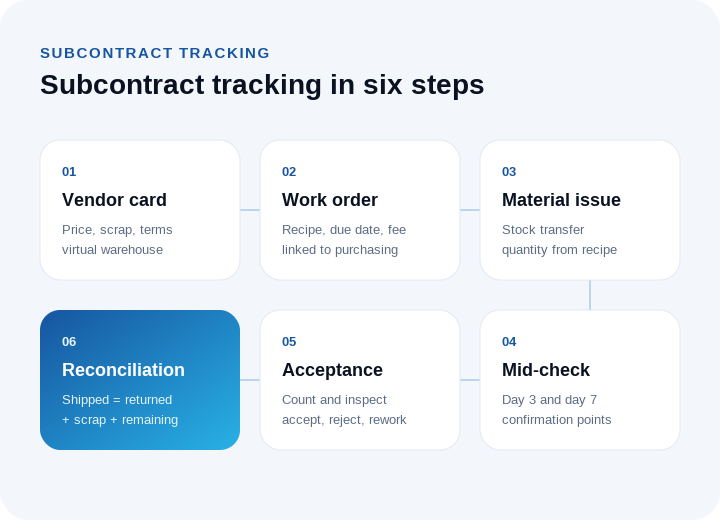
- Vendor card: Keep contact details, agreed price, standard scrap, lead time and acceptance criteria on one card, and open a virtual warehouse for each subcontractor.
- Subcontract work order: The work order states product, quantity, recipe, due date and fee, and is linked to a purchase order.
- Material issue: Record the shipment as a stock transfer; the quantity comes from the recipe, and your financial advisor decides the delivery-note arrangement.
- Mid-check: Set fixed confirmation points during the lead time, such as day 3 and day 7.
- Acceptance: Count and inspect returned goods; record acceptance, rejection and rework separately.
- Reconciliation: Sign off shipped, returned, scrap and remaining with the subcontractor; if the gap is outside tolerance, do not close the work order.
What Mistakes Are Common in Subcontract Tracking?
- Treating a shipment as an issue out: The material leaves your stock and the balance at the subcontractor becomes invisible.
- Reconciling once a year: The gap grows and its cause cannot be found; reconcile at the close of every work order.
- Not writing down standard scrap: With no tolerance, every gap becomes an argument.
- Not weighing the scrap: Expected scrap cannot be compared with returned scrap.
- Noticing delay on delivery day: With no mid-check, your own line has already been waiting.
- Depending on one subcontractor: A capacity problem or a drop in quality stops all production.
We recommend reading: What Is BOM Revision and Engineering Change Management? ECR, ECO, Cut-In and Cost Guide
We recommend reading: What Is Production Capacity Planning and Bottleneck Analysis? Effective Capacity, Load Ratio and Lead-Time Guide
We recommend reading: How to Manage Supplier Risk: Segmentation, Risk Scoring, Single-Source Dependency and Expected Loss Guide
We recommend reading: How to Track Scrap and Yield in Manufacturing: Mass Balance, Scrap Types, Standard Rates and Cost Guide
Custom Software for Production and Supply Processes with İnovabil
At İnovabil our focus is building software from scratch for your company: custom software, ERP, CRM, e-commerce, web, mobile and integration. We write requirements specific to a process, such as subcontract tracking, down during analysis and identify where they connect to your existing system. We do not sell an off-the-shelf product; the solution is designed around your process.
We have built CRM, purchasing and mobile for Avcılar İnşaat; a purchasing system for İZBAN; logistics and shipment planning with wholesale order management for Karyak; and warehouse management plus a complaint and support management system for Sleepy. Send us a short note describing your subcontract flow, and we will put the scope and data flow in writing together.
We recommend reading: Our software development process: step by step from analysis to launch
Frequently Asked Questions
What is subcontract manufacturing tracking?
It is recording and monitoring the material sent to a subcontractor, the work ordered, the product that comes back and the gap in between. The aim is to keep stock at the subcontractor, cost, lead time and quality under control.
Whose inventory does the stock at the subcontractor appear in?
If you retain ownership of the material, it appears in your inventory. For that, a virtual warehouse is opened under the subcontractor's name and the shipment is recorded as a transfer to it, not as an issue out of stock. For tax and delivery-note detail, ask your financial advisor (certified accountant).
How are subcontract scrap and yield calculated?
Yield is net material processed divided by material consumed; in the example, 2,352 ÷ 2,450 = 96.0%. Compare actual scrap with the standard scrap in the recipe; a variance points either to inefficiency at the subcontractor or to an error in the recipe.
Is subcontracting or in-house production cheaper?
It depends on volume. In the example, with a ₺30,000 monthly fixed cost, ₺30 in-house variable cost and ₺48 subcontracting, break-even is about 1,667 units; below it subcontracting is cheaper, above it in-house production is. Flexibility and quality also shape the decision.
Which measures track subcontractor performance?
On-time delivery, acceptance rate and scrap performance are a sufficient start. Combine the three into a weighted score; the score gives concrete grounds for dividing work and for price talks.