

When a sales rep says "we can deliver on Thursday", there should be a calculation behind that sentence. In many companies there is not: someone glances at the stock screen, asks the warehouse, and guesses. The result is broken promises, rush shipments and customer trust that erodes over time. A delivery date promise means counting on-hand stock, incoming orders, existing commitments and capacity together before you confirm an order, so that "how many, and by when" has a reasoned answer. The two main tools are ATP (available to promise) and CTP (capable to promise).
This guide shows how ATP is calculated, how cumulative ATP is used to promise an order, how CTP produces a delivery date when stock is not enough, how a working-day calendar fits in, how to handle priorities and partial shipments, how to measure the on-time-to-promise rate, and what the payback looks like, all on one illustrative product. Every figure is illustrative; none is a real company's data or an industry average.
What Is a Delivery Date Promise (ATP and CTP)?
A delivery date promise is the date you give a customer and commit to keeping. Three approaches answer the same question at different depths.
| Approach | What it looks at | When to use it |
|---|---|---|
| Fixed lead-time promise | Average lead time defined per product | Low-risk items whose stock position rarely changes |
| ATP | Stock, incoming orders, confirmed orders, safety stock | Stocked items; the answer must come instantly |
| CTP | ATP plus materials and bottleneck capacity | Make-to-order items or items where stock falls short |
A fixed lead time goes wrong the moment stock runs out. ATP looks at stock; CTP also looks at production. Stock accuracy is the foundation: if the record does not match reality, the best formula still produces a wrong promise. We covered how to keep stock records right in our inventory tracking guide.
We recommend reading: Our ERP development service
How Is ATP (Available to Promise) Calculated?
The calculation runs period by period. First find the usable starting stock: on-hand stock minus safety stock. Then each incoming order (a firm production or purchase order) opens an ATP period. The ATP of a period is that order's quantity minus the confirmed customer orders in the weeks from that order up to the next incoming order.
ATP = (usable stock in the first period) + incoming order − confirmed orders until the next incoming order. Cumulative ATP is the running total of the period ATPs; it answers "how many can I promise in total by this date?"
The illustrative product: on-hand stock 120 units, safety stock 20 units, so 100 usable. Incoming orders: 150 units in week 2 and 150 units in week 5. Confirmed customer orders by week: 70, 40, 30, 50, 20 and 10 units.
| Row | W1 | W2 | W3 | W4 | W5 | W6 |
|---|---|---|---|---|---|---|
| Confirmed orders | 70 | 40 | 30 | 50 | 20 | 10 |
| Incoming orders | 0 | 150 | 0 | 0 | 150 | 0 |
| Projected balance (nothing promised) | 30 | 140 | 110 | 60 | 190 | 180 |
| Period ATP | 30 | 30 | - | - | 120 | - |
| Cumulative ATP | 30 | 60 | 60 | 60 | 180 | 180 |
The arithmetic: balance W1 = 100 + 0 − 70 = 30; W2 = 30 + 150 − 40 = 140; W3 = 140 − 30 = 110; W4 = 110 − 50 = 60; W5 = 60 + 150 − 20 = 190; W6 = 190 − 10 = 180. The W1 ATP only subtracts the W1 order because the next receipt arrives in week 2: 100 − 70 = 30. The week-2 receipt overlaps through week 4 (W2, W3, W4): 150 − (40 + 30 + 50) = 30. The week-5 receipt covers W5 and W6: 150 − (20 + 10) = 120. Cumulative: 30, 60, 60, 60 and 180.
Why does the projected balance read 110 and 60 in W3 and W4 while cumulative ATP stays at 60? Because if you promised 110 units in W3, the confirmed 50-unit order in W4 could not be met. Cumulative ATP protects the lowest balance of the following weeks.
How Do You Promise an Order with Cumulative ATP?
For a new order the test is simple: is cumulative ATP on the requested date at least the requested quantity? If yes, you promise and deduct the quantity from the earliest eligible periods; if not, you find the earliest date where ATP is enough.
- Customer A, 50 units, by W3: cumulative ATP in W3 is 60 ≥ 50. Promise it; deduct first from W1's 30, then the remaining 20 from W2. New period ATP: W1 0, W2 10, W5 120. Cumulative: 0, 10, 10, 10, 130, 130.
- Customer B, 40 units, by W4: cumulative ATP in W4 is only 10 < 40. The first week where cumulative ATP exceeds 40 is W5 (130). Promise W5, or split 10 units for W4 and 30 for W5 if the customer agrees.
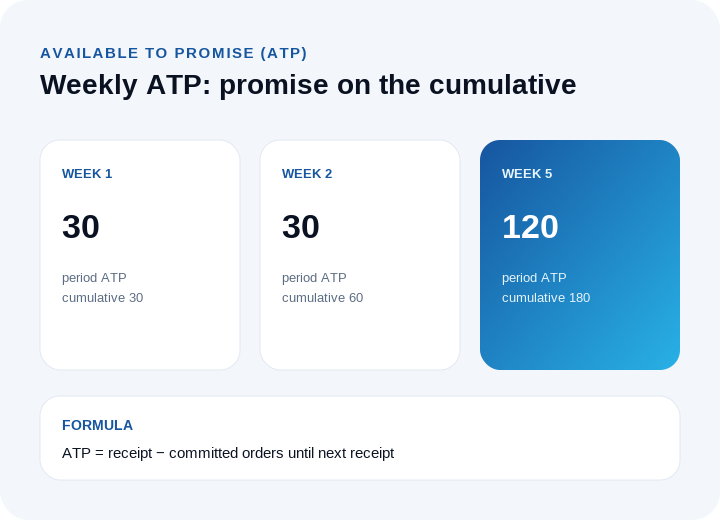
Two rules matter. First, an incoming order enters ATP only when it is firm; building a promise on a "planned" order that has not been released puts the promise at risk. Second, every confirmed order is written to the table at once. For gathering orders from all channels in a single queue, see our order management system guide.
How Do Safety Stock and Reserved Quantity Enter ATP?
Two items quietly inflate ATP. Safety stock is a buffer against demand and supply uncertainty; if it is counted as usable, the buffer loses its purpose. In the example, counting it would raise the starting point from 100 to 120, and cumulative ATP would look 20 units higher in every period (50 instead of 30 in W1, 200 instead of 180 in W5).
Reserved stock (set aside for a confirmed order), quarantined stock (waiting for quality inspection) and damaged stock are also removed from usable stock. The rule: only what can be sold right now enters ATP. For multi-warehouse setups, see our multi-warehouse inventory guide.
How Is the Delivery Date Calculated When Stock Is Not Enough (CTP)?
ATP answers for what is on hand and on the way. For quantities that must still be produced, capacity and materials are counted too. In CTP the delivery date is the later of the material-ready date and the date the bottleneck finishes the job, plus quality and shipping times.
Example: a customer wants 200 units and ATP is not enough. One unit needs 2 units of component X; 300 X are on hand and 200 more arrive on working day 6. The assembly line can make 40 units a day; existing jobs use 28 a day, leaving 12 units of free capacity per day.
| Check | Calculation | Result |
|---|---|---|
| Materials | 200 × 2 = 400 X; 300 on hand is short, +200 on day 6 | First 150 units now, component for the other 50 arrives on day 6; not the constraint |
| Capacity | 200 ÷ 12 = 16.67, rounded up | 17 working days |
| Quality inspection | Fixed time | 1 working day |
| Shipping | Fixed time | 2 working days |
| Delivery | 17 + 1 + 2 | 20 working days after confirmation |
Materials are not the constraint: by the end of day 6 the line can make at most 6 × 12 = 72 units, which needs 144 X; the first 150 units are covered by the 300 X on hand, and the component for the remaining 50 arrives on day 6. The line is the bottleneck. If you add 4 units a day through overtime, capacity becomes 16 and 200 ÷ 16 = 12.5, so 13 working days; delivery drops to 13 + 1 + 2 = 16 working days, a gain of 4 days. For overtime limits, consult legal counsel and HR. The details of capacity calculation are in our capacity planning article, and material requirements in our production planning guide.
How Do You Find the Delivery Date with a Working-Day Calendar?
Lead time is counted in working days; counting calendar days goes wrong around weekends and public holidays. There are three components: the day the order is accepted, preparation (picking, packing) and shipping (transit). A daily cut-off time is defined too; an order confirmed after the cut-off is the next working day's order.
Example (illustrative rules): cut-off 14:00, preparation 1 working day, shipping 2 working days. An order confirmed on Friday at 15:00 is past the cut-off, so it counts as Monday's order. Delivery = Monday + 3 working days = Thursday. Counting calendar days would give "Friday + 3 days = Monday"; the difference is one working day, and the customer waits at the door that day. Public holidays are marked in the calendar.
How Do You Manage Order Priority and Stock Allocation?
If ATP works on a first-come, first-served basis, a large strategic customer can end up with whatever is left after a small order. So allocation rules are written down explicitly.
- First come, first served: simple and fair-looking; it does not protect a strategic customer from stockouts.
- Protected share: a portion of cumulative ATP is reserved for a customer group. In the example, 25% of W3's cumulative ATP of 60, that is 15 units, is protected for group A; the general pool is 45 units. If group B asks for 50 units, 45 are promised now and the remaining 5 from the next ATP period.
Whatever the rule, allocation changes should be traceable; if an order is moved forward, the promise of the order pushed back is updated and its customer is told.
Partial Shipment or Single Shipment?
When cumulative ATP does not cover the requested quantity on a date, there are two ways: deliver the full quantity later in one shipment, or ship what is available now and the rest afterwards. Example with the starting table: a customer wants 100 units by W3; cumulative ATP is 60 in W3 and 180 in W5. A single shipment goes out in W5 (10 working days later). A partial shipment sends 60 in W3 and 40 in W5.
The decision compares two costs: the extra shipment and the value to the customer of receiving part early. Illustrative data: extra shipment ₺350, the customer's waiting cost ₺2 per unit per day. If the 60 units are not held back for 10 working days, the gain is 60 × 10 × ₺2 = ₺1,200; since ₺1,200 > ₺350, a partial shipment makes sense. Break-even: partial shipment wins when waiting days times daily cost per unit exceeds 350 ÷ 60 ≈ 5.83 (here 10 × 2 = 20). You cannot know the customer's real waiting cost, so the partial shipment option is put to the customer.
How Is the On-Time-to-Promise Rate Measured?
A promise is a commitment, not a target; ATP cannot be tuned without measuring whether it was kept. The indicator is the share of orders delivered on or before the promised date. Compliance with the requested date is a separate indicator: a promise can be kept even though the customer's wish was not met.
Example month (illustrative): 200 orders.
| Variance from promise | Orders | Days late in total |
|---|---|---|
| On time or early | 176 | 0 |
| 1 working day late | 12 | 12 |
| 2 working days late | 6 | 12 |
| 3 working days late | 4 | 12 |
| 4 working days late | 2 | 8 |
| Total | 200 | 44 |
On-time-to-promise rate: 176 ÷ 200 = 88%. Late orders average 44 ÷ 24 ≈ 1.83 working days. Because half of the delays are a single day, adding a 1-working-day buffer to promises makes 12 more orders on time: (176 + 12) ÷ 200 = 94%. The price is promises that run about one day longer, weighed against competition and customer expectations. The lasting fix is to classify the causes of delay (wrong stock, late incoming orders, capacity) and correct the inputs; for late incoming orders, see our supplier portal article.
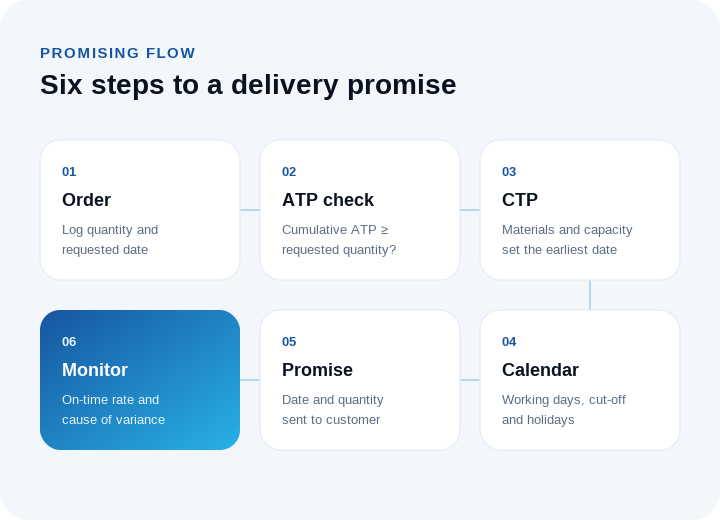
When Does a Promise System Pay for Itself?
Payback comes from two places: a lower cost of late deliveries and less effort spent on promising. Illustrative assumptions: 200 orders a month; each late delivery costs ₺900 (extra follow-up, rush shipping, discounts); promising takes 8 minutes by hand and 2 minutes with a system; hourly cost ₺300; investment ₺234,000; monthly running cost ₺3,800.
- Late deliveries: 24 late orders × ₺900 = ₺21,600. At a 94% rate, 12 late orders × ₺900 = ₺10,800. Saving ₺10,800.
- Effort: 200 × 6 min = 1,200 min = 20 hours × ₺300 = ₺6,000.
- Gross: ₺10,800 + ₺6,000 = ₺16,800; after the ₺3,800 running cost, net ₺13,000 a month.
- Payback: ₺234,000 ÷ ₺13,000 = 18 months.
Sensitivity: if all savings halve, gross is ₺8,400, net ₺4,600 and payback ≈ 50.9 months. Measure the causes of lateness first.
What Steps Set Up a Delivery Date Promise?
- Define lead times and the calendar: preparation, shipping, cut-off time and holidays.
- Make stock trustworthy: sellable stock, reserved, quarantined; safety stock kept apart.
- Make incoming orders firm: only firm orders enter ATP.
- Add capacity and material constraints: CTP for items where stock falls short.
- Write allocation and partial shipment rules: who goes first, when to split.
- Track the on-time rate: measure weekly and classify the causes of variance.
We recommend reading: How to do demand forecasting: moving averages, error measures and safety stock
We recommend reading: What is ERP? Modules, how it works and selection criteria
We recommend reading: Make to Order vs Make to Stock: How to Choose (Decoupling Point, Hybrid Strategy and Cost Guide)
We recommend reading: How to Manage Backorders: Line Status, Priority, Split Shipments and Fill Rate Guide
We recommend reading: How to Manage the Order-to-Cash Process: Cycle Time, Perfect Order Rate and Cash Impact Guide
We recommend reading: How to Design Business Day Calendars and SLA Time Calculation in Software: Holiday Data, Pausing and Due-Date Guide
ERP and Order Processes with İnovabil
At İnovabil our focus is building software from scratch, tailored to the company: custom software, ERP, CRM, e-commerce, web, mobile and integration. If a delivery promise calculation is to be built, we suggest first putting in writing, during requirements analysis, where stock, order, incoming-order and capacity data live and which of it can be trusted; the calculations in this guide can then be rebuilt on that data.
We have built logistics and shipment planning with wholesale order management for Karyak, warehouse management for Sleepy, shipment planning for Bofigo and a purchasing system for İZBAN. These are not a delivery promise product; they are experience in handling order, stock and shipment data together. Send us a short summary of your processes and current systems, and we will prepare a written assessment together. See also our software development process.
Frequently Asked Questions
What is a delivery date promise, and what does ATP mean?
A delivery date promise is a calculated date given to the customer before confirming an order, based on stock, incoming orders and existing commitments. ATP is the formula that finds the quantity you can promise up to a date.
What is the difference between ATP and CTP?
ATP looks only at stock on hand and on the way. CTP also counts materials and bottleneck capacity; it is used for items where stock falls short or that are made to order.
Why is cumulative ATP different from period ATP?
Period ATP shows only the span of one incoming order. Cumulative ATP is their running total and tells you how much can be promised in total by a date; promises are made against the cumulative value.
Should safety stock be included in ATP?
Usually not. Safety stock is a buffer against uncertainty; if it enters ATP, the buffer loses its purpose and promises turn optimistic. In the example, 20 units of safety stock would have inflated cumulative ATP by 20 units in every period.
How many working days of buffer should a promise carry?
There is no single right answer. Look at your own variance pattern: in the example half the delays were a single day, and a one-day buffer lifted the rate from 88% to 94%. The price of a buffer is a longer promise, so decide together with customer expectations.