

The software is delivered, the development team says "our tests passed," and in the first week the warehouse lead finds a step in the dispatch screen that does not fit how the warehouse works, while accounting finds an invoice total that differs from their own calculation. The problem is rarely a lack of testing; it is who tested, and against what. User acceptance testing (UAT) is the structured way for the party that commissions or will use the software to say "we accept this delivery" or "we do not," based on real business scenarios.
This guide explains how to do user acceptance testing from the buyer's side: the UAT plan, turning acceptance criteria into scenarios, choosing testers, test data, defect classification, the acceptance decision rule, the acceptance record and its link to payment, and finally a go/no-go checklist. We work through two rounds of a 40-scenario example on a dealer portal, with the arithmetic shown. All figures are illustrative; they are not an industry average or the result of a real project.
What Is User Acceptance Testing (UAT) and How Does It Differ from Developer Testing?
UAT is the final test in which the real users of a business process check that the software fits that process. Unit, integration and system tests on the developer side ask whether the software works correctly; UAT asks whether it does the right thing. We covered the developer-side testing in our software testing guide; this article is its counterpart on the customer's side.
| Topic | Developer-side testing | User acceptance testing (UAT) |
|---|---|---|
| Who does it? | Developers and the test team | Business users on the buyer's side |
| Based on what? | Technical design, code, interface | Acceptance criteria and the real workflow |
| Question | Does the software work correctly? | Does it meet the business need? |
| Environment | Development and test environment | Production-like acceptance environment |
| Outcome | Defect list, release readiness | Accept, conditional accept or reject |
| Role in the contract | Usually none | Milestone and payment condition |
Do not use UAT as a replacement for developer testing; it comes on top of it. Putting a build that has not passed developer testing into acceptance testing makes users spend their time on defects that were already known.
How Do You Prepare a UAT Plan?
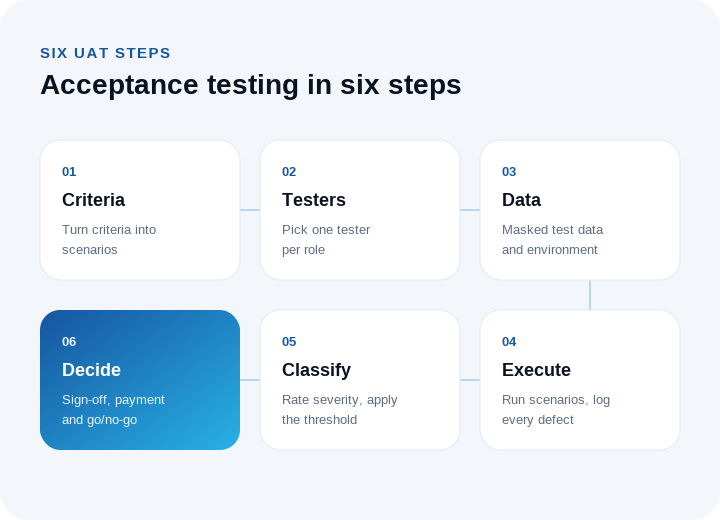
A UAT plan is a one-page answer to five questions: what are we testing, who tests it, when, in which environment, and by which rule do we decide on acceptance. Write the plan before the development team hands over the build, ideally at the contract stage.
- Scope: Which modules and processes are in UAT and which are not. Anything left out of scope is handled as extra work after acceptance.
- Schedule: Preparation, first round, fixes, second round and decision days. In the example, 3 + 2 + 5 + 2 + 1 = 13 working days, about 2.6 weeks.
- Roles: A test coordinator, test users, a decision maker who rates defects, and a contact person on the development side.
- Environment and data: A production-like acceptance environment and test data prepared for it.
- Decision rule: Limits for critical and high-severity defects, the pass rate threshold, and the status of must-have scenarios. This rule must be written down and signed by both sides.
The source of the plan and the acceptance criteria is the requirements document; we explained how to write it in our requirements analysis guide. You cannot derive a testable scenario from a requirement that has no acceptance criterion.
How Do You Derive Test Scenarios from Acceptance Criteria?
Write at least one normal-flow scenario for every acceptance criterion, and often an error or exception scenario as well. A scenario is written in the user's language and verifies a single business outcome: starting state, steps, expected result.
| Acceptance criterion | Scenario | Expected result |
|---|---|---|
| AC-07: A dealer cannot order a product that is out of stock | UAT-14 (normal): add a product with stock 0 to the cart | The product is not added; an "out of stock" message appears |
| AC-07 | UAT-15 (exception): request 5 units of a product with stock 3 | A "maximum 3 units" message appears; no order is created |
| AC-12: The accounting role cannot edit the price list | UAT-31 (permission): open the price list as an accounting user | The list is visible; there are no edit buttons |
In the example project, 24 acceptance criteria produced 40 scenarios: 24 normal flows, 12 error and exception cases, and 4 permission scenarios (24 + 12 + 4 = 40). Give the scenarios a priority too: 14 must-have, 18 should-have and 8 could-have (14 + 18 + 8 = 40). Must-have scenarios are the flows without which the system cannot be used; they have a special place in the acceptance rule.
How Do You Choose Testers for UAT?
A UAT tester is the person who will use that screen in their daily work; it does not have to be the person managing the project. Choose at least one user per role, and prefer people who know the work but are not deeply embedded in the project, because someone seeing the software for the first time notices missing guidance and confusing flows.
- Role coverage: In the example portal, 4 people were chosen: a sales representative, a warehouse lead, an accounting employee and a dealer user. Every role was tested at least once.
- Protected time: Testing is not something users do "when they are free." Splitting 40 scenarios among 4 people gives 10 scenarios each; 10 × 15 min = 150 min = 2.5 hours, and with a 1.5× allowance for logging defects and waiting, 3.75 hours, roughly half a day.
- Decision maker: Name one authorized person who has the final say on severity and acceptance.
- Briefing: In a short 30-minute session, show testers how to run a scenario and how to log a defect; do not confuse this with training on how to use the system.
Effort for two rounds: 4 testers × 3.75 hours = 15 person-hours per round, and 2 rounds = 30 person-hours; at an assumed ₺300 per hour, 30 × ₺300 = ₺9,000.
How Do You Prepare UAT Test Data? Can You Use Real Customer Data?
Do not copy real customer data straight into the acceptance environment. A test environment is usually less protected than production and more people can reach it, so personal data there is an unnecessary risk. Use masked or synthetic data: names, phone numbers, emails and tax numbers should not be real, while the volume and variety should resemble reality.
- Enough variety: The data should contain edge cases such as a zero-stock product, a multi-line order, a dealer close to the credit limit and a returned order.
- Repeatability: Before each round the data is reset to the same starting state; otherwise round two cannot be compared with round one.
- Personal data: If you truly need real data, define access, purpose, retention and deletion with your legal counsel under KVKK (Turkey's personal data protection law); this article is not legal advice.
Do not forget to back up the test data and the environment either; rebuilding a broken acceptance environment can delay a round by days. See our data backup guide for backup practice.
How Are Defects Classified in UAT?
Give every defect a severity at the moment it is logged; severity directly determines the acceptance decision. Four levels are enough for most projects.
| Severity | Definition | Example | Allowed at acceptance |
|---|---|---|---|
| Critical | Work stops, data is corrupted or money is calculated wrongly | Order total differs from the sum of the lines | 0 |
| High | The main flow works but with a serious restriction; no easy workaround | The warehouse dispatch screen fails for one product group | At most 2, with a dated fix plan |
| Medium | A workaround exists; limited impact | Wrong column order in an export | At most 5, planned fix |
| Low | Cosmetic or a minor annoyance | Typo in a warning message | Logged, no limit |
A defect record should include the scenario code, steps, expected and actual result, a screenshot and the severity. Severity and priority are different: severity describes the business impact of the defect, priority the order of fixing. The user side decides severity; the development side may object, but the decision maker's word stands.
How Do You Write the Acceptance Decision Rule?
The acceptance rule is a set of measurable conditions that must all hold at the same time. For the example portal, the rule was written like this: open critical defects 0; open high defects at most 2; open medium defects at most 5; pass rate at least 90%, which means at least 36 of the 40 scenarios; all 14 must-have scenarios passed.
Define three outcomes: accept (the whole rule holds and there are no open defects, or only low ones), conditional accept (the rule holds, but there are open defects with a written fix plan) and reject (any part of the rule fails). Evidence the outcome with a round-end table.
| Measure | Threshold | Round 1 | Round 2 |
|---|---|---|---|
| Passed scenarios | ≥ 36 / 40 (90%) | 31 / 40 = 77.5% ✗ | 38 / 40 = 95.0% ✓ |
| Must-have scenarios passed | 14 / 14 | 12 / 14 ✗ | 14 / 14 ✓ |
| Open critical defects | 0 | 1 ✗ | 0 ✓ |
| Open high defects | ≤ 2 | 3 ✗ | 1 ✓ |
| Open medium defects | ≤ 5 | 5 ✓ | 4 ✓ |
| Outcome | Reject | Conditional accept |
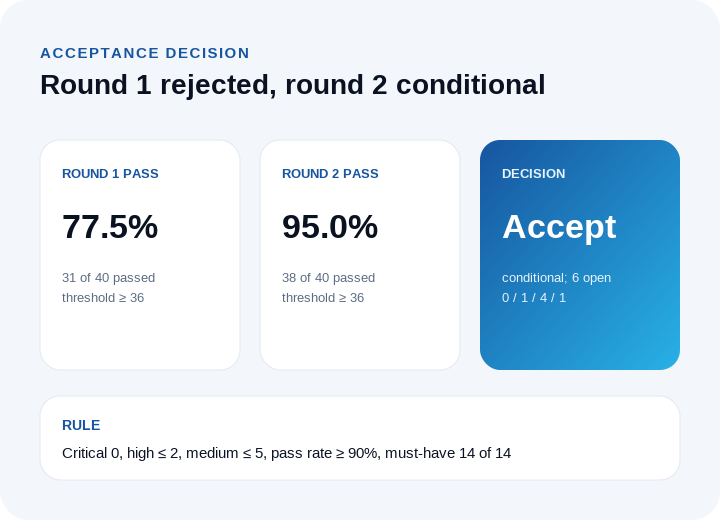
In round 1, 31 of the 40 scenarios passed, 7 failed, and 2 could not be run because they were blocked by a defect (31 + 7 + 2 = 40). In total 11 defects were logged: 1 critical, 3 high, 5 medium, 2 low (1 + 3 + 5 + 2 = 11); defect density was 11 ÷ 40 ≈ 0.28 defects per scenario. The critical defect was an order total calculated wrongly; under the rule, that alone was enough for a rejection.
The development team closed 6 defects: 1 critical, 2 high, 2 medium and 1 low. That left 5 open (1 high, 3 medium, 1 low), and round 2 found 1 new medium defect, so the open total is 1 + 3 + 1 + 1 = 6: 0 critical, 1 high, 4 medium, 1 low. The closure rate of 6 ÷ 12 = 50% looks low, but the deciding measure is not the rate; it is the severity of what remains.
In the second round, rerun all 40 scenarios, not only the ones that were fixed; a fix may have broken another flow. This is a regression check, and it is what caught the new medium defect in round 2.
How Do You Prepare the Acceptance Record and Link It to Payment?
The acceptance record is the document that records the UAT outcome with both sides' signatures. It contains the round result tables, the list of open defects with fix dates, and the conditions and dates of any conditional acceptance. Without a record, "we accepted it" is a verbal statement and invites disputes later.
- Outcome and rule: Which outcome resulted under which rule.
- Open defects: Severity, owner and fix date.
- Condition of conditional acceptance: What happens if the open defects are not closed.
- Signatures and date: The decision maker and the development-side contact person.
In a payment plan the acceptance record is usually a milestone. In our contract example, the fourth payment of the ₺657,000 dealer portal is 25% = ₺164,250 and is tied to the UAT acceptance record. In a conditional acceptance, holding back 10% of that payment for the open defects is a reasonable approach: ₺164,250 × 10% = ₺16,425 is withheld and ₺164,250 − ₺16,425 = ₺147,825 is paid. The withheld amount is released when the open defects are closed. We explained the payment milestones in full in our guide to getting custom software developed; for the legal details of the contract, consult your legal counsel.
Which Checklist Do You Use for the Go/No-Go Decision?
Acceptance is only one part of the go-live decision. A go/no-go list also measures the readiness conditions beyond acceptance. If even one of the following 10 items is a "no," reconsider the cut-over.
- The acceptance decision was made by the rule and the record is signed.
- Every open defect has an owner and a date.
- The production data migration was rehearsed and reconciled.
- Backups run and a restore has been tested.
- Users are briefed and a short user guide is ready.
- The support channel and first-week owners are defined.
- A rollback plan is written: how to return to the old way of working if something goes wrong.
- Permissions and roles were verified in the production environment.
- Integrated systems (invoicing, shipping, accounting) were tried with live connections.
- The cut-over date falls in a low-activity period of the business.
For the cut-over plan and project calendar, see our project plan guide; for logging the risks that can appear during UAT, see our risk management guide.
What Are the Common Mistakes in UAT?
- Writing the rule afterwards: If the thresholds are set after the results are visible, each side reads them in its own favor.
- Testing with the wrong people: Someone who manages the project but does not use the screen cannot see the real problems.
- Copying real customer data: It creates unnecessary personal-data risk.
- Retesting only what was fixed: Side effects of a fix go unnoticed.
- Separating acceptance from payment: If the record is not tied to a payment condition, acceptance becomes a formal signature.
- Treating out-of-scope requests as defects: A request that was not in the requirements is not a defect but a change request; handle and price it separately.
We recommend reading: How to write a software RFP
We recommend reading: What is the software development life cycle?
We recommend reading: How to Run an ERP Implementation: Process Design, Training, Pilot and Go-Live Guide
We recommend reading: What Is Test Automation?
We recommend reading: How to Drive Software Adoption: User Training, Champion Network, Rollout and Measurement Guide
We recommend reading: What Is Data Masking and Anonymization? Test Data, Pseudonyms, k-Anonymity and Payback Guide
We recommend reading: How to Manage Software Environments (Dev, Test, Staging, Production): Drift, Data Flow and Cost Guide
We recommend reading: How to Close a Software Project and Hand It Over: Criteria, Checklist, Access Handover and Lessons Learned
We recommend reading: How to Do Stakeholder Management and Communication Planning for Software Projects? Influence–Interest Matrix, RACI and Report Guide
We recommend reading: How to Do Bug Tracking and Triage in Software: Bug Records, Severity vs Priority and Backlog Guide
Custom Software Ready for Acceptance with İnovabil
At İnovabil, our focus is building company-specific software from scratch: custom software, ERP, CRM, e-commerce, web, mobile and integration. The working order on our process page consists of analysis, design, development, testing, release, and maintenance and support. We recommend that the acceptance criteria and the acceptance rule be written down at the requirements stage, and that UAT be planned as the last gate of those steps.
We have built CRM, purchasing and mobile for Avcılar İnşaat; a purchasing system for İZBAN; logistics and shipment planning with wholesale order management for Karyak; and warehouse management with a complaint and support management system for Sleepy. Send us a short summary of your need; we will write the acceptance criteria together and settle the UAT plan in the first meeting.
We recommend reading: Our software development process: step by step from analysis to release
Frequently Asked Questions
What is user acceptance testing (UAT)?
It is the final test in which the party that will use or commissioned the software checks, with real business scenarios, whether it meets the need, and accepts or rejects the delivery. It is done in addition to developer testing, not instead of it.
Who performs UAT?
The users who run the process day to day perform it; you need at least one person per role. The development team does not run the scenarios; it answers and fixes defects. A pre-appointed, authorized decision maker signs the acceptance decision.
How many scenarios does UAT need and how long does it take?
It depends on scope and the size of the software. In the example dealer portal, 24 acceptance criteria produced 40 scenarios, and with two rounds and fix days it took about 13 working days. This is an illustrative example; derive the number of scenarios in your own project from your acceptance criteria.
How many defects are acceptable at acceptance?
It is set by a written rule at the start of the project. In the example it was critical 0, high at most 2, medium at most 5 and a pass rate of at least 90%. Low-severity defects stay logged and are handled in a later release.
Can real customer data be used in UAT?
Preferably not; use masked or synthetic data. If real data is unavoidable, define access, purpose and deletion conditions under KVKK with your legal counsel.